SLIDE 1
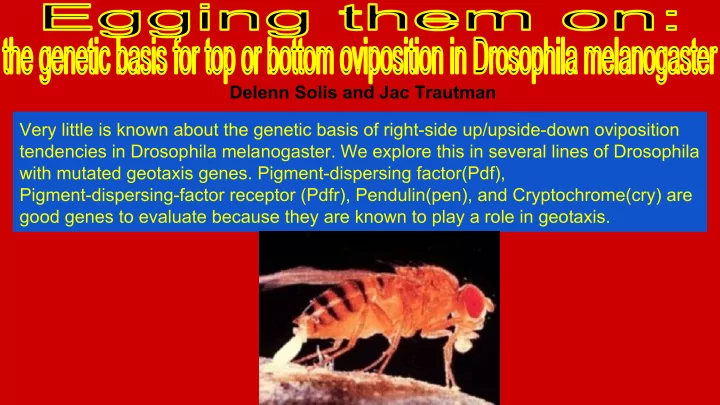
Very little is known about the genetic basis of right-side up/upside-down oviposition tendencies in Drosophila melanogaster. We explore this in several lines of Drosophila with mutated geotaxis genes. Pigment-dispersing factor(Pdf), Pigment-dispersing-factor receptor (Pdfr), Pendulin(pen), and Cryptochrome(cry) are good genes to evaluate because they are known to play a role in geotaxis.
Delenn Solis and Jac Trautman
SLIDE 2 Experimental setup: Drosophila melanogaster flies were sexed under a microscope and several males and females (~5 each) were placed in a fly cage. The cage contained two apple juice plates which were coated evenly with yeast paste: one on the roof of the cage, and
- ne on the floor of the cage. Eggs were counted
between 24-48 hours later. Hypothesis: Drosophila fly lines exhibiting different mutations in one of several geotaxis-related genes will also display differences in the tendency to lay eggs on a right-side-up or upside-down surface. Apple juice plates
SLIDE 3
SLIDE 4
Pdf and Pdfr appear to have an affect on top or bottom oviposition, with the preference for the two genotypes being the top and bottom respectively. Future directions: In addition to more thoroughly assaying these genotypes, it would be useful to breed top and bottom ovipositing lines and then sequence their genomes to try to identify the potential candidate genes responsible
References and acknowledgements: Toma, D.P., White, K.P., Hirsch, J. & Greenspan, R.J. 2002. Identification of genes involved in Drosophila melanogaster geotaxis, a complex behavioral trait. Nature Genetics 31: 349-353. We’d like to thank the following for providing life-saving materials, advice, and feedback: Suzy Renn Greta Glover Sarah Schaack Todd Schlenke