review Unit I study items test next week! Monday, September 30, - - PowerPoint PPT Presentation

review unit i study items test next week
SMART_READER_LITE
LIVE PREVIEW

review Unit I study items test next week! Monday, September 30, - - PowerPoint PPT Presentation

Homework: Begin EQ project planning & construction; review Unit I study items test next week! Monday, September 30, 2013 I. Conversation Piece II. Unit I: EQ Grid: collection or inspection? electronic copy Robinsons external hard


slide-1
SLIDE 1

Homework: Begin EQ project planning & construction; review Unit I study items…test next week!

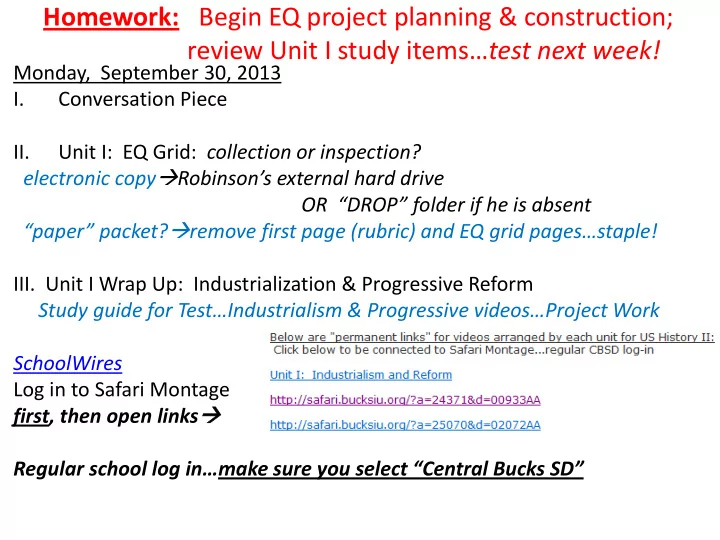
Monday, September 30, 2013 I. Conversation Piece II. Unit I: EQ Grid: collection or inspection? electronic copyRobinson’s external hard drive OR “DROP” folder if he is absent “paper” packet?remove first page (rubric) and EQ grid pages…staple!

  • III. Unit I Wrap Up: Industrialization & Progressive Reform

Study guide for Test…Industrialism & Progressive videos…Project Work SchoolWires Log in to Safari Montage first, then open links Regular school log in…make sure you select “Central Bucks SD”

slide-2
SLIDE 2

Why are we here TODAY?

Students will illustrate & identify Unit I “words” in response the three Essential Questions, review Ch. 8 “telescoping the times,” & begin exploration of the differentiated assessment project.

slide-3
SLIDE 3

Unit I: Industrialism & Reform EQ “Grid” Expectations

  • “Words” From The Americans, Chapters 6-9 refers to relevant key vocabulary terms,

concepts, people, events, groups, etc. that are part of the history of Industrialism & Reform in the late 1800s and early 20th century.

  • As you read "telescoping the times" and SKIM the chapters, choose ONE “word” from

each chapter, plus a 5th “word” from any chapter that helps display your understanding. The “words” you select should help you “uncover” your answer to the Essential Questions (EQs). You may use History Alive! as a resource too!

  • Ch. 13 & 14 ~ Ch. 6 Americans
  • Ch. 15 & 16 ~ Ch. 7 Americans
  • Ch. 16 & 17 ~ Ch. 8 Americans
  • Ch. 17 & 18 ~ Ch. 9 Americans

You should have 15 “words” listed, described, pictured & analyzed by: Mon. 9/30 1) Choose word & define/show meaning…*DETAILS! (who, what, when, where? page #s from textbook REQUIRED to prove you utilized more than just TTT! 2) Picture/drawing/images…VISUAL REPRESENTATION of the “word”…SHOW "it" 3) ANALYZE the “word:” EXPLAIN how this word “connects” to the EQ. Why did you choose it to show your understanding? 5 words from 4+ chapters for each EQ = your ANSWERS showing you learned the EUs!!!

slide-4
SLIDE 4

Unit I: Industrialism & Reform

  • Who benefits and who suffers during the times of

profound (big, huge, BOLD, clear, deep, drastic, flabbergasting) economic ($$$, money, stock, industry, business, environment) change?

  • How can people (individuals & groups?) change

society (better? worse? “mix” of +/-)

  • Did this period of reform move America closer to
  • r further away from its founding ideals?

(E, R, L, O, D)

slide-5
SLIDE 5

Unit I: Industrialism & Reform

The Americans, Ch. 6-9… “ttt” History Alive!, Ch. 13-18 Enduring Understandings

  • 1. The process of

in the US had positive and negative impacts, not only on the economy, but the entire culture.

  • 2. Individuals and groups actively participate to

the government and reform society, but are often met with opposition by those who want to protect the status quo.

  • 3. Social

is a product of society, not just individual differences.

industrialization influence stratification

slide-6
SLIDE 6

Essential Questions for Unit I Industrialism & Progressive Reform

EQ 1: Who benefits and who suffers during the times of profound economic change?

  • The growing industrial economy created profound changes in wealth,
  • pportunity, and equality.
  • How working conditions changed and how the workers responded to new

industrial conditions. EQ 2: How can people change society?

  • How the Progressives responded to the distinctive needs of an industrial society.
  • Progressive attempts at social and moral reform, including legislation and

Constitutional amendments.

  • Women petitioned and protested in order to gain the right to vote.
  • Presidential leadership in obtaining passage of reform and conservation

measures. EQ 3: Did this period of reform move America closer or further away from its founding ideals?

  • How the ideals of liberty, equality, opportunity, rights and democracy were

exemplified or contradicted during this time period.

slide-7
SLIDE 7

Homework: Continue EQ “project” work (due Mon. 10/7) & review Unit I study items (test Tues. 10/8) Tuesday, October 1, 2013 Unit I Wrap Up: Industrialization & Progressive Reform Industrialism & Progressive videos…Project Work SchoolWires Log in to Safari Montage first, then open links

Regular school log in…make sure you select “Central Bucks SD”

slide-8
SLIDE 8

Why are we here TODAY?

Students will continue to explore two documentary videos on Industrialization & Urbanization and the Progressive Movement in Safari Montage, and/or continue research, planning, & construction of Unit I EQ differentiated assessment.

slide-9
SLIDE 9

Schoolwires…Safari Montage

NOTES highly recommended! FOLLOW the Study GUIDE!

slide-10
SLIDE 10

Unit I: Differentiated EQ Assessment Industrialism & Reform

(40 possible points…due Monday, October 7 or sooner)

  • Select either EQ 1 or EQ 2…

1) Who benefits and who suffers during the times of profound economic change? 2) How can people change society? (Progressivism & Reform, plus ideals EQ 3)

  • Select an appropriate format/medium that best

displays your understanding…You decide WHAT & HOW to exhibit your ANSWER…

slide-11
SLIDE 11

EQ format/medium CHOICES

Based on your learning style & attributes as a student select from the following:

1-2 page typed essay “muckraker-like” letter to the editor (op-ed writing) political cartoon or comic strip with title (explanation/analysis required) Venn Diagram, T-chart, or “mental map" (explanation/analysis required) collage with title and “explanatory key” or explanation/analysis poem, short story, song, or rap imaginary “dialogue” or conversation between historical individuals/groups powerpoint slide show podcast or other audio narrative video reenactment or performance narrative *EQ-specific crossword puzzles (1-2 w/ clues (definitions) ONLY = proficiency at best; 1-2 w/ pictures & plan may be advanced) “visual” dictionary with cover (top 6-10 “words” with labeled illustrations and examples, plus "definitions" of all terms OTHER? See me if you have a proposal that you would like to discuss

slide-12
SLIDE 12

Who benefits and who suffers during the times of profound economic change?

One of your predecessors from 2012

slide-13
SLIDE 13

Robber Barons

Robber barons Workers

  • “Captains of Industry”
  • Company owners
  • Controlled large portion or

all of a certain market

  • Very wealthy
  • Benefitted during the

industrial revolution

  • Suffered
  • Unsanitary conditions
  • Not well lit
  • Very long hours
  • Dangerous work
  • Child labor
  • Unhealthy or toxic materials

inhaled

Who are these old rich white dudes?

slide-14
SLIDE 14
slide-15
SLIDE 15

Chinese Exclusion Act

  • 1882-1943
  • Banned Chinese immigrants
  • Exception for students, teachers, merchants,

tourists, government officials

  • Later all Chinese were banned
  • Suffered since excluded from America
  • Those who did live in America were

discriminated against

slide-16
SLIDE 16
slide-17
SLIDE 17

Segregation

  • Separate black and white people
  • African Americans got poorer facilities
  • Separated in public and private places
  • Blacks suffered because of this discrimination
slide-18
SLIDE 18
slide-19
SLIDE 19

Pure Food and Drug Act

Common People Company Owners

  • Benefitted
  • Working conditions were

better

  • Products were safer and

healthier

  • Labels legally had to state the

truth

  • No more (or less) toxins and
  • ther impurities
  • T. Roosevelt pushed for this

act

  • Suffered
  • The world was made aware

to what was actually put in products

Didn’t this also “protect” the companies from LAWSUITS? Why might workers & consumers “suffer?”?

slide-20
SLIDE 20
slide-21
SLIDE 21

Suffrage

  • The right to vote
  • Women wanted a voice in government
  • It was unfair that they couldn’t vote
  • 19th amendment (1919?) gave women the

right to vote

Check your facts and dates carefully!

slide-22
SLIDE 22
slide-23
SLIDE 23

Benefitted Suffered

  • Robber Barons from

industry

  • Common people from Pure

Food and Drug Act that made products healthier

  • Workers from Pure Food

and Drug Act that made work conditions somewhat safer

  • Women when they were

granted suffrage (1919)

  • Workers from bad

conditions

  • Chinese from being

excluded

  • African Americans from

segregation

  • Companies from the Pure

Food and Drug Act

  • Women before suffrage was

granted to them

slide-24
SLIDE 24

In conclusion… My parting thoughts… What I have learned… WRAP UP with some “final point(s)” that are PERSONALIZED!

slide-25
SLIDE 25

Your EQ product will be evaluated in the following areas: Knowledge & Understanding Advanced (18-20) Proficient (14-17) Basic (13 or less)

  • command of accurate, relevant, & appropriately detailed historical info?
  • sufficient background info, specific facts, and/or a “setting” showing awareness of task?
  • clear evidence of “enduring understanding?” (Is there more than just “facts?” Did you

ANSWER the EQ?)

Effort & Care Advanced (18-20) Proficient (14-17) Basic (13 or less)

  • creative and/or personalized presentation of information & understanding?
  • appropriate neatness & clarity?
  • exhibits evidence of thought, planning, & attention to details?

Homework: Continue EQ “project” work (due Mon. 10/7) & review Unit I study items (test Tues. 10/8)

slide-26
SLIDE 26

Homework: EQ “project” due Mon. 10/7 or sooner Review Unit I study items (test Tues. 10/8) Wednesday-Friday, October 2-4, 2013

  • I. Industrialization and Progressive Reform REVIEW

II. NOTES Presidents from the late 19th & early 20th Centuries Social Darwinism

  • III. Unit II: America as a World Power

Enduring Understandings & “Word Wall” work

  • IV. Project Work
slide-27
SLIDE 27

Why are we here the rest of the week?

Students will review industrialization, urbanization, and the Progressive movement via Q & A, video clips, images, and graphs. Students will record notes on Presidents from the late 19th and early 20th century & Social Darwinism. Students will also begin exploration of the Enduring Understandings from Unit II, as well as content-related vocabulary words. Time permitting, students may work on Unit I EQ projects

slide-28
SLIDE 28

What do these IMAGES reveal about the late 1800s & early 20th century? What is meant by the term “Gilded Age?” p. 267

slide-29
SLIDE 29
slide-30
SLIDE 30
slide-31
SLIDE 31
slide-32
SLIDE 32
slide-33
SLIDE 33
slide-34
SLIDE 34
slide-35
SLIDE 35
slide-36
SLIDE 36

What are the four areas of Progressive reform?

slide-37
SLIDE 37

Industrialism & Progressive Reform Test Preparations

  • Mostly multiple choice
  • Photos & cartoons…EXPLAIN (+ and -)
  • Presidential “matching”
  • Are you not curious about “Social Darwinism?!?!?!?”
slide-38
SLIDE 38
  • Charles Darwin returned to England after 5

years of acquiring knowledge around the world about fauna, flora, wildlife, and geology. He used the information to develop his “theory of evolution” which he unveiled in his 1859 book entitled, “On the Origin of Species” by Means of Natural Selection.”

  • Or, “The Preservation of Favoured Races in the

Struggle for Life”

October 2, 1836…

slide-39
SLIDE 39

READ, The Americans, p. 242-243 and/or History Alive! p. 171

2 minutes

slide-40
SLIDE 40

“The great aim of education is not knowledge but action.”

  • Herbert Spencer
slide-41
SLIDE 41

James Garfield

I was a Republican who got shot by a mentally- disturbed man, but my death ultimately resulted in the reform of the civil service system (government jobs). You could say he FIRED (on) me because I refused to HIRE him!

slide-42
SLIDE 42
slide-43
SLIDE 43

William McKinley

I was a Republican who got shot early in my second term, which enabled a powerful "bully- like" Progressive reformer to become president. A mountain is named after me because I helped America grow bigger & more powerful!

slide-44
SLIDE 44

Theodore Roosevelt

Bears were fun to hunt, but I am the most famous & adventurous, reform-minded leader at the turn of the 20th century; I used the “bully pulpit” of the presidency to get my way & push my "Square Deal;" later, I re-entered politics with my "Bull Moose Party” but plans for re- election got shot down by a Democrat.

slide-45
SLIDE 45

William Howard Taft

I was a very “big guy,” and judgmental people might have “LAUGHED” at me, partially because I moved a bit too slowly & softly for the Progressives, especially on tariffs. My predecessor & former friend later battled against me for the White House, which splintered the Republican vote…RIP in a piano box?

slide-46
SLIDE 46

Woodrow Wilson

I was the idealistic Democratic leader and former president of Princeton who won the election of 1912 after TR, “Big Bill," and Eugene

  • V. Debs split most of the vote. United they

stood since 1892, but my "New Freedom" reform program won out. My name has the double letter initials of the

  • nly letter that is multi-syllabic!
slide-47
SLIDE 47

Unit II: America as a World Power

Enduring Understandings EUs

Students will understand that…

  • 1. Since resources are unequally divided across the earth societies will either enter into
  • r

to secure them.

  • 2. American foreign policy is motivated by both

& .

  • 3. The evolution of America’s role in the world has created divisive

among American citizens and government(s).

  • 4. The impact of American foreign policy has left a

legacy. CONFLICT IDEALISM COOPERATION PRAGMATISM ARGUMENTS MIXED

slide-48
SLIDE 48

Word Wall

  • Alphabetized descriptive display of “words” that include definitions, part(s) of

speech, sample sentences & historic details, images & color, similar & opposite words, usage & variations, etc.

  • Pick an appropriately challenging term (see Mr. R’s list)
  • Locate word in several sources:

The Americans History Alive! Longman Dictionary of Contemporary English Dictionary Thesaurus On-line Expectations:

  • DEFINE the “word” in 14 words or lesspersonalized! (INSIDE)

5 points

  • Part(s) of speech…noun? verb? adjective? adverb? (INSIDE)

2 points

  • List synonyms/related words or phrases & antonyms/opposite words (INSIDE) 2 ea.
  • Write a sample sentence showing usage: examples, people, events (IN.) 3 points
  • Neatly print in LARGE, BOLD/DARK? letters (NO caps?!) (OUTSIDE) 3 points
  • Illustrate with pictures, symbols, color, etc. (OUTSIDE mainly)

3 points

slide-49
SLIDE 49

Unit II: America as a World Power Word Wall Terms

vocabulary terms abdicate adequately alliance annex(ation) blockade casualty conscientious convoy corollary diplomat draft empire epidemic expansionism global hysteria idealism imbue insurrection intervene intervention journalism mobilize mutiny nationalism naturalization naval neutral

  • bjector
  • ppressive

pacify pragmatism propaganda provocation quarrel ratify rebellion resilience revolution superiority trench unilateral vessel content terms anti-aircraft armistice conscientious objector convoy system diplomacy dollar diplomacy espionage foreign policy imperialism isolationism isthmus legalism militarism missionaries mobilization moral diplomacy naturalized citizen neutral no mans’ land

  • pen-door policy

pacifist protectorate reparations sedition trench warfare unilateralism world war Yankee yellow journalism PICK a “new word” that is appropriately challenging for YOU! Others could be identified & selected too!