Definitions and Application Areas Ambient intelligence: technology - - PowerPoint PPT Presentation

definitions and application areas
SMART_READER_LITE
LIVE PREVIEW

Definitions and Application Areas Ambient intelligence: technology - - PowerPoint PPT Presentation

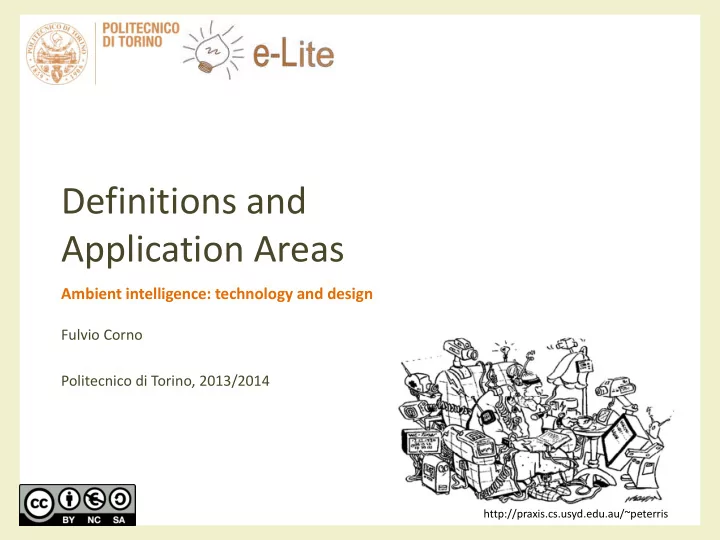
Definitions and Application Areas Ambient intelligence: technology and design Fulvio Corno Politecnico di Torino, 2013/2014 http://praxis.cs.usyd.edu.au/~peterris Summary Definition(s) Application areas Requested features

slide-1
SLIDE 1

Definitions and Application Areas

Ambient intelligence: technology and design

Fulvio Corno Politecnico di Torino, 2013/2014

http://praxis.cs.usyd.edu.au/~peterris

slide-2
SLIDE 2

Summary

  • Definition(s)
  • Application areas
  • Requested features
  • Architectures

2013/2014 Ambient intelligence: technology and design 2

slide-3
SLIDE 3

DEFINITION(S)

Definitions and Application Areas

2013/2014 Ambient intelligence: technology and design 3

slide-4
SLIDE 4

What is Ambient Intelligence?

  • Wide area
  • Expectations evolving over time
  • “Definition” or “prediction”?
  • Multiple definitions found, from complementary

points of view

  • Some researchers trying to define a common

framework

2013/2014 Ambient intelligence: technology and design 4

slide-5
SLIDE 5

The starting point

  • The concept of Ambient

Intelligence (AmI) provides a vision of the Information Society where the emphasis is

  • n greater user-friendliness,

more efficient services support, user-empowerment, and support for human interactions. People are surrounded by intelligent intuitive interfaces that are embedded in all kinds of objects and an environment that is capable of recognising and responding to the presence of different individuals in a seamless, unobtrusive and often invisible way.

2013/2014 Ambient intelligence: technology and design 5

slide-6
SLIDE 6

Some other definitions

2013/2014 Ambient intelligence: technology and design 6

slide-7
SLIDE 7

Comprehensive AmI definition

  • “An Ambient Intelligence system is a digital

environment that proactively, but sensibly, supports people in their daily lives”

Cook et al, Ambient Intelligence: Technologies, applications and opportunities, 2009

2013/2014 Ambient intelligence: technology and design 7

slide-8
SLIDE 8

Comprehensive IE definition

  • “An Intelligent Environment is one in which the

actions of numerous networked controllers (controlling different aspects of an environment) is

  • rchestrated by self-programming pre-emptive

processes (e.g., intelligent software agents) in such a way to create an interactive holistic functionality that enhances occupants experiences.”

Augusto et al, Intelligent Environments: a Manifesto, 2013

2013/2014 Ambient intelligence: technology and design 8

slide-9
SLIDE 9

Interactions among disciplines

2013/2014 Ambient intelligence: technology and design 9

slide-10
SLIDE 10

Main steps for AmI

Sensing Reasoning Acting Interacting

2013/2014 Ambient intelligence: technology and design 10

slide-11
SLIDE 11

Sensing

  • Sensors, sensor networks

– Wired or wireless – Independent or embedded in a device (eg. Smartphone)

  • Ambient or body

2013/2014 Ambient intelligence: technology and design 11

slide-12
SLIDE 12

Examples (ambient, wireless)

2013/2014 Ambient intelligence: technology and design 12

slide-13
SLIDE 13

Examples (wearable)

2013/2014 Ambient intelligence: technology and design 13

http://www.notchdevice.com/ Inside clothes Haptic Feedback Movement capture Metria™ Informed Health 3-axis accelerometer, Galvanic Skin Response, 2 temperature sensors (body, skin) Self-tracking Steps, calories, sleep, distance, …

slide-14
SLIDE 14

Sensor data

Huge Noisy Missing points Heterogeneous measures Time- & space- dependent Raw vs. processed

  • “Making sense of data”
  • Stream data processing
  • Signal processing

algorithms

  • Sensor fusion
  • Big data handling
  • Filtering,

disambiguation, interpretation

2013/2014 Ambient intelligence: technology and design 14

slide-15
SLIDE 15

Reasoning

  • Needed to provide responsiveness and adaptability
  • Interpret and recognize context and activity
  • User modeling, context modeling
  • Context detection and context awareness
  • Mobility tracking
  • Activity recognition, activity prediction
  • Decision making

– Acting vs. suggesting

2013/2014 Ambient intelligence: technology and design 15

slide-16
SLIDE 16

Acting

  • Home automation systems (lights, doors, windows,

temperature, …)

  • User Interfaces or Wearable devices (notifications,

information, alerting, …)

  • Robots

2013/2014 Ambient intelligence: technology and design 16

slide-17
SLIDE 17

Interacting with users

  • Traditional user interfaces

– Web, mobile

  • Home fixtures
  • Natural user interfaces

– Speech, gestures, body motion tracking, emotions, facial expressions, attention, … – Interaction bypasses ICT equipment (“disappearing computer”)

  • Should be the most important aspect
  • f an AmI, but…

2013/2014 Ambient intelligence: technology and design 17

slide-18
SLIDE 18

Related Buzzwords…

  • IoT – Internet of Things

– Physical objects are part of the Internet infrastructure. Objects are capable of interacting with other objects

  • M2M – Machine to machine communication

– Technologies that allow both wireless and wired systems to communicate with other devices of the same type

  • IoE – Internet of Everything

– The Internet of Everything is the networked connection of people, process, data, and things (Cisco)

  • Smart Homes, Domotics

– Today’s solutions, with limited or no intelligence

2013/2014 Ambient intelligence: technology and design 18

slide-19
SLIDE 19

APPLICATION AREAS

Definitions and Application Areas

2013/2014 Ambient intelligence: technology and design 19

slide-20
SLIDE 20

Application areas

  • The general principles are applicable to different

types of environments

– Private homes – Public/shared buildings – Open spaces

  • The type of applications is extremely varied
  • The approach and many founding technologies are

shared across application domains

2013/2014 Ambient intelligence: technology and design 20

slide-21
SLIDE 21

Some application areas

2013/2014 Ambient intelligence: technology and design 21

Note: Just “Smart” or Really “Intelligent” ?

slide-22
SLIDE 22

A recent example…

2013/2014 Ambient intelligence: technology and design 22

https://nest.com/

slide-23
SLIDE 23

REQUESTED FEATURES

Definitions and Application Areas

2013/2014 Ambient intelligence: technology and design 23

slide-24
SLIDE 24

Features

  • What are the features characterizing an AmI system?
  • What is really an “intelligent” system, versus a

“smart” one, versus an “automated” one?

  • What characteristics are implied by the AmI

definition(s)?

2013/2014 Ambient intelligence: technology and design 24

slide-25
SLIDE 25

Features

AmI

Sensitive Responsive Adaptive Transparent Ubiquitous Intelligent

2013/2014 Ambient intelligence: technology and design 25

slide-26
SLIDE 26

Sensitive & Responsive

  • Able to sense

– The environment – The occupants

  • Able to process sensor

data

  • Able to respond to user

needs

  • Able to act on the

environment

2013/2014 Ambient intelligence: technology and design 26

slide-27
SLIDE 27

Adaptive

  • Able to infer a situational context

– From environment data – From user data (identity, presence, actions, …) – From statistics and preferences – From external information sources

  • Able to adapt to the context

– the interpretation of sensing – the generated response

  • «Context-Aware Computing»

2013/2014 Ambient intelligence: technology and design 27

slide-28
SLIDE 28

Transparent

  • «The most profound technologies are those that
  • disappear. They weave themselves into the fabric of

everyday life until they are indistinguishable from it» (Weiser, 1991)

  • «Disappearing computer»

2013/2014 Ambient intelligence: technology and design 28

slide-29
SLIDE 29

Ubiquitous

  • Ubiquitous Computing, Pervasive Computing

– Ubiquitous: present, appearing, found everywhere – Pervasive: spreading widely throughout an area or a group

  • f people
  • Able to be distributed over the ambient and over

different people

  • Requires mobility, miniaturization, wireless

communications, energy management

  • Requires interoperability, discovery, self-configuration

2013/2014 Ambient intelligence: technology and design 29

slide-30
SLIDE 30

Intelligent

  • Incorporates Artificial Intelligence:

– Machine learning, agent-based software, robotics – Hearing, vision, language, knowledge processing – Semantic web, reasoning

  • AI is an enabler for achieving context awareness,

adaptivity, proactive responsiveness

2013/2014 Ambient intelligence: technology and design 30

slide-31
SLIDE 31

ARCHITECTURES

Definitions and Application Areas

2013/2014 Ambient intelligence: technology and design 31

slide-32
SLIDE 32

AmI requires complex systems

  • Drawing from may different fields of Computer

Science and Electronics

  • Requiring the most advanced solutions for integrating

such diverse and numerous subsystems and devices

  • Needing to switch from one-off prototypes to

scalable, reusable, plug&play, industrially robust solutions

  • Industries and researchers need to play together with

standardization initiatives

  • Need to (re)gain the central role of end users

2013/2014 Ambient intelligence: technology and design 32

slide-33
SLIDE 33

Home automation technologies

2013/2014 Ambient intelligence: technology and design 33

slide-34
SLIDE 34

Home automation technologies

2013/2014 Ambient intelligence: technology and design 34

RS-485 Home Automation Building Automation Informatica

slide-35
SLIDE 35

Standards?

  • Users are in the hands
  • f manufacturers
  • Technologies and

protocols

– Don’t interoperate – Rapid obsolescence – Don’t trust new «Universal Standards»

2013/2014 Ambient intelligence: technology and design 35 http://xkcd.com/927/

slide-36
SLIDE 36

System overview

2013/2014 Ambient intelligence: technology and design 36

D D D D Application Devices

  • Tecnologie dei sensori
  • Protocolli di comunicazione
  • Scala (locale, geografica)
  • Numero di dispositivi
  • Frequenze di

campionamento

  • Sicurezza / autenticazione
  • Tipologia dei dati
  • Unidirezionale o

bidirezionale

  • Codifica dei dati
  • Polling / Pushing

Infrastructure & AmI

  • Sensori ambientali (temperatura, umidità,

CO2, inquinanti, illuminazione, vento, …)

  • Sensori utente (presenza, movimento, accessi,

…)

  • Misuratori energetici (energia e potenza

elettriche, consumi gas e acqua, …)

  • Attuatori (relais, elettrovalvole, motorizzazioni,

segnalatori, …)

  • Sistemi di automazione
  • Tipologie di interconnessione
  • Cruscotti (osservazione, monitoraggio, …)
  • Dati storici (memorizzazione,

consolidamento, consultazione, …)

  • Allarmi (anomalie, superamento soglie, …)
  • Controllo remoto (comando attuatori,

dis/attivazione azioni, modifica set-point, …)

  • Tendenze (analisi su dati storici, analisi su dati

in tempo reale)

  • Elaborazioni in tempo reale (calcolo

grandezze derivate, sensori virtuali, …)

  • Intelligenza ambientale (comfort, risparmio

energetico, applicazione scenari, adattamento dinamico, …)

  • Integrazione con sistemi informativi
slide-37
SLIDE 37

In the real world

2013/2014 Ambient intelligence: technology and design 37

D D D D Devices AmI Infrastructure Application Application Application Application Application D Wired Wireless Custom-made Appliance Internet

slide-38
SLIDE 38

Errors to avoid

2013/2014 Ambient intelligence: technology and design 38

D D D D Application Devices Infrastructure D D D D Application Infrastructure D

«All you can eat» application The «tooooo smart gateway»

Devices

slide-39
SLIDE 39

Target approach

2013/2014 Ambient intelligence: technology and design 39

AmI system

slide-40
SLIDE 40

Open Horizontal AmI Architectures

2013/2014 Ambient intelligence: technology and design 40

D D D D D D D D D D D D Application Application Application Application Neutral representation Basic services API Protocol interfaces/drivers Data exchange Real time processing Intelligence Application (service, agent) Intelligence

slide-41
SLIDE 41

An example middleware

2013/2014 Ambient intelligence: technology and design 41

D D D D D D D D

Domotic devices (switches, buttons, relays, sensors, meters, …) Domotic bus (wired, wireless)

GW

Bus-to-IP gateway Bus-to-serial gateway

GW

Ethernet, Wi-Fi, USB

User Interface

Mobile, Web, Home Display, Multi Touch, Accessibility, Natural language, …

Data analysis

ERP, Web services, Stream processors, Datawarehouse Dog Bundles Device abstraction, Event abstraction, State abstraction, Rules engine, …

User Interface User Interface Smart Appliance

slide-42
SLIDE 42

Resources

  • Scenarios for Ambient Intelligent in 2010, ISTAG Group, 2001
  • Smart Environments: Technology, Protocols and Applications,

DJ Cook, S Das, John Wiley & Sons, 2004

  • How smart are our environments? An updated look at the

state of the art, DJ Cook, SK Das - Pervasive and mobile computing, 2007

  • Ambient intelligence: Technologies, applications, and
  • pportunities, DJ Cook, JC Augusto, VR Jakkula - Pervasive and

Mobile Computing, 2009

  • Intelligent environments: a manifesto, JC Augusto, V Callaghan,

D Cook, A Kameas, I Satoh - Human-centric Computing and Information Sciences, 2013

  • Ambient Intelligence: A Survey, F Sadri, ACM Comput. Surv.,

October 2011

2013/2014 Ambient intelligence: technology and design 42

slide-43
SLIDE 43

License

2013/2014 Ambient intelligence: technology and design 43

  • These slides are distributed under a Creative Commons license

“Attribution – NonCommercial – ShareAlike (CC BY-NC-SA) 3.0”

  • You are free to:

– Share — copy and redistribute the material in any medium or format – Adapt — remix, transform, and build upon the material – The licensor cannot revoke these freedoms as long as you follow the license terms.

  • Under the following terms:

– Attribution — You must give appropriate credit, provide a link to the license, and indicate if changes were made. You may do so in any reasonable manner, but not in any way that suggests the licensor endorses you or your use. – NonCommercial — You may not use the material for commercial purposes. – ShareAlike — If you remix, transform, or build upon the material, you must distribute your contributions under the same license as the original. – No additional restrictions — You may not apply legal terms or technological measures that legally restrict others from doing anything the license permits.

  • http://creativecommons.org/licenses/by-nc-sa/3.0/