
SLIDE 1
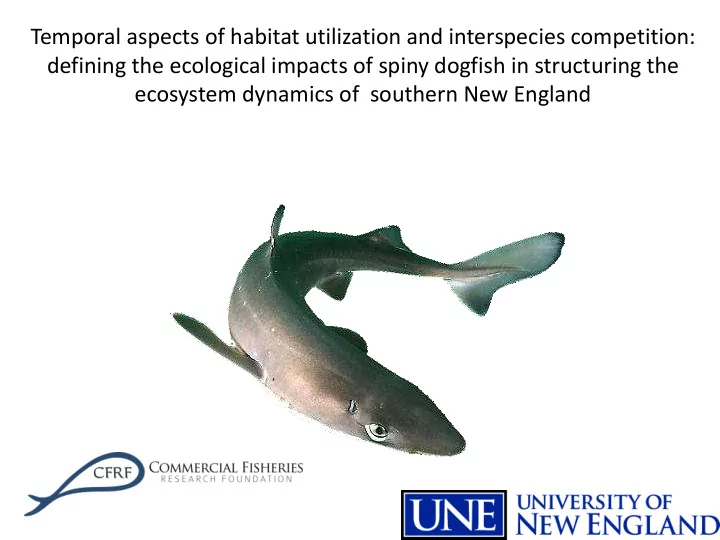
Temporal aspects of habitat utilization and interspecies competition: defining the ecological impacts of spiny dogfish in structuring the ecosystem dynamics of southern New England
defining the ecological impacts of spiny dogfish in structuring the - - PowerPoint PPT Presentation
Temporal aspects of habitat utilization and interspecies competition: defining the ecological impacts of spiny dogfish in structuring the ecosystem dynamics of southern New England "Voracious almost beyond belief, the dogfish entirely
Temporal aspects of habitat utilization and interspecies competition: defining the ecological impacts of spiny dogfish in structuring the ecosystem dynamics of southern New England
"Voracious almost beyond belief, the dogfish entirely deserves its bad reputation”.
Jim Armstrong MAFMC
Reproduction Ecology Movement Essential Habitat
PM AM PM
Hypothesis 1: Based on satellite tag data and anecdotal evidence from fisherman,
we aimed to test whether an active vertical movement pattern exhibited by spiny dogfish prevents this species from being effectively captured by NEFSC otter trawl surveys.
Hypothesis 2: Dogfish do not migrate south, out of southern New England waters,
during the winter. Directed Collaborative and Cooperative Research Opportunity – Subject area: Spiny Dogfish, Squalus acanthias
Hypothesis 1 and 2: Monthly bottom and mid water surveys occured in tandem (side
by side). This will allow for temporal and spatial comparisons to be made between the abundance of spiny dogfish captured on the benthos to those captured in mid water.
Comb Jellies 13.8% Other Inverts 23.5% S quids 5.2% Herring 10.9% Mackerel 19.1% Flatfish 2.5% Cod-Like Fish 4.3% Other Fish 20.7%
Dogfish Food Habits, SPRING SURVEY
A starting point for ecosystem implications
Based on 40,000 stomachs examined (fall + spring)
Courtesy of Paul Rago, NMFS
Hypothesis 3: If hypotheses 1 and 2 were true, then a year round dogfish population would impact ecosystem dynamics within this region. Conducting stable isotope and stomach content analysis order to test for direct and indirect competition and the impacts of these interactions on other commercially important species.
δ15N = 16.1 o/oo δ15N = 8.6 o/oo
δ15N = 12.5 o/oo
δ15N = 10.5 o/oo
Carnivores Omnivores Herbivores Primary Producers
Hypothesis 1: Based on satellite tag data and anecdotal evidence from fisherman,
we aimed to test whether an active vertical movement pattern exhibited by spiny dogfish prevents this species from being effectively captured by NEFSC otter trawl surveys.
Hypothesis 2: Dogfish do not migrate south, out of southern New England waters,
during the winter.
Temporal aspects of habitat utilization and interspecies competition: defining the ecological impacts of spiny dogfish in structuring the ecosystem dynamics of southern New England
Hypothesis 3: If hypotheses 1 and 2 were true, then a year round dogfish population would impact ecosystem dynamics within this region.
December 2010 March 2011 April 2011 May 2011 July 2011 August 2011 November 2011 September 2011 February 2012
5, 30 min tows
Hypothesis 1: Based on satellite tag data and anecdotal evidence from fisherman,
we aimed to test whether an active vertical movement pattern exhibited by spiny dogfish prevents this species from being effectively captured by NEFSC otter trawl surveys
200 400 600 800 1000 1200 1400 Dec-10 Mar-11 Apr-11 May-11 Jul-11 Aug-11 Nov-11 Number of Individuals Month Bottom Midwater
Jim Armstrong MAFMC 23,000,000
Hypothesis 2: Dogfish do not migrate south, out of southern New England waters,
during the winter
528 17 8 8 506 603 1361 442 556 1124 108 1 1 1 129 200 400 600 800 1000 1200 1400 Dec-10 Feb-11 Mar-11 Apr-11 May-11 Jul-11 Aug-11 Nov-11 Number of Individuals Month
Kernel Utilization Distribution (KUD)
16 Months
R2 = 0.94 P < 0.001
6-8 months shorter than the literature suggests
Full Term
Jim Armstrong MAFMC
Hypothesis 3: If hypotheses 1 and 2 are true, then a year round dogfish population would impact ecosystem dynamics within this region
Dogfish %IRI n = 208
Longfin Squid Jellyfish Bones Shortfin Squid Green Crab Sea Robin Clam Baby Dogfish Anaskid Worm Amphipod Blueback Herring Unknown Bird Mackerel Squid Whiting Summer Flounder American Eel Crab Skate Gadiforme Cod Intestines Butterfish Teleost Rock Crab
45% 20% 24%
Dogfish %IRI n = 208 Atlantic Cod %IRI n = 19 Striped Bass %IRI n = 27 Bluefish %IRI n = 16 Monkfish %IRI n = 1
Herring Unidentified Fish Rock Crab Butterfish Squid Amphipod Flounder
62% 45% 24% 20% 23% 6% 5% 3% 43% 37% 12% 49% 30% 17% 4% 90% 10%
Fluke %IRI n = 16 Smooth Dogfish %IRI n = 17 Scup %IRI n = 16 Whiting %IRI n = 6 Black Sea Bass %IRI n = 7
Rock Crab Unidentified Fish Shrimp Shortfin Squid Amphipod
77% 92% 10% 5% 6% 62% 36% 94% 6% 85% 9%
Species Sample Size δC13 (‰) δN15 (‰) Cod 17
14.5 (0.3) Dogfish 14
14.8 (0.4)
Data already entered into model : habitat area, biomass in the habitat area, production/biomass, consumption/biomass values, landings, discards and catch rates Still being entered – diet composition