DECnet-IV, DECnet-Plus und TCP/IP Evolution of DNA DNA Phases - - PowerPoint PPT Presentation

decnet iv decnet plus und tcp ip
SMART_READER_LITE
LIVE PREVIEW

DECnet-IV, DECnet-Plus und TCP/IP Evolution of DNA DNA Phases - - PowerPoint PPT Presentation

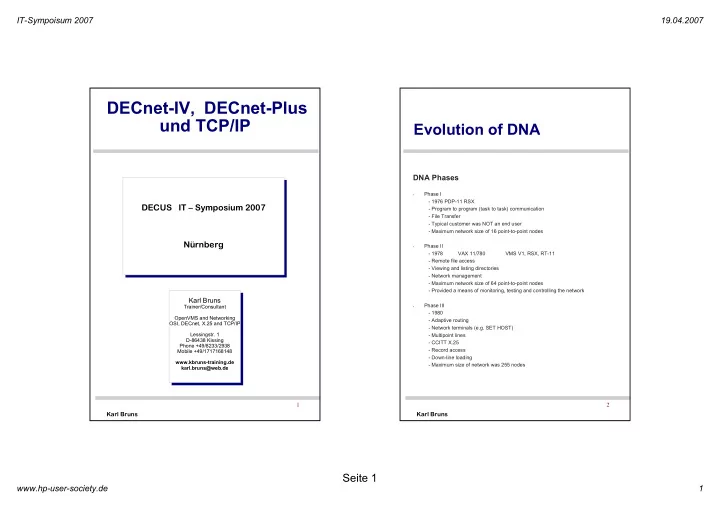
IT-Sympoisum 2007 19.04.2007 DECnet-IV, DECnet-Plus und TCP/IP Evolution of DNA DNA Phases Phase I - 1976 PDP-11 RSX DECUS IT Symposium 2007 DECUS IT Symposium 2007 - Program to program (task to task) communication - File


slide-1
SLIDE 1

IT-Sympoisum 2007 19.04.2007 www.hp-user-society.de 1

Seite 1

1 Karl Bruns

DECnet-IV, DECnet-Plus und TCP/IP

Karl Bruns

Trainer/Consultant OpenVMS and Networking OSI, DECnet, X.25 and TCP/IP

  • Lessingstr. 1

D-86438 Kissing Phone +49/8233/2938 Mobile +49/1717168148 www.kbruns-training.de karl.bruns@web.de

Karl Bruns

Trainer/Consultant OpenVMS and Networking OSI, DECnet, X.25 and TCP/IP

  • Lessingstr. 1

D-86438 Kissing Phone +49/8233/2938 Mobile +49/1717168148 www.kbruns-training.de karl.bruns@web.de

DECUS IT – Symposium 2007 Nürnberg DECUS IT – Symposium 2007 Nürnberg

2 Karl Bruns

Evolution of DNA

DNA Phases

  • Phase I
  • 1976 PDP-11 RSX
  • Program to program (task to task) communication
  • File Transfer
  • Typical customer was NOT an end user
  • Maximum network size of 16 point-to-point nodes
  • Phase II
  • 1978

VAX 11/780 VMS V1, RSX, RT-11

  • Remote file access
  • Viewing and listing directories
  • Network management
  • Maximum network size of 64 point-to-point nodes
  • Provided a means of monitoring, testing and controlling the network
  • Phase III
  • 1980
  • Adaptive routing
  • Network terminals (e.g. SET HOST)
  • Multipoint lines
  • CCITT X.25
  • Record access
  • Down-line loading
  • Maximum size of network was 255 nodes
slide-2
SLIDE 2

IT-Sympoisum 2007 19.04.2007 www.hp-user-society.de 2

Seite 2

3 Karl Bruns

Evolution of DNA

  • Phase IV
  • 1983
  • Incorporated LAN technology into DECnet
  • Ethernet-LANs
  • LAT-Support, Terminalserver
  • with VMS 4.0: VAXcluster
  • Token Ring Support for Q-Bus
  • SNA-Gateway
  • Implementing OSI with separate Products: VOTS, OSAK, FTAM,

X.400, ...

  • Maximum size of network ~64.000 nodes
  • Phase V
  • 1988

IBM announced SAA Digital announced DNA Phase V with full support of the OSI architecture model NSAP max. 20 bytes

  • 1991

VAX Extensions for VAX/VMS (Wave 1) VAX P.S.I. V5 still remaining NCP DECnet/OSI for Ultrix

  • 1992

DECnet/OSI Wave 2 full NCL-Management

  • 1993 Wave 3

DNA IV applications over OSI Transport (TP4) DECnet/OSI for Digital UNIX

  • 1996

DECnet-Plus for OpenVMS V7.1 and Digital UNIX V4.0

4 Karl Bruns

DECnet IV Architektur

DCL.EXE user defined protocols user layer Data Access Protocol Mail CTERM REMACP X.25 GAP $QIO ... Session Protocol Network Service Protocol Routing Vector Routing Ethernet V2 FDDI DDCMP X.25 CI appli- cation layer session layer end commu- nication layer routing layer data link layer physical layer Network Mgmt Listener NCP

slide-3
SLIDE 3

IT-Sympoisum 2007 19.04.2007 www.hp-user-society.de 3

Seite 3

5 Karl Bruns

Verwaltung von DECnet IV

  • Volatile Database:
  • SHOW
  • SET
  • CLEAR
  • Permanent Database:
  • LIST
  • DEFINE
  • PURGE
  • Erweiterungen der Kommandos:
  • LINE
  • CIRCUIT
  • LINK
  • OBJECT
  • EXECUTOR
  • $ MC NCP
  • NCP>
  • NODE

6 Karl Bruns

Verwaltung von DECnet IV

  • Beispiele:
  • NCP> SHOW LINE EWA-0 CHAR
  • NCP> SHOW CIRCUIT EWA-0

CHAR

  • NCP> SHOW KNOWN LINE

CHAR

  • NCP> SHOW KNOWN CIRCUIT

CHAR

  • NCP> SHOW KNOWN LINK

CHAR

  • NCP> SHOW KNOWN OBJECT
  • NCP> SHOW KNOWN NODES
  • NCP> SHOW EXEC CHAR
  • NCP> SHOW EXEC STATUS
slide-4
SLIDE 4

IT-Sympoisum 2007 19.04.2007 www.hp-user-society.de 4

Seite 4

7 Karl Bruns

Verwaltung von DECnet IV Einschalten des Event- Loggings:

  • NCP> SET LOGG MONITOR

KNOWN EVENTS

  • NCP> SET LOGG MONITOR

STATE ON

  • NCP> EXIT
  • $ REPLY/ENABLE

8 Karl Bruns

Verwaltung von DECnet IV

  • Konfigurieren von DECnet IV:
  • $ @ SYS$MANAGER:NETCONFIG.COM
  • Start von DECnet IV:
  • $ @ SYS$MANAGER:STARTNET.COM
  • Sollte vor LAT und TCP/IP gestartet

werden in SYSTARTUP_VMS.COM oder SYSMAN

  • Anhalten von DECnet:
  • NCP> SET EXEC STATE SHUT
  • NCP> SET EXEC STATE OFF
  • Vorstellung der DECnet-Knoten:
  • NCP> SET NODE 1.5 NAME AXP5
  • NCP> DEF NODE 1.5 NAME AXP5
slide-5
SLIDE 5

IT-Sympoisum 2007 19.04.2007 www.hp-user-society.de 5

Seite 5

9 Karl Bruns

Verwaltung von DECnet IV

  • Knoten hört auf MOP-

Requests:

  • NCP> SET CIRC EWA-0

STATE OFF

  • NCP> SET CIRC EWA-0

SERVICE ENABLE

  • NCP> SET CIRC EWA-0

STATE ON

10 Karl Bruns

Verwaltung von DECnet IV

  • Fehlersuche
  • $ SHOW DEV E* /FULL
  • $ANALYSE / SYSTEM

> SHOW LAN

  • MC NCP
  • Counters zurücksetzen:
  • NCP> ZERO ... COUNTERS
  • Anzeigen:
  • NCP> SHOW ... COUNTERS
  • Beispiel:
  • NCP> ZERO KNOWN LINE

COUNTERS

  • Warten...
  • NCP> SHOW KNOWN LINE

COUNTERS

slide-6
SLIDE 6

IT-Sympoisum 2007 19.04.2007 www.hp-user-society.de 6

Seite 6

11 Karl Bruns

Installation von DECnet

  • Bei Installation von OpenVMS

wird nach DECnet Version gefragt

  • Für die Migration von DECnet

IV auf DECnet-Plus muss Phase IV erst deinstalliert werden:

$ PRODUCT REMOVE DECNET_PHASE_IV

  • Dann kann DECnet-Plus

installiert und konfiguriert werden:

$ PRODUCT INSTALL DECNET_OSI $ NET$CONFIGURE ADVANCED

12 Karl Bruns

  • DNA Phase IV, complete stack including
  • DNA IV Applications
  • DNA IV Routing
  • DNA IV Datalinks (DDCMP etc.)
  • OSI (Complete Stack, Layers 1-7)
  • OSI Applications (FTAM, VTP)
  • OSI Transport (TP0, TP2, TP4)
  • OSI Routing (ISO 8473, ISO 9542, ISO 10589)
  • OSI Datalinks (ISO 8802.3, ISO 8802.2, ...)
  • OSI CONS (X.25, ISO 8208, ISO 7776)
  • DNA Phase IV Applications over TP4
  • DNA IV - OSI Interworking
  • Phase IV Router with V Router
  • Phase IV and V Router with IV and V End Systems
  • “DECnet over TCP/IP”

What comprises DECnet-Plus ?

slide-7
SLIDE 7

IT-Sympoisum 2007 19.04.2007 www.hp-user-society.de 7

Seite 7

13 Karl Bruns

The Double-Headed Monster

DNA Net Mgmt CMIP NCL

DECmcc

D E C d t s D E C d n s C T E R M

X.25 SNA

G A P D A P M A I L NSP (CLNS) ISO Internet, IS-IS Routing and IS-ES Ethernet V2.0 LLC1 LLC2 Ethernet 802.3 FDDI DDCMP HDLC OSI Net Mgmt APPL MGMT V T P F T A M X 5 X 4 Frame Relay

Token Ring 802.5

CDI DECdns, .. 7 6 5 4 3 2 1 $ Q I O ... DNA Session Control ...

OSI Presentation

OSI Session ISO TP 0, 2, 4 (CONS) X.25 PLP

Frame Layer (LAPB) X.21, ISDN X.21 bis DQDB SMDS 802.6

PPP 14 Karl Bruns Reference Model of Open Systems Interconnection ISO 7498 describes:

  • 1. 7-layer-architectured-model
  • 2. abstract description of the layers and services
  • 3. Protocols of the layers (entities)

OSI Standards

ISO 7498-2 CCITT X.800 ISO 7498-1 CCITT X.200 ISO 7498-3 CCITT X.650 ISO 7498-4 CCITT X.700 Security Architecture Basic Reference Model Naming and Adressing Management Framework

slide-8
SLIDE 8

IT-Sympoisum 2007 19.04.2007 www.hp-user-society.de 8

Seite 8

15 Karl Bruns

OSI Applications

  • ver CONS

FTAM X.400 ... OSI Presentation OSI Session OSI Transport TP0, TP2 X.25 packet layer X.25 frame layer LAPB X.21 X.21bis ISDN LLC2 802.2 Ethernet 802.3 MAN (DQDB) 802.6 FDDI 9314-x OSI Application

16 Karl Bruns

  • CLNS: ISO Internet Protocol 8473
  • CONS: OSI Transport directly over X.25 PLP over X.25 frame layer or LLC2
  • Null Internet
  • Routing: IS-IS (Link State Routing LSR)

ES-IS DNA IV-routing (Routing Vector Routing (RVR) = Distance Vector Routing)

  • Adaptive Routing
  • Routing is based on costs (Metric)
  • ES = End System
  • IS = Intermediate System (Router)
  • L1-routing
  • L2-routing (area routing)
  • L1

L2 RVR RVR RVR LSR LSR RVR LSR LSR

  • most important rule: within an area only one algorithm
  • for mixed domains on L2:

Interphase links with static routes (Reachable Address Tables)

Network Layer

slide-9
SLIDE 9

IT-Sympoisum 2007 19.04.2007 www.hp-user-society.de 9

Seite 9

17 Karl Bruns

ES-IS Protocol

ISO 9542 - ES-IS PROTOCOL

Used in conjunction with ISO 8473 (ISO 9542 is meaningless without ISO 8473). Supported by all Phase V nodes. ISO 9542 supports automatic configuration of adjacent node addresses.

  • End systems identify adjacent intermediate systems
  • Intermediate systems (IS) identify adjacent end systems (ES) on LAN and

WAN, and identify adjacent IS on WAN.

  • Adjacent IS on LAN are found by listening for IS-IS Hello be used.
  • When an adjacent WAN IS is found, then IS-IS Hello will be used.
  • IS informs ES of a better path.
  • ES can operate on a LAN, and without static tables.
  • ES can autoconfigure their area address from an adjacent IS.

Only the following three extra message types are defined:

  • ES Hello
  • IS Hello
  • Redirect

18 Karl Bruns

IS-IS Protocol

IS-IS PROTOCOL - ISO 10589 WITH EXTENSIONS

The IS-IS protocol is supported by routers (IS) and not by end systems (ES).

  • The original IS-IS protocol in DNA Phase V Routing was Digital proprietary.
  • The core of this original specification was taken as the base for ISO 10589
  • ISO 10589 does not include multiprotocol routing, but has been extended by
  • ther specifications (for example, by RFC1195) to include integrated

multiprotocol routing.

  • DNA Routing (Integrated IS-IS) is a superset of ISO 10589
  • DNA Routing has been modified to ensure that implementations conform to ISO

10589.

  • The IS-IS protocol is used by intermediate systems (routers) to exchange information

about other nodes in the network

  • IS are informed of the existence of nonadjacent nodes
  • IS can determine the best (least cost) path to other nodes
  • Phase V routing algorithm
  • Link State Routing (LSR), same as that used in ISO 10589
  • LSR defines the Phase V IS-IS messages (link state packets) to exchange, and

the algorithm to calculate the least cost path

  • Phase IV routing algorithm
  • Routing Vector Routing (RVR)
  • There is no ISO standard for this protocol (it is Digital proprietary)
  • Defines different messages and algorithm
  • Supported by Phase V routers for interoperability with Phase IV routers
slide-10
SLIDE 10

IT-Sympoisum 2007 19.04.2007 www.hp-user-society.de 10

Seite 10

19 Karl Bruns

IS-IS Protocol

Hierarchical Routing:

Phase V Routing is hierarchical (similar idea to Phase IV) A network may be divided into DECnet areas as follows:

  • Level 1 (L1) routers route messages within their own area.
  • Level 2 (L2) routers (known as area routers) can route messages from area to

area.

  • Level 2 routers also perform L1 routing within their own area
  • On a Level 2 router it is possible to set a circuit to be L2 only. When this is

done, the circuit will only be used to route messages between L2 routers, and will not route to L1 routers or to ES. This is a new feature.

20 Karl Bruns

Digital Router and Gateway Products

  • WANrouter 100/500 (not longer supported)
  • X25 Gateway (not longer supported)
  • WANrouter 90
  • WANrouter 250
  • DECnis 500/600
  • DECbrouter 90 (Cisco)
  • RouteAbout-Family (Proteon)
  • with VMS 7.1:

host-based routing is back for VAX and AXP

slide-11
SLIDE 11

IT-Sympoisum 2007 19.04.2007 www.hp-user-society.de 11

Seite 11

Karl Bruns

NSAP Network Service Access Point

  • addresses the Network layer:

Network Entity Title (NET)

  • points to an entity in the Transport layer:

NSP (sel = %x20)

  • r OSI Transport (sel = %x21)

NSAP IDP DSP AFI IDI NET DECnet - Area ID SEL SEL ID Pre-DSP Local- Area %X00

IDP - Initial Domain Part DSP

  • Domain Specific Part

AFI - Authority and Format Identifier IDI - Initital Domain Identifier SEL - Selector 22 Karl Bruns

Authority and Format Identifier

Authority and Format Identifier (AFI) Initail Domain Identifier (IDI) Domain Specific Part (DSP) Initial Domain Part (IDP)

AFI Allocations

00-09 Reserved - will not be allocated 10-35 Reserved for future allocation by ISO and CCITT jointly 36-59 Allocated and assigned 60-69 Allocated for future assignment by ISO 70-79 Allocated for future assignment by CCIT 80-99 Reserved for future allocation by ISO and CCITT jointly

slide-12
SLIDE 12

IT-Sympoisum 2007 19.04.2007 www.hp-user-society.de 12

Seite 12

23 Karl Bruns

Initial Domain Identifier (IDI)

Authority and Format Identifier (AFI) Initail Domain Identifier (IDI) Domain Specific Part (DSP) Initial Domain Part (IDP)

IDI Formats

Allocation DCC - Data Country Code ICD

  • International Code Designator

The size and the format of the Initial Domain Identifier is dermined by individual addressing authorities Size and Format X.121 ISO DCC F.69 E.163 E.164 ISO - ICD Local Up to 14 digits 3 digits Up to 8 digit telex number Up to 12 digit PSTN number Up to 15 digit ISDN number 4 digits Null Karl Bruns

AFI and IDI

Allocation and IDI Description Information

Allocation Authority Private Network ISO DCC ISO 6523-ICD X.121 F.69 E.163 E.164 AFI Value 49 39 47 37 53 41 55 43 57 45 59 Use AFI if Leading IDI Digit is n/a n/a n/a non zero zero non zero zero non zero zero non zero zero IDI Value n/a Allocated for single- country organizations Allocated for international

  • rganizations

Based on X.25 address Based on X.25 address Based on telex number Based on telex number Based on telephone number Based on telephone number Based on ISDN number Based on ISDN number Digits 0 (none) 3 fixed length 4 fixed length 14 maximum length 14 maximum length 8 maximum length 8 maximum length 12 maximum length 12 maximum length 15 maximum length 15 maximum length

slide-13
SLIDE 13

IT-Sympoisum 2007 19.04.2007 www.hp-user-society.de 13

Seite 13

25 Karl Bruns

Domain Specific Part (DSP)

Authority and Format Identifier (AFI) Initail Domain Identifier (IDI) Domain Specific Part (DSP) Initial Domain Part (IDP)

Generic Example

Subnetwork Identifier The size and the format of the Domain Specific Part is dermined by individual addressing authorities Device Address Selector Address Karl Bruns

Multihoming

  • The use of areas to subdivide a DECnet network

allows for hierarchical routing. In DECnet/OSI, an individual area may have up to three area addresses.

Area Terminology

  • This is only allowed for areas that are running LSR; Phase V routers running RVR

cannot have multiple area addresses.

  • A maximum of three area adresses for the same destination:
  • Multihomed area - The term for an area with several DECnet area

addresses.

  • Multihomed node - The term for a node within a multihomed area, as all

Phase V nodes in such an area will share alle the area addresses.

  • No similar concept under Phase IV - Each node and area had just a

single area address (area number). Each node may be a member of only one area.

  • In this respect it is similar to Phase IV
  • If the area has three area addresses:
  • Each node may have up to three DECnet area addresses (a node is not

forced to use them all).

  • Each DECnet area address will be combined with the node’s ID to form

three NETs (equivalent to three node addresses).

  • Each NET will be combined with the SEL value for each client protocol.
  • A node with three NETs and supporting both NSP and OSI TP4

will have six NSAPs. A DECnet/OSI area may have several DECnet area addresses (several DECnet area numbers).

slide-14
SLIDE 14

IT-Sympoisum 2007 19.04.2007 www.hp-user-society.de 14

Seite 14

27 Karl Bruns

Transport Layer

NSP (Network Service Protocol)

Overview

NSP is a Digital proprietary protocol that is also used in earlier phases of DNA.

  • The version of NSP used in DNA Phase V includes a number of relatively

minor enhancements over earlier versions of NSP.

  • Backward compatibility with earlier versions is assured.

NSP provides a connection-oriented transport service.

  • In DNA Phase V the connections are referred to as transport connections

(TC). Earlier phases of DNA referred to them as logical links.

NSP Functions

The major functions of NSP are:

  • Connection establishment
  • Connection release
  • Data transfer and flow control
  • Segmentation and reassembly
  • Error detection and recovery

28 Karl Bruns

OSI Transport

  • The OSI Transport is layer 4 of the OSI Network Reference Model.
  • Provides transparent transfer of data between session entities and

relieves them from any concern with the detailed way in which reliable and cost-effective transfer of data is achieved.

  • The OSI Transport makes use of the services of the Network Layer

(layer 3).

  • TPDU (Transport Protocol Data Units) are the untis of data that the

Transport Layer exchanges (transmits and receives) over the interface with the Network Layer.

  • From the Network Layer side of this interface they appear as NSDUs

(Network Service Data Units).

  • The OSI Transport provides services to the OSI Session Layer and to the

DNA Session Control Layer.

  • TSDU (Transport Services Data Unit) are the untis of data that the

Transport Layer exchanges with its user.

  • From the OSI Session Layer side of the interface they appear as SPDUs

(Session Protocol Data Units).

  • ISO Standards
  • ISO 8072 - OSI Transport Service Definition
  • ISO 8073 - OSI (connection-oriented) Transport Protocol Definition
  • Transport classes - Five classes defined for ISO 8073 Transport

Class 0 (TP0), Simple Class Class 1 (TP1), Basic Error Recovery Class Class 2 (TP2), Multiplexing Class Class 3 (TP3), Error Recovery and Multiplexing Class Class 4 (TP4), Error Detection and Recovery Class

  • ISO 8602 - OSI (connectionless) Transport Protocol Definition
  • not architected for DNA and not implemented by Digital
slide-15
SLIDE 15

IT-Sympoisum 2007 19.04.2007 www.hp-user-society.de 15

Seite 15

29 Karl Bruns

OSI Transport

The functions of OSI Transport are similar to those of NSP. Some of the transport classes support only subsets of the full functionality.

  • Connection establishment
  • Supported by all transport classes
  • Negotiates the transport class to be used for the connection (among
  • ther responsibilities
  • Connections release
  • Supported by all transport classes, although there is no explicit release

in Class 0

  • Error detection and recovery
  • Not supported by Class 0 or 2
  • Error recovery supported by Class 1 and 3
  • Error detection and recovery supported by Class 4
  • Data transfer and flow control
  • All classes support data transfer, although Class 0 does not support

expedited data.

  • Transport level flow control is utilized in Classes 3 and 4, and is optional

in Class 2. (It is not available in Class 0 and 1.)

  • Segmentation and reassembly
  • All classes support segmentation and reassembly.

30 Karl Bruns

OSI Transport Implementations in DECnet-PLUS

  • OSI Transport operates over CONS
  • Digital implements CONS in the PSI and WANDD products, which

implement the X.25 packet-level protocol for operation over WAN (LAPB(E)) and LAN (LLC2).

  • Digital supports the use of TP0, TP2 and TP4 over CONS.
  • OSI Transport operates over CLNS
  • Digital implements CLNS (in Phase V) as DNA IV Routing in DECnet

products.

  • Digital supports only the use of TP4 over CLNS.

NOTE DNA Routing may run over X.25 networks, but this is still a CLNS service.

slide-16
SLIDE 16

IT-Sympoisum 2007 19.04.2007 www.hp-user-society.de 16

Seite 16

31 Karl Bruns

DNA Session Control

Maps Node Names to Addresses

DECnet/OSI maps from names to addresses for an outgoing connection and from addresses to names for an incoming connection.

  • Phase V Session Control uses CDI to store the information. Phase IV uses a local

database on each node.

  • Phase IV performs a simple name to address translation. Phase V additionally

support:

  • Multiple addresses, for example, several NSAPs.
  • Storage and retrieval of protocol stack information, for example, to select

NSP or OSI TP4

  • The protocol stack and address information is stored in the DECdns

attribute DNA$Towers. This consists of ordered-by-layer protocol Ids and corresponding addresses. For example: (Session Control ID + Object Number) + (TP4+TSAP) + (Routing ID+NSAP) NOTE Protocol stack information is held only for the Network Layer and above. The data link is selected by the Network Layer.

32 Karl Bruns

OSI Session

  • OSI Session forms layer 5 of the OSI Network Reference Model.
  • OSI Session makes use of the services of OSI Transport (Layer 4).
  • OSI Session provides services to the OSI upper layers. The normal user of these

services is the OSI Presentation Layer.

ISO Standards

  • ISO 8326 is the OSI Session Service definition.
  • ISO 8327 is the OSI Session Protocol definition
  • ISO 9548 is the OSI Connectionless Session Protocol definition

Functionality of OSI Session Compared to DNA Session Control

DNA Session Control and OSI Session are similar to the extent that they each define layer 5 of their corresponding protocol stacks. In most other respects these protocols are different.

  • DNA Session Control runs over either NSP or OSI Transport Class 4, which make

use of DNA Routing (CLNS) at the Network Layer.

  • OSI Session cannot run over NSP, but can run over any supported OSI Transport

Class, and over whichever network over TP4 over DNA Routing (CLNS).

  • DNA supports TP0 and TP2 over CONS and TP4 over either CONS
  • r

CLNS, so it is possible to run OSI Session over TP4 over DNA Routing (CLNS). Most of the functionality of OSI Sessionis involved in providing services during the data transfer phase.

  • These services allow the session user to structure the exchange of messages, so

that the messages involved in providing a particular user function (for example, a transaction) are grouped together.

  • The session services, additionally, allow the session user to:
  • Resynchronize the user function
  • Abort the user function
  • Suspend the user function for later resumption
slide-17
SLIDE 17

IT-Sympoisum 2007 19.04.2007 www.hp-user-society.de 17

Seite 17

33 Karl Bruns

Structure of Communication between Processes

  • Session communications may be structured or unstructured.
  • Wether a session connection is structured and the extent of the structuring is

determined by the functional units selected during the establishment of the connection.

34 Karl Bruns

The Presentation Layer provides for a common representation to be used between application entities. This layer relieves the application entities of any concern for common representation of information. It provides them with syntax independence.

  • Service definition - ISO 8822
  • Protocol definition
  • Connection-orientated - ISO 8823
  • Connectionless - ISO 9576
  • Abstract syntax notation
  • ASN.1 notation - ISO 8824
  • ASN.1 encoding rules - ISO 8825
  • Characteristics
  • Negotiation and selection of syntax
  • Functional units
  • Syntax
  • Concrete
  • Transfer
  • Abstract
  • Presentation context

OSI Presentation layer

slide-18
SLIDE 18

IT-Sympoisum 2007 19.04.2007 www.hp-user-society.de 18

Seite 18

35 Karl Bruns

DECnet-Plus over IP

LAN´s mit IP-, OSI- und DECnet-Applikationen

1) Router müssen sämtliche Protokolle routen.

36 Karl Bruns

DECnet-Plus over IP

2) Integrated IS-IS ISO 10589 RFC 1195 IS-IS Link State Packets übertragen IP Routing Informationen

slide-19
SLIDE 19

IT-Sympoisum 2007 19.04.2007 www.hp-user-society.de 19

Seite 19

37 Karl Bruns

DECnet-Plus over IP

3) RFC 1006: OSI-Applikationen über TCP/IP RFC 1859+RFC 2126: DECnet-Applikationen über TCP/IP

38 Karl Bruns

DECnet-Plus over IP

  • Requirements:
  • DECnet/OSI V6.x or DECnet-Plus for

OpenVMS

  • DECnet/OSI V3.2B or DECnet-Plus

for Digital Compaq UNIX

  • TCP/IP stack that supports the PWIP

driver (only OpenVMS)

  • OSI Transport utilizes the RFC1006

and RFC1006plus templates

  • in the Session Control Naming

Search Path should be the fully qualified host name for DNS/BIND included so that IP host name to IP address translation can take place .

slide-20
SLIDE 20

IT-Sympoisum 2007 19.04.2007 www.hp-user-society.de 20

Seite 20

39 Karl Bruns The OSI-Applications over TCP/IP

RFC1006

FTAM VT X.400 X.500 ... ASN.1 OSI Applications OSI Presentation OSI Session OSI Transport TP0 RFC1006 TCP IP Network Access

40 Karl Bruns

OSI Transport TP2

The DNA-Applications over TCP/IP

RFC1006+RFC1859+RFC2126

DAP CTERM Mail Phone ... CDI Common Directory Interface DNA-Applications Session Control RFC 1006+ $QIO DNS / BIND TCP IP Network Access Global Namespace Local Naming

slide-21
SLIDE 21

IT-Sympoisum 2007 19.04.2007 www.hp-user-society.de 21

Seite 21

41 Karl Bruns

DECnet-Plus over IP

42 Karl Bruns

DECnet-Plus over IP

slide-22
SLIDE 22

IT-Sympoisum 2007 19.04.2007 www.hp-user-society.de 22

Seite 22

43 Karl Bruns

DECnet-Plus over IP

44 Karl Bruns

DECnet-Plus over IP

slide-23
SLIDE 23

IT-Sympoisum 2007 19.04.2007 www.hp-user-society.de 23

Seite 23

45 Karl Bruns

DECnet-Plus over IP

46 Karl Bruns

Neue Features für DECnet- Plus in OpenVMS 7.3-2

DNS/BIND kann erster bzw. einziger Namespace (Directory Service) sein. DECdns läuft nun über TCP/IP gemäß RFC 1859, d.h. IP address towers können in DECdns verwaltet werden. DECdtss läuft nun in reiner IP-Umgebung. Global DTSS-Server kann von einen BIND-Server oder vom DECdns-Server über TCP/IP gelesen werden. DECnet-Plus unterstützt „LAN failover sets“. NCL SHUT ALIAS PORT Clustermember erlaubt keine weiteren ALIAS-Verbindungen.

slide-24
SLIDE 24

IT-Sympoisum 2007 19.04.2007 www.hp-user-society.de 24

Seite 24

47 Karl Bruns

Neue Features für DECnet- Plus in OpenVMS 8.2

  • FTAM wird noch nicht unterstützt

für OpenVMS I64 Systeme

  • sys$manager:isis$configure.com

ermöglicht Link State Routing IS-IS !!!!

  • Help Updates

48 Karl Bruns

Zeitsynchronisation DECdts

  • DECdts ist ein netzwerkverteilter

Service für OpenVMS und Tru64 Unix zur Synchronisation der Uhren im Netz LAN und WAN basierend auf einem Client/Server Modell

  • Jeder Server bietet die Zeit an Clients

und Applikationen durch Clerks an.

  • DECdts erlaubt den Anschluss von

externen Uhren, z.B. Hopfuhr.

  • Lokale Server arbeiten im LAN
  • Globale Server übermitteln die Zeit in

WANs

  • Courierserver vermitteln dazwischen
slide-25
SLIDE 25

IT-Sympoisum 2007 19.04.2007 www.hp-user-society.de 25

Seite 25

49 Karl Bruns

Zeitsynchronisation NTP

  • Network Time Protocol Version 3 RFC1305

March 1992

  • TCP/IP Services for OPENVMS V5.4

unterstützt NTP 4.2

  • NTP ermöglichst externe Uhren,

z.B. im Internet ptbtime1.ptb.de

  • Nachteile von NTP im Vergleich zu DECdts:

keine Kenntnisse von Sommer/Winterzeit Workaround: Systemparameter AUTO_DLIGHT_SAV ab OpenVMS 7.3-2

  • Zeitausgleich wird sehr langsam durchgeführt

1 Sekunde pro 2000 Sekunden

  • Workaround: NTP 4.2 1 Sekunde pro 20 Sek

50 Karl Bruns

Zeitsynchronisation NTP

NTP kann Zeit nicht abrupt auf aktuellen Wert einstellen Workaround: NTP im Startup stoppen, Zeit synchronisieren und NTP wieder starten, verwende dazu NTPD Kommandos Fazit: Kunden waren mit reiner NTP Konfiguration nicht zufrieden, gerade im Cluster oder Hot Standby Lösung: lies Zeit von externen NTP Server in DTS Server ein und synchronisiere sie im DECnet-Plus. Verwende dazu DTSS$PROVIDER.EXE in SYS$EXAMPLES Zur Ausfallsicherheit konfiguriere 2 DECdts Server im LAN Beste Kundenzufriedenheit in allen Fällen !!