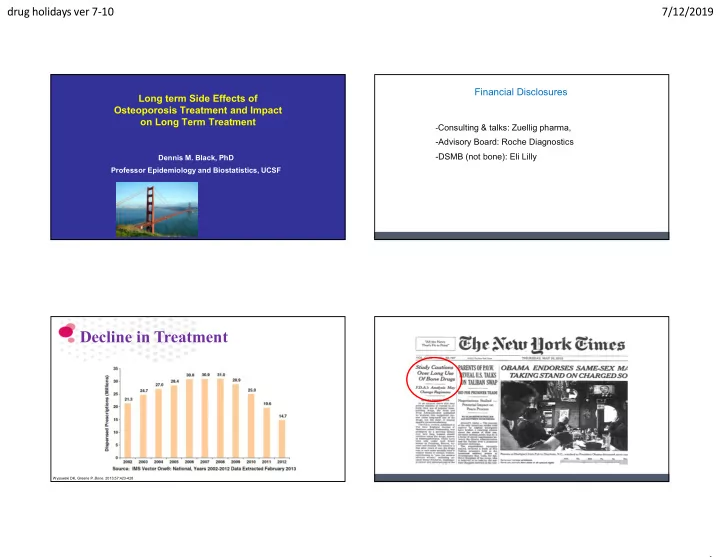
Decline in Treatment Wysowski DK, Greene P. Bone. 2013;57:423-428 1 - - PowerPoint PPT Presentation

decline in treatment
SMART_READER_LITE
LIVE PREVIEW

Decline in Treatment Wysowski DK, Greene P. Bone. 2013;57:423-428 1 - - PowerPoint PPT Presentation

drug holidays ver 7-10 7/12/2019 Financial Disclosures Long term Side Effects of Osteoporosis Treatment and Impact on Long Term Treatment - Consulting & talks: Zuellig pharma, -Advisory Board: Roche Diagnostics -DSMB (not bone): Eli Lilly


slide-1
SLIDE 1

drug holidays ver 7-10 7/12/2019 1

Long term Side Effects of Osteoporosis Treatment and Impact

  • n Long Term Treatment

Dennis M. Black, PhD Professor Epidemiology and Biostatistics, UCSF

Financial Disclosures

  • Consulting & talks: Zuellig pharma,
  • Advisory Board: Roche Diagnostics
  • DSMB (not bone): Eli Lilly

Wysowski DK, Greene P. Bone. 2013;57:423-428

Decline in Treatment

slide-2
SLIDE 2

drug holidays ver 7-10 7/12/2019 2

5

Possible Harms of Osteoporosis Therapy

Potential BP harms: Less impactful

  • GI intolerance
  • Ophthalmologic, renal effects, acute phase reaction
  • Atrial fibrillation and esophageal cancer

Potential BP harms: More impactful

  • Osteonecrosis of the jaw (ONJ)
  • Atypical femur fractures (AFF)

*

Bisphosphonates and ONJ: Summary

  • Very rare in osteoporosis patients (1 to 50 per 100,000 in BP users)
  • Much higher in oncology use (higher doses, other factors)
  • Also seen with non-BP therapies
  • Little evidence that doses used for osteoporosis increase risk of ONJ
  • If so, very low risk
  • Other RFs: periodontal disease, oral surgery (extractions/implants),

diabetes, Ca, others

  • 2012 American Dental Association report (Hellstein et al) has helped

to decrease concerns in U.S.

  • Etiology/mechanism remains uncertain
  • Treatments increasingly effective

Kahn, JBMR 2015; Hellstein, ADA 2012; Khan O.Int 2016

Atypical Femur Fractures (AFF)

Khosla 2012 (photo: Dr. M. Rosenwasser, Columbia U)

Summary of 2014 ASBMR Case Definition for Atypical Femur Fracture

  • Location along femoral diaphysis (between LT and DMF)

and

  • Meets >4 of 5 Major Criteria
  • Minimal or no trauma
  • Fracture line from lateral cortex & transverse, may be oblique across femur
  • Complete fractures thru both cortices; incomplete fx lateral cortex
  • Non- or minimally comminuted
  • Localized reaction in lateral cortex
  • Minor Criteria (may be present)
  • Increased cortical thickness (generalized)
  • Prodromal symptoms (pain in thigh/groin)
  • Bilateral
  • Delayed healing

Shane, et. al. JBMR, 2010/2014

slide-3
SLIDE 3

drug holidays ver 7-10 7/12/2019 3

Fracture in (begins in) region below lesser troch and distal metaphyseal flare Has perpendicular fracture line in lateral cortex, can be

  • blique after that

Endosteal or periosteal thickening at fracture site Low trauma No or minimal comminution

Atypical Femur Fracture (~ASMBR criteria) Evidence Linking Osteoporosis Treatment to AFF*

1) Case Reports and Case Series (from 2007) 2) Observational/epidemiologic studies (Canada, Denmark, US,

Sweden, other countries)

  • Case-control studies
  • Cohort studies

3) A bit of data from RCT’s (too small for rare events)

  • 2013: Meta-analysis of bisphosphonates and atypical fracture

(Gedmintas, JBMR, 2013)

  • Note: Focus on bisphosphonates since most data. AFF seen

with other meds including denosumab, romosozumab, others

*Black, et al Endo Reviews 7/2018

Two Key AFF Cohort Study Examples for Incidence and RR for BP/AFF

1) Swedish study (Schilcher) 2) Kaiser Northwest, U.S. (Feldstein) Both:

  • Reviewed individual x-rays from fracture patients
  • Large, population-based with good pharmacy records
  • Important limitation

Helpful to assess:

  • Incidence of AFF
  • Relative risk of BP use and AFF

Feldstein, et al. JBMR 2012; Schilcher, NEJM 2014

  • Age > 55 y, F/M
  • All hip/femur fractures in Sweden (Nat’l

Reg) 2008-2010

  • Review X-rays for AFF:
  • Subtrochanteric or femoral shaft
  • ICD-10 (S722 and S723)
  • ASBMR 2014 criteria
  • Link to pharmaceutical register

Schilcher et al, NEJM 5/11; Schilcher et al, NEJM (ltr), 2014; Schilcher et al Acta Ortho, 2015

Incidence of AFF: Swedish Study of Bisphosphonates and Atypical Fracture (2011, 2014 update)
slide-4
SLIDE 4

drug holidays ver 7-10 7/12/2019 4

Incidence of AFF from Swedish Study

  • ~3 million Swedish men and women > age 55
  • ~50,000 proximal femur fractures in 2008-10
  • ~5500 ICD-coded subtroch or femoral shaft (ST/FS) x-rays

reviewed using ASBMR 2014 criteria

  • 172 confirmed atypical femur fractures

Schilcher et al, NEJM 5/11; Schilcher et al, NEJM (ltr), 2014; Schilcher et al Acta Ortho, 2015

172 AFF (out of 50,000 femur fractures)

How Common are AFFs Among All Femur Fractures in Swedish Data?

Schilcher et al, NEJM 2014

1000 Hip/Femur Fractures

*ST/FS: subtroch or femoral shaft 3 million men and women 3 years 50,000 femur fractures 5,500 Subtrochanteric/femoral shaft 172 AFF

110 ICD-coded ST/FS*

3.4 AFF’s

15

Black, Rosen. NEJM 1/16

Black et al. Endo Reviews 2018

16

Incidence of AFF’s: Number of AFF’s per 1000 Hip Fracture

  • Schilcher (Sweden) and Feldstein (KP NW) are only published

population-based studies with x-ray confirmation (using ASBMR criteria)

  • Consistent with other population-based studies

Feldstein, et al. JBMR 2012; Schilcher, NEJM 2014

slide-5
SLIDE 5

drug holidays ver 7-10 7/12/2019 5

What is the Relative Risk for AFF from BP Use?

What is the Relative Risk for AFF with Any Bisphosphonate Use?

  • Relative risk in Schilcher (Swedish) and Feldstein studies.
  • Both reviewed X-rays & both compare to “typical subtroch/fem

shaft”.

Feldstein, et al. JBMR 2012; Schilcher, NEJM 2014

Study Relative risk: any BP and AFF 95% CI Schilcher 33.3 (18-38) Feldstein 2.1 (0.99-4.99)

  • Very different relative risks!

*Gedmintas L, et al J Bone Miner Res. 2013

1.70 (1.22 to 2.37) Gedmintas L, J Bone Miner Res. 2013

Meta-analysis of Any BP Use and ST/FS or AFF: 13 ‘Case-control’ and ‘Cohort’ Studies

All used ICD codes (no xrays) 4/100

Benefits vs. Risks for 3 Years of BP Therapy in 1000 Osteoporotic Women

Black DM, Rosen CJ. N Engl J Med 2016;374:254-262.

slide-6
SLIDE 6

drug holidays ver 7-10 7/12/2019 6

21

Summary: If One Treats 1000 Osteoporotic Women for 3 Years Benefits: Prevent 100 fractures including 11 hip fx Harms: ‘Cause’ 0.08 AFF Put another way, For every 1000 fractures prevented, 1 AFF caused

Black, Rosen. NEJM 1/16

22

Benefits and Risks for Treatment Beyond 5 Years

1. Benefits/efficacy 2. Risks (AFF) Benefits of BP Beyond 5 Years….

2 4 6 8 10

Risedronate Alendronate Zoledronic acid

ALN = alendronate; DB = double-blind; EXT 1= extension 1; EXT 2= extension 2; FIT = Fracture Intervention Trial; FLEX = FIT Long-term EXtension; HORIZON-PFT = Health Outcomes and Reduced Incidence with Zoledronic acid Once Yearly Pivotal Fracture Trial; OL, Open-label; PBO = placebo; RCT = randomized controlled trial; RIS = risedronate; VERT-MN = Vertebral Efficacy with Risedronate Therapy MultiNational; Z3P3 = zoledronic acid treatment for 3 years followed by placebo for 3 years; Z6 = zoledronic acid treatment for 6 years; ZOL = zoledronic acid.
  • 1. Black DM, et al. N Engl J Med. 2007;356:1809-1822. 2. Black DM, et al. J Bone Miner Res. 2012; 27:243-254. 3. The Effect of 6 versus 9 Years of Zoledronic Acid Treatment in Osteoporosis:
A Randomized Extension to the HORIZON-Pivotal Fracture Trial (PFT).Presented at ASBMR 2013 (abstract no. SA0389). 4. Black DM, et al. Lancet. 1996;348:1535-1541. 5. Cummings SR, et al. JAMA. 1998;280:2077–2082.
  • 6. Black DM, et al. JAMA. 2006;296:2927-2938. 7. Reginster J-Y, et al. Osteoporos Int. 2000;11:83–91. 8. Sorensen OH, et al. Bone. 2003;32:120-126. 9. Mellström DD, et al. Calif Tissue Int. 2004;75:462-468.

FIT4,5 ALN (n = 3236) PBO (n = 3223) RCT – FLEX6 ALN 5 mg (n = 329) or 10 mg (n = 333) PBO (n = 437) HORIZON-PFT1 ZOL (n = 3889) PBO (n = 3876) RCT – EXT12 Z6 (n = 616) Z3P3 (n = 617) VERT-MN7 RIS 2.5 mg (n = 408) 5 mg (n = 407) PBO (n = 407) RCT – EXT8 RIS (n=135) PBO (n=130) OL-EXT9

RIS 7 yrs (n = 83) PBO 5 yrs/RIS 2yrs (n = 81)

RCT – EXT23 Z9 (n = 95) Z6P3 (n = 95)

Time (Years) 0 2 4 6 8 10

Black JAMA 2006; Black et al. JBMR 2012

Black JAMA 2006; Black et al. JBMR 2012

Years FLEX (Alendronate) HORIZON Ext (Zoledronic acid)

0.1 1 10 Vertebral FX (clinical) Non-vertebral Fracture Alendronate (FLEX: 5 yrs/5 yrs

1.00 (0.8, 1.3) 0.45 (0.2, 0.85) 0.99 (0.7, 1.5) 0.48 (0.3, 0.9)

Vertebral FX (morphometric) Non-vertebral Fracture Zoledronic acid: HORIZON: 3yrs/3 yrs

Reductions (Relative Risks) for Fractures for Continuing vs. Discontinuing Bisphosphonates: Alendronate and ZOL

3 Relative Hazard (± 95% CI) Favors Bisphosphonate Favors Placebo Black JAMA 2006; Black et al. JBMR 2012

slide-7
SLIDE 7

drug holidays ver 7-10 7/12/2019 7

Total Hip BMD Change in FLEX: Residual Benefit After Stopping

= Placebo = ALN (Pooled 5 mg and 10 mg groups) 1 2 3 4 5 F 0 F 1 F 2 F 3 F 4 FL 0 FL 1 FL 2 FL 3 FL 4 FL 5

Mean Percent Change Year Start of FLEX

P<0.001 ALN vs PBO

FIT FLEX FIT 3 to 4.5 yrs FIT/FLEX Recess 1 to 2 yrs FLEX 5 yrs 2.8% * Black, et. al. JAMA, 12/06

Fracture reductions with Long-term Continuation of bisphosphonates (2 RCTs*): Clinical Conclusions

  • Consistent fracture results for Alendronate and ZOL
  • Continuing for an additional 5 years ...
  • Lowers vertebral fractures risk
  • No evidence for a reduction in non-vertebral

− Confidence intervals are wide and allow for possible benefit

  • There are benefits to continuing > 5 years, but fewer than initiating
  • Continue those at highest risk of vertebral fracture

*Black JAMA 2006; Black et al. JBMR 2012

Black JAMA 2006; Black et al. JBMR 2012

27 FLEX vertebral fracture benefit: Who to continue?

Femoral Neck BMD T- Score (start FLEX) 5 Yr risk (%) Clinical Vert.

  • Fx. In PBO

Number Needed to Treat

All women in study

All BMD values 5.5 34 ≤ -2.5 9.3 21

  • 2.5 to -2

5.8 33 ≥ -2 2.3 81 No prevalent vert. fracture (start of FLEX) ≤ -2.5 8.0 24

  • 2.5 to -2

3.0 63 ≥ -2 1.8 102 Prevalent vertebral fracture (start of FLEX) ≤ -2.5 11.1 17

  • 2.5 to -2

11.1 17 ≥ -2 3.7 51 Black, et al. NEJM. 2012 May 31;366(22):2051-3 Consistent with more recent ASBMR guidelines for LT treatment (later)

What about long term safety? Does AFF risk increase with longer duration of BP treatment? Several studies treatment duration and AFF risk. 2 examples:

  • 1. Schilcher (Swedish) study (2008-2010)
  • 2. 2012 Kaiser Southern Calif. case series of AFF*
  • X-rays evaluations: 142 cases
  • Influential (but some methodologic limitations)

*Dell JBMR 2012; **Schilcher et al 2014

slide-8
SLIDE 8

drug holidays ver 7-10 7/12/2019 8

(adapted from Dell et al., 2012) (adapted from Schilcher et al., 2014)

Duration of Use (years)

None 0.1-1.9 2.0-3.9 4.0-5.9 6.0-7.9 8.0-9.9 10+

  • 20

20 40 60 80 100 120 140 160 <1 1-1.9 2-2.9 3-3.9 >4

  • 20

20 40 60 80 100 120 140 160

Relative Risk vs. No Use Relative Risk vs. < 1 year of Use Duration of Use (years)

Relative Risk of AFF by Duration of BP Use 2012 KP So. Calif. And 2015 Swedish study

Limitations in both studies:

  • No adjustment for covariables
  • Cross sectional only
  • Other limitations

30

*

If you are interested in AFF….

. Endocrine Reviews. 9/2018

Kaiser Permanente Southern California (KPSC) Osteoporosis Cohort Study (SOCS) 2018 Study (D. Black, Annette Adams, Co-PIs)

  • Cohort studied: ~ 1 million women > age 50
  • Racially diverse
  • Evaluate all x-rays from subtrochanteric and femoral shaft fractures (ASBMR

criteria) from 2007 thru 2017

  • Adjust in a prospective analysis (time-dependent covars)
  • Adjust duration of BP use for many other clinical risk factors
  • Novel: Adjust for pre-treatment BMD
  • Goal: prediction tool for AFF risk
  • Also look at decrease in AFF risk following discontinuation of BP

Black & Adams & Gieger ASBMR 2018, 2019

Kaiser Permanent Southern California Osteoporosis Cohort (SOCS): AFF Risk Factors Results: In 1 million women: 306 AFFs (11 years) (~2/100,000 py)

  • 25 (~8%) in women with no BP use
  • 271 (~92%) in women with some BP use

This analysis: BP use >=3 months (200k women)

Hypotheses:

  • Several clinical variables will be predictive of AFF risk
  • Adjustment for clinical risk factors will attenuate relationship of BP duration to

AFF

  • Adjustment for BMD will further attenuate BP relationships
slide-9
SLIDE 9

drug holidays ver 7-10 7/12/2019 9

AFF Incidence by Duration (Unadjusted)

AFF Incidence by Duration of Use (per 10k) AFF Incidence by Duration of Use (per 10k) AFF Incidence by Time Since Discontinuation (per 10k)

Black & Adams & Gieger ASBMR 2018, 2019 Black & Adams & Gieger ASBMR 2018, 2019

AFF by Ethnicity (Unadjusted)

AFF Incidence (per 10k) AFF, Hip and All Fractures Incidence (per 10k) Will adjustment for covariables attenuate this?

Risk factors for AFF (n=195k, AFF=271)

Risk Factor Unadj HR (p) MV Adj HR (p) Age (vs. 85+ yrs) 50-64 yrs 1.2 (0.546) 1.6 (0.142) 65-74 yrs 2.6 (<0.001) 2.7 (<0.001) 75-84 yrs 2.6 (<0.001) 2.4 (0.001) > 85 yrs 1.0 1.0 BP duration (vs. 0-1 yr) 1-3 yrs 4.2 (<0.001) 2.9 (0.004) 3-5 years 13.2 (<0.001) 8.7 (<0.001) 5-8 years 32.2 (<0.001) 19.4 (<0.001) >8 years 69.9 (<0.001) 44.0 (<0.001) Asian 5.2 (<0.001) 4.6 (<0.001) Smoking ever 0.4 (0.004) 0.6 (0.171) Height (-2 cm) 0.6 (<0.001) 0.6 (<0.001) Weight (+5 kg) 0.99 (0.029) 1.1 (<0.001) Any prior fracture 2.0 (0.002) 2.0 (0.002) Yrs since last BP use (1 y) 0.5 (<0.001) 0.6 (<0.001) BMD adjustment made no difference (BMD not related to AFF!!) Black & Adams & Gieger ASBMR 2018, 2019 Duration of use remains strongly associated with AFF risk even after adjustment Asian race 5x risk, even after adjustment Shorter and heavier women at higher risk

SOCS (KPSC) Study Preliminary Findings:

Hypotheses:

  • Several clinical variables will be predictive of AFF risk
  • Yes (race, weight, height, smoking, age)
  • Adjustment for clinical risk factors will attenuate relationship of

BP duration to AFF

  • Yes but only slight attenuation. Duration of use still very strong
  • Adjustment for pre-treatment BMD (and prior fracture) will

greatly attenuate BP duration increase in AFF risk

  • WRONG!
  • These results will be used to build predictive equations for AFF risk for

eventual clinical use

  • Help determine which patients should take drug holiday after 3-5 years of BP.

Black & Adams & Gieger ASBMR 2018, 2019

slide-10
SLIDE 10

drug holidays ver 7-10 7/12/2019 10

AFF Incidence by Time Since Stopping BP (Unadjusted)

AFF Incidence by Duration of Use (per 10k) AFF Incidence by Duration of Use (per 10k) AFF Incidence by Time Since Discontinuation (per 10k)

Black & Adams & Gieger ASBMR 2018, 2019

Are Drug Holidays Are Likely to be Effective in Reducing AFF Risk?

Years after Discontinuing Swedish study 2012 Black, Adams KPSC 2018 0-1 70% 44% 1-4 80% 80% >4 80% 78% Reduction in AFF in years after discontinuing BPs (compared to continuing)

In another study in KPSC (in press, JBMR), on drug holiday, hip and non-vertebral fracture risk did not increase during a drug holiday These two results together support value of BP drug holiday

Black & Adams & Gieger ASBMR 2018, 2019

ASBMR Task Force Guidelines on Long-term Osteo. Treatment (Adler et al JBMR 2015)

  • Suggests evaluation of patients on oral BP’s after 5

years with possible drug holiday in some patients

  • Recommendations based on fracture efficacy only

ASBMR Task Force Guidelines on Long Term Osteoporosis Therapy (Adler et al 2016)—Where to Update? What’s new from KP data?

  • KP results suggest considering the AFF risk part of equation as well.
  • Strong increase in AFF risk with longer treatmt, risk decreased with

drug holiday

  • Drug holidays especially for those at higher AFF risk:
  • Asians
  • Those with >> 5 years of BP use
  • Younger patients (e.g. < age 65)
  • Shorter and heavier patients
  • (Glucocorticoid (maybe not..also at high risk of hip and vertebral fracture))
slide-11
SLIDE 11

drug holidays ver 7-10 7/12/2019 11

ASBMR Task Force Guidelines (Adler et al 2015-16)

  • MORE!

Emerging evidence supports

  • More sophisticated assessment of patients for

drug holidays incorporating AFF risk info

  • Probably more aggressive use of drug

holidays

  • Shorter treatment for those higher AFF risk

Summary of benefits vs. risks for ALN or ZOL treatment as a function of time

Benefits Hip, non- vertebral and spine reductions Risks Treatment 3-5 years Benefits: Only spine reductions Risks Treatment Beyond 5 yrs Benefits unproven Risks uncertain Treatment Beyond 10 years with ALN (6 years with ZOL)

Drug Holiday Depends on Treatment

Denosumab, Teriparatide (2 yrs) and Abaloparatide (2 yrs), Romo., HRT, Raloxifene: DON’T STOP without follow up

Cannot consider drug holiday Benefits lost soon after stopping

  • Quick BMD loss after anabolic
  • Denosumab: may be rebound, multiple Vfx soon after

stopping in some patients If patient wants to discontinue, use other therapy to solidify gains (mostly likely bisphosphonate or denosumab) ALN and ZOL but uncertain for Risedronate and Ibandronate

45

Long-term Bisphosphonate and BP and Drug Holidays

  • AFFs seem to be associated with longer duration of BP use
  • RF’s for AFF: height, weight, race, GC use, (not age or BMD)
  • Drug holidays after 3-5 years of BPs for 3 to 5 years will likely reduce

AFF risk

  • Over the next 1-2 years, we can improve risk prediction for AFF to

more precisely target drug holidays

  • Personalized medicine for drug holidays! Balance fracture and AFF

risks

slide-12
SLIDE 12

drug holidays ver 7-10 7/12/2019 12

46

Thanks for your attention and questions!