bp 7-2 18 version 7/13/2018 Financial Disclosures Addressing - - PowerPoint PPT Presentation

bp 7 2 18 version 7 13 2018
SMART_READER_LITE
LIVE PREVIEW

bp 7-2 18 version 7/13/2018 Financial Disclosures Addressing - - PowerPoint PPT Presentation

bp 7-2 18 version 7/13/2018 Financial Disclosures Addressing Patient and Provider Concerns About Osteoporosis Treatments None Douglas C. Bauer, MD Professor Medicine and Epidemiology & Biostatistics, UCSF 1 A Clear Example of a


slide-1
SLIDE 1

bp 7-2 18 version 7/13/2018 1

1

Addressing Patient and Provider Concerns About Osteoporosis Treatments

Douglas C. Bauer, MD Professor Medicine and Epidemiology & Biostatistics, UCSF

Financial Disclosures

None

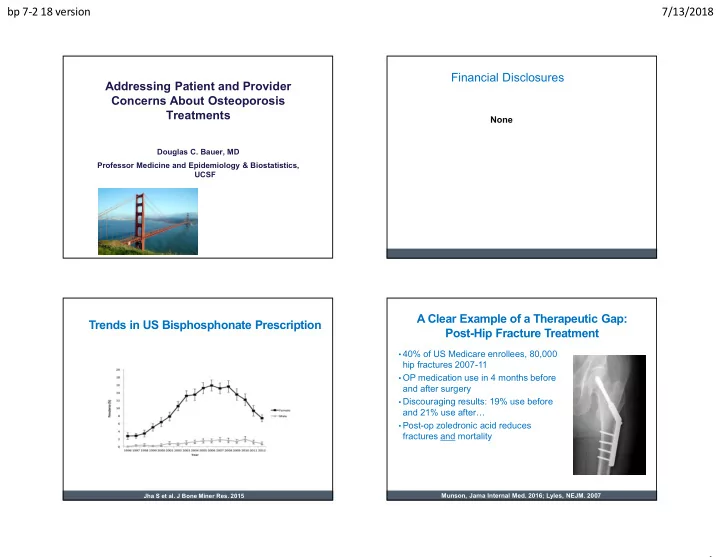
Trends in US Bisphosphonate Prescription

Jha S et al. J Bone Miner Res. 2015

A Clear Example of a Therapeutic Gap: Post-Hip Fracture Treatment

  • 40% of US Medicare enrollees, 80,000

hip fractures 2007-11

  • OP medication use in 4 months before

and after surgery

  • Discouraging results: 19% use before

and 21% use after…

  • Post-op zoledronic acid reduces

fractures and mortality

Munson, Jama Internal Med. 2016; Lyles, NEJM. 2007

slide-2
SLIDE 2

bp 7-2 18 version 7/13/2018 2

Another Therapeutic Gap and Memorable Case

  • 65 yr. old white female followed for decades with HTN

(Hctz), eczema (topical steroids) and glucose intolerance

  • Osteoporotic BMD (fnBMD -2.6, spineBMD -2.8)
  • Uneventful menopause age 52, no other risk factors.

Adequate dietary calcium intake. No previous fracture.

  • Labs and vitamin D level normal
  • Discussed treatment options, agreed to weekly ALN
  • Briefly discussed both common (GI) and uncommon (ONJ,

AFF) side effects

  • Seen regularly over next two years, medications refilled

Another Therapeutic Gap and Memorable Case

  • Sudden onset severe thoracic back pain while picking up

grandchild

  • X-rays: severe T8 wedge fracture.
  • When asked about medication compliance:

“I had some stomach upset and read that Fosamax had bad side effects, so I stopped it after a month or so. …” “I did not want to disappoint you so I did not tell you…”

Who is Responsible for the Therapeutic Gap?

  • Providers, patients and health system (payers) all contribute
  • Key factors for primary care providers:
  • Lack of awareness and competing priorities
  • Complex and conflicting guidelines
  • Key factors for patients:
  • Under estimation of personal risk and consequences
  • Uncertainty about drug efficacy
  • Media-fueled fears about drug side effects

National Osteoporosis Foundation Survey, 2017

Quantitative Assessment of Benefits and Risks

  • f Osteoporosis Treatment

Short-term treatment (3-5 years)

  • Benefits (fracture reductions)
  • Risks (ONJ, AFF)
  • Benefits vs. risk

Focus on Anti-resorptives (esp. BP’s)

slide-3
SLIDE 3

bp 7-2 18 version 7/13/2018 3

Summary of Bisphosphonate Fracture Reductions (up to 5 Years)

Khosla S, et al. JCEM, 2012;

Also reductions ~25% in non-vertebral fractures

Zoledronic acid Zoledronic acid

Black, Rosen. NEJM 1/16; **Khosla, JBMR 9/16

NNT and Fractures Prevented for 3 Years of BP (or Dmab) Treatment

Compare to 3 years of statin to prevent one major cardiovascular event: NNT= 95

Black NEJM 2016; Khosla JCEM 2012

g

Among older women with prevalent VF or T-score<-2.5

12

Possible Harms of Osteoporosis Therapy

Potential BP harms: Less impactful

  • GI intolerance
  • Ophthalmologic, renal effects, acute phase reaction
  • Atrial fibrillation and esophageal cancer

Potential BP harms: More impactful

  • Osteonecrosis of the jaw (ONJ)
  • Atypical femur fractures (AFF)

*

“Bisphosphonates might lead to jawbone death in patients who have dental surgery” New York Times, 2009

slide-4
SLIDE 4

bp 7-2 18 version 7/13/2018 4

Bisphosphonates and ONJ: Summary

  • Very rare in osteoporosis patients (about 4-6 per 10,000 py

in BP users)

  • Higher in oncology use (higher doses, other factors)
  • Little evidence that doses used for osteoporosis increase

risk of ONJ

  • If so, very low risk
  • 2012 American Dental Association report (Hellstein et al)

has helped to decrease concerns in U.S.

  • Etiology/mechanism remains uncertain

Kahn, JBMR 2015; Hellstein, ADA 2012

Morphologic Characteristics of Atypical Femur Fracture (AFF)

Khosla 2012 (photo: Dr. M. Rosenwasser, Columbia U)

Khosla 2012 (photo: Dr. M. Rosenwasser, Columbia U)

Summary of 2014 ASBMR Case Definition for Atypical Femur Fracture

  • Location along femoral diaphysis (between LT and DMF)

and

  • Meets >4 of 5 Major Criteria
  • Minimal or no trauma
  • Fracture line from lateral cortex & transverse, may be oblique across

femur

  • Complete fractures thru both cortices; incomplete fx lateral cortex
  • Non- or minimally comminuted
  • Localized reaction in lateral cortex
  • Minor Criteria (may be present)
  • Increased cortical thickness (generalized)
  • Prodromal symptoms (pain in thigh/groin)
  • Bilateral
  • Delayed healing

Shane, et. al. JBMR, 2010/2014

slide-5
SLIDE 5

bp 7-2 18 version 7/13/2018 5

Evidence Linking Osteoporosis Treatment to AFF

1) Case Reports and Case Series (from 2007) 2) Observational/epidemiologic studies (Canada,

Denmark, US, Sweden, other countries)

  • Case-control studies
  • Cohort studies
  • Most use ICD codes, did not have x-rays
  • Problematic comparitors

3) A bit of data from RCT’s (too small for rare events)

  • 2013: Meta-analysis of bisphosphonates and atypical

fracture (Gedmintas, JBMR, 2013)

*Black, et al Endo Reviews e pub 7/2018

Two Important Cohort Studies for Risks vs. Benefits over 3-5 Years BP Treatment 1) Swedish study (Schilcher) 2) Kaiser Northwest, U.S. (Feldstein) Both:

  • Reviewed individual x-rays from fracture patients
  • Large, population-based with good pharmacy records

Helpful to assess:

  • Incidence of AFF
  • Relative risk of BP use and AFF

Feldstein, et al. JBMR 2012; Schilcher, NEJM 2014

  • All hip/femur fractures in Sweden (Nat’l

Reg) 2008-2010

  • Review X-rays for AFF:
  • Subtrochanteric or femoral shaft
  • ICD-10 (S722 and S723)
  • ASBMR 2014 criteria
  • Link to pharmaceutical register (start

2005, 3-5 yrs only)

Schilcher et al, NEJM 5/11; Schilcher et al, NEJM (ltr), 2014; Schilcher et al Acta Ortho, 2015

Swedish Study of Bisphosphonates and Atypical Fracture (2011, 2014 update) Incidence of AFF from Swedish Study

  • ~3 million Swedish men and women > age 55
  • ~50,000 proximal femur fractures in 2008-10
  • ~5500 subtroch or femoral shaft (ST/FS) x-rays reviewed

using ASBMR 2014 criteria

  • 172 confirmed atypical femur fractures

Schilcher et al, NEJM 5/11; Schilcher et al, NEJM (ltr), 2014; Schilcher et al Acta Ortho, 2015

172 AFF (out of 50,000 femur fractures)

slide-6
SLIDE 6

bp 7-2 18 version 7/13/2018 6

1000 Hip/Femur Fractures

110 ICD-coded ST/FS*

3.4 AFF’s

How Common are AFFs Among All Femur Fractures in Swedish Data?

Taken from Schilcher, NEJM 2014 *ST/FS: subtroch or femoral shaft

24

Black, Rosen. NEJM 1/16

Black et al. Endo Reviews In Press

25

Incidence of AFF’s: Number of AFF’s per 1000 Hip Fracture

  • Swedish and Kaiser Northwest are the only

published population-based studies with x-ray confirmation (using ASBMR criteria)

  • Incidence in both studies is about 4 AFF per 1000

hip fractures

  • Consistent with other population-based studies

Feldstein, et al. JBMR 2012; Schilcher, NEJM 2014

Meta-analysis of BP Use and ST/FS or AFF: 13 ‘Case-control’ and ‘Cohort’ Studies

*Gedmintas L, et al J Bone Miner Res. 2013

1.70 (1.22 to 2.37) Gedmintas L, J Bone Miner Res. 2013

slide-7
SLIDE 7

bp 7-2 18 version 7/13/2018 7

Benefits vs. Risks for 3 Years of BP Therapy in 1000 Osteoporotic Women

Black DM, Rosen CJ. N Engl J Med 2016;374:254-262.

30

Summary: If One Treats 1000 Osteoporotic Women for 3 Years Benefits: Prevent 100 fractures including 11 hip fx Harms: ‘Cause’ 0.08 AFF Put another way, For every 1000 fractures prevented, 1 AFF caused

Black, Rosen. NEJM 1/16

31

Benefits for osteoporosis treatment far outweigh any risks, even allowing for some risk of AFF BUT

Simply quoting statistics to patients without carefully listening and addressing their concerns is not going to work…

Osteoporosis Treatment 3-5 years: the Bottom Line

32

  • Can we predict AFF risk and avoid BPs in

certain populations?

  • Geometry: neck-shaft angle,

cortical thickness differ in some

  • studies. Asian populations?

Weak associations…

  • Genetic: geranylgeranyl

diphosphate synthase (GGPS1) mutations in 3 sisters with AFF. Rare variants…

  • Unlikely to be clinically useful

What Else Can Be Done to Reassure Patients?

Mahjoub, JBMR 2016; Roca-Ayats et al. NEJM 2017

slide-8
SLIDE 8

bp 7-2 18 version 7/13/2018 8

33

  • Likely that AFF begin as stress fractures.

Can we find potential AFF before they

  • ccur?
  • Prodromal pain: Common but no good data

yet on prevalence or utility of systematic assessments.

  • - Monitoring for preclinical abnornalities:
  • No reliable serum biomarkers to date
  • X-ray surveillance impractical
  • DXA?

What Else Can Be Done to Reassure Patients?

GE LUNAR SOFTWARE FOR AFF DETECTION

Early Reports of Femur Imaging in BP Users

  • 257 Irish patients, BP therapy > 5 yr
  • Extended femur scan at the time of routine DXA
  • Abnormal DXA images (e.g., “flaring”, “beaking”)

suggested in 19 (7.4%)

  • Radiographic evaluation:

7 had no abnormality 5 with unrelated radiographic abnormality 7 (2.7%) incomplete AFF (2 with thigh pain)

McKenna, J Clin Densitometry 2013

slide-9
SLIDE 9

bp 7-2 18 version 7/13/2018 9 Important Caveats

  • Population data on clinical AFFs indicate a far lower

prevalence, at worst in the range of 0.13% to 0.22%

  • Abnormal scans must be confirmed and most will be

false positives

  • Many (majority?) with radiographic changes consistent

with partial or incomplete AFF may not progress to AFFs

  • Nonetheless, serial femur imaging might identify a

potentially high risk sub-group for more extensive imaging and consideration of drug discontinuation

Min et al. JCEM 102:545, 2016

38

Help Is On the Way to Improve Patient Acceptance…

  • Multi-stakeholder Initiative with Center for Medical

Technoloigy Policy (CMTP): Will identify key barriers, develop strategic options and a plan for dissemination and implementation.

  • NIH Office of Disease Preventition: Objective, external

review of current science related to fracture prevention and important knowledge gaps. 10/18 meeting

  • ASBMR Call to Action: 37 organizations pledging to

intensify efforts to increase the screening, diagnosis and treatment of high-risk individuals…

Organizations That Have Pledged to Increase Efforts for the Call to Action

  • American Society for Bone and Mineral Research
  • American Academy of Orthopaedic Surgeons
  • American Academy of Physician Assistants
  • American Association of Clinical Endocrinologists
  • American Bone Health
  • American College of Rheumatology
  • American Medical Society for Sports Medicine
  • American Orthopaedic Association
  • American Osteopathic Academy of Orthopedics
  • American Society for Surgery of the Hand
  • Australia New Zealand Bone and Mineral Society
  • Bulgarian Society of Osteoporosis and Osteoarthritis
  • Czech Society for Metabolic Bone Diseases
  • Dutch Society of Cancer and Bone Metabolism
  • European Calcified Tissue Society
  • European Union Geriatric Medicine Society
  • Finnish Osteoporosis Association
  • Georgian Association of Skeletal Metabolism Diseases
  • Hellenic Osteoporosis Foundation
  • International Geriatric Fracture Society, Inc.
  • International Osteoporosis Foundation
  • International Society for Clinical Densitometry
  • Michigan Consortium for Osteoporosis
  • National Bone Health Alliance (US)
  • National Osteoporosis Foundation (US)
  • National Osteoporosis Society (UK)
  • Northern California Institute for Bone Health, Inc.
  • Orthopaedic Research and Education Foundation
  • Orthopedic Research Society
  • Orthopedic Trauma Association (US)
  • Osteoporosis Australia
  • Osteoporosis Canada
  • Osteoporosis New Zealand
  • Syrian National Osteoporosis Society
  • University of Rochester Department of Orthopaedics and

Rehabilitation

  • U.S. Bone and Joint Initiative
  • 4BoneHealth

Summary: Addressing Concerns about Osteoporosis Treatments

  • Patient and provider education
  • Emphasize clear knowledge base about initiating treatment:

−Who to treat and the benefits from treatment

  • Develop better messages to counter misleading perceptions

about balance of risks vs. benefits of osteoporosis treatment

  • More research and consensus:
  • Optimal duration and drug holidays

−Clarify association with BP use

  • Identification of clinical and biologic

risk factors for AFF

  • Test utility of serial femur imaging
slide-10
SLIDE 10

bp 7-2 18 version 7/13/2018 10

Thanks for Listening! Questions or Comments?