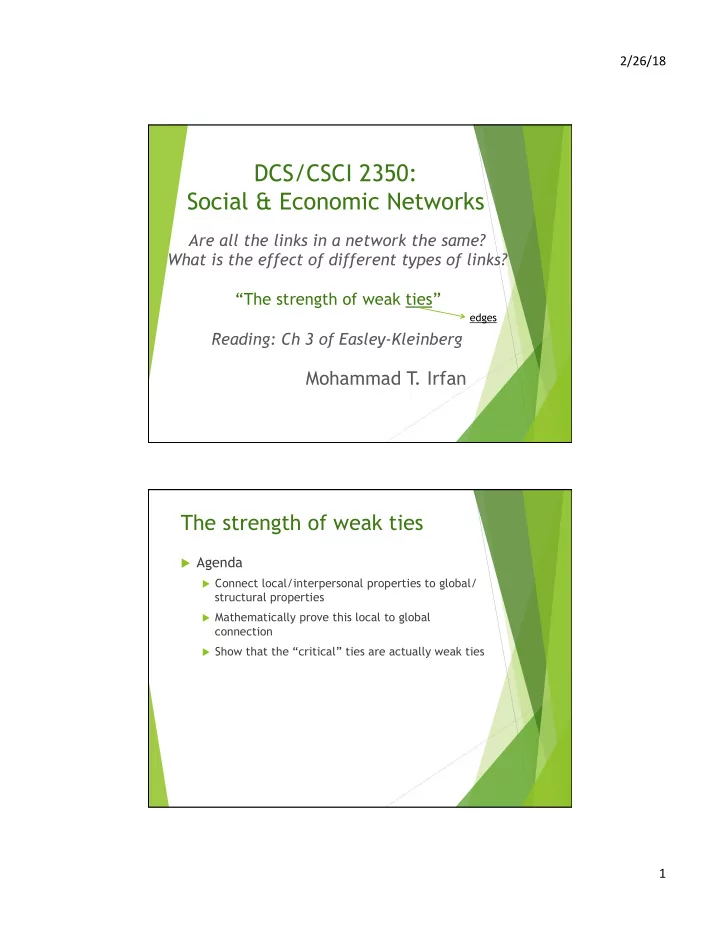
DCS/CSCI 2350: Social & Economic Networks Are all the links in a - - PDF document

dcs csci 2350 social economic networks
SMART_READER_LITE
LIVE PREVIEW

DCS/CSCI 2350: Social & Economic Networks Are all the links in a - - PDF document

2/26/18 DCS/CSCI 2350: Social & Economic Networks Are all the links in a network the same? What is the effect of different types of links? The strength of weak ties edges Reading: Ch 3 of Easley-Kleinberg Mohammad T . Irfan The


slide-1
SLIDE 1

2/26/18 1

DCS/CSCI 2350: Social & Economic Networks

Are all the links in a network the same? What is the effect of different types of links? “The strength of weak ties” Reading: Ch 3 of Easley-Kleinberg

Mohammad T . Irfan

edges

The strength of weak ties

u Agenda

u Connect local/interpersonal properties to global/

structural properties

u Mathematically prove this local to global

connection

u Show that the “critical” ties are actually weak ties

slide-2
SLIDE 2

2/26/18 2

Granovetter’s study (1960s)

u Acquaintances, not friends, hold critical

information about job opportunities

Triadic closure

A B C B and C are very likely to become friends (Rapoport, 1953) u Triadic closure increases clustering coeff. (why?) u Reasons why triadic closure happens

1.

Opportunity for B and C to meet

2.

B and C can trust each other

3.

A wants to reduce stress by making B and C friends

u Teen suicide <-> low (local) clustering coefficient

(Bearman and Moody, 2004)

slide-3
SLIDE 3

2/26/18 3

Local bridge

u An edge whose endpoints do

not have any common friend

ó An edge which is not a side of

any triangle

ó An edge whose deletion

causes the distance between its endpoints to be > 2

Next: under some condition, every local bridge must be a “weak” tie

  • Q1. Are local bridges important? Why?
  • Q2. Is local bridge a local or a global property?

Background for proving local bridges are weak ties

u Tie-strength (simplifying gradation, temporal

effect, etc.)

u Weak (acquaintance) u Strong (friend)

u Strong Triadic Closure Property (STCP)

(Granovetter, 1973)

  • Q. Is tie-strength a local or a global property?

Definition.

Node-level property

slide-4
SLIDE 4

2/26/18 4

The strength of weak ties

u If a node A satisfies STCP and has at least 2

strong ties, then any local bridge it's involved in must be a weak tie.

u Proof.

Large-scale social networks (real-world) and the strength of weak ties

slide-5
SLIDE 5

2/26/18 5

Weak ties in Facebook (Marlow et al., 2009)

Colleagues High school friends

Weak ties in Facebook (cont...)

slide-6
SLIDE 6

2/26/18 6

Weak ties (passive network) – What’s the use?

Twitter (Huberman et al., 2009)

slide-7
SLIDE 7

2/26/18 7

Are weak ties really powerful?

Gladwell: “weak ties seldom lead to high-risk activism”

Counter-argument

slide-8
SLIDE 8

2/26/18 8

Counter-argument Counter-argument

slide-9
SLIDE 9

2/26/18 9

Other Examples?

Community detection in social networks using local bridges

Section 3.6 (Advanced)

slide-10
SLIDE 10

2/26/18 10

Coauthorship network (Newman- Girvan, 2004)

Idea

u Delete local bridges one after another u Get connected components

u close-knit communities

u Divisive graph partitioning

(as opposed to agglomerative)

slide-11
SLIDE 11

2/26/18 11

But… which local bridge to delete first? Also… what if there’s no local bridge?

Need some form of “betweenness” measure for the edges!

slide-12
SLIDE 12

2/26/18 12

Solution: Girvan-Newman algorithm (2002)

u Calculate the betweenness of each edge u Successively delete the edge(s) with the highest

betweenness (and recalculate betweenness)

  • Q. When should we stop?

Betweenness of an edge

u Every node is sending 1 gallon of water to

every other node (total n-1 gallons)

u Water will only flow through the shortest

paths

u Equally distributed among multiple shortest paths

u Betweenness of an edge

= Quantity of water flowing through it

slide-13
SLIDE 13

2/26/18 13

How to compute the betweenness of an edge?

slide-14
SLIDE 14

2/26/18 14

A B C D E F G H

Algorithm

(A) For each node X do the following:

1.

Do BFS starting with X

2.

Calculate the # of S.P . from X to every other node

3.

Calculate the quantity of water flow through each edge

(B) Betweenness of an edge = sum of all water flow through that edge (i.e., sum over all the BFS)

BFS starting at node A

A B C D E F G H BFS needs to be done starting at each node (not just node A)! Note: Showing all the edges; it's not BFS tree!

slide-15
SLIDE 15

2/26/18 15

# of S.P . from A to every node

A B C D E F G H This is the # of S.P . from A to G, not distance from A to G 1 1 1 2 1 3 3 Formula: # of S.P . from A to E = Sum of the # of S.P . from A to each friend of E in the previous level

Calculate water flow on each edge

A B C D E F G H 1 1 1 2 1 3 3 Node A has sent 1 gallon of water to every other node. Water flows only on S.P .– splits evenly on multiple S.P .

2/3 gal. 1/3 gal.

Why? Bottom-up calculation of water flow

slide-16
SLIDE 16

2/26/18 16

Calculate water flow on each edge

A B C D E F G H 1 1 1 2 1 3 3 Node A has sent 1 gallon of water to every other node. Water flows only on S.P .– splits evenly on multiple S.P .

2/3 gal. 1/3 gal.

Calculate water flow on each edge

A B C D E F G H 1 1 1 2 1 3 3 Node A has sent 1 gallon of water to every other node. Water flows only on S.P .– splits evenly on multiple S.P .

2/3 gal. 1/3 gal. 2/3 gal. 1/3 gal. 7/6

  • gal. 7/6

gal. 5/3 gal. 13/6 gal. 23/6 gal. 1 gal. Why 7/6 gal from D to E?

  • Ans. E consumes 1 gallon and

passes 2/3 + 2/3 = 4/3 gallons below it. So, E needs a supply

  • f 1 + 4/3 = 7/3 gallons, which

is split evenly into two S.P . from A to E.

We are not done yet! For each edge, we need to sum up the water flow from each and every BFS.

slide-17
SLIDE 17

2/26/18 17

Karate club (Zachary, 1977)