
SLIDE 1
11/13/19 1
DCS/CSCI 2350: Social & Economic Networks
Matching Markets
Readings: Ch. 10 of EK & Handout for stable marriage
Mohammad T . Irfan
1 2
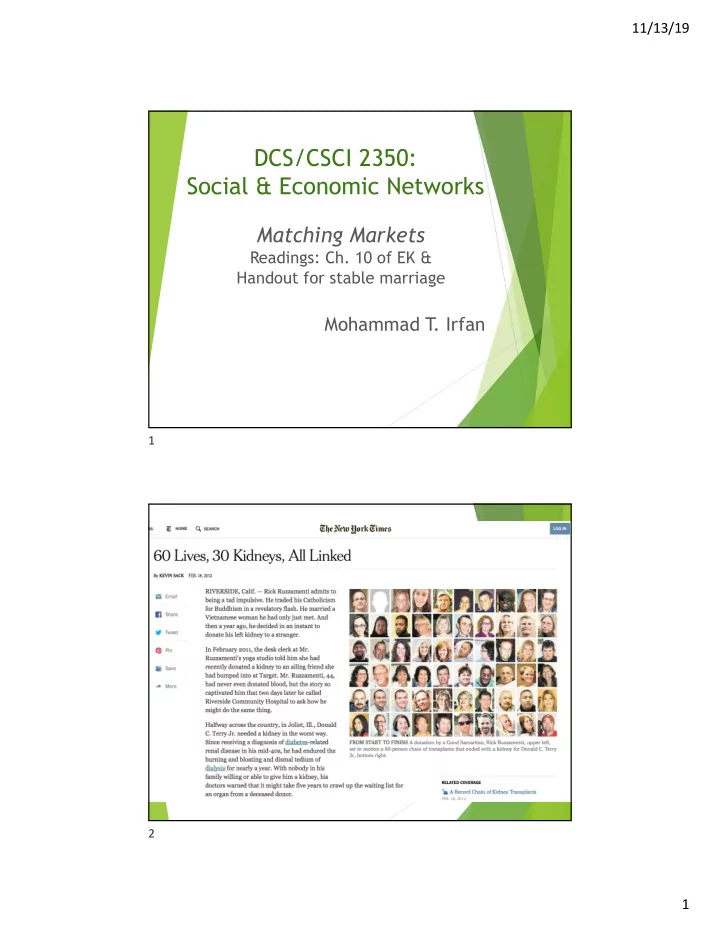
DCS/CSCI 2350: Social & Economic Networks Matching Markets - - PDF document
11/13/19 DCS/CSCI 2350: Social & Economic Networks Matching Markets Readings: Ch. 10 of EK & Handout for stable marriage Mohammad T . Irfan 1 2 1 11/13/19 Alvin Roth Nobel Prize 2012 3 Lloyd Shapley Nobel Prize 2012 4 2
1 2
3
4
u Given n men and n women, where each man
u Stable matching: no pair X and Y (not
u Such X & Y: "blocking pair"
u Perfect matching
u Everyone is matched (monogamous) u Necessary condition: # men = # women
5
u Yes, Gale-Shapley algorithm (1962) [On board]
6
u http://mathsite.math.berkeley.edu/smp/sm
8
u Thm 1.2.1. The algorithm terminates with a
u Thm 1.2.2. Men-proposing version is men-
u Thm 1.2.3. Men proposing version is the worst
9
11
12
13
u Around 80K 8-th graders are matched to
u Each student ranks at most 12 schools u Schools rank applicants
u 'But schools continue to tell parents and students
— “with a wink” — that they may be penalized if they don't list their school first.' (https://www.dnainfo.com/new- york/20161115/kensington/nyc-high-school- admissions-ranking) u Match by DOE
14
16
18
Each link: The room is “acceptable” by the student
19
u Choice of edges in the
Dark edges are the chosen edges—also known as the assignment
20
A bipartite graph One perfect matching Another perfect matching
21
u A set of nodes S is constricted if
u |N(S)| < |S|
u Constricted set è Perfect
u Reverse is also true!
S N(S)
22
u Gives a characterization of perfect matching u A bipartite graph (with equal numbers of
23
u Each student has a valuation for each room u Find a perfect matching that maximizes the
u Social welfare = sum of the valuations
26
u Many different perfect matchings:
Alice 70, 20, 30 Bob 60, 20, 0 Cindy 50, 40, 10 Room 1 Room 2 Room 3
Social welfare = 130
30 60 40
Social welfare = 100
70 20 10
How to find a perfect matching that maximizes the social welfare? Optimal assignment
Social welfare = 110
70 40
27
28
u n sellers, each is selling a house
u pi = price of seller i’s house
u n buyers
u vij = buyer j’s valuation of seller i’s house (or house i) u (vij – pi) is buyer j’s payoff if he buys house i
u Assumption: buyers are not stupid
u Maximize their payoffs u Maximum payoff must also be >= 0
u Preferred seller graph
u Bipartite graph between buyers and sellers where
every edge encodes a buyer’s maximum payoff (>= 0)
29
u A perfect matching in the preferred seller
u Market clearing prices (MCP): The set of prices at
which we get a perfect matching u It would be awesome if the perfect matching
u Maximizes social welfare (i.e., sum of the buyers’
valuations in that assignment)
30
u Show: Any MCP gives an optimal assignment u Does an MCP always exist?
u Constructive proof (by an algorithm)
31 32
u MCP: prices for which there exists a perfect
u Algorithm
1.
Initialize prices to 0
2.
Buyers react by choosing their preferred seller(s)
3.
If resulting graph has a perfect matching then done! Otherwise, the neighbors of a constricted set increase price by 1 unit; (Normalize the prices—by decreasing all prices by the same amount so that at least one price is 0); Go to step 2 u MCP maximizes each buyer's payoff as well
33
u Single-item auction is a matching market!
34