DCS/CSCI 2350: Social & Economic Networks Games and game theory: - - PDF document

dcs csci 2350 social economic networks
SMART_READER_LITE
LIVE PREVIEW

DCS/CSCI 2350: Social & Economic Networks Games and game theory: - - PDF document

4/10/16 DCS/CSCI 2350: Social & Economic Networks Games and game theory: A brief introduction Reading: Ch. 6 of EK Mohammad T . Irfan Game Theory u Game u Ernst Zermelo (1913): In any chess game that does not end in a


slide-1
SLIDE 1

4/10/16 ¡ 1 ¡

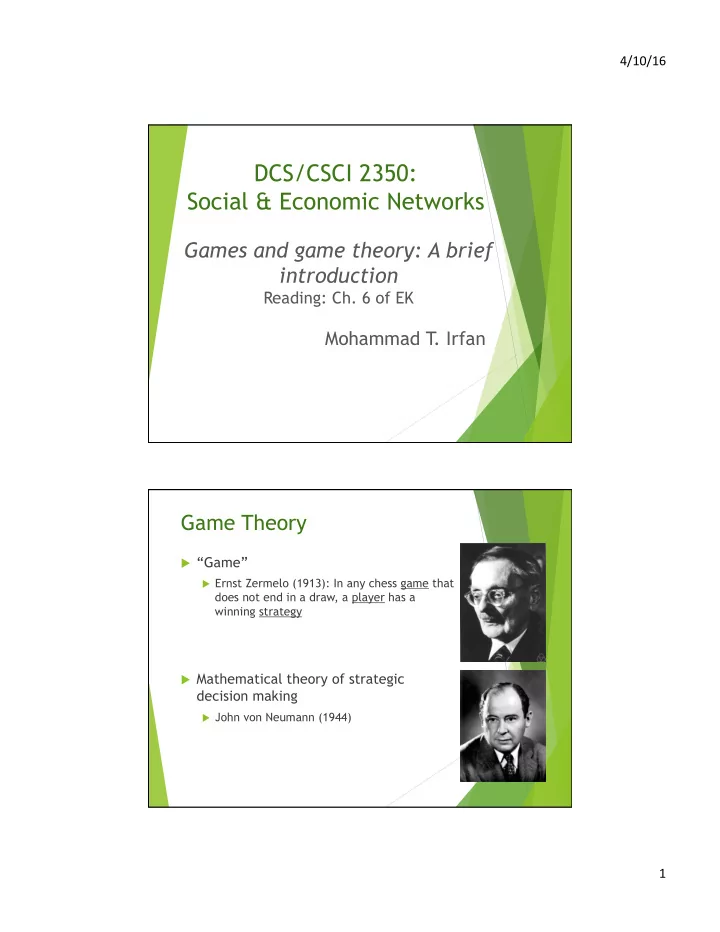
DCS/CSCI 2350: Social & Economic Networks

Games and game theory: A brief introduction

Reading: Ch. 6 of EK

Mohammad T . Irfan

Game Theory

u “Game”

u Ernst Zermelo (1913): In any chess game that

does not end in a draw, a player has a winning strategy u Mathematical theory of strategic

decision making

u John von Neumann (1944)

slide-2
SLIDE 2

4/10/16 ¡ 2 ¡

Example: Split or Steal

u https://www.youtube.com/watch?

v=yM38mRHY150

u Rules of the game u Outcome

One possible model

u What will happen? Payoff matrix

Split Steal Split

$33K, $33K $0+fr., $66K

Steal

$66K, $0+fr. $0, $0

Lucy Tony

slide-3
SLIDE 3

4/10/16 ¡ 3 ¡

Payoff matrix

Split Steal Split

$33K, $33K $0+fr., $66K

Steal

$66K, $0+fr. $0, $0

Why did they end up with 0?

Lucy Tony

Nash Equilibrium

Everyone plays his/her best response simultaneously

John F . Nash Nobel Prize, 1994

Nash equilibrium

Practical scenarios = Stable outcome = Nash equilibrium

slide-4
SLIDE 4

4/10/16 ¡ 4 ¡

Applications

u Application: market equilibria

u Predict where the market is heading to

u Mechanism design for the Internet

u Google and Yahoo apply game-theoretic techniques

u Auctions

u Example– spectrum allocation

7

Other Applications

u Understanding the Internet

u Selfish routing is a constant-factor off from

  • ptimal

u Load balancing and resource allocation u p2p and file sharing systems u Cryptography and security u Social and economic networks u Many other …

8

slide-5
SLIDE 5

4/10/16 ¡ 5 ¡

Next: Formal discussion

Game

u One-shot games (simultaneous move) u 3 components

u Players u Strategies/actions u Payoffs

Payoff matrix

Split Steal Split

$33K, $33K $0+fr., $66K

Steal

$66K, $0+fr. $0, $0

Tony Lucy

Call these pure strategies Pure-strategy NE

slide-6
SLIDE 6

4/10/16 ¡ 6 ¡

Famous example: prisoner's dilemma

u What will they do? Payoff matrix

Not Confess Confess Not Confess

  • 1, -1
  • 10, 0

Confess

0, -10

  • 5, -5

Suspect 1 Suspect 2

Assumptions

u Payoffs reflect player’s preference u Payoffs are known to all u Actions are known to all (different players

could have different actions– but everyone knows everyone’s actions)

u Each player wants to maximize own payoff

slide-7
SLIDE 7

4/10/16 ¡ 7 ¡

Solution concepts

Best response

u Best strategy of a player, given the other

players’ strategies

u Always exists!

slide-8
SLIDE 8

4/10/16 ¡ 8 ¡

(Strictly) dominant strategy

u A strategy of a player that is (strictly) better

than any of his other strategies, no matter what the other players do

u Does not always exist

Nash equilibrium (NE)

u A joint strategy (one strategy/player) s.t.

each player plays his best response to others simultaneously

u (Equiv.) A joint strategy s.t. no player gains

by deviating unilaterally

slide-9
SLIDE 9

4/10/16 ¡ 9 ¡

Pure-strategy Nash equilibrium

u Players do not use any probability in choosing

strategies as they do in "mixed-strategy" (to be covered later)

Quiz

u What is the difference between a dominant

strategy and a best response?

slide-10
SLIDE 10

4/10/16 ¡ 10 ¡

Quiz

u Here’s a clip from the movie A Beautiful

Mind that “tries to” portray John Nash’s discovery of Nash equilibrium.

u Is this actually a Nash equilibrium?

Misconceptions

u Equilibrium signifies a tie/draw/balance u Equilibrium outcome is the best possible

  • utcome for all players (A Beautiful Mind)

u Self-interested players want to hurt each

  • ther
slide-11
SLIDE 11

4/10/16 ¡ 11 ¡

Questions

u Does NE always exist? (Answer later ...) u If it exists, is it unique? (Next)

Games with multiple NE

  • 1. Coordination game/battle of the sexes
  • 2. Stag hunt game (coordination)
  • 3. Hawk-dove game (anti-coordination)
slide-12
SLIDE 12

4/10/16 ¡ 12 ¡

Does NE always exist? Mixed-strategy NE

  • 1. Normandy Landing
  • 2. Matching pennies game

Can there be both pure- strategy and mixed- strategy NE?

Hawk-dove game

slide-13
SLIDE 13

4/10/16 ¡ 13 ¡

More on mixed-strategy NE

Penalty kick game What does playing mixed strategy mean?

Penalty kick game

29

slide-14
SLIDE 14

4/10/16 ¡ 14 ¡

Penalty kick game (continued)

30

Penalty kick game (continued)

31

slide-15
SLIDE 15

4/10/16 ¡ 15 ¡

Penalty Kick Game- Equilibrium

u E[GK plays Left] = p(1) + (1-p)(-1) = 2p – 1 u E[GK plays Right] = p(-1) + (1-p)(1) = 1 – 2p u 2p – 1 = 1 – 2p è p = ½ u Similarly, q = ½ u “Professionals Play Minimax”- Ignacio Palacios-Huerta

32

Left (q) Right (1- q) Left (p) -1, +1 +1, -1 Right (1- p)

+1, -1 -1, +1

Goalkeeper Shooter

Zero-sum Game

Penalty kick game (real-world)

Left (0.42) Right (0.58) Left (0.38)

0.58, 0.42 0.95, 0.05

Right (0.62)

0.93, 0.07 0.70, 0.30

Shooter Goalkeeper

Equilibrium probabilities match real-world probabilities from data!

slide-16
SLIDE 16

4/10/16 ¡ 16 ¡

What does mixed strategy mean?

u Active randomization – tennis, soccer u Proportion interpretation – evolutionary

biology

u Probabilities of player 1 are the belief of

player 2 about what player 1 is doing (Bob Aumann)

u Misconception

u Players just choose probabilities

u Correct

u players play pure strategies selected according to

these probabilities

Von Neumann’s Theorem (1928)

u Every finite 2-person zero-sum game has a

mixed equilibrium John von Neumann (1903 – 1957)

35

slide-17
SLIDE 17

4/10/16 ¡ 17 ¡

Theorem of Nash (1950)

u Every finite game has an equilibrium in

mixed strategies John F . Nash (1928 – 2015) Nobel Prize, 1994

36

Other solution concepts

u Socially optimal solution

u Joint strategy that maximizes the sum of payoffs u The sum of payoffs is called social welfare

u Pareto-optimal solution

u A joint-strategy such that there is no other

strategy where (1) everyone gets payoff at least as high (2) at least one player gets strictly higher payoff u None of the above might be NE

(Extremely rarely they are NE)