Day 3 ! " 5 slide synopsis of last lecture A: Sequence + - - PDF document

day 3
SMART_READER_LITE
LIVE PREVIEW

Day 3 ! " 5 slide synopsis of last lecture A: Sequence + - - PDF document

Day 3 ! " 5 slide synopsis of last lecture A: Sequence + structure " Covariance Models (CMs) represent conserved RNA sequence/structure motifs " B: the CM guide tree " They allow accurate search " C: probabilities


slide-1
SLIDE 1

Day 3!

5 slide synopsis of last lecture

"

Covariance Models (CMs) represent conserved RNA sequence/structure motifs" They allow accurate search" But " "a) search is slow" "b) model construction is laborious"

56 57

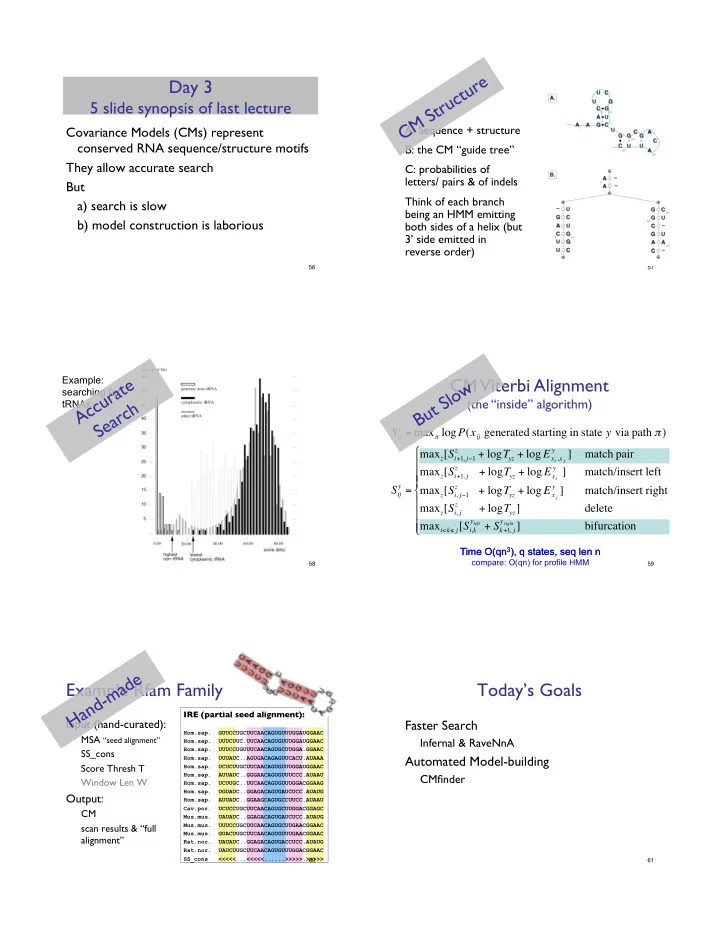
A: Sequence + structure" B: the CM “guide tree”" C: probabilities of letters/ pairs & of indels" Think of each branch being an HMM emitting both sides of a helix (but 3’ side emitted in reverse order)"

Example: searching for tRNAs

58

Sij

y = max" logP(xij generated starting in state y via path ")

Sij

y =

maxz[Si+1, j#1

z

+ logTyz + log Exi ,x j

y

] match pair maxz[Si+1, j

z

+ logTyz + log Exi

y ]

match/insert left maxz[Si, j#1

z

+ logTyz + log Ex j

y ]

match/insert right maxz[Si, j

z

+ logTyz] delete maxi<k$ j[Si,k

yleft + Sk+1, j yright ]

bifurcation % & ' ' ' ( ' ' '

Time O(qn3), q states, seq len n

59

CM Viterbi Alignment!

(the “inside” algorithm)"

Time O(qn3), q states, seq len n

compare: O(qn) for profile HMM IRE (partial seed alignment):!

Hom.sap. GUUCCUGCUUCAACAGUGUUUGGAUGGAAC Hom.sap. UUUCUUC.UUCAACAGUGUUUGGAUGGAAC Hom.sap. UUUCCUGUUUCAACAGUGCUUGGA.GGAAC Hom.sap. UUUAUC..AGUGACAGAGUUCACU.AUAAA Hom.sap. UCUCUUGCUUCAACAGUGUUUGGAUGGAAC Hom.sap. AUUAUC..GGGAACAGUGUUUCCC.AUAAU Hom.sap. UCUUGC..UUCAACAGUGUUUGGACGGAAG Hom.sap. UGUAUC..GGAGACAGUGAUCUCC.AUAUG Hom.sap. AUUAUC..GGAAGCAGUGCCUUCC.AUAAU Cav.por. UCUCCUGCUUCAACAGUGCUUGGACGGAGC Mus.mus. UAUAUC..GGAGACAGUGAUCUCC.AUAUG Mus.mus. UUUCCUGCUUCAACAGUGCUUGAACGGAAC Mus.mus. GUACUUGCUUCAACAGUGUUUGAACGGAAC Rat.nor. UAUAUC..GGAGACAGUGACCUCC.AUAUG Rat.nor. UAUCUUGCUUCAACAGUGUUUGGACGGAAC SS_cons <<<<<...<<<<<......>>>>>.>>>>>

Example Rfam Family"

Input (hand-curated):"

MSA “seed alignment”" SS_cons" Score Thresh T" Window Len W"

Output:"

CM" scan results & “full alignment”"

60

Today’s Goals "

Faster Search"

Infernal & RaveNnA"

Automated Model-building"

CMfinder"

61

slide-2
SLIDE 2

Homology search "

Sequence-based"

Smith-Waterman" FASTA" BLAST"

Sharp decline in sensitivity at ~60-70% identity" So, use structure, too"

64

Impact of RNA homology search"

  • B. subtilis
  • L. innocua
  • A. tumefaciens
  • V. cholera
  • M. tuberculosis

(and 19 more species)

  • peron

glycine riboswitch

(Barrick, et al., 2004)

65

Impact of RNA homology search"

  • B. subtilis
  • L. innocua
  • A. tumefaciens
  • V. cholera
  • M. tuberculosis

(Barrick, et al., 2004)

(and 19 more species)

  • peron

glycine riboswitch (and 42 more species)

(Mandal, et al., 2004)

BLAST-based CM-based

66

Faster Genome Annotation !

  • f Non-coding RNAs !

Without Loss of Accuracy"

Zasha Weinberg "

& W.L. Ruzzo"

Recomb ‘04, ISMB ‘04, Bioinfo ‘06"

RaveNnA: Genome Scale ! RNA Search "

Typically 100x speedup over raw CM, w/ no loss in accuracy: " " "Drop structure from CM to create a (faster) HMM"

"Use that to pre-filter sequence; "

"Discard parts where, provably, CM score < threshold;" "Actually run CM on the rest (the promising parts)" "Assignment of HMM transition/emission scores is key " " "(a large convex optimization problem)"

Weinberg & Ruzzo, Bioinformatics, 2004, 2006

69

CM’s are good, but slow!

EMBL CM hits junk Rfam Goal 1 month, 1000 computers Our Work ~2 months, 1000 computers EMBL CM hits Ravenna Rfam Reality EMBL hits junk BLAST CM

71

10 years, 1000 computers

slide-3
SLIDE 3

Covariance! Model"

Key difference of CM vs HMM: Pair states emit paired symbols, corresponding to base-paired nucleotides; 16 emission probabilities here.

72

Oversimplified CM!

(for pedagogical purposes only)"

A C G U – A C G U – A C G U – A C G U –

73

CM to HMM"

A C G U – A C G U – A C G U – A C G U – A C G U – A C G U – A C G U – A C G U –

CM HMM

74

25 emisions per state 5 emissions per state, 2x states

Need: log Viterbi scores CM ! HMM"

Key Issue: 25 scores " 10"

P

A C G U – A C G U –

L

A C G U – A C G U –

R CM HMM

75

Key Issue: 25 scores " 10"

Need: log Viterbi scores CM ! HMM"

PCA ! LC + RA PCC ! LC + RC PCG ! LC + RG PCU ! LC + RU PC– ! LC + R– … … … … … PAA ! LA + RA PAC ! LA + RC PAG ! LA + RG PAU ! LA + RU PA– ! LA + R–

NB: HMM not a prob. model

P

A C G U – A C G U –

L

A C G U – A C G U –

R CM HMM

77

Rigorous Filtering"

Any scores satisfying the linear inequalities give rigorous filtering! Proof: ! CM Viterbi path score ! ! “corresponding” HMM path score! ! Viterbi HMM path score !

(even if it does not correspond to any CM path)" PAA ! LA + RA PAC ! LA + RC PAG ! LA + RG PAU ! LA + RU PA– ! LA + R– …

78

slide-4
SLIDE 4

Some scores filter better"

PUA = 1 ! LU + RA" PUG = 4 ! LU + RG" " " " " " " Assuming ACGU # 25%" Option 1: " " " "Opt 1:" LU = RA = RG = 2 " " LU + (RA + RG)/2 = 4 " Option 2: " " " "Opt 2:" LU = 0, RA = 1, RG = 4 " LU + (RA + RG)/2 = 2.5"

79 83

Assignment of scores/ “probabilities” "

Convex optimization problem"

Constraints: enforce rigorous property" Objective function: filter as aggressively as possible"

Problem sizes: "

1000-10000 variables" 10000-100000 inequality constraints"

“Convex” Optimization "

Convex: ! local max = global max;" simple “hill climbing” works" Nonconvex:! can be many local maxima, ≪ global max;! “hill-climbing” fails"

84

Estimated Filtering Efficiency!

(139 Rfam 4.0 families)"

Filtering fraction" # families (compact)" # families (expanded)" < 10-4" 105" 110" 10-4 - 10-2" 8" 17" .01 - .10" 11" 3" .10 - .25" 2" 2" .25 - .99" 6" 4" .99 - 1.0" 7" 3"

~100x speedup

Averages 283 times faster than CM

# break even

85 87

Results: new ncRNAs (?) "

Name" # Known" (BLAST + CM)" # New" (rigorous filter + CM)"

Pyrococcus snoRNA" 57" 123" Iron response element" 201" 121" Histone 3’ element" 1004" 102*"

Retron msr" 11" 48" Hammerhead I" 167" 26" Hammerhead III" 251" 13" U6 snRNA" 1462" 2" U7 snRNA" 312" 1" cobalamin riboswitch " 170" 7"

13 other families" 5-1107" 0"

Heuristic Filters"

Rigorous filters optimized for worst case" Possible to trade improved speed for small loss in sensitivity?" Yes – profile HMMs as before, but optimized for average case" Often 10x faster, modest loss in sensitivity"

102

slide-5
SLIDE 5

Software "

Ravenna implements both rigorous and heuristic filters" Infernal (engine behind Rfam) implements heuristic filters and some other accelerations"

E,g., dynamic “banding” of dynamic programming matrix based on the insight that large deviations from consensus length must have low scores."

107

CM Search Summary "

Still slower than we might like, but dramatic speedup over raw CM is possible with:"

No loss in sensitivity (provably), or" Even faster with modest (and estimable) loss in sensitivity"

108

RNA Motif Discovery"

CM’s are great, but where do they come from?" An approach: comparative genomics"

Search for motifs with common secondary structure in a set of functionally related sequences."

Challenges"

Three related tasks"

Locate the motif regions." Align the motif instances." Predict the consensus secondary structure."

Motif search space is huge!"

Motif location space, alignment space, structure space."

115

RNA Motif Discovery "

Typical problem: given a 10-20 unaligned sequences of 1-10kb, most of which contain instances of one RNA motif of 100-200bp

  • - find it."

Example: 5’ UTRs of orthologous glycine cleavage genes from $-proteobacteria" Example: corresponding introns of

  • rthogolous vertebrate genes"

117

Approaches"

Align-First: Align sequences, then look for common structure" Fold-First: Predict structures, then try to align them" Joint: Do both together"

118

Pitfall for sequence-alignment- first approach"

Structural conservation ≠ Sequence conservation"

Alignment without structure information is unreliable"

CLUSTALW alignment of SECIS elements with flanking regions

same-colored boxes should be aligned

120

slide-6
SLIDE 6

Approaches"

Align-first: align sequences, then look for common structure" Fold-first: Predict structures, then try to align them"

single-seq struct prediction only ~ 60% accurate; exacerbated by flanking seq; no biologically- validated model for structural alignment"

Joint: Do both together"

Sankoff – good but slow" Heuristic"

125 132

CMFinder "

Simultaneous alignment, folding & motif description !

Yao, Weinberg & Ruzzo, Bioinformatics, 2006" Folding predictions Smart heuristics Candidate alignment CM Realign EM Mutual Information

Combines folding & mutual information in a principled way.

139

CMfinder Accuracy!

(on Rfam families with flanking sequence)"

/CW /CW

Applications:!

ncRNA discovery in ! prokaryotes and vertebrates!

Key issue in both cases is! exploiting prior knowledge ! to focus on promising data "

Application I:!

Prokaryotes "

A Computational Pipeline for High Throughput Discovery

  • f cis-Regulatory Noncoding RNA in Prokaryotes.

Yao, Barrick, Weinberg, Neph, Breaker, Tompa and Ruzzo. PLoS Computational Biology. 3(7): e126, July 6, 2007.

Identification of 22 candidate structured RNAs in bacteria using the CMfinder comparative genomics pipeline.

Weinberg, Barrick, Yao, Roth, Kim, Gore, Wang, Lee, Block, Sudarsan, Neph, Tompa, Ruzzo and Breaker. Nucl. Acids Res., July 2007 35: 4809-4819.

Predicting New cis-Regulatory RNA Elements "

Goal: "

Given unaligned UTRs of coexpressed or orthologous genes, find common structural motifs"

Difficulties: "

Low sequence similarity: alignment difficult" Varying flanking sequence " Motif missing from some input genes"

146

slide-7
SLIDE 7

147

Use the Right Data;! Do Genome Scale Search"

Dataset collection Footprinter CMfinder Ravenna Search

150

Right Data: Why/How"

We can recognize, say, 5-10 good examples amidst 20 extraneous ones (but not 5 in 200 or 2000) of length 1k or 10k (but not 100k)" Regulators often near regulatees (protein coding genes), which are usually recognizable cross-species" So, find similar genes (“homologs”), look at adjacent DNA "

(Not strategy used in vertebrates - 1000x larger genomes)"

151

Genome Scale Search: Why"

Many riboswitches, e.g., are present in ~5 copies per genome" In most close relatives " More examples give better model, hence even more examples, fewer errors " More examples give more clues to function - critical for wet lab verification"

But inclusion of non-examples can degrade motif…"

Approach "

Get bacterial genomes" For each gene, get 10-30 close orthologs (CDD)" Find most promising genes, based on conserved sequence motifs (Footprinter)" From those, find structural motifs (CMfinder)" Genome-wide search for more instances "(Ravenna)" Expert analyses (Breaker Lab, Yale)"

152

Processing Times"

Input from ~70 complete Firmicute genomes available in late 2005-early 2006, totaling ~200 megabases"

166

2946 CDD groups 35975 motifs 1740 motifs 1466 motifs

Retrieve upstream sequences Motif postprocessing Identify CDD group members

< 10 CPU days

Motif postprocessing Footprinter ranking

< 10 CPU days 1 ~ 2 CPU months

CMfinder RaveNnA

10 CPU months

CMfinder refinement

< 1 CPU month

Rank Score # CDD Rfam RAV CMF FP RAV CMF ID Gene Descriptio n

43 107 3400 367 11 9904 IlvB Thiamine pyrophosphate-requiring enzymes RF00230 T-box 1 10 344 3115 96 22 13174 COG3859 Predicted membrane protein RF00059 THI 2 77 1284 2376 112 6 11125 MetH Methionine synthase I specific DNA methylase RF00162 S_box 3 5 2327 30 26 9991 COG0116 Predicted N6-adenine-specific DNA methylase RF00011 RNaseP_bact_b 4 6 66 2228 49 18 4383 DHBP 3,4-dihydroxy-2-butanone 4-phosphate synthase RF00050 RFN 7 145 952 1429 51 7 10390 GuaA GMP synthase RF00167 Purine 8 17 108 1322 29 13 10732 GcvP Glycine cleavage system protein P RF00504 Glycine 9 37 749 1235 28 7 24631 DUF149 Uncharacterised BCR, YbaB family COG0718 RF00169 SRP_bact 10 123 1358 1222 36 6 10986 CbiB Cobalamin biosynthesis protein CobD/CbiB RF00174 Cobalamin 20 137 1133 899 32 7 9895 LysA Diaminopimelate decarboxylase RF00168 Lysine 21 36 141 896 22 10 10727 TerC Membrane protein TerC RF00080 yybP-ykoY 39 202 684 664 25 5 11945 MgtE Mg/Co/Ni transporter MgtE RF00380 ykoK 40 26 74 645 19 18 10323 GlmS Glucosamine 6-phosphate synthetase RF00234 glmS 53 208 192 561 21 5 10892 OpuBB ABC-type proline/glycine betaine transport systems RF00005 tRNA1 122 99 239 413 10 7 11784 EmrE Membrane transporters of cations and cationic drug RF00442 ykkC-yxkD 255 392 281 268 8 6 10272 COG0398 Uncharacterized conserved protein RF00023 tmRNA Table 1: Motifs that correspond to Rfam families. “Rank”: the three columns show ranks for refined motif clusters after genome scans (“RAV”), CMfinder motifs before genome scans (“CMF”), and FootPrinter results (“FP”). We used the same ranking scheme for RAV and CMF. “Score”:

Table 1: Motifs that correspond to Rfam families "

167

slide-8
SLIDE 8

Tbl 2: Prediction accuracy compared to prokaryotic subset of Rfam full alignments. Membership: # of seqs in overlap between our predictions and Rfam’s, the sensitivity (Sn) and specificity (Sp) of our membership predictions. Overlap: the avg len of overlap between our predictions and Rfam’s (nt), the fractional lengths of the overlapped region in Rfam’s predictions (Sn) and in ours (Sp). Structure: the avg # of correctly predicted canonical base pairs (in overlapped regions) in the secondary structure (bp), and sensitivity and specificity of

  • ur predictions. 1After 2nd RaveNnA scan, membership Sn of Glycine, Cobalamin increased to

76% and 98% resp., Glycine Sp unchanged, but Cobalamin Sp dropped to 84%.

171 Rfam Membership Overlap Structure # Sn Sp nt Sn Sp bp Sn Sp RF00174 Cobalamin 183 0.741 0.97 152 0.75 0.85 20 0.60 0.77 RF00504 Glycine 92 0.561 0.96 94 0.94 0.68 17 0.84 0.82 RF00234 glmS 34 0.92 1.00 100 0.54 1.00 27 0.96 0.97 RF00168 Lysine 80 0.82 0.98 111 0.61 0.68 26 0.76 0.87 RF00167 Purine 86 0.86 0.93 83 0.83 0.55 17 0.90 0.95 RF00050 RFN 133 0.98 0.99 139 0.96 1.00 12 0.66 0.65 RF00011 RNaseP_bact_b 144 0.99 0.99 194 0.53 1.00 38 0.72 0.78 RF00162 S_box 208 0.95 0.97 110 1.00 0.69 23 0.91 0.78 RF00169 SRP_bact 177 0.92 0.95 99 1.00 0.65 25 0.89 0.81 RF00230 T-box 453 0.96 0.61 187 0.77 1.00 5 0.32 0.38 RF00059 THI 326 0.89 1.00 99 0.91 0.69 13 0.56 0.74 RF00442 ykkC-yxkD 19 0.90 0.53 99 0.94 0.81 18 0.94 0.68 RF00380 ykoK 49 0.92 1.00 125 0.75 1.00 27 0.80 0.95 RF00080 yybP-ykoY 41 0.32 0.89 100 0.78 0.90 18 0.63 0.66 mean 145 0.84 0.91 121 0.81 0.82 21 0.75 0.77 median 113 0.91 0.97 105 0.81 0.83 19 0.78 0.78

Rank # CDD Gene: Description Annotation 6 69 28178 DHOase IIa: Dihydroorotase PyrR attenuator [22] 15 33 10097 RplL: Ribosomal protein L7/L1 L10 r-protein leader; see Supp 19 36 10234 RpsF: Ribosomal protein S6 S6 r-protein leader 22 32 10897 COG1179: Dinucleotide-utilizing enzymes 6S RNA [25] 27 27 9926 RpsJ: Ribosomal protein S10 S10 r-protein leader; see Supp 29 11 15150 Resolvase: N terminal domain 31 31 10164 InfC: Translation initiation factor 3 IF-3 r-protein leader; see Supp 41 26 10393 RpsD: Ribosomal protein S4 and related proteins S4 r-protein leader; see Supp [30] 44 30 10332 GroL: Chaperonin GroEL HrcA DNA binding site [46] 46 33 25629 Ribosomal L21p: Ribosomal prokaryotic L21 protein L21 r-protein leader; see Supp 50 11 5638 Cad: Cadmium resistance transporter [47] 51 19 9965 RplB: Ribosomal protein L2 S10 r-protein leader 55 7 26270 RNA pol Rpb2 1: RNA polymerase beta subunit 69 9 13148 COG3830: ACT domain-containing protein 72 28 4174 Ribosomal S2: Ribosomal protein S2 S2 r-protein leader 74 9 9924 RpsG: Ribosomal protein S7 S12 r-protein leader 86 6 12328 COG2984: ABC-type uncharacterized transport system 88 19 24072 CtsR: Firmicutes transcriptional repressor of class III CtsR DNA binding site [48] 100 21 23019 Formyl trans N: Formyl transferase 103 8 9916 PurE: Phosphoribosylcarboxyaminoimidazole 117 5 13411 COG4129: Predicted membrane protein 120 10 10075 RplO: Ribosomal protein L15 L15 r-protein leader 121 9 10132 RpmJ: Ribosomal protein L36 IF-1 r-protein leader 129 4 23962 Cna B: Cna protein B-type domain 130 9 25424 Ribosomal S12: Ribosomal protein S12 S12 r-protein leader 131 9 16769 Ribosomal L4: Ribosomal protein L4/L1 family L3 r-protein leader 136 7 10610 COG0742: N6-adenine-specific methylase ylbH putative RNA motif [4] 140 12 8892 Pencillinase R: Penicillinase repressor BlaI, MecI DNA binding site [49] 157 25 24415 Ribosomal S9: Ribosomal protein S9/S16 L13 r-protein leader; Fig 3 160 27 1790 Ribosomal L19: Ribosomal protein L19 L19 r-protein leader; Fig 2 164 6 9932 GapA: Glyceraldehyde-3-phosphate dehydrogenase/erythrose 174 8 13849 COG4708: Predicted membrane protein 176 7 10199 COG0325: Predicted enzyme with a TIM-barrel fold 182 9 10207 RpmF: Ribosomal protein L32 L32 r-protein leader 187 11 27850 LDH: L-lactate dehydrogenases 190 11 10094 CspR: Predicted rRNA methylase 194 9 10353 FusA: Translation elongation factors EF-G r-protein leader

Table 3: High ranking motifs not found in Rfam

172 173

mRNA leader mRNA leader switch?

178 Weinberg, et al. Nucl. Acids Res., July 2007 35: 4809-4819.

boxed = confirmed riboswitch (+2 more)

New Riboswitches!

(all lab-verified)" SAM – IV "(S-adenosyl methionine)" SAH "(S-adenosyl homocystein)" MOCO "(Molybdenum Cofactor)" PreQ1 – II "(queuosine precursor)" GEMM "(cyclic di-GMP)"

179

ncRNA discovery in Vertebrates "

Comparative genomics beyond ! sequence based alignments: ! RNA structures in the ENCODE regions "

Torarinsson, Yao, Wiklund, Bramsen, Hansen, Kjems, Tommerup, Ruzzo and Gorodkin. !

Genome Research, Feb 2008, 18(2):242-251 ! PMID: 18096747

"

199
slide-9
SLIDE 9

ncRNA discovery in Vertebrates "

Natural approach : Align, Fold, Score" Previous studies focus on highly conserved regions (Washietl, Pedersen et al. 2007)"

Evofold (Pedersen et al. 2006)" RNAz (Washietl et al. 2005)"

We explore regions with weak ! sequence conservation, where ! alignments aren’t trustworthy"

Thousands of candidates Thousands more

201

CMfinder Search in Vertebrates"

Extract ENCODE Multiz alignments "

Remove exons, most conserved elements. " 56017 blocks, 8.7M bps."

Apply CMfinder to both strands." 10,106 predictions, 6,587 clusters. "

High false positive rate, but still suggests 1000’s of RNAs. " (We’ve applied CMfinder to whole human genome:! many 100’s of CPU years. Analysis in progress.)"

Trust 17-way alignment for

  • rthology, not for

detailed alignment

202

Overlap with known transcripts "

Input regions include only one known ncRNA ! hsa-mir-483, and we found it." 40% intergenetic, 60% overlap with protein coding gene"

204

G+C data P N Expected Observed P-value % 0-35 igs 0.062 380 23 24.5 0.430 5.8% 35-40 igs 0.082 742 61 70.5 0.103 11.3% 40-45 igs 0.082 1216 99 129.5 0.00079 18.5% 45-50 igs 0.079 1377 109 162.5 5.16E-08 20.9% 50-100 igs 0.070 2866 200 358.5 2.70E-31 43.5% all igs 0.075 6581 491 747.5 1.54E-33 100.0%

Overlap w/ Indel Purified Segments "

IPS presumed to signal purifying selection" Majority (64%) of candidates have >45% G+C" Strong P-value for their overlap w/ IPS "

206

4799

208

Comparison with Evofold, RNAz"

3134 1781 548 44 169 230

CMfinder Evofold RNAz

Small overlap (w/ highly significant p-values) emphasizes complementarity" Strong association with “Indel purified segments” - I.e., apparently under selection" Strong association with known genes"

Alignment Matters"

211

The original MULTIZ alignment without flanking regions. RNAz Score: 0.132 (no RNA)

Human GGTCACTTCAAAGAGGGCTT-GTGGGGCTGTGAAACCAAGAGGT----CTTAACAGTATGACCAAAAACTGAAGTTCTCTATAGGATGCTGTAG- Chimp GGACATTTCAATGCGGGCTC-ATGGGGCTGTGAAGCCAAGAGCT----ATTAACACTATGACCAAGGACTGAAATTCTCTATAGGAT- Cow GGTCATTTCAAAGAGGGCTT-ATGAGACCA--AAACCGGGAGCT----CTTAATGCTGTGACCAAAGATTGAAGTTCTCCATAGAATATTACGGTCACTCAAAAGTGCTATGTTTTCCTAAGGAGA Dog GGTCATTTCAAAGAGGGCTTTGTGGAACTA--AAACCAAGGGCT----CTTAACTCTGTGACCAAATATTAGAGTTCTCCATAGGATGT- Rabbit GATCATTTCAAAGAGGGTTT-GTGGTGCTGTGAAGTCAAGAACT----CTTAACTGTATGCCCAAAGATTAAAGTTCTCCATAAGACGCAATGCTCACTCAATAATGTTACATATTCTTGAGAAGT Rhesus GGTCACTTCAAAGAGGGCTT-GTGGGGCTGTGAAACCAAGAGGTAGGTCTTAACAGTATAACCAAAGACTGAAGTTCTCTATAGGATGCCATAG- Str ((((((......(((((((...(((..........)))..))))....)))......))))))............(((((.(((((....((((.((((....))))))))....))))).)))))

The local CMfinder re-alignment of the MULTIZ block. RNAz Score: 0.709 (RNA)

Human GGTCACTTCAAAGAGGGCTT-GTGGGGCTGTGAAA-CCA-----AGAGGTCTTAACAGTATGACCAAAAACTGAAGTTCTCTATAGGATGCTGTAG- Chimp GGACATTTCAATGCGGGCTC-ATGGGGCTGT-GAAGCCA-----AGAGCTATTAACACTATGACCAAGGACTGAAATTCTCTATAGGAT- Cow GGTCATTTCAAAGAGGGCTT-ATGAGACCA--AAA-CCG-----GGAGCTCTTAATGCTGTGACCAAAGATTGAAGTTCTCCATAGAATATTACGGTCACTCAAAAGTGCTATGTTTTCCTAAGGAGA Dog GGTCATTTCAAAGAGGGCTTTGTGGAACTA--AAA-CCA-----AGGGCTCTTAACTCTGTGACCAAATATTAGAGTTCTCCATAGGATGTAA- Rabbit GATCATTTCAAAGAGGGTTT-GTGGTGCTGT-GAAGTCA-----AGAACTCTTAACTGTATGCCCAAAGATTAAAGTTCTCCATAAGACGCAATGCTCACTCAATAATGTTACATATTCTTGAGAAGT Rhesus GGTCACTTCAAAGAGGGCTT-GTGGGGCTGTGAAA-CCAAGAGG-TAGGTCTTAACAGTATAACCAAAGACTGAAGTTCTCTATAGGATGCCATAG- Str ((((((......((((((((..(((...........)))......))))))))......))))))............(((((.(((((....((((.((((....))))))))....))))).)))))

slide-10
SLIDE 10

Realignment "

Average pairwise sequence similarity % realigned

212 213

10 of 11 top (differentially) expressed"

Vertebrate Summary"

Lots of structurally conserved ncRNA" Functional significance often unclear" But high rate of confirmed tissue-specific expression in (small) set of top candidates in humans" BIG CPU demands…" Still need for further methods development & application"

221

ncRNA Summary "

ncRNA is a “hot” topic" For family homology modeling: CMs" Training & search like HMM (but slower)" Dramatic acceleration possible" Automated model construction possible " New computational methods yield new discoveries" Many open problems"

227

Thanks!"