DataPower DataPower-MQ Integration MQ Integration Deep Dive Deep - - PDF document

datapower datapower mq integration mq integration deep
SMART_READER_LITE
LIVE PREVIEW

DataPower DataPower-MQ Integration MQ Integration Deep Dive Deep - - PDF document

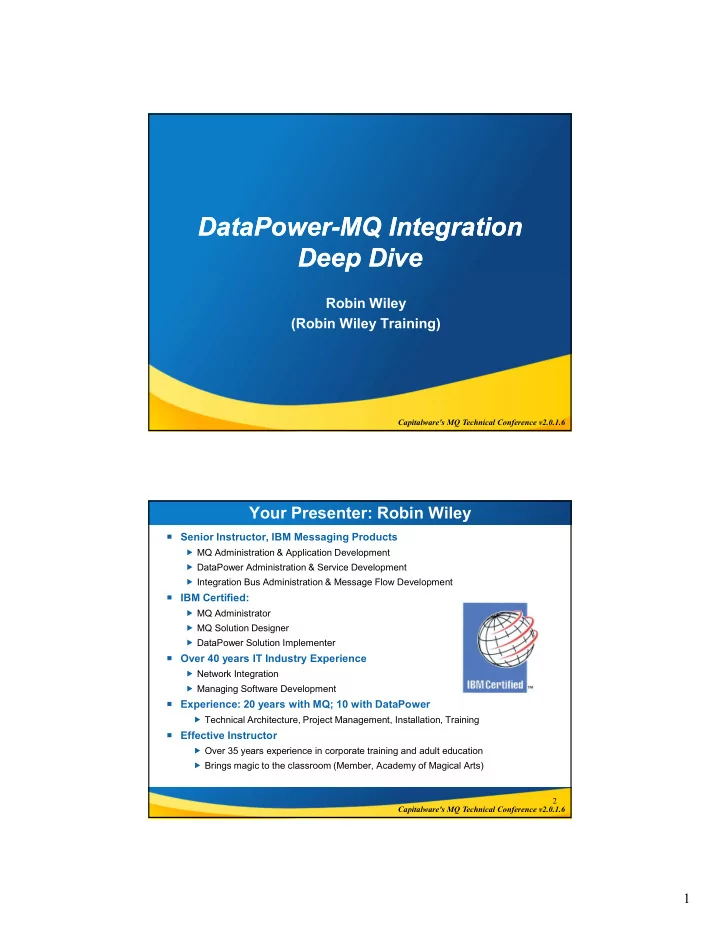
DataPower DataPower-MQ Integration MQ Integration Deep Dive Deep Dive Robin Wiley (Robin Wiley Training) Capitalware's MQ Technical Conference v2.0.1.6 Your Presenter: Robin Wiley Senior Instructor, IBM Messaging Products MQ


slide-1
SLIDE 1

1

Capitalware's MQ Technical Conference v2.0.1.6

DataPower DataPower-MQ Integration MQ Integration Deep Dive Deep Dive

Robin Wiley (Robin Wiley Training)

Capitalware's MQ Technical Conference v2.0.1.6 2

 Senior Instructor, IBM Messaging Products

 MQ Administration & Application Development  DataPower Administration & Service Development  Integration Bus Administration & Message Flow Development

 IBM Certified:

 MQ Administrator  MQ Solution Designer  DataPower Solution Implementer

 Over 40 years IT Industry Experience

 Network Integration  Managing Software Development

 Experience: 20 years with MQ; 10 with DataPower

 Technical Architecture, Project Management, Installation, Training

 Effective Instructor

 Over 35 years experience in corporate training and adult education  Brings magic to the classroom (Member, Academy of Magical Arts)

Your Presenter: Robin Wiley

slide-2
SLIDE 2

2

Capitalware's MQ Technical Conference v2.0.1.6 3

Focus:

 MQ 8 & DP 7.5

Topics:

 Queue Manager Object  MQ Front Side Handler  MQ URL  Message Headers  Error Handling  Transaction Management

Agenda

Capitalware's MQ Technical Conference v2.0.1.6

Queue Manager Object

slide-3
SLIDE 3

3

Capitalware's MQ Technical Conference v2.0.1.6 5

Queue Manager Object

Capitalware's MQ Technical Conference v2.0.1.6 6

 Host Name (IPv4)

 address:port 192.168.57.1:1414  address(port) 192.168.57.1(1414)  address 192.168.57.1 default port 1414

 Host Name (IPv6)

 [address]:port [2202::148:248]:1414  address(port) 2202::148:248(1414)  address 2202::148:248 default port 1414

 Host Name (DNS)

 hostname:port myserver:1414  hostname(port) myserver(1414)  hostname myserver default port 1414

Queue Manager Object

slide-4
SLIDE 4

4

Capitalware's MQ Technical Conference v2.0.1.6 7

Queue Manager Object

Capitalware's MQ Technical Conference v2.0.1.6 8

Queue Manager Object

slide-5
SLIDE 5

5

Capitalware's MQ Technical Conference v2.0.1.6 9

 Channel Name

 SVRCONN name as defined on the Queue Manager

 Channel Heartbeat (seconds)

 Approximate time between heartbeat flows on the channel  0 = no heartbeat flow exchanged  Does not set the heartbeat on the channel  Negotiates heartbeat value with channel definition -- greater is used

 Cache Timeout (seconds)

 How long the appliance keeps alive a dynamic connection in the connection cache  Must be greater than the negotiated heartbeat interval but less than the Queue Manager keep alive interval (defined on the host)

Queue Manager Object

Capitalware's MQ Technical Conference v2.0.1.6 10

 User Name

 Supplied to Queue Manager at connection  Maximum 12 characters

 Alternate User

 Enables or disables MQOD.AlternateUserId  Off = use Message Descriptor User Identifier for queue authorization  On (default) = use Object Descriptor Alternate User Identifier for queue authorization (need to create Object Descriptor)

 XML Manager

 Recommend using a dedicated XML Manager per QM object

Queue Manager Object

slide-6
SLIDE 6

6

Capitalware's MQ Technical Conference v2.0.1.6 11

 Maximum Message Size

 Limit the size of the MQ message payload

 Units of Work

 Controls syncpoint processing (transaction management)  Affects MQ Front Side Handlers only  Two values: 0 or 1

 Units of Work = 0

 No syncpoint control  Front Side Handler MQGET is immediate and irrevocable  If error, message integrity is responsibility of DataPower

 Units of Work = 1

 Enables syncpoint control  Front Side Handler MQGET has an implied MQGMO_SYNCPOINT  If error, message is rolled back via implied MQBACK

Queue Manager Object

Capitalware's MQ Technical Conference v2.0.1.6 12

Queue Manager – Connections Tab

slide-7
SLIDE 7

7

Capitalware's MQ Technical Conference v2.0.1.6 13

 Total Connection Limit:

 Connection pool size of the QM object  Default value is 250  Can tune the total connection limit for performance

 Initial Connections:

 Maximum simultaneous initial connection requests  Default value is 1  If too high, may flood the Queue Manager

 Local Address

 Local address for outbound connections  Specific local interface and port  For a range of ports, use (1414,1420) or x.x.x.x(1414,1420)

Queue Manager – Connections Tab

Capitalware's MQ Technical Conference v2.0.1.6 14

 Automatic Retry

 On: Attempt to reconnect to the Queue Manager if connection dropped  Off: Disable and re-enable the Queue Manager object to reconnect

 Retry Interval

 Time interval between attempts to retry failed connections  Recommend 10 to 15 seconds (default is 1 second)  Low value can spike CPU and memory usage

 Retry Attempts

 Number of attempts to retry the failed connections  After threshold reached, the Long Retry Interval is used instead  Default value of 0 (zero) disables Long Retry Interval  Recommend non-zero value

Queue Manager – Connections Tab

slide-8
SLIDE 8

8

Capitalware's MQ Technical Conference v2.0.1.6 15

 Long Retry Interval

 Interval in seconds to retry connection after Retry Attempts  Recommend 600 seconds (default is 1800)  Must be greater than the Retry Interval (if less, ignored)

 Reporting Interval

 How often to log retries (seconds)  Suppresses duplicate log entries  Recommend setting this the same as Retry Interval

Queue Manager – Connections Tab

Capitalware's MQ Technical Conference v2.0.1.6 16

 Sharing Conversations

 Maximum conversations sharing single TCP/IP connection  Value is negotiated between SVRCONN SHARECNV setting and DataPower (lower value takes effect)  Value of 0 means NO Shared Conversations  Suppresses MQ V7+ features (Administrator stop-quiesce; Heartbeating; Read ahead; Client asynchronous consume)  Value of 1 means NO Shared Conversations  Allows MQ V7+ features (Administrator stop-quiesce; Heartbeating; Read ahead; Client asynchronous consume)  Value > 1 means Shared Conversations permitted  Allows MQ V7+ features (Administrator stop-quiesce; Heartbeating; Read ahead; Client asynchronous consume)  Can impact performance of clients (unless V7+ features used)

Queue Manager – Connections Tab

slide-9
SLIDE 9

9

Capitalware's MQ Technical Conference v2.0.1.6 17

Queue Manager – Connections Tab

Capitalware's MQ Technical Conference v2.0.1.6 18

 SSL Client Type: Client Profile

 Select the SSL Client Profile object to use from the pick list  Must be used for connection to a z/OS host

 SSL Client Type: Proxy Profile

 Deprecated – recommend using Client Profile instead  Select the SSL Proxy Profile object to use from the pick list

 SSL Key Repository

 Select the location of the key database file

 SSL Version 3 Support

 Permit SSL v3 or not

 SSL Cipher Specification

 Choose the Cipher Spec to use

Queue Manager – Connections Tab

slide-10
SLIDE 10

10

Capitalware's MQ Technical Conference v2.0.1.6

Client Profile Object

Capitalware's MQ Technical Conference v2.0.1.6 20

Client Profile – Main Tab

slide-11
SLIDE 11

11

Capitalware's MQ Technical Conference v2.0.1.6 21

 Protocols:

 Choose the protocols to be supported

 Ciphers:

 Choose the ciphers to be supported

 Use SNI:

 Send the Server Name Indication (SNI) TLS extension in the client hello message

 Permit connections to insecure SSL servers:

 Allow connection to potentially vulnerable servers

 Enable compression:

 Allow SSL compression  Not recommended – can allow CRIME or BREACH attacks

 Identification credentials:

 If mutual authentication requested by server

 Validate server certificate:

 Check the credentials presented by the server (Default: On)

 Validation credentials:

 Crypto Validation Credential object used for server certificate validation

Client Profile – Main Tab

Capitalware's MQ Technical Conference v2.0.1.6 22

Client Profile – Session Caching Tab

slide-12
SLIDE 12

12

Capitalware's MQ Technical Conference v2.0.1.6 23

 Enable session caching:

 Allow SSL session caching

 Session Cache Timeout:

 How long before cache is flushed  Maximum: 86,400 seconds (24 hours)

 Session Cache Size:

 How many entries to be cached  Maximum: 500,000

Client Profile – Session Caching Tab

Capitalware's MQ Technical Conference v2.0.1.6 24

Client Profile – Advanced Tab

 Elliptical Curves:

 Build a list of acceptable Elliptical Curve algorithms (RFC 4492)  Allows equivalent security to current cryptosystems like RSA but smaller key size  Favored for mobile technology

slide-13
SLIDE 13

13

Capitalware's MQ Technical Conference v2.0.1.6

Back to the Queue Manager Object

Capitalware's MQ Technical Conference v2.0.1.6 26

 Coded Character Set ID

 Presented to the SVRCONN channel during connection  Same as setting MQCCSID Environment Variable

 Convert Input

 On: Ask the Queue Manager to convert messages using the CCSID (default)  Off: No conversion

Queue Manager – CCSI Tab

slide-14
SLIDE 14

14

Capitalware's MQ Technical Conference v2.0.1.6 27

Queue Manager – MQCSP Tab

Capitalware's MQ Technical Conference v2.0.1.6 28

 Defines the MQCSP Data Structure

 Simulates passing MQCSP using MQCONNX

 MQCSP User ID

 Sent via MQCSP if present  If blank (and Password Alias set to “none”), no MQCSP is sent

 MQCSP Password Alias

 Points to the encrypted password stored within DataPower  Password is sent in clear text in MQCSP after retrieval from the Alias

Queue Manager – MQCSP Tab

slide-15
SLIDE 15

15

Capitalware's MQ Technical Conference v2.0.1.6

MQ Front Side Handler Object

Capitalware's MQ Technical Conference v2.0.1.6 30

MQ Front Side Handler

slide-16
SLIDE 16

16

Capitalware's MQ Technical Conference v2.0.1.6 31

 Get Queue

 Name of queue to get messages from  Mandatory, unless Pub/Sub being used

 Put Queue

 Optional, because:  May be "one-way" messaging (fire and forget)  May be using Reply-To Queue  May be dynamically allocated by Response Rule code

 The number of concurrent MQ conversations:

 Number of parallel active and pending MQGETs for the Get Queue  Recommend value of 1 (in high throughput situations, may use up to 5)  Regardless of this setting, multiple FSH threads will still use multiple connections  If greater than 1, monitor Queue Manager for workload  If greater than 1, Backout Threshold must be this value plus 1  If using message ordering (MQGMO_LOGICAL_ORDER), set it to 1

MQ Front Side Handler

Capitalware's MQ Technical Conference v2.0.1.6 32

 Get Message Options

 Allows the use of any MQGMO_Options parameters  Overrides any specific parameters set elsewhere

 Polling Interval

 How long to wait on an empty queue (seconds)  Equivalent to Wait Interval with conventional MQ applications  Low value increases network traffic  Recommend default of 30

 Retrieve Backout Settings

 Get BOTHRESH and BOQUEUE from the Get Queue  Issues MQINQ before every MQGET – potential performance hit  Only relevant if queue parameters were set by MQ administrator  Recommend set "off" and use Queue Manager Object settings

MQ Front Side Handler

slide-17
SLIDE 17

17

Capitalware's MQ Technical Conference v2.0.1.6 33

Some MQGMO Options

MQGMO_NONE 1 MQGMO_WAIT 2 MQGMO_SYNCPOINT 4 MQGMO_NO_SYNCPOINT 8 MQGMO_SET_SIGNAL 16 MQGMO_BROWSE_FIRST 32 MQGMO_BROWSE_NEXT 64 MQGMO_ACCEPT_TRUNCATED_MSG 128 MQGMO_MARK_SKIP_BACKOUT 256 MQGMO_MSG_UNDER_CURSOR 512 MQGMO_LOCK 1024 MQGMO_UNLOCK 2048 MQGMO_BROWSE_MSG_UNDER_CURSOR 4096 MQGMO_SYNCPOINT_IF_PERSISTENT 8192 MQGMO_FAIL_IF_QUIESCING 16384 MQGMO_CONVERT 32768 MQGMO_LOGICAL_ORDER 65536 MQGMO_COMPLETE_MSG 131072 MQGMO_ALL_MSGS_A VAILABLE 262144 MQGMO_ALL_SEGMENTS_A VAILABLE

Capitalware's MQ Technical Conference v2.0.1.6 34

 Use Queue Manager in URL

 Defines the behavior of var://service/URL-in when a QM Group is specified  If on, the variable returns the name of the chosen Queue Manager  If off, the variable returns the name of the Queue Manager Group  Default off

 CCSI

 Sets the CCSID in the MQ Message Descriptor  If blank or zero, default is ISO-8859-1 (latin-1)  For MQCCSI_EMBEDDED enter 4294967295  For MQCCSI_INHERIT enter 4294967294

MQ Front Side Handler

slide-18
SLIDE 18

18

Capitalware's MQ Technical Conference v2.0.1.6 35

MQ Front Side Handler

Capitalware's MQ Technical Conference v2.0.1.6 36

 Subscribe Topic String

 Pub/Sub topic string for subscription  If Get Queue also defined, this is ignored

 Subscription Name

 Used to establish or resume a Durable Subscription

 Publish Topic String

 Pub/Sub topic string for response publication  If Put Queue also defined, this is ignored

 Parse Properties

 Extracts MQ V7 (and above) Message Properties into Node Set  Minor overhead, so leave off unless needed

MQ Front Side Handler

slide-19
SLIDE 19

19

Capitalware's MQ Technical Conference v2.0.1.6 37

 Selector

 Allows selective retrieval of messages based on properties  Forces sequential search of queue so may be inefficient

 Exclude Message Headers

 Strip off selected MQ header types

 Header to extract Content-Type

 Can obtain Content-Type from

 MQMD  RFH  RFH2

MQ Front Side Handler

Capitalware's MQ Technical Conference v2.0.1.6 38

 Async Put

 Put message to queue without waiting for a response  Do not use when Queue Manager units-of-work is 1  Recommend only use where performance is an issue

 Batch Size

 Number of messages to handled as a singe commit or rollback operation  Recommend leave this as zero – each message is a separate transaction

MQ Front Side Handler

slide-20
SLIDE 20

20

Capitalware's MQ Technical Conference v2.0.1.6

MQ Back-End URL

Capitalware's MQ Technical Conference v2.0.1.6 40

 General Syntax:

 dpmq://mqQueueManagerObject/URI?<parameters>

 RequestQueue=requestQueueName

 Name of the backend MQ request queue

 ReplyQueue=replyQueueName

 Name of the backend MQ reply queue

 Sync=true

 Issues a Commit call when a message is put on Request Queue

 GMO=optionsValue

 MQGMO_Options parameter value when getting from Reply Queue

 PMO=optionsValue

 MQPMO_Options parameter value when putting to Request Queue

MQ Back-End URL

slide-21
SLIDE 21

21

Capitalware's MQ Technical Conference v2.0.1.6 41

 ParseHeaders={true|false}

 Specifies whether to parse and strip headers from message

 SetReplyTo={true|false}

 Specifies whether to set MD ReplyToQ during Put

 AsyncPut={true|false}

 Specifies whether to use Asynchronous Put  Only valid when using MQ V7 (and above)

 Browse={first|next|current}

 Controls non-destructive retrieval of messages

MQ Back-End URL

Capitalware's MQ Technical Conference v2.0.1.6 42

 ContentTypeHeader=header

 Which MQ header identifies the content type of the message

 ContentTypeXPath=expression

 XPath expression to extract the content type of message

 ParseProperties={on|off}

 Parse message properties

 PublishTopicString=string and SubscribeTopicString=string

 Specifies topic to use with Pub/Sub (MQ V7 and above)

 SubscriptionName=string

 Specifies name for a durable subscription (MQ V7 and above)

 Selector=expression

 SQL92 style query filtering on message properties  Performance hit

MQ Back-End URL

slide-22
SLIDE 22

22

Capitalware's MQ Technical Conference v2.0.1.6

Multi-Protocol Gateway Parameter Settings

Capitalware's MQ Technical Conference v2.0.1.6 44

MPGW Headers Tab – MQ Headers

slide-23
SLIDE 23

23

Capitalware's MQ Technical Conference v2.0.1.6 45

MPGW Headers Tab – MQ Headers

 Using Header Injection (Header Tab)  Example setting Format and Persistence:

 Direction: Front (for FSH MQPUT)  Direction: Back (for Backend MQPUT)  Header Name: MQMD  Header Value: <MQMD><Format>MQSTR</Format><Persistence>1</Persistence></MQMD>

Capitalware's MQ Technical Conference v2.0.1.6

MQ Programmatic Control

slide-24
SLIDE 24

24

Capitalware's MQ Technical Conference v2.0.1.6 47

 Using the Stylesheet method (page 1 of 2)

MQ Headers – Programmatic Manipulation

Capitalware's MQ Technical Conference v2.0.1.6 48

 Using the Stylesheet method (page 2 of 2)

MQ Headers – Programmatic Manipulation

slide-25
SLIDE 25

25

Capitalware's MQ Technical Conference v2.0.1.6 49

 Context variable method to inject the MQMD header

 For the following code to work:  Set Transform Action's OUTPUT context to "EVENTS"  Set Result Action's INPUT context to "EVENTS"

MQ Headers – Programmatic Manipulation

Capitalware's MQ Technical Conference v2.0.1.6 50

 JMS Headers as Message Properties

 Must set FSH “Parse Properties” to be “on”  Must set “Exclude RFH2” to be “off”  Message Properties appear as “MQMP” header

MQ Headers – Programmatic Manipulation

slide-26
SLIDE 26

26

Capitalware's MQ Technical Conference v2.0.1.6 51

 JMS Headers as RFH2

 Must set FSH “Parse Properties” to be “off”  Must set “Exclude RFH2” to be “on”  Message Properties appear as “MQRFH2” headers

MQ Headers – Programmatic Manipulation

Capitalware's MQ Technical Conference v2.0.1.6 52

 MQ error handling example:

MQ Error Handling

slide-27
SLIDE 27

27

Capitalware's MQ Technical Conference v2.0.1.6 53

 Backend application must copy MsgId to CorrelId

 DataPower Back-End retrieves reply using CorrelId

 MQPUT1 Simulation

 Create MQ Object Descriptor header with Queue Manager name in it  Request Rule issues MQOPEN/MQPUT/MQCLOSE to back end Queue Manager

 ReplyToQ Usage

 If set, Response Rule sends message there

 ReplyToQmgr Usage

 Can be set to send to a different Queue Manager  If destination is a Cluster, no need to supply ReplyToQmgr

MQ Conversational Processing

Capitalware's MQ Technical Conference v2.0.1.6 54

 XSL code snippet to set ReplyToQ and ReplyToQmgr in a Request Rule:

MQ Conversational Processing

slide-28
SLIDE 28

28

Capitalware's MQ Technical Conference v2.0.1.6 55

 XSL code snippet to set ReplyToQ and ReplyToQmgr in a Response Rule:

MQ Conversational Processing

Capitalware's MQ Technical Conference v2.0.1.6

Transactional Processing

slide-29
SLIDE 29

29

Capitalware's MQ Technical Conference v2.0.1.6 57

 DataPower is a standard MQ Client

 It does NOT offer Extended Transactional Client functionality  NO XA two-phase commit

 DataPower is considered an application by MQ

 Therefore, no inherent message integrity

 If the same Queue Manager at front and back:

 True message integrity  Once and once-only delivery

 If different Queue Managers at front and back

 No possibility of two-phase commit  Message integrity assured if DataPower configured properly  Possibility of messages sent more than once

MQ Transactional Processing

Capitalware's MQ Technical Conference v2.0.1.6 Queue Manager QM2 58 Queue Manager QM1 FS.IN DataPower Response Rule Request Rule FS.OUT BE.OUT BE.IN App 2 App 1 Units of Work = 0 Sync=false; Transactional=false

No Transactional Control Scenario: Two Different Queue Managers

slide-30
SLIDE 30

30

Capitalware's MQ Technical Conference v2.0.1.6 Queue Manager QM2 59 Queue Manager QM1 FS.IN DataPower Response Rule Request Rule FS.OUT BE.OUT BE.IN App 2 App 1 Units of Work = 1 Sync=false; Transactional=false

Front Side Transactional Control only Scenario: Two Different Queue Managers

Capitalware's MQ Technical Conference v2.0.1.6 Queue Manager QM2 60 Queue Manager QM1 FS.IN DataPower Response Rule Request Rule FS.OUT BE.OUT BE.IN App 2 App 1 Units of Work = 0 Sync=false; Transactional=true

Back End Transactional Control only Scenario: Two Different Queue Managers

slide-31
SLIDE 31

31

Capitalware's MQ Technical Conference v2.0.1.6 Queue Manager QM2 61 Queue Manager QM1 FS.IN DataPower Response Rule Request Rule FS.OUT BE.OUT BE.IN App 2 App 1 Units of Work = 1 Sync=false; Transactional=true

Front Side and Back End Transactional Control Scenario: Two Different Queue Managers

Capitalware's MQ Technical Conference v2.0.1.6 62 Queue Manager QM1 FS.IN DataPower Response Rule Request Rule FS.OUT BE.OUT BE.IN App 2 App 1

No Transactional Control

Units of Work = 0 Sync=false; Transactional=false

Scenario: One Queue Manager (Front & Back)

slide-32
SLIDE 32

32

Capitalware's MQ Technical Conference v2.0.1.6 63 Queue Manager QM1 FS.IN DataPower Response Rule Request Rule FS.OUT BE.OUT BE.IN App 2 App 1

Front Side Transactional Control only

Units of Work = 1 Sync=false; Transactional=false

Scenario: One Queue Manager (Front & Back)

Capitalware's MQ Technical Conference v2.0.1.6 64 Queue Manager QM1 FS.IN DataPower Response Rule Request Rule FS.OUT BE.OUT BE.IN App 2 App 1

Front Side Transactional Control only

Units of Work = 1 Sync=true; Transactional=false

Scenario: One Queue Manager (Front & Back)

slide-33
SLIDE 33

33

Capitalware's MQ Technical Conference v2.0.1.6 65 Queue Manager QM1 FS.IN DataPower Response Rule Request Rule FS.OUT BE.OUT BE.IN App 2 App 1

Front Side and Back End Transactional Control

Units of Work = 1 Sync=true; Transactional=true

Scenario: One Queue Manager (Front & Back)

Capitalware's MQ Technical Conference v2.0.1.6 66 Queue Manager QM1 FS.IN DataPower Request Rule App 1 Units of Work = 1 FS.ERR FSH BOTHRESH = 3 BOQUEUE = FS.ERR

Poison Message

slide-34
SLIDE 34

34

Capitalware's MQ Technical Conference v2.0.1.6 67 Queue Manager QM1 FS.IN DataPower Request Rule App 1 Units of Work = 1 FS.ERR FSH BOTHRESH = 3 BOQUEUE = FS.ERR

Poison Message

Capitalware's MQ Technical Conference v2.0.1.6 68

DataPower Knowledge Center Documentation

https://www.ibm.com/support/knowledgecenter/en/SS9H2Y_7.5.0/ com.ibm.dp.doc/retrieve-backout-setting_mqfsh.html

Poison Message

“If there are no backout settings, the backout function is disabled.”

8

slide-35
SLIDE 35

35

Capitalware's MQ Technical Conference v2.0.1.6

Questions & Answers

Capitalware's MQ Technical Conference v2.0.1.6

Thank You!

Contact: Robin@RobinWileyTraining.com Handouts: RobinWileyTraining.com/MQTC2016 End of Session