Arne Naess Founder of Deep Ecology: biospheric egalitarianism - - PowerPoint PPT Presentation

arne naess
SMART_READER_LITE
LIVE PREVIEW

Arne Naess Founder of Deep Ecology: biospheric egalitarianism - - PowerPoint PPT Presentation

Arne Naess Founder of Deep Ecology: biospheric egalitarianism Coined term deep ecology in 1973 Deep ecology now has many, many adherents in philosophy, science, political activism and literature 1 Why Deep? Deep


slide-1
SLIDE 1

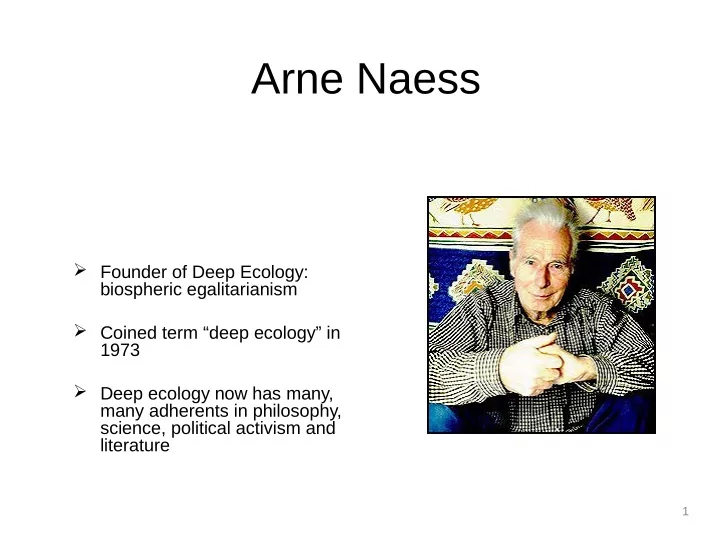
Arne Naess

  • Founder of Deep Ecology:

biospheric egalitarianism

  • Coined term “deep ecology” in

1973

  • Deep ecology now has many,

many adherents in philosophy, science, political activism and literature

1

slide-2
SLIDE 2

Why “Deep”?

  • “Deep ecology” is deep because it questions fundamental assumptions in
  • ur philosophies and world view.
  • Attempts to deduce principles of action from basic values and premises.
  • Examples of “deep” questions:
  • What is an individual?
  • What things have intrinsic value and moral standing?
  • How should we understand nature?
  • What is the relationship between people and nature?
  • Deep ecology answers tend to be anti-individualist and anti-reductionist,

and pro-holism.

2

slide-3
SLIDE 3
  • Week Deep Ecology

“Weak Ecology”

  • We need to protect the environment as a

resource for humans.

  • We can do this by making minor changes in
  • ur lifestyle (Reduce, Reuse, Recycle).
  • Third world population growth is the main

cause of environmental damage and must be stopped.

3

slide-4
SLIDE 4
  • “Deep Ecology”
  • Humankind is not the only thing with intrinsic value.

Deep ecologists often call themselves biocentrists – all living things are valuable.

  • Humankind needs to live in harmony with nature, not

dominate it.

  • We must radically change our lifestyle, our view of

what it means to be “rich,” which includes appreciation of cultural diversity and decentralization

  • f social and political structures.
  • It is our extravagant lifestyle, and then its

globalization that is the problem, not the just the population of third world nations.

4

slide-5
SLIDE 5
  • Guiding Principles of Deep Ecology
  • Anti-anthropocentric
  • All life has inherent value – and equal value. Humans have no special moral

status.

  • Richness and diversity of life are inherently good.
  • Individuals not as important as wholes: species, ecosystems, biodiversity, the

earth.

  • The world would be better off with fewer people, and people should have less

impact on the rest of nature.

  • We need to change our economic, technical and industrial systems, philosophical

world view, and materialistic consumerist lifestyle.

  • We can’t rely on science to “fix” our current problems. Science can only treat the
  • symptoms. We must try to cure the disease.
  • We can have a better life if we choose a life that is closer to nature and less
  • materialistic. We would be better off and nature would be better off.

5

slide-6
SLIDE 6
  • How is Deep Ecology “Deeper”?
  • Raises more probing questions, of a philosophical

type, not just scientific or economic.

  • Calls for a more radical transformation of our

lifestyles, toward much more simple living.

  • Calls into question government structures and social

institutions.

  • Claims that these changes must be based on a

realization of our unity or Oneness with all of life, all reality.

  • Attempts to draw on diverse religions and

philosophies to support its case.

6

slide-7
SLIDE 7
  • Deep Ecology: Some Key Principles
  • There is a metaphysical unity of all reality, even

more fundamental than the unity of parts working together.

  • All of the system has equal inherent value

(ecological egalitarianism). (But some make room for ‘vital interests’ one has for concerns close to them.)

  • Personal maturity involves the realization of unity

through “Self-Realization” or “Identification” with all

  • f reality.
  • Identification with all life will result in respect for the

diversity of life and cultures, and will lead to radical changes in lifestyles, social institutions and political structures.

7

slide-8
SLIDE 8
  • Dominant view

– Dominance over nature – Natural environment as resources for human – Materialism – Economic growth for the purpose of self- demand – Earth “supplies” unlimited – High technological progress as solution for resources and waste – Consumerism – National/centralized community

  • Deep ecology

– Harmony with nature – All nature has intrinsic worth/biospecies equality – Simple material need (for the purpose of self realization) – Earth “supplies” limited – Doing with enough/reuse/recyclin g – Social equality – Diversity

8

slide-9
SLIDE 9
  • Criticism:
  • Founded on unjustified anthropomorphism: imbuing animals, plants, ecosystems,

the earth, with human-like feelings and interests

  • Romanticizes nature as wise, harmonious, beautiful, good. But nature can be

cruel, ugly, destructive.

  • Where does inherent value come from?
  • For something to have intrinsic rights or to deserve protection, it must have
  • interests. How can plants or ecosystems have interests?
  • How could we, as humans, possibly understand the interests of other animals,

plants, ecosystems, etc.

  • Inconsistent? There are no individuals, humans are merely a part of the whole, yet

humans are uniquely responsible for environmental destruction.

9

slide-10
SLIDE 10
  • Convergence
  • Although there are differing religious views of

nature, and differing philosophical views of nature

  • There is a common implication of almost all of them:

we need to take care of the world around us.

  • To do this, we must live less selfish, greedy lives,

and recognize the value of that which is around us.

  • Recognize that we are intimately connected to the

natural world.

  • Attempt to live more simply, with what we have

rather than always wanting more. (Humans can be very greedy.)

  • Find ways to live in harmony with our natural home,

interfering with natural processes as little as

  • possible. (Humans have the capacity to be very

destructive.)

10

slide-11
SLIDE 11

Ecofeminism

11

  • Rejects Patriarchal

Dualisms

  • The domination of

nature by men is wrong is similar to and related to the domination of women by men.

  • Must break the pattern
  • f "power over"

relationships will benefit both women and the natural world. Acid attack victims

slide-12
SLIDE 12

EcoFeminism: noticing domination based on difference

  • Sexism: male over female
  • Racism: white over black
  • Classism: wealthy over working class
  • Heterosexism: heterosexuals over GLBTQ
  • Ageism: adult youth over children & elders
  • Ableism: temporarily abled over differently abled
  • Speciesism: human over other animal species
  • Anthropocentrism: culture over nature

12

slide-13
SLIDE 13

Basic Insights of Ecofeminism

  • 1. Conceptions of nature and of women

have been linked: earth as female, female as earthly/animal-like.

  • 2. Devaluation and abuse of nature and

women have gone hand in hand.

  • 3. To overcome this problem, we must

analyze and resist both together, and devise an ideal which liberates both.

  • 4. Expansion often made: all
  • ppressions (race, class, gender,

environment) are linked and need to be fought together.

13

slide-14
SLIDE 14

Nondualistic & nonhierarchical

Versus Patriarchy as dualistic & hierarchical The world is fundamentally an interrelated web of relationships. The world is fundamentally egalitarian rather than hierarchical. Dualities and hierarchies are social constructions of patriarchy, not essential qualities of the world.

14

slide-15
SLIDE 15

Ethics of care

Versus Patriarchy’s rationally determined justice Ethics begins with our essential interrelatedness, not autonomy as individuals. Our interrelatedness locates us in a situation

  • f responsibility to others, naturally caring

for them (as long as we are open to our connections). Ethics are developed not by rationally determining justice but by deepening our awareness of our interrelatedness and extending our natural caring.

15

slide-16
SLIDE 16

Versus Patriarchy’s notion of progress is domination over nature and other cultures in pursuit of material affluence. The spread of patriarchal civilization is not true progress but rather the extension of the domination of those in power. Individual and cultural diversity, like biodiversity, are the basis for cultural health and richness. True progress comes from a multiplicity of individuals and cultures working in dialogue and cooperation. The ideal is to empower diverse individuals and cultures and engage them in cultural, political, and environmental processes.

16

slide-17
SLIDE 17
  • Feminism is not just about women.
  • It is about a new relationships

17

slide-18
SLIDE 18

Ecofeminists standpoint

  • Connection between oppression of

women and oppression of nature.

  • To understand this connection.
  • Solutions to ecological problems must

include a feminist perspective.

  • Spiritual connection of women with

earth-nature because of biological connections.

18

slide-19
SLIDE 19
  • Ecofeminists look for nonviolent solutions

to world problems. They consider feminine values necessary for survival in the conditions of the world's patriarchy.

  • And while ecofeminists may subscribe to

liberal, radical, or Marxist/socialist thought, their main focus is on ecology - both of nature and human systems.

19

slide-20
SLIDE 20

Ecofeminism: Patriarchal society interlocking pillars…sexism, racism, class exploitation and environmental destruction. Deep connection between women & nature as reproducers & nurtures but socially created.

20

slide-21
SLIDE 21

Women must see that there can be no liberation for them and no solution to the ecological crisis within a society whose fundamental model of relationships continues to be one of domination. They must unite the demands of the women’s movement with those

  • f the ecological movement to envision a

radical reshaping of the basic socioeconomic relations and the underlying values of this [modern industrial] society ( New Woman/New Earth, Ruether, 204).

21

slide-22
SLIDE 22

In her Introduction to Ecofeminism: Women, Culture, Nature, editor Warren asserts: What makes ecofeminism distinct is its insistence that nonhuman nature and naturism (i.e., the unjustified domination of nature) are feminist issues. Ecofeminist philosophy extends familiar feminist critiques of socialisms of domination to nature .

22

slide-23
SLIDE 23

In her essay “Development, Ecology and Women" Shiva: , Maldevelopment militates against this equality in diversity, and superimposes the ideologically constructed category of western technological man as a uniform measure of the worth of classes, cultures, and genders… Diversity, and unity and harmony in diversity, become epistemologically unattainable in the context of maldevelopment, which then becomes synonymous with women’s underdevelopment (increasing sexist domination), and nature’s depletion (deepening ecological crises)… .

23