Data Sharing at the N ational Research I nstitute for E arth Science - - PowerPoint PPT Presentation

data sharing at the n ational research i nstitute for e
SMART_READER_LITE
LIVE PREVIEW

Data Sharing at the N ational Research I nstitute for E arth Science - - PowerPoint PPT Presentation

Data Sharing at the N ational Research I nstitute for E arth Science and D isaster Resilience Katsuhiko SHIOMI Network Center for Earthquake, Tsunami and Volcano, NIED 2017.12.05 International workshop on sharing, citation and publication of


slide-1
SLIDE 1

Katsuhiko SHIOMI

Network Center for Earthquake, Tsunami and Volcano, NIED

2017.12.05 “International workshop on sharing, citation and publication of scientific data across disciplines” @NIPR, Tachikawa
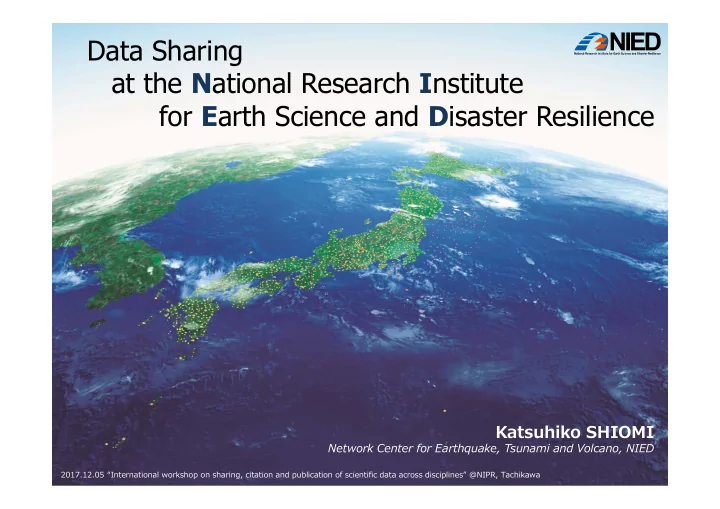
Data Sharing at the National Research Institute for Earth Science and Disaster Resilience

slide-2
SLIDE 2

Contents

  • 1. Outline of the National Research Institute

for Earth Science and Disaster Resilience

  • 2. Earthquake observation by NIED
  • Three kinds of seismograph networks on the land area

and two networks on the seafloor

  • Realtime data sharing between the related
  • rganizations
  • Public service via the Internet

~ As an example of NIED Hi-net ~

  • 3. Future plans
slide-3
SLIDE 3

Nationwide Observation Stations

Weather & Snow Volcanoes Earthquakes Earthquakes & Tsunamis

Rainfall & Wind

Every 5 min.

Snowfall

Every hour

slide-4
SLIDE 4

Nationwide Observation Stations

Weather & Snow Volcanoes Earthquakes Earthquakes & Tsunamis

Rainfall & Wind

Every 5 min.

Snowfall

Every hour

Earthquake Info.

Every second / when earthquake occurs

Volcano Info.

Every hour ~

(depends on the contents)

slide-5
SLIDE 5

Monitoring of Waves on Land and Seafloor

Volcanoes Earthquakes Earthquakes & Tsunamis

Ryukyu Is. Ogasawara Is.

  • Composed by more than 2100
  • bservation stations.
  • All seismograph data are open to

the public.

(S‐net data is preparing.)

slide-6
SLIDE 6

Three-kind Seismograph Networks on the Land Area

Volcanoes Earthquakes

K-NET/KiK-net: Event trigger recording with 100 Hz Hi-net/F-net: Continuous data recording with 100 Hz

slide-7
SLIDE 7

What is “Earthquake Data”? Basic Data: 3-component time series measuring the size of ground shaking

3 seismometers orthogonal to each

  • ther (e.g., UD/NS/EW)

Metadata

  • Station Location
  • Sensor Type
  • Sensor Sensitivity
  • Info. of Data Logger

:

Waveform data U D N S E W Time [s]  Primary products: Seismic Intensity / Hypocentre Catalogue etc. Digitize 

Clock Info.

slide-8
SLIDE 8

JAMSTEC, AIST Local Government etc...

Data Exchange System*

IP-VPN Network

Hi-net/F-net Stations

Public Services

JMA

Earthquake Early Warning Earthquake Catalogue

Real-time Data Collection and Sharing

Research

Data Storage & Distribution

Research

Data Storage & Distribution

Education/Research

Universities

ERI, Univ. of Tokyo Other Universities

Internet

also V-net, S-net and DONET

*Based on the agreement on March, 2004. Member of the agreement is 9 universities, 6 research institutes, 3 local governments and JMA (as of Sep. 2014)

Time Delay: 0.2 ~ 0.5s Every Second

slide-9
SLIDE 9

NIED Hi-net Website

Quick Announcement Large Earthquake Info. (M≥5) Latest Earthquake Info.(M≥2.5) Hypocenter Distribution of the Last 24 Hours

http://www.hinet.bosai.go.jp/?LANG=en

slide-10
SLIDE 10

Hypocenter Distribution

Nation-wide Regional Scale Prefecture Scale 30 Days / 7 Days / 24 Hours

slide-11
SLIDE 11

Waveform Images of Hi-net

2016/04/14 21:26:34 M6.5 at Kumamoto

Aftershocks

2016/04/16 01:25:05 M7.3 at Kumamoto

N S

M 7.3 ‐ 30km S of Halabjah, Iraq

(USGS/NEIC)

slide-12
SLIDE 12

http://www.hinet.bosai.go.jp/?LANG=en

NIED Hi-net Website

slide-13
SLIDE 13

Pages for Registered Users

Waveform Data Hypocentre Catalogue Metadata Documents & Tools

Purposes:

for evaluation of the efficiency of the MOWLAS data for improvement of the data service for maintenance of the seismic networks

slide-14
SLIDE 14

Summary for Earthquake data Nationwide seismograph networks are

  • perated by NIED.
  • 1. Waveform data are sharing in real-time with the related

institutes/organizations.

– JMA announces the EEW to the public using the data. – Universities use the data for their education and research activities.

  • 2. Waveform data is opened to the public via the Internet.

– Not only waveform data by NIED but also those by other

  • rganizations are opened.

– Metadata (e.g., station location, sensor info., geological info.) are also opened.

  • 3. User registration is required to download the waveform data.

– Name, affiliation, E-mail address, and purpose of using data are required for registration. – User information and data access statistics are used for the improvement of the data service and the maintenance of the seismic networks.

slide-15
SLIDE 15

Database On the NIED Website

http://www.bosai.go.jp/e/activities/database/

  • Database
  • Earthquakes
  • Waveform data
  • Earthquake information
  • Japanese seismic hazard maps
  • Volcanoes
  • Seismic / geodetic data
  • Volcanic Activity
  • Meteorological disasters
  • The X-band multi-parameter

radar (MP-X)

  • The Typhoon data base

system(NIED-DTD)

  • Landslide disasters
  • Landslide map database
  • Landslide disasters database
  • Snow and Ice disasters
  • Snowpack and related

meteorological conditions

  • Database
  • Earthquakes
  • Waveform data
  • Earthquake information
  • Japanese seismic hazard maps
  • Volcanoes
  • Seismic / geodetic data
  • Volcanic Activity
  • Meteorological disasters
  • The X-band multi-parameter

radar (MP-X)

  • The Typhoon data base

system(NIED-DTD)

  • Landslide disasters
  • Landslide map database
  • Landslide disasters database
  • Snow and ice disasters
  • Snowpack and related

meteorological conditions

slide-16
SLIDE 16

Data DOI

Operation of observation stations/facilities of NIED are supported by the national budgets mainly. To explain the necessity of the databases for progress of science & technology is very important database Main Purpose: Visualize cited performance of the NIED's research data Assumed Advantages:

  • Easy to cite the data in publications
  • Easy to catch how many publications used the data
slide-17
SLIDE 17

Problems applying data DOI to EQ data Data Unit

– Networks are working: Increasing every second. – Each network is composed by 50 ~ 1000 stations.

  • Each station has its own observation parameters and repair

histories individually.

– Some networks have several kinds of sensors.

  • e.g., S-net has 150 stations with three accelerographs, a

velocity seismograph and two tsunami gauges.

Hi-net 1,406GB F-net 178GB V-net 159GB Accelerographs 1,114GB Velocity Seismographs 357GB Tsunami Gauges 73GB DONET 120GB S-net 1,544GB

Continuous waveform data size

  • f MOWLAS on Oct. 2017

3.2TB/Month

slide-18
SLIDE 18

Problems applying data DOI to EQ data

Available for picking the arrival time of the earthquake motion. Inappropriate for analysis using three‐ component seismograms.

Data Quality

– Troubles on the earthquake observation

  • Data lost by power trouble, communication line trouble or system down
  • Noisy data

– Electrical noise (e.g., Lightning) – Ground noise (e.g., Strong wind, Road construction)

  • Data with small amplitude / wrong data

– Output voltage reduction by degradation of a sensor

Time [s] UD NS EW Velocity [μm/s]

slide-19
SLIDE 19

Problems applying data DOI to EQ data

Available for picking the arrival time of the earthquake motion. Inappropriate for analysis using three‐ component seismograms.

Data Quality

– Troubles on the earthquake observation

  • Data lost by power trouble, communication line trouble or system down
  • Noisy data

– Electrical noise (e.g., Lightning) – Ground noise (e.g., Strong wind, Road construction)

  • Data with small amplitude / wrong data

– Output voltage reduction by degradation of a sensor

Time [s] UD NS EW Velocity [μm/s] Frequency [Hz]

0.1 1 10

  • Amp. Spectra [μm]

101 100 10‐1 10‐2 10‐3 10‐4

UD NS EW

Reliable bandwidth in the sensor specification

slide-20
SLIDE 20

Thank you for your attention!

  • 1. Earthquake observation data (waveform data) are

sharing in real-time with the related institutes and/or

  • rganizations. The data are used for monitoring

earthquake activity, earthquake research, and educational activities

  • 2. Waveform data is opened to the public via the
  • Internet. User registration is required to download the

waveform data.

  • 3. In order to track papers/reports cited the data of

NIED’s networks, NIED will introduce the data DOIs to the NIED’s database.

Summary