
SLIDE 1
Daryl Wilson President & CEO Hydrogenics
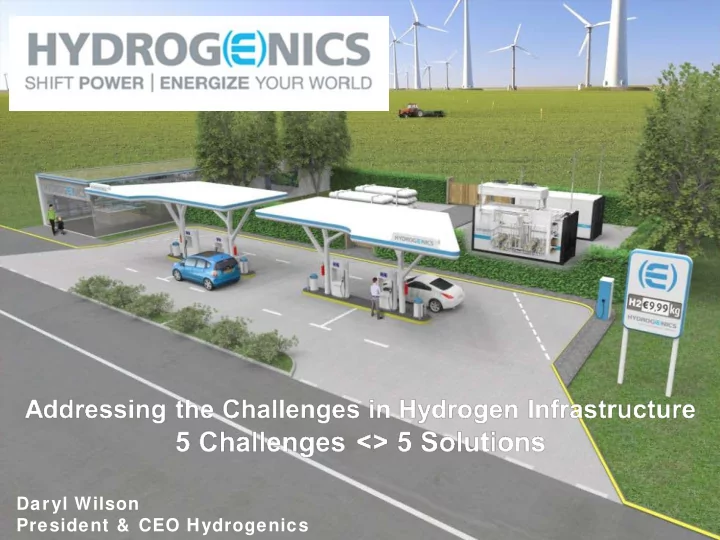
Daryl Wilson President & CEO Hydrogenics Five Challenges of - - PowerPoint PPT Presentation
Daryl Wilson President & CEO Hydrogenics Five Challenges of Fuelling Infrastructure 1. Challenge to innovate 2. Challenge to address funding & cost 3. Challenge to preserve green attributes 4. Challenge to find fresh business models
Daryl Wilson President & CEO Hydrogenics
Five Challenges of Fuelling Infrastructure
There is a world of experience to harvest here!
With more than 300 global fueling installations More than 40 within Hydrogenics portfolio
Some Lessons Learned Reflection is Timely
WaterstoNet, Brussels, Belgium 65kg/day, 350bar
Ruter/AL, Oslo, Norway 260kg/day, 350bar
Challenge: Innovation The Problem: We use what we have rather than challenge what is needed A positive approach: Linde Ionic Compression Hydrogenics Contribution: Next Gen. MW Class PEM Water Electrolysis 6 x spatial improvement in onsite generation 2MW > 12MW = 5000kg/d = 1000 cars Some recommendations:
700bar Fueling Station Setup
Fuel Cell Grade (99,998%)
According to SAEJ 2601 requirements
68 kWh/kg H2 produced
Module 1: Electrolyser (21,32, 65, 97 or 130kg/day) Module 2: Compression, cooling, booster , 850bar storageand Storage management system 700 bar Dispenser 6 meters 9 meters
Vattenfall, Hamburg, Germany Largest European H2 Station owned by a utility 1 MW Hydrogenics Electrolyser – Project by Linde
Challenge: Cost & Funding The Problem: After billions of vehicle R&D we are stuck on who pays for communal assets A positive approach: Mitsui cost target challenge Hydrogenics Contribution: Scale merit of increased demand n=100 pricing Cost reduction in balance of plant design “eliminate” Energy system integration with storage & stabilization Some recommendations:
Postauto, Brügg, Switzerland 130kg/day, 350bar
Challenge: To Preserve Green Attributes The Problem: After developing a power train capable
we settle for just 55% (less than half) A positive approach: California “Green H2 incentive” Hydrogenics Contribution: Increased electrolysis current density and efficiency to 90% Create total life cycle cost model which delivers on target Some recommendations:
Electrolysis: 450 > 42 g CO2/mile = 90% Reduction NG: 450 > 200 g CO2/mile = 55% Reduction
Challenge: To think of business models The Problem: We are quickly trapped in the old paradigm
about the total business model A positive approach: California station owner incentives Hydrogenics Contribution: Energy storage and stabilization services (patented) Create total life cycle cost model which delivers on target Some recommendations:
Increasingly we have “excess” electricity
14 Hydrogen Fueling Station Control and Optimization
Grid
Challenge: To think of total energy systems The Problem: We continue to see fueling infrastructure as an isolated element of the total energy system and fail to recognize synergies. A positive approach: No one has done this yet! Hydrogenics Contribution: Energy storage and stabilization services (patented) Flexible operating regime for electrolysis with “overdrive” Some recommendations:
What is Power-to-Gas?
Source data: National Energy Board secondary energy demand forecast, Rethinking Energy Conservation in Ontario, May 2010 reportA Power-to-Gas Solution brings new economic and technology flexibility between the traditional energy silos of power grids, gas pipelines and transport
17 A Virtuous Cycle with electrolysis
Hydrogenics’ team added value
19