SLIDE 1
CYMATICS
IN MUSIC
Del Hungerford, D.M.A. www.healingfrequenciesmusic.com
SLIDE 2 DOWNLOAD THIS PRESENTATION!
- Go to www.healingfrequenciesmusic.com
- Click on “Blog” on the navigation bar
- Either use search feature or look for blog post titled
“Cymatics”
- PDF file will be at the bottom of the page below this
video
- All links will be clickable on the PDF
SLIDE 3 CYMATICS?
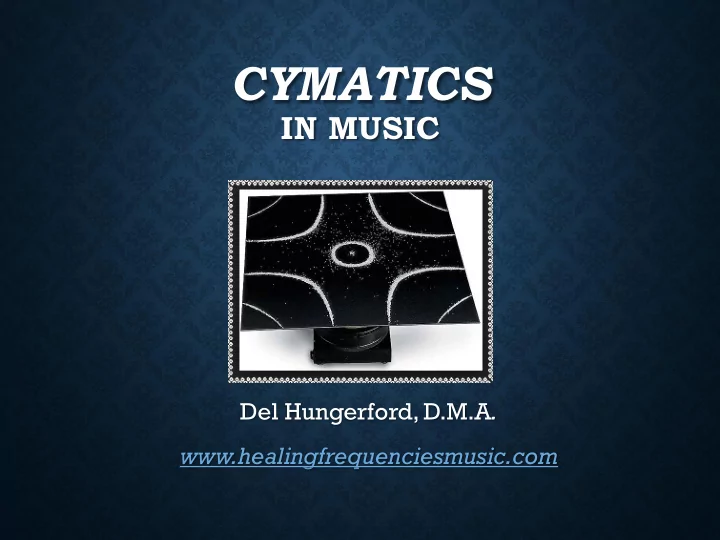
Term coined by Hans Jenny (1904-1972), a Swiss follower of the philosophical school known as anthroposophy. Cymatics is from Greek word for “wave” where it creates a modal vibrational phenomena. In 1680, Robert Hooke saw the nodal patterns associated with the modes of vibration of glass plates. In the 1780’s, the German musician and physicist Ernst Chladni noticed that the modes of vibration of a membrane or a plate can be observed by sprinkling the vibrating surface with a fine dust.
SLIDE 4 ERNST CHLADNI
- Chladni introduced what we
now call “cymatics” in 1787 in his book Discoveries on the Theory of Sound
understanding of acoustic phenomena and functioning of musical instruments.
SLIDE 5
CHLADNI PLATES
SLIDE 6
MORE CHLADNI PLATES
SLIDE 7
CHLADNI FIGURES AND MUSICAL PITCHES
SLIDE 8 MORE SPECIFICS
- Powder, salt, or sand moves due to the vibration and
accumulates progressively in points of the surface corresponding to the sound vibration (nodes and anti- nodes).
- The points form a pattern of lines, known as "nodal lines
- f the vibration mode.“ (Wikipedia)
- Different patterns emerge in the excitatory medium
depending on the geometry of the plate and the driving
SLIDE 9 HANS JENNY
- A physician and natural scientist
who coined the term cymatics to describe acoustic effects of sound wave phenomena.
- Jenny put sand, dust and fluids on
a metal plate connected to an
- scillator to produce a broad
spectrum of frequencies.
- Vibrational energy created the
geometric shapes through the frequency of the vibration emitted by the oscillator.
SLIDE 10 MARGARET WATTS-HUGHES
- A Welsh woman who invented
(1885) a device she named the “Eidophone.”
- The Eidophone was made of an
- pen-ended wooden resonating
chamber where a rubber membrane was stretched over the top.
- By singing into a tube that
interfaced with the resonating chamber, she was able to create “voice figures.”
pictured from her book Eidophone and Voice Figures published in 1904
SLIDE 11
GO TO WWW.CYMASCOPE.COM TO PURCHASE WATT’S BOOK (CLICK THE “SHOP” BUTTON)
SLIDE 12
“OLD HUNDREDTH” VOICE
FIGURES
SLIDE 13 BENJAMIN SILLIMAN
- August 8, 1779 – November 24, 1864
- He was an early American chemist
and science educator.
- He was one of the first American
professors of science, at Yale College, the first person to distill petroleum in America
- He was the founder of the American
Journal of Science, the oldest continuously published scientific journal in the United States.
SLIDE 14
IS THERE A “NOTE” TO NATURE?
SLIDE 15 JOHN STUART REID AND THE CYMASCOPE
- John Stuart Reid is an acoustics engineer,
currently working in England
- “Reid began experimenting with
instrumentation that would enable an accurate visual equivalent of sound to be created from any audible sound, resulting in the invention of the CymaScope CymaGlyph [sound] images, created on the CymaScope, are considered to be analogs of sound and music since the geometries they contain correlates with the musical pitches that cause patterns to form on the instrument's membrane.”
SLIDE 16
CYMASCOPE IMAGES
SLIDE 17
CYMASCOPE
John Stuart Reid invented the Cymascope
SLIDE 18 CAN MUSIC INFLUENCE THE LONGEVITY OF HUMAN BLOOD CELLS?
- An experiment by Emily Abbey, John Stuart Reid, and Sayer Ji
- What is the significance of this project? If specific genres of music
could be shown to extend the life of blood cells, versus the possible negative effects of noise on blood cell mortality, it may radically alter the listening habits of individuals and the environments in which they immerse themselves. The results may also provide a better understanding of noise exposure in the workplace. In addition, this initial experiment will provide a foundation for future experiments planned to help identify the medical mechanisms that underpin sound therapy, a drug-free modality that is showing potential in the support
- f many forms of illness.
- https://experiment.com/projects/can-music-influence-the-longevity-
- f-human-blood-cells?s=discover
SLIDE 19 CYMASCOPE APP!
To download the app, go to the play store from your device or visit www.cymascope.com
SLIDE 20 WHERE ELSE DO WE SEE CYMATIC FIGURES?
- Crop circles
- Stone structures in
South Africa
- In nature
- The ceiling of the
Rosslyn Chapel in Scotland
SLIDE 21
CROP CIRCLES
SLIDE 22
MICHAEL TELLINGER WWW.MICHAELTELLINGER.COM
SLIDE 23
CYMATICS IN NATURE
SLIDE 24 THE ROSSLYN CHAPEL
- Rosslyn Chapel is in Scotland
near Edinburgh
- There are 213 “cubes” with
cymatic patterns
SLIDE 25
ROSSLYN CUBES
SLIDE 26 STAVE ANGEL
- The “stave angel” is
- n the Apprentice
Pillar
be pointing at the 3 main notes (B, C, A)
cymatic patterns, these notes are in the A=435 concert pitch
SLIDE 27
ROSSLYN MOTET WWW.THEROSSLYNMOTET.COM
SLIDE 28 CURIOSITIES
- If cymatic shapes are built into cubes in the Rosslyn Chapel,
what other historic buildings could they also be in?
- It’s obvious people understood cymatics were related to music
pitches, otherwise the cubes in the Rosslyn chapel wouldn’t have been created.
- John Stuart Reid indicates cymatic figures are also in Egypt.
SLIDE 29 RESOURCES
- John Stuart Reid: www.cymascope.com
- Stuart Mitchell: https://stuart-mitchell.com/
- Rosslyn Motet information: https://www.therosslynmotet.com/
- Nigel Stanford (musician) YouTube video with cymatics at work!
https://www.youtube.com/watch?v=Q3oItpVa9fs
- Interview with John Stuart Reid on Cymatics by Joe Dolezal
(www.joedolezal.com) Available on his YouTube channel
- Robert Boerman: www.watersoundimages.com
- Natalie Gray (www.thegrayescape.com) interviews John Stuart Reid.
Episode 35 titled “The Startling Secrets of Sound” is available on her YouTube channel