Cutting Edge Genetics Made Easy Karyotype Molecular testing with - - PowerPoint PPT Presentation

cutting edge genetics made easy
SMART_READER_LITE
LIVE PREVIEW

Cutting Edge Genetics Made Easy Karyotype Molecular testing with - - PowerPoint PPT Presentation

10/19/2017 The evolution of prenatal genetic testing Cutting Edge Genetics Made Easy Karyotype Molecular testing with FISH Chromosomal microarray Teresa Sparks, MD Cell free DNA screening Department of Obstetrics, Gynecology,


slide-1
SLIDE 1

10/19/2017 1

Cutting Edge Genetics Made Easy

Teresa Sparks, MD Department of Obstetrics, Gynecology, and Reproductive Sciences University of California, San Francisco

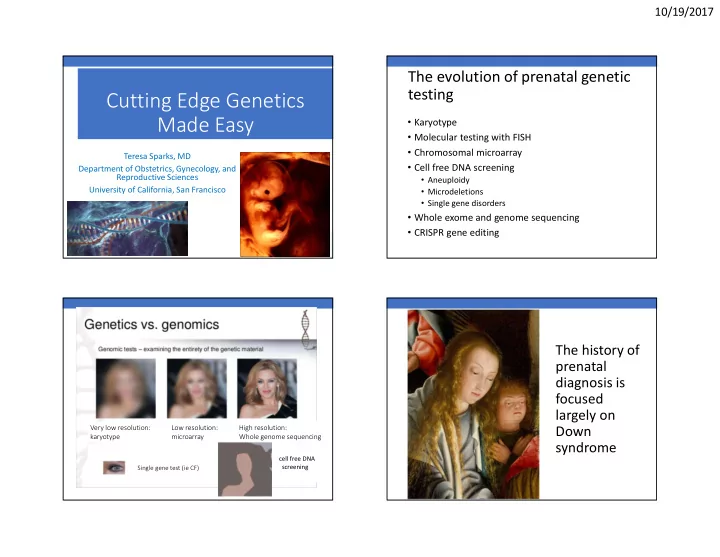
The evolution of prenatal genetic testing

  • Karyotype
  • Molecular testing with FISH
  • Chromosomal microarray
  • Cell free DNA screening
  • Aneuploidy
  • Microdeletions
  • Single gene disorders
  • Whole exome and genome sequencing
  • CRISPR gene editing

Low resolution: microarray Very low resolution: karyotype High resolution: Whole genome sequencing

Single gene test (ie CF) Ccell free DNA screening

The history of prenatal diagnosis is focused largely on Down syndrome

slide-2
SLIDE 2

10/19/2017 2

Why all the focus on Down syndrome?

Lejeune, 1959

1979: NICHD Consensus Panel on Amniocentesis

1997

slide-3
SLIDE 3

10/19/2017 3

Prenatal diagnosis has largely relied on ultrasound and karyotype with recent introduction of MRI and microarray

DOWN SYNDROME!! Fluorescence in situ hybridization - FISH

FISH: uses targeted DNA probe to identify submicroscopic deletions in chromosomes.

  • Detects syndromes such as:

22q11 deletion William’s syndrome Prader-Willi/Angelman syndrome

  • Need to know what and where to target!

William’s Syndrome

Normal Female Chromosomes Deletion 7q11.23 (Williams Syndrome) Two copies present (normal)

slide-4
SLIDE 4

10/19/2017 4

Chromosomal microarrays

  • “Lab-on-a-chip”
  • Detects thousands of

microdeletions and duplications at the same time

Microdeletions are genomic imbalances detected by microarray but not karyotype

Miller et al, 2010, AJHG

Chromosomal Microarray (CMA) for Prenatal Diagnosis

Diagnostic Yield of Chromosomal Microarray in Cases with Normal Karyotype

Indication for Testing Clinically Relevant (N=96) U/S Anomaly

N=755

6.0% AMA

N=1,966

1.7% Positive Screen

N=729

1.7% Other

N=372

1.3%

slide-5
SLIDE 5

10/19/2017 5

“Non-invasive Genome” Non-Invasive Single Gene Tests

  • Maternal and fetal cell free DNA cannot be easily

distinguished

  • However, can identify de novo or paternal gene mutation
  • This includes blood type if mother is Rh negative and fetus

is Rh positive

37 yo G1P0 at 28 wks

slide-6
SLIDE 6

10/19/2017 6

  • N=47 cases
  • Correct in 46 (96.2%)
  • Useful tool in 3rd trimester to distinguish IUGR from

achondroplasia

Chitty LS, et al. Prenat Diagn 35:656, 2015

slide-7
SLIDE 7

10/19/2017 7

Whole Genome and Whole Exome Sequencing

  • Whole Genome Sequencing
  • Obtaining the complete sequence of all 6 billion base pairs
  • f DNA in any individual
  • Whole Exome Sequencing
  • Obtaining the complete sequence of the ~2% of the

genome containing the exons that encode proteins

Whole Exome Sequencing

“Trio”

slide-8
SLIDE 8

10/19/2017 8

36 yo with two prior abnormal pregnancies

  • Severe ventriculomegaly
  • Midface hypoplasia
  • Bilateral echogenic kidneys
  • MSAFP: 18 MoM
  • Amnio: AFAFP 45 MoM
  • Normal microarray

WES results

CRB2: p.W759X CRB2: p.W759X CRB2: p.W759X CRB2: p.N800K CRB2: p.W759X CRB2: p.N800K CRB2: p.N800K

The future: Noninvasive whole genome sequencing?

Patient group based

  • n genomic variants

Patient group Tailored therapy

Precision Medicine

slide-9
SLIDE 9

10/19/2017 9

What is “CRISPR”? What is “CRISPR”?

  • Clustered
  • Regularly
  • Interspaced
  • Short
  • Palindromic
  • Repeats
slide-10
SLIDE 10

10/19/2017 10

What is “CRISPR”?

  • Clustered
  • Regularly
  • Interspaced
  • Short
  • Palindromic
  • Repeats
  • Part of bacterial immune

system against invading viruses

  • Repeating sequences of

genetic code

  • Used to target and

modify “typos” in the three-billion-letter sequence of the human genome

CRISPR 101

Cas9 enzyme can cut DNA at specific locations, and allow small segments of DNA to be added or removed. CRISPR is a collection of DNA sequences that tells Cas9 where to cut

CRISPR-Cas9 gene editing system

RNA guide can target any unique DNA sequence

Genome editing

Cas9 is attached to the RNA guide RNA aligns to the target DNA and Cas9 cuts the DNA The DNA can repair itself, or be amended with an inserted gene

slide-11
SLIDE 11

10/19/2017 11

Clinical applications

  • Edit pig DNA so organs can be transplanted into humans
  • Inject CRISPR-edited WBCs into humans to treat cancer
  • Treat illnesses such as cystic fibrosis, sickle-cell anemia

and Huntington's disease

  • Modify and repair embryos

Stem cell/gene therapy

  • thalassemia
  • muscular dystrophy
  • hemophilia

Fetal Surgery ‘Omics Biology Devices

The Brave New World of Fetal Medicine

Pregnancy Complications

  • preterm labor
  • preeclampsia

Fetal Origins of Adult Disease

  • diabetes
  • hypertension

Healthy Beginnings Rare, Fatal Birth Defects

Conclusions

slide-12
SLIDE 12

10/19/2017 12

10/19/2017

www.mfprecision.ucsf.edu

Maternal copy number variants and cfDNA

Snyder et al, NEJM, 2015

slide-13
SLIDE 13

10/19/2017 13

Meschino et al, Prenatal Diagn, 2016