Current status, research findings, and management response Maurizio - - PowerPoint PPT Presentation

current status research findings and
SMART_READER_LITE
LIVE PREVIEW

Current status, research findings, and management response Maurizio - - PowerPoint PPT Presentation

Floridas ongoing coral disease outbreak: Current status, research findings, and management response Maurizio Martinelli Floridas Coral Disease Response Coordinator Florida Sea Grant Photos: FDEP First signs of trouble Diploria


slide-1
SLIDE 1

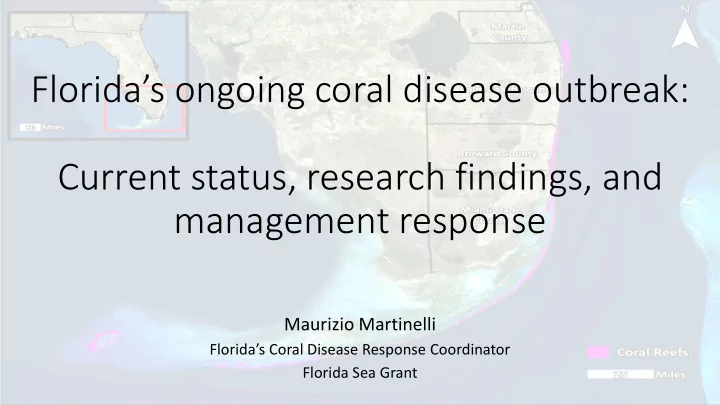
Florida’s ongoing coral disease outbreak: Current status, research findings, and management response

Maurizio Martinelli

Florida’s Coral Disease Response Coordinator Florida Sea Grant
slide-2
SLIDE 2
slide-3
SLIDE 3

Photos: FDEP

slide-4
SLIDE 4

First signs of trouble

Diploria labyrinthiformis Pseudodiploria strigosa Meandrina meandrites Eusmilia fastigiata Dichocoenia stokesii

Photos: Rob Ruzicka, FWC

slide-5
SLIDE 5

The current extent and impact of the coral disease

  • utbreak

Key research findings and the management response Resources for you

We will cover…

Karen Neely, NSU

slide-6
SLIDE 6
slide-7
SLIDE 7
slide-8
SLIDE 8
slide-9
SLIDE 9
slide-10
SLIDE 10
slide-11
SLIDE 11
slide-12
SLIDE 12

= Potential signs of SCTLD

slide-13
SLIDE 13

Susceptible species (

= ESA listed species) ( = major framework builders)

Highly susceptible

Colpophyllia natans (Boulder brain coral) Dendrogyra cylindrus (Pillar coral) Dichocoenia stokesii (Elliptical star coral) Diploria labyrinthiformis (Grooved brain coral) Eusmilia fastigiata (Smooth flower coral) Meandrina meandrites (Maze coral) Pseudodiploria strigosa (Symmetrical brain coral) Pseudodiploria clivosa (Knobby brain coral)

Intermediately susceptible

Montastraea cavernosa (Great star coral) Orbicella annularis (Lobed star coral) Orbicella faveolata (Mountainous star coral) Orbicella franksi (Boulder star coral) Siderastrea radians (Lesser starlet coral) Siderastrea siderea (Massive starlet coral) Solenastrea bournoni (Smooth star coral) Stephanocoenia intersepta (Blushing star coral)

Unknown susceptibility

Agaricia agaricites (Lettuce coral) Agaricia fragilis (Fragile saucer coral) Favia fragum (Golfball coral) Helioseris cucullata (Sunray lettuce) Isophyllia rigida (Rough star coral) Isophyllia sinuosa (Sinuous cactus) Madracis arenterna (Pencil coral) Mussa angulosa (Spiny flower coral) Mycetophyllia spp. (Cactus corals) Scolymia spp. (Disk corals)

slide-14
SLIDE 14

Intermediately susceptible: Tissue loss of 5-10 cm2 per day

Rate of tissue loss

Highly susceptible species: Tissue loss of 20-40 cm2 per day

Dec 2015 Sept 2015

Top: Rob Ruzicka, FWC; Bot: FDEP & NSU

slide-15
SLIDE 15

Species-specific prevalence rate

66-100% prevalence of SCTLD on susceptible species

slide-16
SLIDE 16

Jan 22, 2018

Mortality rate

Feb 5, 2018 Feb 16, 2018 March 1, 2018

Historically, ~100% mortality rate of colonies showing disease signs

Top: FDEP; Bot: Sharp & Maxwell, FWC

slide-17
SLIDE 17

Long tenure. After four years, the disease is still active in endemic areas and

advancing through unaffected reefs.

Large spatial scale. The outbreak covers most of the reef tract, with no

signs of stopping.

High number of species affected. Roughly half of Florida’s 45 stony

corals are susceptible.

High frequency of whole colony mortality. If a colony becomes

infected, it will likely suffer complete mortality.

An unprecedented event?

slide-18
SLIDE 18

Response Partners

slide-19
SLIDE 19

Response Structure

Disease Advisory Committee Reconnaissance and Intervention Team Restoration Trials Team International Cooperation Team Executive Coordination Team (DEP, FWC, NOAA) Management Team Disease Response Coordinator Citizen Engagement Team Regulatory Team Communications Team Coral Rescue Team Epidemiology and Research Team Data Management Team

slide-20
SLIDE 20

Transmission experiments demonstrate this is infectious Therapeutic diagnoses suggest bacterial pathogen(s) are involved Pathogen isolation experimentation has identified pathogenic bacteria Histology suggests that lesions begin in the gastrodermis Temporal progression across species

Key research findings

Day 0 Day 3 Day 8 Transmission via direct contact and through sterile seawater

Source: Ushijima & Paul, Smithsonian. Unpublished.

slide-21
SLIDE 21

Transmission experiments demonstrate this is infectious Therapeutic diagnoses suggest bacterial pathogen(s) are involved Pathogen isolation experimentation has identified pathogenic bacteria Histology suggests that lesions begin in the gastrodermis Temporal progression across species

Key research findings

No treatment Treated w/ amoxicillin & kanamycin

Source: Ushijima & Paul, Smithsonian. Unpublished.

slide-22
SLIDE 22

Transmission experiments demonstrate this is infectious Therapeutic diagnoses suggest bacterial pathogen(s) are involved Pathogen isolation experimentation has identified pathogenic bacteria Histology suggests that lesions begin in the gastrodermis Temporal progression across species

Key research findings

Source: Ushijima et al., Smithsonian. Unpublished.

slide-23
SLIDE 23

Transmission experiments demonstrate this is infectious Therapeutic diagnoses suggest bacterial pathogen(s) are involved Pathogen isolation experimentation has identified pathogenic bacteria Histology suggests that lesions begin in the gastrodermis Temporal progression across species

Key research findings

Source: Landsberg et al., FWC. Unpublished.

slide-24
SLIDE 24

Transmission experiments demonstrate this is infectious Therapeutic diagnoses suggest bacterial pathogen(s) are involved Pathogen isolation experimentation has identified pathogenic bacteria Histology suggests that lesions begin in the gastrodermis Temporal progression across species

Key research findings

Source: Sharp & Maxwell, FWC. Unpublished.

slide-25
SLIDE 25

Antiseptic treatment: chlorinated epoxy Antibiotic treatment: amoxicillin via ‘Base2’ or shea butter

Disease treatments

Top: Brian Walker, NSU; Bot: Karen Neely, NSU

slide-26
SLIDE 26

Coral Rescue

Collection efforts are underway to “rescue” colonies of priority species ahead of the disease front to be kept in on-land facilities for future restoration efforts

Photos: Stephanie Schopmeyer, FWC

slide-27
SLIDE 27

A tissue loss disease presenting on multiple species

What to look for on your reefs

Sequential disease signs by species Lesions sometimes starting in apparently healthy tissue

(1) M. meandrites, C. natans, D. cylindrus (2) Other brain corals (3) Boulder corals

slide-28
SLIDE 28

Stony Coral Tissue Loss Disease Case Definition Field Identification Guide Coral Disease Treatment SOPs Diver Decontamination Protocol International Coordination Team Florida Reef Tract Coral Disease Coordination Calls Available at: https://floridakeys.noaa.gov/coral-disease/ https://floridadep.gov/fco/coral/content/florida-reef-tract-coral-disease-outbreak

Resources

Karen Neely, NSU

slide-29
SLIDE 29

Maurizio Martinelli

Coral Disease Response Coordinator +1 305 795 1221 mmartinelli1@ufl.edu https://floridakeys.noaa.gov/coral-disease/

https://floridadep.gov/fco/coral/content/florida-reef-tract-coral-disease-

  • utbreak