Cumula tive I mpa c ts, Co mmunity Vulne ra b ility De pa rtme nt - - PowerPoint PPT Presentation

cumula tive i mpa c ts co mmunity vulne ra b ility
SMART_READER_LITE
LIVE PREVIEW

Cumula tive I mpa c ts, Co mmunity Vulne ra b ility De pa rtme nt - - PowerPoint PPT Presentation

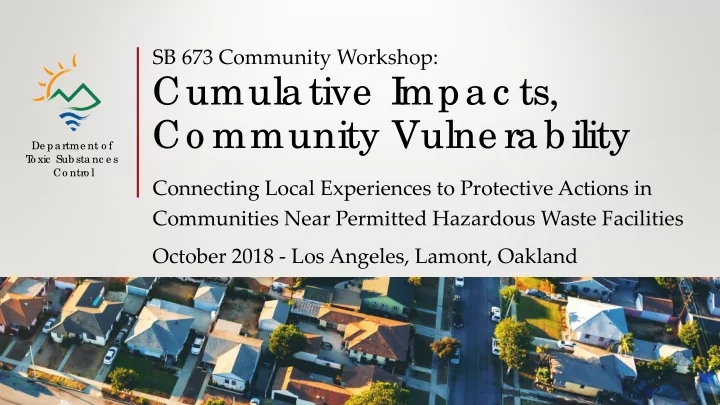
SB 673 Community Workshop: Cumula tive I mpa c ts, Co mmunity Vulne ra b ility De pa rtme nt o f T o xic Sub sta nc e s Co ntro l Connecting Local Experiences to Protective Actions in Communities Near Permitted Hazardous Waste Facilities


slide-1
SLIDE 1

De pa rtme nt o f T

  • xic Sub sta nc e s

Co ntro l

SB 673 Community Workshop:

Cumula tive I mpa c ts, Co mmunity Vulne ra b ility

Connecting Local Experiences to Protective Actions in Communities Near Permitted Hazardous Waste Facilities October 2018 - Los Angeles, Lamont, Oakland

slide-2
SLIDE 2

We lc o me a nd Ope ning Re ma rks

Barbara Lee, Director

California Department of Toxic Substances Control

Ana Mascareñas, Assistant Director for Environmental Justice and Tribal Affairs

California Department of Toxic Substances Control

Kevin Hamilton, Central California Asthma Collaborative Mariah Thompson, California Rural Legal Assistance Ingrid Brostrom, The Center on Race, Poverty & The Environment Nayamin Martinez, Central California Environmental Justice Network

Department of Toxic Substances Control

2

slide-3
SLIDE 3

Department of Toxic Substances Control

3

Symposia: Sacramento & Diamond Bar Partnership with Academic Researchers Stakeholder Consultation Meetings Community Workshops 10/22 – South LA 10/24 – Lamont 10/25 – Oakland Continuing Public Outreach

Pub lic E ng a g e me nt

March & July 2017 Summer 2018-2020 July-August 2018 October 2018 Spring 2019

slide-4
SLIDE 4

Wo rksho p Ag e nda

  • 6:30pmWelcome and Opening Remarks
  • 7:00

Presentation on Draft Regulatory Framework Concepts

  • 7:15

World Café Community Discussion Round 1 - Community Experience Round 2 - Addressing Impacts

  • 8:00

Report Back

  • 8:25

Next Steps and Wrap Up

  • 8:30pmAdjourn

Department of Toxic Substances Control

4

slide-5
SLIDE 5

Co mmunity Ag re e me nt - Guide line s fo r Co nve rsa tio n

  • Speak from the heart: your truth, your experiences, your perspectives. Be

honest, fair, and as candid as possible

  • Listen from the heart: let go of stories that make it hard to hear each
  • ther. All ideas and points of view have value
  • Trust that you will know what to say: no need to rehearse: think

innovatively and welcome new ideas

  • Say just enough: without feeling rushed, be concise and considerate of the

time of others. Share the airtime

  • Cell phone courtesy – be present

Department of Toxic Substances Control

5

slide-6
SLIDE 6

Co mmunity I ntro duc tio ns – T ha nk yo u fo r jo ining us!

At your table, introduce yourself and share: What do you value most in your community?

Department of Toxic Substances Control

6

slide-7
SLIDE 7

Pre se nta tio n: SB 673 Ha za rdo us Wa ste F a c ility Pe rmitting Crite ria

Bonnie Holmes-Gen Senior Environmental Scientist DTSC

Department of Toxic Substances Control

7

slide-8
SLIDE 8

Se na te Bill 673 (L a ra ) Stre ng the ns Sa fe g ua rds in Pe rmits

Department of Toxic Substances Control

8

SB 673

Financial Assurance Permit Violation History Training of Facility Personnel Health Risk Assessment Financial Responsibility Cumulative Impacts Community Vulnerability Minimum Setback Distances – Sensitive Sites

slide-9
SLIDE 9

SB 673 Mitig a tio n, Mo nito ring a nd Pub lic E ng a g e me nt Pro je c ts

Adding Community Protections Beyond:

  • Existing Hazardous Waste Permitting
  • California Environmental Quality Act
  • Tanner Act
  • Local Permitting Agencies

Department of Toxic Substances Control

9

slide-10
SLIDE 10

Department of Toxic Substances Control

10 Permitted Facilities in California Affected Communities The Proposed Pathway Approach

slide-11
SLIDE 11

Storage Treatment Recycling Disposal Generator Transporter

Department of Toxic Substances Control

11

Ha za rdo us Wa ste Ac tivitie s

Permitted Facilities in California Affected Communities The Proposed Pathway Approach

slide-12
SLIDE 12

Ha za rdo us Wa ste Pe rmitte d F a c ilitie s

  • 81 permitted facilities

in California:

  • Treatment
  • Storage
  • Recycling
  • Disposal

Department of Toxic Substances Control

12

slide-13
SLIDE 13

13

slide-14
SLIDE 14

Hazardous Waste Facility Characteristics

Facility Size Number and Type of Environmental Permits Type and Amount of Waste Hazardous Waste Activities Truck Traffic Generated by the Facility Past Violation History

Department of Toxic Substances Control

14

Ha za rdo us Wa ste F a c ility Cha ra c te ristic s

slide-15
SLIDE 15

Me a suring Cumula tive I mpa c ts Unde rsta nding Co mmunity Vulne ra b ility

  • Primary Tool:

CalEnviroScreen 3.0

  • Supplemental Tools:
  • Environmental Justice Screening Method (EJSM)
  • Healthy Places Index (HPI)
  • Air or Water (surface or groundwater) Monitoring
  • Risk from Diesel Truck Routes
  • Hazardous Waste Facility Risk Assessment
  • Toxic Hot Spots Assessment
  • Facility Compliance History
  • Designation as Impacted Community (AB 617)

Department of Toxic Substances Control

15

Permitted Facilities in California Affected Communities The Proposed Pathway Approach

slide-16
SLIDE 16

Department of Toxic Substances Control

16

Permitted Facilities in California Affected Communities The Proposed Pathway Approach

slide-17
SLIDE 17

Co mmunity Pro je c t I de a s - Sho rt L ist

  • Reduced truck traffic

emissions, replacement with clean trucks, rerouting

  • Safer chemical substitutions
  • Community investments in

improved environmental health

  • Community monitoring of

pollution, including air, water, dust, soil, and biomonitoring

  • Healthy homes assessments and

lead abatement

  • Facility pollution prevention

measures

  • Other ideas?

Department of Toxic Substances Control

17

slide-18
SLIDE 18

SB 673 (L a ra ) - Re g ula to ry Co nc e pts

Initial Recommendation of Facility Action Pathways

  • 1. Review hazardous waste facility activities
  • 2. Assess combined environmental impacts and

community responses to pollution.

Department of Toxic Substances Control

18

Permitted Facilities in California Affected Communities The Proposed Pathway Approach

Table Discussion: What impacts has your community experienced near permitted facilities?

slide-19
SLIDE 19

SB 673 (L a ra ) - Re g ula to ry Co nc e pts

Public Review and Draft List of Facility Action Pathways

  • 1. Public review and comment.
  • 2. Place facilities on one of three action pathways
  • 3. Review facility action pathways periodically

Department of Toxic Substances Control

19

Table Discussion: What information is needed to best understand community impacts and vulnerabilities?

slide-20
SLIDE 20

Pro po se d Ac tio n Pa thwa ys

Department of Toxic Substances Control

20

I

  • Mitigation
  • Monitoring
  • Public

Engagement

II

  • Mitigation OR

Monitoring Public Engagement

III

  • Public

Outreach

slide-21
SLIDE 21

SB 673 (L a ra ) Re g ula to ry Co nc e pts

Permit Application Review

  • Additional public review
  • Public input on monitoring, mitigation and

engagement strategies

  • Facilities develop specific action plan depending on

pathway

  • Permit decision with conditions

Department of Toxic Substances Control

21

Table Discussion: What actions should be considered to address cumulative impacts and community vulnerabilities?

slide-22
SLIDE 22

Department of Toxic Substances Control

22

Symposia: Sacramento & Diamond Bar Partnership with Academic Researchers Stakeholder Consultation Meetings Community Workshops 10/22 – South LA 10/24 – Lamont 10/25 – Oakland Continuing Public Outreach

Pub lic E ng a g e me nt

March & July 2017 Summer 2018-2020 July-August 2018 October 2018 Spring 2019

slide-23
SLIDE 23

SB 673 DT SC Co nta c ts

  • Ana Mascareñas, Assistant Director for Environmental Justice and Tribal

Affairs (916) 956-1896

  • Nelline Kowbel, Acting Permitting Division Chief

(510) 540-3807

  • Bonnie Holmes-Gen, Senior Environmental Scientist

(916) 323-9757

Department of Toxic Substances Control

23

Email: permits_hwm@dtsc.ca.gov

slide-24
SLIDE 24

Co mmunity Co nve rsa tio ns - I nstruc tio ns

  • 1. Please join a table with other participants

and a Host.

  • 2. There will be two rounds. Listen for

the conversation topic for Round 1.

  • 3. Share your thoughts. Each round of

conversation is 20 minutes.

  • 4. If you wish, Move to a different table

when time is called and continue the conversation on a follow up topic.

  • 5. Please listen to your table Host for the

next conversation topic. 6. Select one person who is willing to

report back on the ideas that you

discussed in your group. Everyone will help in identifying the important ideas to share.

  • 7. Express yourself. Feel free to jot down

ideas, draw, or doodle during the conversation.

Department of Toxic Substances Control

24

slide-25
SLIDE 25

Que stio ns fo r Disc ussio n

Round 1 - Community Experience:

  • What impacts has your community

experienced near permitted facilities?

  • What makes your community vulnerable

and sensitive to these impacts?

  • What steps do permitted facilities take to

proactively engage community members? Round 2 - Addressing Adverse Impacts:

  • What actions can be taken to lessen

impacts in your community?

  • How can monitoring be used to better

understand and address impacts?

  • What steps do permitted facilities take

to reduce impacts?

Department of Toxic Substances Control

25

slide-26
SLIDE 26

Re po rt Ba c k a nd T ying I t T

  • g e the r
  • Share one idea that you discussed
  • Please limit your report out to 2 minutes to ensure that all

tables get to report

  • Only add new ideas – we will track all ideas
  • We will continue to share ideas as time permits

Department of Toxic Substances Control

26

slide-27
SLIDE 27

Thank you for joining us this evening and sharing your time, thoughts, and input with us.

Department of Toxic Substances Control

27

T ha nk Yo u