Culture of Hybrid Striped Bass Phase II and Phase III Production J. - - PowerPoint PPT Presentation

culture of hybrid striped bass
SMART_READER_LITE
LIVE PREVIEW

Culture of Hybrid Striped Bass Phase II and Phase III Production J. - - PowerPoint PPT Presentation

Culture of Hybrid Striped Bass Phase II and Phase III Production J. Trushenski SOUTHERN ILLINOIS UNIVERSITY CARBONDALE FISHERIES AND ILLINOIS AQUACULTURE CENTER Phase II Production Production Cycle From Phase-I harvest to 1 year old


slide-1
SLIDE 1

SOUTHERN ILLINOIS UNIVERSITY CARBONDALE FISHERIES AND ILLINOIS AQUACULTURE CENTER

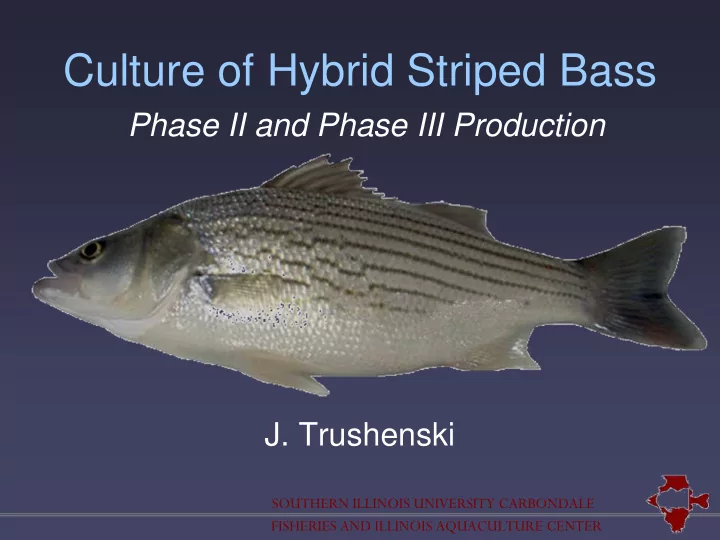
Culture of Hybrid Striped Bass

Phase II and Phase III Production

  • J. Trushenski
slide-2
SLIDE 2

Phase II Production

Production Cycle

  • From Phase-I harvest to 1 year old
  • Growing season: June to October
  • Can survive winters well
  • Grow from 1-2 to 10 inches (25-50 to 250 mm)

Most rapid weight gain occurs during Phase II

  • Highest growth rates
  • Aggressive feeding

Taking full advantage of rapid growth stage requires careful monitoring of water quality, nutrition, and feed management

slide-3
SLIDE 3

Feeds

  • 36-50% protein
  • 10-16% fat

Formulations currently in use

  • Salmon/trout diets
  • Striped bass diets

Floating pellets preferred

  • Observe fish status
  • Easy opportunity to generally assess survival,

size, and condition

  • Reduce or increase amount of feed

according to demand

To support rapid muscle gain and high activity level, typical feeds contain

slide-4
SLIDE 4

Pond Culture

Phase II are stocked at lower densities

  • 4,000 – 100,000 fish/acre
  • Emergency aeration is essential

For uniform size and increased survival

  • 10,000 to 24,000 fish/acre
  • Above 24,000 fish/acre need constant aeration
slide-5
SLIDE 5

Pond Culture

  • No need for additional fertilizer
  • Feed and fish waste provide nutrients to support

phytoplankton

  • Plankton may shade out submerged vegetation
  • Fertilizer increases phytoplankton and negatively effect

O2 and pH

slide-6
SLIDE 6

Harvest

Seine harvest similar to Phase I

  • Typically harvest when temperatures

Typically harvest when temperatures are below 54 are below 54° °F (12 F (12° °C) C)

  • Expect 0.25

Expect 0.25-

  • 0.5 lb fish (8

0.5 lb fish (8 – – 10 in) 10 in)

  • 85% survival is common

85% survival is common

  • Concludes 1st year in production cycle

Restock for Phase III

  • Size grade fish by hand

Size grade fish by hand

  • Stock similar sized fish

Stock similar sized fish together for phase III together for phase III growout growout

slide-7
SLIDE 7

Phase III Production

Fish are grown out to market size

  • Second year of production cycle
  • 1 ½ to 2 lbs (0.7 to 1 kg)
  • Overwinter following Phase II harvest
  • Growing season June - October

Production intensity increases

  • Large production load
  • Careful monitoring of water quality, feed, and predators

Several production strategies employed

  • Ponds
  • Cages
  • Vertical raceways
  • Indoor recirculation systems
slide-8
SLIDE 8

Pond Culture

Larger ponds, lower stocking rates

  • 1-10 acres (0.5 to 4 ha ), usually 5-6 acres (2-2.5 ha)
  • 3440 fish/acre (8600 fish/ha)

Susceptible to predation

  • Birds, raccoons
  • Deterrent devices (noise makers, decoys, etc.) often used

Transition to slightly lower nutrient density feeds

  • 36-38% protein, 10% lipid typical

Feed by blower

  • Twice daily
  • 2-3% of the combined weight of the fish
  • Never above 280 kg/ha
slide-9
SLIDE 9

Harvest

Harvest before third growing season

  • Seines
  • Boom truck and loading net
  • 90% survival is common

Live cars are often used to hold fish in ponds while slaughter or other preparation occurs bank-side

slide-10
SLIDE 10

Recirculating Aquaculture System (RAS) Culture

Most intensive form of aquaculture Increased control over production environment

  • Little influence of

natural limitations

  • Predation
  • Weather
  • Access

With increased control comes increased complexity

  • Culturists must provide

and maintain complete suite of environmental criteria

slide-11
SLIDE 11

Components of RAS

Culture Tanks

  • Round tanks, raceways, etc.

Aeration or Oxygenation

  • Diffusers, liquid O2 injection, etc.

Solid Waste Removal

  • Sedimentation basins, screen filters, bead filters

Biological Filtration

  • Fluidized bed filters, trickle filters, rotating biological contactors,

etc.

Optional components

  • Foam fractionation, carbon dioxide stripping, ozone or UV

disinfection

slide-12
SLIDE 12

Rapid Production, High Yields

Produce 0.33 to 0.5 lbs/gallon of water Stocked at 0.25 lb will take approximately 5-7 months to reach market size (1.25 to 2.0 lbs.)

slide-13
SLIDE 13

General RAS Characteristics

Advantanges

Reduced water requirements Year-round production Use existing buildings High yields per gallon Improved feed conversions Greater security

Disadvantages

High initial investment Complex systems Expensive equipment Increased power usage and dependency Water quality management Inefficiencies in filtration

slide-14
SLIDE 14

Other Considerations for RAS

High density livestock production can resulted in increased occurrence and quicker spread of disease

  • Similar to traditional feedlots

Greater capital needed for construction and maintenance Increased training necessary for staff

slide-15
SLIDE 15

Cages and Vertical Raceways

Utilize existing surface water bodies to culture fish Constructed of durable and non-toxic mesh material mounted on a frame

  • Simplifies feeding
  • Reduces predation
  • Allows circulation of water through cage
  • High stocking densities may require mechanical circulation

and/or aeration

  • Floats and is anchored to a dock or weight
  • Easy access
slide-16
SLIDE 16

HSB Cage Culture

Can grow from one gram to 1.5 to 2 pounds in 18 months Stocking densities range from 2.5 to 5 fish per cubic foot

  • One 4’x4’x8’ cage per

surface acre of water at a high stocking density with water circulation and aeration

slide-17
SLIDE 17

HSB Vertical Raceway Culture

Similar to cages, but air lifts are used to move water through raceway (up to 450 gallons/min) Advantages over traditional cages

  • Higher stocking densities
  • 10-15 fish/cubic foot
  • Yields as high as 5000

pounds/acre/year

  • Improved water quality
  • Reduced manpower
  • Less off flavor

Need emergency backup generators

slide-18
SLIDE 18

Marketing

Some markets prefer live fish or fillets, but whole-on- ice marketing is typical Slaughtered using ice bath or electrocution

  • Rapid death and careful handling is important
  • Cuts, tears and bruising make fish unappealing

Whole-on-ice

  • Very small = 0.75 to 1.0 lbs.
  • Small = 1.0 to 1.5 lbs.
  • Medium = 1.5 to 2.0 lbs.
  • Large = 2.0 to 2.5 lbs.
  • Jumbo = 2.5 lbs. and up

Live

  • 1.25 to 1.75 lbs.
  • >2 lbs. too large
slide-19
SLIDE 19

3-Phase vs. 2-Phase Production Cycle

Advantages No size grading and re- stocking between phase II and phase III Reduced stress from Handling Reduced costs Stock larger fingerlings (10 g) to reduce size variation

Disadvantages Less control of population density Survival is hard to estimate Increased cost of fingerlings