Live-Transport of Hybrid Striped Bass: Harvest, Holding and Hauling - - PowerPoint PPT Presentation

live transport of hybrid striped bass harvest holding and
SMART_READER_LITE
LIVE PREVIEW

Live-Transport of Hybrid Striped Bass: Harvest, Holding and Hauling - - PowerPoint PPT Presentation

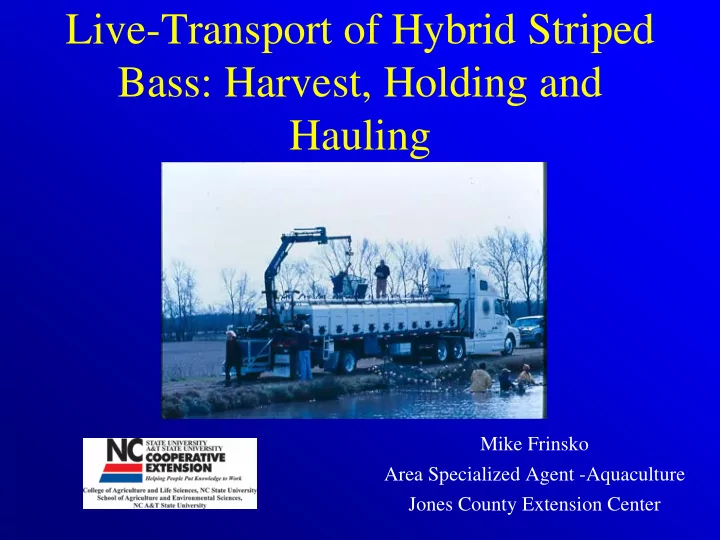
Live-Transport of Hybrid Striped Bass: Harvest, Holding and Hauling Mike Frinsko Area Specialized Agent -Aquaculture Jones County Extension Center Live-Transport Definition: Movement of fish from one environment to another

slide-1
SLIDE 1

Live-Transport of Hybrid Striped Bass: Harvest, Holding and Hauling

Mike Frinsko Area Specialized Agent -Aquaculture Jones County Extension Center

slide-2
SLIDE 2

Live-Transport

  • Definition: “Movement of fish from one

environment to another”

  • Goal: Consistently provide healthy fish in good

condition

  • Objective: Limit stressors!!!!!

– Chemical (D.O., pH, NH3) – Physical (scale abrasion, fining) – Biological (confinement, social stress)

slide-3
SLIDE 3

Harvesting Strategies

  • Purge 1-3 days before

Harvest

  • Harvest in cool morning

periods

  • Pull net slowly/uniformly
  • Net -free from “pockets”
  • Electric ties trimmed
  • Use KNOTLESS mesh

netting

slide-4
SLIDE 4

Harvesting Strategies

  • 4 acre pond= 5000 lbs

in 1 “pull”

– 8000 lbs+ in winter

  • Keep ½ in live car and

½ in seine

  • Don’t overcrowd!

– Check DO every 5 min. – Use salt, 02/air – Monitor stress signs

slide-5
SLIDE 5

Harvesting Strategies

  • Concentrate fish

slowly in net

  • Don’t overcrowd!

– Check DO every 5 min. – Use salt, 02/air – Monitor stress signs

  • May use tank/tarp to

maintain environmental conditions

slide-6
SLIDE 6

Harvesting Strategies

  • Fish removed with

scooping action of basket and assisted with dip nets

  • Don’t exceed:

– 50-100 lbs per net foodfish – 25-50 lbs phase IIs – 20-25 lbs fingerlings

  • verloaded
slide-7
SLIDE 7

Harvesting Strategies: Phase II Grading

  • Work fish slowly to

pescilator/grader

  • Move fish in cool

weather

  • Don’t overcrowd!

– Check DO every 5 min. – Use salt, 02/air – Monitor stress signs

slide-8
SLIDE 8

Harvesting Strategies

  • Truck equipped with

boom crane

  • Tanks filled with pond

water = no acclimation

– 4-8 ppt salt

  • Liquid O2 tanks, D.O.

above saturation

  • Sufficient Labor
  • Working equipment
slide-9
SLIDE 9

Holding Systems

  • Pre-conditions Fish to Withstand Stress of

Live Hauling

  • Provides opportunity to:

– Acclimate to High Density (Toughens Fish) – Purge waste and off-flavors – Grade fish – Treat with approved therapeutics – All-weather access = market flexibility

slide-10
SLIDE 10

Holding Systems: Circular Pools

  • Grain bin “ring” with

liner

– 20’ dia. x 4’ height – Easy to repair, affordable – Self cleaning center drain

  • CO2 stripping with

aeration (agitation)

slide-11
SLIDE 11

Holding Systems: Circular Pools

  • Oxygen injection via

an “O2 saturator”

– 5-8 ppm

  • Single pass system

– approximately 4 complete exchanges every day – Check NH3 – Keep Salt at 4-8 ppt for 12 hours

slide-12
SLIDE 12

Holding Systems: Circular Pools

  • Acclimate to pool

– Fill pool in advance to warm /cool, saves time

  • May hold as much as

5000 lbs foodfish in summer (~ 0.5 lbs /gal)

– Temperature and size dependent – Phase II’s 2500-3000 lbs – Fingerlings 2000-2500 lbs

slide-13
SLIDE 13

Handling Techniques After Purging

  • Crowding

screen/grader

  • Isolate size required
  • Easily select quantity

needed for market

  • Slow crowding,

conditions fish for transit

slide-14
SLIDE 14

Handling Techniques After Purging

  • Weigh fish, record

stocking rate

  • PII’s .75-1 lb/gal.
  • Foodfish-1.25 lbs/gal

(Winter 1.5-1.75)

  • Adjust to situation, i.e.

duration of haul, equipment type, tanks, etc

slide-15
SLIDE 15

Handling Techniques After Purging

  • Loading smaller

quantities reduces stress and physical damage

  • Acclimate slowly (5

min/2oC change in temp.)

– Use tank water if possible – Always check D.O. levels >6 ppt

slide-16
SLIDE 16

Handling Techniques After Purging

  • Place, not pour, fish

into receiving water

  • Cautious handling will

result in few sites of infection (pulled scales, punctures)

  • Use knotless mesh

nets and smooth, clean surfaced baskets

slide-17
SLIDE 17

Live Hauling

  • Many truck/tank designs
  • Use fiberglass or

aluminum tanks

– insulated

  • Use liquid O2
  • Drivers responsible for

fish from farm to market

  • Have all state transport

permits

slide-18
SLIDE 18

Live Hauling

  • Outlet on side of tanks

for ease of unloading

  • Internal baffles reduce

H2O movement

  • Haul at 4-8 ppt NaCl
  • Check O2 every 1-3

hours

– Note behavior, fin color

  • Acclimate to receiving

facility before release

slide-19
SLIDE 19