Cultural Resource M Management U.S. Na Nation onal Park Service - - PowerPoint PPT Presentation

cultural resource m management u s na nation onal park
SMART_READER_LITE
LIVE PREVIEW

Cultural Resource M Management U.S. Na Nation onal Park Service - - PowerPoint PPT Presentation

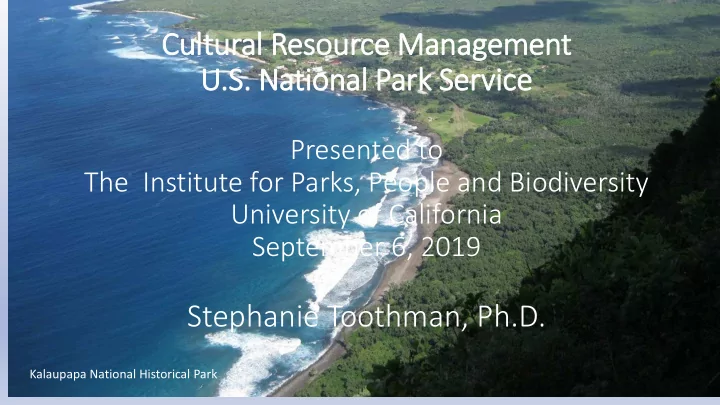
Cultural Resource M Management U.S. Na Nation onal Park Service Presented to The Institute for Parks, People and Biodiversity University of California September 6, 2019 Stephanie Toothman, Ph.D. Kalaupapa National Historical Park


slide-1
SLIDE 1

Cultural Resource M Management U.S. Na Nation

  • nal Park Service

Presented to The Institute for Parks, People and Biodiversity University of California September 6, 2019

Stephanie Toothman, Ph.D.

Kalaupapa National Historical Park

slide-2
SLIDE 2

Cultural Resource M Management

The N National l Park S Serv rvic ice w will ill protect, preser erve, a and foster er a apprec eciation o

  • f

the he cul ultural r resources in n its c cus usto tody and nd de demonstrate te i its r respect f for t the he people les t traditio ionall lly a asso ssociated with thos

  • se r

resou

  • urces throu
  • ugh a

approp

  • priate

programs ms of research, p planning, a and stewardship.

National P Park Service M e Managem ement P Policies es 2006, C Cultura ral Resourc rce Ma Management, Chapter F r Five ve.

Big Hole National Battlefield

slide-3
SLIDE 3

Cultu tural R Resou

  • urces

ces: Tangible and intangible aspects

  • f cultural systems, both living and dead, that are

valued by or representative of a given culture or that contain information about a culture.

Effigy Mounds National Monument Independence National Historical Park

slide-4
SLIDE 4

Cu Culture/Nature: Natural resources such as fish, clean water, and plant materials may be considered as cultural resources if they support a way of life.

Musselshell Meadows, Nez Perce National Historical Park Salmon returning to the Elwha River, Olympic National Park

slide-5
SLIDE 5

NPS Cultural Resources Classifi

ficati tions

  • Arch

cheological R Resource ces

  • Cultural L

Landscapes

  • Ethnograp

aphic R Resources

  • Historic a

and P Prehistoric c Struct ctures

  • Museum C

Collections

Fort Monroe National Monument

slide-6
SLIDE 6

Archeol eological R Resou

  • urces

ces a are t e the s sites es a and m mater erial remain ins of

  • f past h

t human l life or

  • r activ

ctivit itie ies w which a are of

  • f

arch cheolo logic ical i l interest s such ch a as too

  • ols

ls, p , pottery, r rock ck carvings, a and h human an r remai ains.

Biscayne National Park Jamestown, Colonial National Historical Park Petrified Forest National Park Knife River Indian Villages National Historic Site

slide-7
SLIDE 7

Cultural La l Landscapes r rep epresent th the c e com

  • mbin

ined w works o

  • f

nature an and m man

  • an. They a

are g geographic a areas, i including both c cultural a and n natural r resources a associated with a a historic e event, a activity, o

  • r person o
  • r exhibiting o
  • ther

cultural o

  • r aesthetic v

values.

Gettysburg National Military Park National Mall, Lincoln Memorial

slide-8
SLIDE 8

Ethnogr graphic Resources are r resources o

  • f cultural

sign gnificance t to the p peoples t traditionally associated wi with them. m.

Historic Salmon Drying Rack, Brooks Camp Katmai National Park and Preserve Chaco Culture National Historical Park

slide-9
SLIDE 9

Histor

  • ric a

and Prehistoric B c Buildings a are c e crea eated ed principally t to provide s shelter f for h human a activities.

Belmont-Paul Women’s Equality National Monument Chaco Culture National Historic Park Olympic National Park

slide-10
SLIDE 10

Histor

  • ric a

and Prehistoric S c Structu tures es a are f e functi tion

  • nal

con

  • nstructio

ions m made f for

  • r p

purposes o

  • th

ther th than human sh shelter

Sheep Shearing Pens John Day Fossil Beds NM Cairn, Mount Rainier National Park

slide-11
SLIDE 11

Museum Obje ject cts a are m materia ial th l thin ings p pos

  • sses

essin ing functional, a aesthetic, c cultural s symbolic, a and o

  • r

sci cien entifi ific v c value, u , usually lly m movable le b by natu ture or

  • r

des esig

  • ign. N

. NPS m main intain ins b both

  • th cu

cultural a l and n natu tural l col

  • lle

lect ctio ions.

slide-12
SLIDE 12

The N Nati tion

  • nal P

Park S Servi vice m ce manages es c cultu tural resou

  • urces

ces in e ever ery u unit of the Nati tion

  • nal P

Park S System em

slide-13
SLIDE 13

The m e majo jorit ity of

  • f th

the e Natio tional P l Park S System’s u unit its were d designated ed t to commem emor

  • rate a

and p pres eser erve nationally s significant e events, p people, a and p places.

Ellis Island Clara Barton National Historic Site Cesar E. Chavez National Monument Tuskeegee Airman NHS Saint Gaudens National Historical Park

slide-14
SLIDE 14

The N e Natio ional P l Park S Ser ervic ice t tells ells s stor

  • rie

ies a and m manages res esources th that s span th thousands of

  • f yea

ears f from ea early ly sites of

  • f human h

habit itatio ion t to

  • th

the 1 1960s ci civil r vil rights mov

  • vem

emen ents.

Arlington Man Site, Channel Islands National Park Brown v. Board of Education National Historic Site

slide-15
SLIDE 15

The National P Park S Service manages

  • 2,000,000 prehistoric and

historic archaeological sites

  • 27,000 historic and

pre-contact structures

  • 2100 Cultural Landscapes
  • 3,500 statues, monuments and memorials
  • 167,000,000 million objects and archival documents
slide-16
SLIDE 16

The N Nati tion

  • nal P

Park S Servi vice m ce manages es c cultu tural r resou

  • urces

ces within a a nation

  • nal

framework of historic p pres eser ervati tion

  • n

and e envi viron

  • nmental l

laws, p proc

  • clamati

tion

  • ns, e

execu ecuti tive

  • rders, r

regulations ns, s standar ards a and g guidelines t that provi vide t e the f e foundati tion

  • n f

for o

  • ur m

managem emen ent p t polici cies es.

.

slide-17
SLIDE 17

This framework mandates a high level

  • f stewardship for

cultural resources, while providing the flexibility to address the diversity of cultural resources within the national park system

slide-18
SLIDE 18

U.S. Laws, Standards, and Management Policies that guide NPS cultural resource management

  • The Antiquities Act (1906)
  • The National Park Service Organic Act (1916)
  • The Historic Sites Act (1935)
  • The National Historic Preservation Act (1966)
  • Native American Graves Protection

and Repatriation Act (1990)

  • Secretary of the Interior’s Standards and Guidelines
  • National Park Service Management Policies (2006)

.

slide-19
SLIDE 19

National Park Service Organic Act (1916)

  • Mandates the preservation of the “historic sites” within

the parks, while providing for their enjoyment by present and future generations of Americans

  • This dual mandate creates challenges for the

preservation of cultural resources. Cultural resources are finite and subject to deterioration from age, consumptive use, and exposure to the environment.

slide-20
SLIDE 20

Nati tion

  • nal H

Histor

  • ric P

Pres eser ervation Ac Act 1966

  • Establishes a federal-state-tribal-local government partnership to

carry out the national preservation program

  • Directs all Federal Agencies to establish historic preservation

programs to protect historic properties under their jurisdiction (Section 110)

  • Requires federal agencies to consult with interested parties on the

potential effects of proposed federal undertakings on historic properties eligible for the National Register of Historic Places (Section 106)

  • Establishes the National Register of Historic Places, maintained by the

National Park Service

slide-21
SLIDE 21

NPS NPS Managem emen ent P Policies outline a process of research, planning, and stewardship for parks to manage their cultural resources NPS NPS Direc ector

  • r’s Order

ers and Ha Handbook

  • ks provide

specific guidance and technical information to support these policies.

slide-22
SLIDE 22

Resea earch: The NPS conducts an interdisciplinary program of research into the cultural resources of each park. Research goals include:

  • Providing a systematic, adequate, and current information base

representing park cultural resources and traditionally associated peoples in support of planning, management, and operations.

  • Ensuring appropriate protection, preservation, treatment, and

interpretation of cultural resources, employing the best current scholarship.

  • Developing appropriate technologies and methods for monitoring,

protecting, preserving, and treating cultural resources.

slide-23
SLIDE 23

Signifi ficance: ce: T The N Nati tional R Register o

  • f H

Histor

  • ric

c Places es C Criter eria f for E Evaluati tion

  • n

Objects, sites, districts and buildings:

  • A. Associated with events that have made a

significant contribution to the broad patterns of our history

Boott Mills, Lowell National Historic Park U.S.S. Arizona, Pearl Harbor

slide-24
SLIDE 24

National Register Criterion B

Associated with the lives of significant persons in

  • ur past

John F. Kennedy National Historic Site Harriet Tubman National Historic Site

slide-25
SLIDE 25

Nati tional Register Criterion C C

Embody the distinctive characteristics of a type, period, or method of construction, or Represent the work of a master, or that possess high artistic values, or that represent a significant and distinguishable entity whose components may lack individual distinction

Parterre at Hampton National Historic Site Visitor Center, Dinosaur National Monument

slide-26
SLIDE 26

Nati tional Register Criterion D D

  • D. Have yielded or may be likely to yield,

information important in history or prehistory.

Ice patch archeology, Glacier National Park Denali National Park

slide-27
SLIDE 27

Park rk Baseline Inventori ries and Documents

  • Historic Resource Studies and National Register of Historic Places

nomination forms

  • Archeological Sites Management Information System, Research

Designs, and Reports

  • National Catalog of Museum Objects
  • List of Classified Structures (Historic Structures)
  • Cultural Landscape Inventories and Reports
  • Ethnographic Resources Inventories and Reports
slide-28
SLIDE 28

Pl Planning: i : identify options f for p r protecting and preservi ving r resources, using inform rmation on:

  • The significance and integrity of the resource
  • Potential threats such as fire, pests, human activities and

environmental impacts such as climate change

  • The feasibility of proposed treatment options (preservation,

rehabilitation, restoration, reconstruction)

  • Available resources (funding, materials, lifecycle issues,

technical skills) and park priorities.

slide-29
SLIDE 29

Stewardship

  • Stewardship is the implementation phase of this cultural resource

management process.

  • Proposed treatments are implemented and documented in

accordance with the Secretary of the Interior’s Standards.

  • Conditions are monitored
  • Adverse effects are avoided or mitigated when possible
  • When loss is unavoidable, resources are documented to create a

permanent record of the cultural information they contain.

slide-30
SLIDE 30

Secr ecretary of

  • f th

the I Interio ior’s S Standards a and G Guid idelin lines for A Archeol eology a and H Histor

  • ric P

Pres eser ervation

The four standards for historic buildings and structures illustrate the basic NPS approach to managing cultural resources… protecting and preserving the structure, form, original materials, and location of an building, structure, object, landscape or site is the preferred treatment.

  • Preservation
  • Rehabilitation
  • Restoration
  • Reconstruction
slide-31
SLIDE 31

Preservation: For buildings, structures, and

landscapes, the preferred treatment is preservation, maintaining the resource in good condition and retaining as much original fabric as possible.

Volcano House Maintenance Project, Hawaii Volcanoes National Park

slide-32
SLIDE 32

Rehabilitation of buildings, structures and landscapes for continued or new use involves bringing them up to good condition while maintaining character- defining features and replacing deteriorated materials with the same or similar materials.

Rehabilitation of Carpenter’s Shop at Cane River Creole National Historical Park

slide-33
SLIDE 33

Restoration involves major work to restore a building, structure or landscape after severe damage or to its original period of significance.

Pu’ukohola Heiau National Historic Site Restoring the Heiau by traditional Native Hawaiian methods after an earthquake.

slide-34
SLIDE 34

Reconstruction is permitted if directed by Congress or if critical to understanding the site. It must be accomplished following strict guidelines requiring adequate documentation and accurate materials and workmanship.

Original and Reconstructed Watchtower, Manzanar NHS

slide-35
SLIDE 35

Super erinten enden ent’s R Role e in C Cultural Resou

  • urce

e Management

  • Superintendents are delegated the responsibility to carry out the

requirements of these laws, regulations, and policies within their

  • parks. They are directly accountable to the regional and national NPS

directorates.

  • Superintendents are directed to work with qualified professionals to

ensure that research, planning, and stewardship policies are met.

  • Superintendents are responsible for consulting with interested parties

and traditionally associated peoples in accordance with laws such as NHPA, NAGPRA, and government-to-government responsibilities under Indian Law.

slide-36
SLIDE 36

Inter eres ested ed P Parties

  • Tribal, state, and local governments
  • State and tribal historic preservation officers
  • The Advisory Council on Historic Preservation
  • Other interested federal agencies
  • Traditionally associated peoples
  • Present-day park neighbors
slide-37
SLIDE 37

Traditi tionally Associ ciated P Peoples

Those peoples whose cultural systems or ways of life have an association with park resources and values that predates the establishment of the park. Examples:

  • Native Alaskans
  • American Indians
  • Native Hawaiians and Pacific Islanders
  • Hispanic and African Americans
  • Acadians
slide-38
SLIDE 38

Olympic National Park rk and El Elwha R River r Resto toration: C Consulta tation re requirements

The restoration of the river and its salmon runs had the potential to affect:

  • Fish populations, river flows and banks, historic dams listed on the

National Register of Historic Places and unknown numbers of archeological sites and ethnographic resources inundated behind the dams

  • Interested parties and Traditionally Associated People affected –

Federally-recognized tribes, neighboring communities, state and federal agencies, national and regional preservation and conservation

  • rganizations
slide-39
SLIDE 39

List of O On-line Sites for r Furt rther I r Inform rmation

National Park Service: www.nps.gov/history, www.nps.gov/tps, www.nps.gov/subjects/nationalregister/index.htm. www.nps.gov/history/local-law/arch_stnds_1.htm President’s Advisory Council on Historic Preservation: www.achp.gov National Trust for Historic Preservation: www.savingplaces.org State and Local Historic Preservation Websites