
SLIDE 1
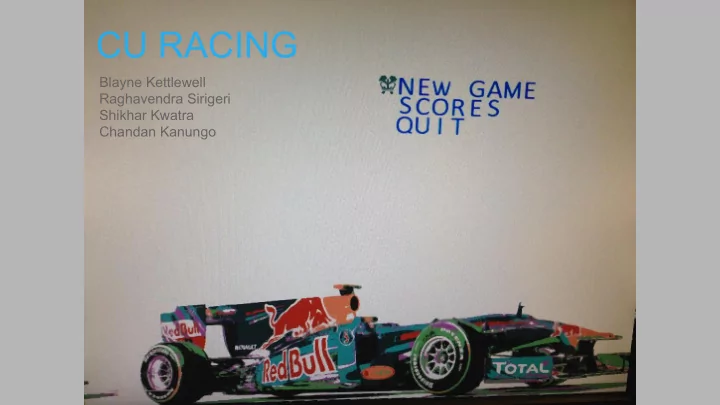
CU RACING
Blayne Kettlewell Raghavendra Sirigeri Shikhar Kwatra Chandan Kanungo
CU RACING Blayne Kettlewell Raghavendra Sirigeri Shikhar Kwatra - - PowerPoint PPT Presentation
CU RACING Blayne Kettlewell Raghavendra Sirigeri Shikhar Kwatra Chandan Kanungo Project Concept Evolution Precedent Ideas Early Concept Final Gameplay Project Goals Design a Sprites Graphics engine inspired from the TI TMS9918
Blayne Kettlewell Raghavendra Sirigeri Shikhar Kwatra Chandan Kanungo
Early Concept Precedent Ideas Final Gameplay
○ Extend texture resolution from 8 pixels to 32 pixels, sprite resolution >= 64 pixels ○ Update colors from Light/Dark pixels to 9 bit colorspace (512 color alternatives/pixel)
○ No Graphics MIFs! ○ Allows for simplified creation of new game tracks and menus ○ Mitigates limited RAM space on the Cyclone V
0x1FFF 0x0000 Red Color Pattern Table “Bit 2” 0x1FFF 0x0000 Red Color Pattern Table “Bit 1” 0x1FFF 0x0000 Blue Color Pattern Table “Bit 0”
Port RAMs to represent 512 colors/pixel
address space”
(32 bits/ pattern) ○ 256 patterns Green Color Pattern Tables
Pattern0 Line 0 (U32) Pattern0 Line 1 (U32) Pattern0 Line 1 (U32) Pattern0 Line 1 (U32) Pattern0 Line 1 (U32) Pattern0 Line 1 (U32) Pattern0 Line 31 (U32) Pattern1 Line 0 (U32) Pattern0 Line 31 (U32) Pattern1 Line 0 (U32) Pattern0 Line 31 (U32) Pattern1 Line 0 (U32)
Name Table 0xFFFF 0x0000 Name0 (U8) Name1 (U8) 1 2 3 4 ... ... Name2 (U8) Name3 (U8) Name4 (U8) Pattern Tables LUTs Name Index Calc. hCount vCount 64 x 1024 Patterns 2D Background Pattern Space
Field of View
○ 32 pixels “nameOffsetX/Y” ○ 1 pixel “pixelOffsetX/Y”
design choice ○ Made movement more complicated than necessary
isolating a few bugs
7 8 1 2 3 2 4
“trackXNames.txt” grassYellow.png straightGrassLeft.png roadTileWithoutLine.png roadTileWithLine.png straightGrassRight.png tree-0-0.png tree-0-1.png tree-1-0.png tree-1-1.png grassYellow.png grassYellow.png grassYellow.png grassYellow.png grassYellow.png grassYellow.png grassYellow.png grassYellow.png grassYellow.png grassYellow.png grassYellow.png “trackXPatterns.txt”
U p d a t e d S R A M R e a d d i r e c t i
.
Wikipedia: Rotation Equation
1) High Level Software Algorithm POC 2) System Verilog implementation + Modelsim Validation 3) Signal-Tap II Debugging
○ Different experience levels, time commitments, interest etc. etc.
○ X <= Y can yield unexpected results, sometimes it’s better to manually index the bits you care about ○ Parameter constants can be different in the RTL viewer from what you would expect based on your System Verilog code ○ Warnings are almost too forgiving, some may be better to fail the compilation (net inferrence)
the system interconnections
deliverables.
target