CSI T 2 0 1 3 Rational Arithm etic w ith Floating Point Vaclav - - PowerPoint PPT Presentation

csi t 2 0 1 3
SMART_READER_LITE
LIVE PREVIEW

CSI T 2 0 1 3 Rational Arithm etic w ith Floating Point Vaclav - - PowerPoint PPT Presentation

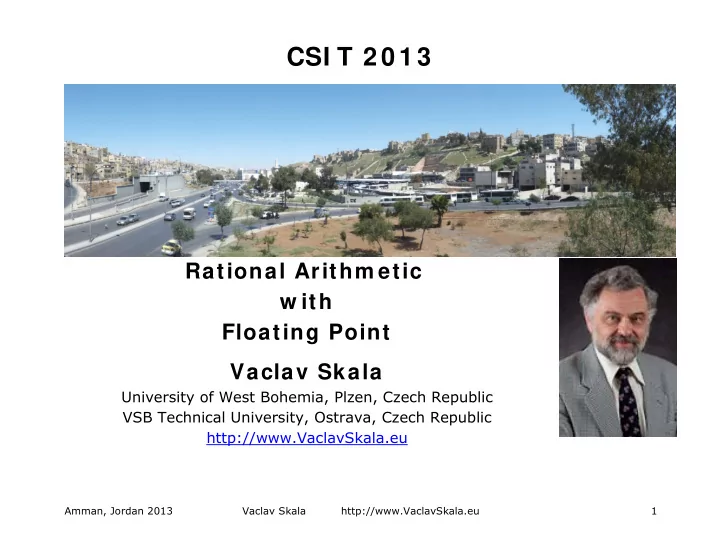
CSI T 2 0 1 3 Rational Arithm etic w ith Floating Point Vaclav Skala University of West Bohemia, Plzen, Czech Republic VSB Technical University, Ostrava, Czech Republic http://www.VaclavSkala.eu Amman, Jordan 2013 Vaclav Skala


slide-1
SLIDE 1

CSI T 2 0 1 3

Amman, Jordan 2013 Vaclav Skala http://www.VaclavSkala.eu 1

Rational Arithm etic w ith Floating Point Vaclav Skala

University of West Bohemia, Plzen, Czech Republic VSB Technical University, Ostrava, Czech Republic http://www.VaclavSkala.eu

slide-2
SLIDE 2

CSI T 2 0 1 3

Amman, Jordan 2013 Vaclav Skala http://www.VaclavSkala.eu 2

Plzen ( Pilsen) City

Plzen is an old city [first records of Plzen castle 976] city of culture, industry, and brewery. City, where today’s beer fermentation process was invented that is why today’s beers are called Pilsner - world wide

slide-3
SLIDE 3

CSI T 2 0 1 3

Amman, Jordan 2013 Vaclav Skala http://www.VaclavSkala.eu 3

University of W est Bohem ia 1 7 5 3 0 students + 9 8 7 PhD students Com puter Science and Engineering Mathem atics (+ Geomatics) Physics Cybernetics Mechanics (Computational)

  • Over 5 0 % of income from research and application projects
  • NTIS project (investment of 64 mil. EUR)
  • 2nd in the ranking of Czech technical / informatics faculties 2009, 2012
slide-4
SLIDE 4

CSI T 2 0 1 3

Amman, Jordan 2013 Vaclav Skala http://www.VaclavSkala.eu 4

“Real science” in the XXI century

Courtesy of Czech Film, Barrandov

slide-5
SLIDE 5

CSI T 2 0 1 3

Amman, Jordan 2013 Vaclav Skala http://www.VaclavSkala.eu 5

Num erical system s

  • Binary system is used nearly exclusively
  • Octal & hexadecimal representation is used
  • If we would be direct descendants of tetrapods –

we would have a great advantage – “simple counting in hexadecimal system”

Nam e Base Digits E m in E m ax BI NARY B 16 Half 2 10+1 −14 15 B 32 Single 2 23+1 −126 127 B 64 Double 2 52+1 −1022 1023 B 128 Quad 2 112+1 −16382 16383 DECI MAL D 32 10 7 −95 96 D 64 10 16 −383 384 D 128 10 34 −6143 6144

IEEE 758-2008 standard

slide-6
SLIDE 6

CSI T 2 0 1 3

Amman, Jordan 2013 Vaclav Skala http://www.VaclavSkala.eu 6

Mathem atically perfect algorithm s fail due to instability Main issues

  • stability, robustness of algorithms
  • acceptable speed
  • linear speedup – results depends on HW, CPU …. parameters !

Num erical stability

  • limited precision of float / double
  • tests A ? B with floats

if A = B then ….. else ….. ; if A = 0 then ….. else …. should be forbidden in programming languages

  • division operation should be removed or postponed to the last

moment if possible - “blue screens”, system resets

slide-7
SLIDE 7

A

T T d w { } /

Amman, Jorda

Typical

  • inter
  • point
  • detec

throu Typical double x w hile ( x { if (x x += } /* if p

an 2013

exam pl rsection o t lies on Ax + ction if a ugh problem x = -1; d x < +1) == p) C = p; p = 0.1 t

Vacla

es of in

  • f 2 lines

a line in + By + C a line inte m double p Console.O then no

CSI

v Skala

stability s in E3 E2 or a C = 0 o ersects a p = ….; Out.Write

  • utput,

T 2 0 1

http://www.V

y plane in

  • r Ax + B

a polygon eLine(” * if p = 0

1 3

VaclavSkala.e

E3 By + Cz n, touche *** ”) 0.25 the

eu

+ D = 0 es a vert en expec tex or pa cted outp

7

asses put */

slide-8
SLIDE 8

A

D P p I V p ?

Amman, Jorda

Delauna Point ins points in It can be VD is ver position ?? ROBU

an 2013

ay triang ide of a regular e seen th ry sensit change USTNES

Vacla

gulation circle giv rectangu hat the D tive to a S ??

CSI

v Skala

n & Voro ven by th ular grid DT & point

T 2 0 1

http://www.V

  • noi dia

hree poin .

1 3

VaclavSkala.e

agram nts – pro

eu

  • blems w

with mesh

8

hing

slide-9
SLIDE 9

CSI T 2 0 1 3

Amman, Jordan 2013 Vaclav Skala http://www.VaclavSkala.eu 9

Floating point

  • Not all numbers are represented

correctly

  • Logarithmic arithmetic
  • Continuous fractions
  • Interval arithmetic

Generally NOT valid identities due to limited precision

  • 1

[ ]

  • x y

4 1 1 3 2 5 3 …

x + y = [a + c, b + d] x = [ a , b ] x - y = [a - d, b - c] y = [ c , d ] x × y = [min(ac, ad, bc, bd), max(ac, ad, bc, bd)] x / y = [min(a/c, a/d, b/c, b/d), max(a/c, a/d, b/c, b/d)] if y ≠ 0

3; 7,15,1,292,1,1,1,2,1,3,1 …

slide-10
SLIDE 10

CSI T 2 0 1 3

Amman, Jordan 2013 Vaclav Skala http://www.VaclavSkala.eu 10

Statem ents like if <float> = <float> then …. or if <float> ≠ <float> then …. should not be allow ed in languages Quadratic equation 0 usually solved as ,

  • If 4 then

4 /2 ⁄ to get m ore reliable results.

slide-11
SLIDE 11

CSI T 2 0 1 3

Amman, Jordan 2013 Vaclav Skala http://www.VaclavSkala.eu 11

Function value com putation at 77617, 33096 , 333.75 11 121 2 5.5 /2 6.33835 10 single precision 1,1726039400532 double precision 1,1726039400531786318588349045201838 extended precision The correct result is “somewhere” in the interval of [0,82739605994682136814116509547981629, 0,82739605994682136814116509547981629 Exact solution , 2 2 54767 66192

slide-12
SLIDE 12

CSI T 2 0 1 3

Amman, Jordan 2013 Vaclav Skala http://www.VaclavSkala.eu 12

Num erical com putations Hilbert’s Matrix

  • 1 1 1

1 2 1

  • 1.0E-13

1.0E-11 1.0E-09 1.0E-07 1.0E-05 1.0E-03 1.0E-01 1.0E+01 1.0E+03 1.0E+05 1.0E+07 1.0E+09 1.0E+11 1.0E+13 1.0E+15 1.0E+17 1.0E+19 3 4 5 6 7 8 9 10 11 12 13 14 15 16 17 18 19 20 Error Order of the Hilbert matrix

ε εp ξ

slide-13
SLIDE 13

CSI T 2 0 1 3

Amman, Jordan 2013 Vaclav Skala http://www.VaclavSkala.eu 13

Projective Space X = [X, Y]T X∈E2 x = [ x, y: w]T x∈P2 Conversion: X = x / w Y = y / w & w ≠ 0 If w = 0 then x represents “an ideal point” - a point in infinity, i.e. it is a directional vector. The Euclidean space E2 is represented as a plane w = 1.

x y w w=1 x X Y (a) p P

2

E

2

ρ a b c c=1 D(p) D(ρ A B (b) D(P )

2

D(E )

2

slide-14
SLIDE 14

CSI T 2 0 1 3

Amman, Jordan 2013 Vaclav Skala http://www.VaclavSkala.eu 14

Points and vectors

  • Vectors are “freely m ovable” – not having a fixed position

, : 0

  • Points are not “freely m ovable” – they are fixed to an origin of

the current coordinate system , : and , : usually in textbooks 1 A vector in the Euclidean coordinate system - CORRECT Horrible “construction” DO NOT USE I T – I T I S TOTALLY W RONG , : , : 1 1 , : 0 This was presented as “How a vector” is constructed in the projective space in a textbook!! W RONG, W RONG, W RONG This construction has been found in SW as well!!

slide-15
SLIDE 15

CSI T 2 0 1 3

Amman, Jordan 2013 Vaclav Skala http://www.VaclavSkala.eu 15

Points and vectors A vector given by two points in the projective space , : This is the CORRECT SOLUTI ON, but what is the interpretation? A “difference” of coordinates of tw o points is a vector in the m athem atical m eaning and is a “scaling” factor actually In the projective representation (if the vector length matters) , : , : 0

  • We have to strictly distinguish if we are working with points, i.e. vector

as a data structure represents the coordinates, or with a vector in the mathematical meaning stored in a vector data structure. VECTORS x FRAMES

slide-16
SLIDE 16

CSI T 2 0 1 3

Amman, Jordan 2013 Vaclav Skala http://www.VaclavSkala.eu 16

Duality For simplicity, let us consider a line p defined as: aX + bY + c = 0 We can multiply it by w ≠ 0 and we get: ax + by + cw = 0 i.e. pTx = 0 p = [ a, b: c]T x = [ x, y: w]T=[ wX, wY: w]T A line p∈E2 is actually a plane in the projective space P2 (point [0,0:0]T excluded)

x y w w=1 x X Y (a) p P

2

E

2

ρ a b c c=1 D(p) D( ) ρ A B (b) D(P )

2

D(E )

2

slide-17
SLIDE 17

CSI T 2 0 1 3

Amman, Jordan 2013 Vaclav Skala http://www.VaclavSkala.eu 17

Duality From the mathematical notation we cannot distinguish whether p is a line and x is a point or vice versa in the case of P2. It means that

  • a point and a line are dual in the case of P2, and
  • a point and a plane are dual in the case of P3.

The principle of duality in P2 states that: Any theorem remains true when we interchange the words “point” and “line”, “lie on” and “pass through”, “join” and “intersection”, “collinear” and “concurrent” and so on. Once the theorem has been established, the dual theorem is

  • btained as described above.

This helps a lot to solve some geometrical problems.

slide-18
SLIDE 18

CSI T 2 0 1 3

Amman, Jordan 2013 Vaclav Skala http://www.VaclavSkala.eu 18

Exam ples of dual objects and operators Prim itive Dual prim itive E2 Point Line Line Point E3 Point Plane Plane Point Operator Dual operator Join Intersect Intersect Join Com putational sequence for a problem is the sam e for a dual problem .

slide-19
SLIDE 19

CSI T 2 0 1 3

Amman, Jordan 2013 Vaclav Skala http://www.VaclavSkala.eu 19

I ntersection of tw o lines Let two lines and are given by , and , We have to solve a system of linear equations

  • and

* Then well known formula is used

  • But what if is small?

Usually a sequence like det. . is used. What is ? Note * usually a line is in its explicit form as instead of 0 , i.e. the

implicit form

slide-20
SLIDE 20

CSI T 2 0 1 3

Amman, Jordan 2013 Vaclav Skala http://www.VaclavSkala.eu 20

How a line is given by tw o X1 and X2points? We have to solve a homogeneous system of linear equations

  • 1
  • 1
  • i.e. . It means that there is one param etric set of solutions!

NOW Computation of

  • an intersection of two lines is given as
  • a line given by two points is given as

Different schem es for com putation BUT Those problem s are DUAL, w hy algorithm s are different??

slide-21
SLIDE 21

CSI T 2 0 1 3

Amman, Jordan 2013 Vaclav Skala http://www.VaclavSkala.eu 21

Definition The cross product of the two vectors x 1 = [x1,y1:w1]T and x 2 = [x2,y2:w2]T is defined as:

  • where: i = [1,0:0]T, j = [0,1:0]T, k = [0,0:1]T

Please, note that homogeneous coordinates are used.

slide-22
SLIDE 22

CSI T 2 0 1 3

Amman, Jordan 2013 Vaclav Skala http://www.VaclavSkala.eu 22

Theorem Let two points x 1 and x 2 be given in the projective space. Then the coefficients of the p line, which is defined by those two points, are determined as the cross product of their homogeneous coordinates

,

Proof Let the line p∈E2 be defined in homogeneous coordinates as (coefficient is used intentionally to have the same symbol representing a “distance” of the element from the origin for lines and planes) We are actually looking for a solution to the following equations:

0 0

where: p = [a, b : c]T

slide-23
SLIDE 23

CSI T 2 0 1 3

Amman, Jordan 2013 Vaclav Skala http://www.VaclavSkala.eu 23

It means that any point that lies on the p line must satisfy both the equation, i.e. 0 0 and the equation 0 in

  • ther words the p vector is defined as
  • We can write

0 i.e.

  • Note that cross product and dot product are instructions in Cg/HLSL
  • n GPU
slide-24
SLIDE 24

CSI T 2 0 1 3

Amman, Jordan 2013 Vaclav Skala http://www.VaclavSkala.eu 24

Evaluating the determinant

  • we get the line coefficients of the line p as:
  • Note:

1.A line 0 is a one parametric set of coefficients , From two values and we have to compute 3 values, coefficients , and 2.For w = 1 we get the standard cross product formula and the cross product defines the p line, i.e. 1 2 where: ,

slide-25
SLIDE 25

CSI T 2 0 1 3

Amman, Jordan 2013 Vaclav Skala http://www.VaclavSkala.eu 25

We have seen, in the Euclidean space, the computation of

  • an intersection of two lines is given as
  • a line given by two points is given as

I f projective representation is used it is actually an application

  • f the cross product.

Those problem s are DUAL and algorithm s are identical ??

Cross product is equivalent to a solution of a linear system of equations! No division operations!

slide-26
SLIDE 26

CSI T 2 0 1 3

Amman, Jordan 2013 Vaclav Skala http://www.VaclavSkala.eu 26

DUALI TY APPLI CATI ON In the projective space points and lines are dual. Due to duality we can directly intersection of two lines as

  • , :

If the lines are parallel or close to parallel, the homogeneous coordinate 0 and users have to take a decision – so there is no sequence in the code like det. . …in the procedure. Generally computation can continue even if 0 if projective space is used.

slide-27
SLIDE 27

CSI T 2 0 1 3

Amman, Jordan 2013 Vaclav Skala http://www.VaclavSkala.eu 27

Com putation in Projective Space - Barycentric coordinates Let us consider a triangle with vertices X 1, X 2, X 3, A position of any point X∈E2 can be expressed as A linear system of equations has to be solved If points x i are given as [xi, yi, zi: wi ]T and wi ≠ 1then x i must be “normalized” to wi = 1, i.e. 4 * 3 = 12 division operations

1 1 2 2 3 3 1 1 2 2 3 3 1 2 3

additional condition 1 1 i = 1,...,3

i i i

a X a X a X X a Y a Y a Y Y a a a a P a P + + = + + = + + = ≤ ≤ =

P1 x1 x x3 P3 x2 P2

slide-28
SLIDE 28

CSI T 2 0 1 3

Amman, Jordan 2013 Vaclav Skala http://www.VaclavSkala.eu 28

Com putation in Projective Space Rewriting

1 1 2 3 2 1 2 3 3 4

1 1 1 1 b X X X X b Y Y Y Y b b ⎡ ⎤ ⎡ ⎤ ⎢ ⎥ ⎢ ⎥ ⎢ ⎥ = ⎢ ⎥ ⎢ ⎥ ⎢ ⎥ ⎢ ⎥ ⎣ ⎦ ⎣ ⎦

Solution of the linear system of equations (LSE) is equivalent to generalized cross product

1 1 2 2 3 3 4 1 1 2 2 3 3 4 1 2 3 4 4 4

1,...,3

i i

b X b X b X b X b Y b Y b Y b Y b b b b b a b i b + + + = + + + = + + + = = − = ≠

[ ]

1 2 3 4 1 2 3 1 2 3

× × , , , , , , , , , 1,1,1,1

T T T T

b b b b X X X X Y Y Y Y = = ⎡ ⎤ ⎣ ⎦ = ⎡ ⎤ ⎣ ⎦ = ⎡ ⎤ ⎣ ⎦ = b ξ η w b ξ η w

slide-29
SLIDE 29

CSI T 2 0 1 3

Amman, Jordan 2013 Vaclav Skala http://www.VaclavSkala.eu 29

Com putation in Projective Space if wi ≠ 1 or wi = 1 => new entities: projective scalar, projective vector

  • Skala,V.: Barycentric coordinates computation in homogeneous coordinates,

Computers&Graphics, 2008)

1 1 2 3 2 1 2 3 3 1 2 3 4

b x x x x b y y y y b w w w w b ⎡ ⎤ ⎡ ⎤ ⎢ ⎥ ⎢ ⎥ ⎢ ⎥ = ⎢ ⎥ ⎢ ⎥ ⎢ ⎥ ⎢ ⎥ ⎣ ⎦ ⎣ ⎦

1 2 3 4 1 2 3 1 2 3 1 2 3

× × , , , , , , , , , , , ,

T T T T

b b b b x x x x y y y y w w w w = = ⎡ ⎤ ⎣ ⎦ = ⎡ ⎤ ⎣ ⎦ = ⎡ ⎤ ⎣ ⎦ = ⎡ ⎤ ⎣ ⎦ b ξ η w b ξ η w

1 2 3 2 3 1 3 1 2

( : ) 1 ( : ) 1 ( : ) 1 b w w w b w w w b w w w ≤ − ≤ ≤ − ≤ ≤ − ≤

slide-30
SLIDE 30

CSI T 2 0 1 3

Amman, Jordan 2013 Vaclav Skala http://www.VaclavSkala.eu 30

Com putation in Projective Space Line in E3 as Tw o Plane I ntersection Standard formula in the Euclidean space , , :

: , , : :

Line given as an intersection of two planes , , : 0

  • The form ula is quite “horrible” one and for students not

acceptable as it is too com plex and they do not see from the form ula com es from .

slide-31
SLIDE 31

CSI T 2 0 1 3

Amman, Jordan 2013 Vaclav Skala http://www.VaclavSkala.eu 31

Basic operations using projective Robustness of computation is a key issue in many sophisticated computational algorithms as sophisticated engineering problems solved today might be ill conditioned. However different data structures have to be considered, i.e.

  • projective scalar :
  • projective vector : , … ,

Fundam ental operations w ith:

  • A. scalars
  • addition, resp. subtraction

: : :

  • multiplication

: : :

  • division

: /: :

slide-32
SLIDE 32

CSI T 2 0 1 3

Amman, Jordan 2013 Vaclav Skala http://www.VaclavSkala.eu 32

  • B. vectors
  • addition resp. subtraction

: , … , : , … , : , … , , … ,

  • scalar multiplication (dot product)

: , … , · : , … , :

  • vector multiplication (cross product)

: , … , : , … , : , … , , … , Note that the projective vector is different from a vector which consists

  • f projective scalars.
slide-33
SLIDE 33

CSI T 2 0 1 3

Amman, Jordan 2013 Vaclav Skala http://www.VaclavSkala.eu 33

  • C. exponent normalization

Exponents due to arithmetic operations tend to grow or become

  • smaller. It means that the exponent overflow or underflow is to be

check and exponents can be normalized. This is very simple operation as it means that the same value in the exponent is to be added or subtracted from both – numerator and denominator as well. Extraction of an exponent for a single and double precision is defined EXP := (FP_value land MASK) shr m; where: land is bitwise and operation, shr is shift right, MASK is the binary mask and m is the argument for the shift operation. Precision MASK m Exp_Digits Single &7FC0 4 255 Double &7F80 7 2047

slide-34
SLIDE 34

CSI T 2 0 1 3

Amman, Jordan 2013 Vaclav Skala http://www.VaclavSkala.eu 34

  • D. Comparison operation

The comparison operation is a little bit tricky as the condition i.e. : : Projective scalars have to have homogeneous coordinate non-negative, i.e. 0 and 0 The condition is to be replaced as follows:

slide-35
SLIDE 35

CSI T 2 0 1 3

Amman, Jordan 2013 Vaclav Skala http://www.VaclavSkala.eu 35

Advantages

  • The mantissa is actually doubled due to the “hidden” division
  • peration by the homogeneous value a there is a higher range of the

fractional part

  • The exponent range is higher. If a single precision is used, the range

is 2 to 2 , i.e.the range is actually 2

  • The division operation is eliminated by multiplication of a

homogeneous value in which denominator is “hidden”

  • Infinity can be handled properly, i.e. division by a value close or

equal to zero does not cause “floating point overflow”

  • If double precision for numerator and denominator is used is used,

actually a quadruple extended precision is implemented; if quadruple precision is available we get more that 2 times better precision

  • Simple implementation on vector-vector architectures, like GPU –

available projective Library P-Lib [25]

slide-36
SLIDE 36

CSI T 2 0 1 3

Amman, Jordan 2013 Vaclav Skala http://www.VaclavSkala.eu 36

Disadvantages

  • Current hardware does not support projective rational floating point,

but the additional computational cost of that is low, but should be considered

  • Operations are approx. two times longer if not vector-vector

architecture or SSE instructions are used

  • Value of exponents have to be controlled – there is a possibility of

exponent overflow or underflow, but easily solved by addition or subtraction to numerator and denominator in hardware. Normalization can be made in software without a significant slowdown

  • f computations.
  • There is a significant difference between vector of projective scalar

values and projective vector, i.e. representation of values

slide-37
SLIDE 37

CSI T 2 0 1 3

Amman, Jordan 2013 Vaclav Skala http://www.VaclavSkala.eu 37

Vector of projective scalars Projective vector

  • , … ,
  • : , … ,

:

means equal projectively : , … , and users have to be careful in the mathematical and expression formulations.

  • In the case of iterative methods on the current CPU longer

computation time is to be expected. The given approach is not convenient for application of iterative methods on CPU due to exponent values control in software Experimental verification Let us consider following simple examples for demonstration of the proposed projective rational arithmetic in linear algebra.

slide-38
SLIDE 38

CSI T 2 0 1 3

Amman, Jordan 2013 Vaclav Skala http://www.VaclavSkala.eu 38

Gauss elim ination Gaussian elimination method is well known for solving a system of linear equations where:

  • It generally produces an upper triangular matrix, row echolon form,

and then solves the unknown in the backward run. The structure of the Gaussian elimination method is for k := 1 to n for i := k+1 to m for j := k+1 to m

slide-39
SLIDE 39

CSI T 2 0 1 3

Amman, Jordan 2013 Vaclav Skala http://www.VaclavSkala.eu 39

The expression for can be rewritten as

  • As the value of can be very small, i.e. 0, and division by a

denominator could cause significant inaccuracy or floating point

  • verflow, exchange of rows is made in practice. If the projective

notation is used : where: is the homogeneous part of the expression. If : and : is the reciprocal value on , then we can write It should be noted that a reciprocal value : is actually a swap

  • f and values. The scalar value 0 represented in the projective

notation is 1: 0, i.e. the homogeneous value is non-zero, usually 1.

slide-40
SLIDE 40

CSI T 2 0 1 3

Amman, Jordan 2013 Vaclav Skala http://www.VaclavSkala.eu 40

It means that no division operation is needed, however it is still “hidden” in the homogeneous coordinate and pivoting has to be used. As the solution of a system linear equations is equivalent to extended cross-product [9] [12] [14] we can write where |

  • and

… where is the solution of the linear system of equations in the projective form, i.e. : , … , . It can be seen that no division is required unless we need to express the computed value in the Euclidean space.

slide-41
SLIDE 41

CSI T 2 0 1 3

Amman, Jordan 2013 Vaclav Skala http://www.VaclavSkala.eu 41

As direct consequence of the equivalence we can easily solved many computational problems without the division operation. The projective rational arithmetic with floating point has been verified experimentally for stability and precision of computation and inversion

  • f the Hilbert matrix was used, which converge to a singular matrix

with the growing size. The experiments proved the expected properties

  • f the proposed approach, details can be found in [12]. [25].
slide-42
SLIDE 42

CSI T 2 0 1 3

Amman, Jordan 2013 Vaclav Skala http://www.VaclavSkala.eu 42

Conclusion Projective rational arithmetic with floating point was described and fundamental arithmetic operations were described. The projective representation using homogeneous coordinates is used in computer graphics and computer vision and its application enabled to solve many problems in more effective way. As it was shown the projective representation is convenient for general numerical computation as well as it has several advantages of the standard single or double floating point representation. From the precision point of view, it offers higher range of exponents and also significantly wider range for a fraction representation. The presented approach is convenient for vector-vector hardware architectures including GPU. If used on CPU with SSE instructions it is slightly slower than the computation with the Euclidean notation, but

  • ffers higher precision natively. If double representation is used it
  • ffers more than quadruple or extended representation.
slide-43
SLIDE 43

CSI T 2 0 1 3

Amman, Jordan 2013 Vaclav Skala http://www.VaclavSkala.eu 43

Acknow ledgm ent The author would like to thank to anonymous reviewers for their critical comments and hints that improved this paper significantly. Thanks also belong to students and colleagues at the University of West Bohemia, Plzen and VSB-Technical University, Ostrava for their suggestions. The project was supported by the Ministry of Education of the Czech Republic, project No. LH12181.

slide-44
SLIDE 44

CSI T 2 0 1 3

Amman, Jordan 2013 Vaclav Skala http://www.VaclavSkala.eu 44

Geom etry algebra · in E3 · I t is strange – result of a dot product is a scalar value while result of the outer product (cross product) is a vector. What is ??? Please, for details see

  • http://geometricalgebra.zcu.cz/
  • GraVisMa – recent workshops on Computer Graphics, Computer Vision

& Mathematics http://www.GraVisMa.eu

  • W SCG – Conferences on Com puter Graphics, Com puter Vision

& Visualization since 1992 http://www.wscg.eu

slide-45
SLIDE 45

CSI T 2 0 1 3

Amman, Jordan 2013 Vaclav Skala http://www.VaclavSkala.eu 45

References

  • Skala,V.: Barycentric Coordinates Computation in Homogeneous Coordinates, Computers

& Graphics, Elsevier, ISSN 0097-8493, Vol. 32, No.1, pp.120-127, 2008

  • Skala,V.: Intersection Computation in Projective Space using Homogeneous Coordinates,
  • Int. Journal of Image and Graphics, ISSN 0219-4678, Vol.7, No.4, pp.615-628, 2008
  • Skala,V.: Length, Area and Volume Computation in Homogeneous Coordinates, Int.

Journal of Image and Graphics, Vol.6., No.4, pp.625-639, ISSN 0219-4678, 2006

  • Skala,V., Kaiser,J., Ondracka,V.: Library for Computation in the Projective Space, 6th

Int.Conf. Aplimat, Bratislava, ISBN 978-969562-4-1, pp. 125-130, 2007

  • Skala,V.: GPU Computation in Projective Space Using Homogeneous Coordinates , Game

Programming GEMS 6 (Ed.Dickheiser,M.), pp.137-147, ISBN 1-58450-450-1, Charles River Media, 2006

  • Skala,V.: A new approach to line and line segment clipping in homogeneous coordinates,

The Visual Computer, ISSN 0178-2789, Vol.21, No.11, pp.905-914, Springer Verlag, 2005

  • Generally: Authors publications with on-line DRAFTs via http://www.VaclavSkala.eu

References related

  • Yamaguchi,F.:Computer-Aided Geometric Design: A Totally Four-Dimensional Approach,

Springer, 2002

  • Agoston,M.K.: Computer Graphics and Geometric Modeling - Mathematics, ISBN 1-

58233-817-2, Springer, 2005
slide-46
SLIDE 46

CSI T 2 0 1 3

Amman, Jordan 2013 Vaclav Skala http://www.VaclavSkala.eu 46

Additional references for Geom etric Algebra and Conform al Geom etry

  • Bayro-Corrochano,E: Geometric Computing: For Wavelet Transforms, Robot Vision,

Learning, Control and Action, Springer, 2010

  • Bayro-Corrochano,E, Sobczyk,G.: Geometric Algebra with Application in Science and

Engineering, Birkhauser, 2001

  • Browne,J.: Grassmann Algebra - Draft Exploring Application of Extended Vector Algebra

with Mathematica, Swinburn University of Technology, Melbourne, Australia, 2001

  • Chevalley,C.: The Algebraic Theory of Spinors and Clifford Algebras, Springer, 1995
  • Doran,Ch., Lasenby,A.: Geometric Algebra for Physicists, Cambridge Univ.Press, 2003
  • Dorst,L., Fontine,D., Mann,S.: Geometric Algebra for Computer Science, Morgan

Kaufmann, 2007

  • Gu,X.D., Yau,S.-T.: Computational Conformal Geometry, International Press, Somerville,

USA, 2008

  • Hildenbrand,D.: Foundations of Geometric Algebra Computing, Springer 2012
  • Li,H., Olver,P.J., Sommer,G.: Computer Algebra and Geometric Algebra with

Applications, Springer

  • Perwass,Ch.: Geometric Algebra with Applications in Engineering, Springer Verlag, 2008
  • Sommer, G.: Geometric Computing with Clifford Algebras. Theoretical Foundations and

Applications in Computer Vision and Robotics, Springer, Berlin, 2001

  • Suter,J.: Geometric Algebra Primer [PDF] University of Twente, The Netherlands
slide-47
SLIDE 47

CSI T 2 0 1 3

Amman, Jordan 2013 Vaclav Skala http://www.VaclavSkala.eu 47

  • Vince,J.: Geometric Algebra for Computer Science, Springer, 2008
  • Vince,J.: Geometric Algebra: An Algebraic System for Computer Games and Animation,

Springer, 2009

  • Macdonald,A: A Survey of Geometric Algebra and Geometric Calculus,

http://faculty.luther.edu/~macdonal, 2009

  • Advances in Applied Clifford Algebras - Birkhauser-Springer journal

[http://www.clifford-algebras.org]

  • Digital papers on-line repository of WSCG since 1992

available from http://www.wscg.eu

slide-48
SLIDE 48

CSI T 2 0 1 3

Amman, Jordan 2013 Vaclav Skala http://www.VaclavSkala.eu 48

Questions

???

Contact Vaclav Skala c/o University of West Bohemia Faculty of Applied Sciences

  • Dept. of Computer Science and Engineering

CZ 306 14 Plzen, Czech Republic http:/ / w w w .VaclavSkala.eu skala@kiv.zcu.cz subj. CSIT 2013

Supported by the Ministry of Education of the Czech Republic, projects LH12181, LG13047