CSE 332: Final NP Completeness Monday, March 17, Johnson 102 - - PDF document

cse 332
SMART_READER_LITE
LIVE PREVIEW

CSE 332: Final NP Completeness Monday, March 17, Johnson 102 - - PDF document

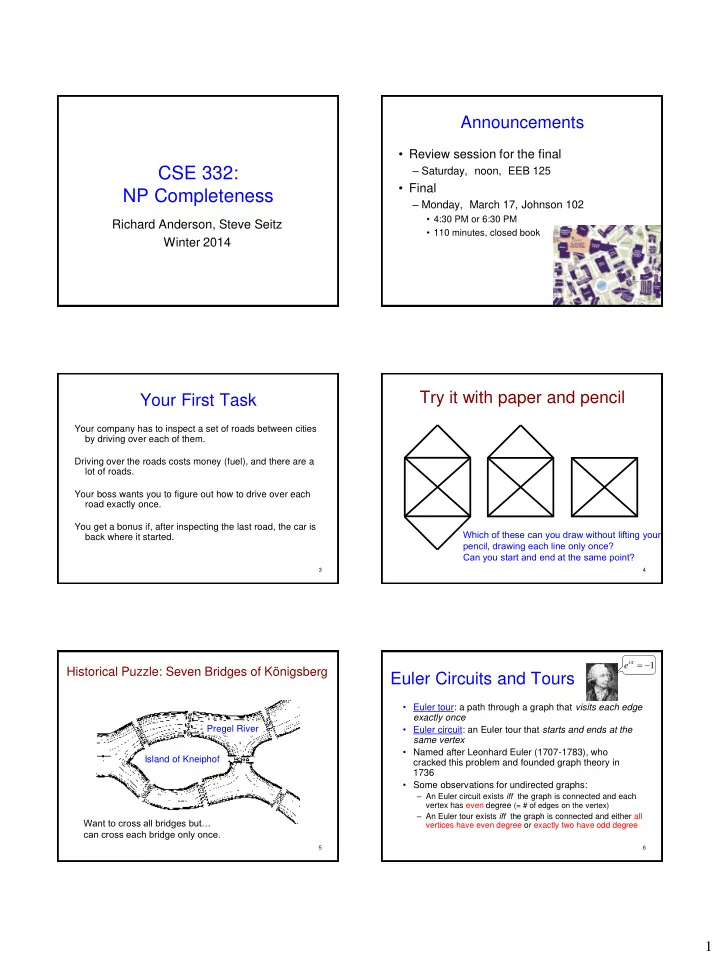
Announcements Review session for the final Saturday, noon, EEB 125 CSE 332: Final NP Completeness Monday, March 17, Johnson 102 4:30 PM or 6:30 PM Richard Anderson, Steve Seitz 110 minutes, closed book Winter 2014 2


slide-1
SLIDE 1

1

CSE 332: NP Completeness

Richard Anderson, Steve Seitz Winter 2014

Announcements

  • Review session for the final

– Saturday, noon, EEB 125

  • Final

– Monday, March 17, Johnson 102

  • 4:30 PM or 6:30 PM
  • 110 minutes, closed book

2 3

Your First Task

Your company has to inspect a set of roads between cities by driving over each of them. Driving over the roads costs money (fuel), and there are a lot of roads. Your boss wants you to figure out how to drive over each road exactly once. You get a bonus if, after inspecting the last road, the car is back where it started.

4

Try it with paper and pencil

Which of these can you draw without lifting your pencil, drawing each line only once? Can you start and end at the same point?

5

Historical Puzzle: Seven Bridges of Königsberg

Pregel River Island of Kneiphof Want to cross all bridges but… can cross each bridge only once.

6

Euler Circuits and Tours

  • Euler tour: a path through a graph that visits each edge

exactly once

  • Euler circuit: an Euler tour that starts and ends at the

same vertex

  • Named after Leonhard Euler (1707-1783), who

cracked this problem and founded graph theory in 1736

  • Some observations for undirected graphs:

– An Euler circuit exists iff the graph is connected and each vertex has even degree (= # of edges on the vertex) – An Euler tour exists iff the graph is connected and either all vertices have even degree or exactly two have odd degree

1  

 i

e

slide-2
SLIDE 2

2

7

Finding Euler Circuits

Given a connected, undirected graph G = (V,E), find an Euler circuit in G. Euler Circuit Existence Algorithm: Check to see that all vertices have even degree Running time = Euler Circuit Algorithm: 1. Do an edge walk from a start vertex until you are back at the start vertex. Mark each edge you visit, and do not revisit marked edges. You never get stuck because of the even degree property. 2. The walk is removed leaving several components each with the even degree

  • property. Recursively find Euler circuits for

these. 3. Splice all these circuits into an Euler circuit Running time =

8

Euler Tour

G A B C D E F For an Euler Tour, exactly two vertices are odd, the rest

  • even. Using a similar algorithm, you can find a path

between the two odd vertices.

9

Your Second Task

Your boss is pleased…and assigns you a new task. Your company has to send someone by car to a set of cities. The primary cost is the exorbitant toll going into each city. Your boss wants you to figure out how to drive to each city exactly once, returning in the end to the city of origin.

10

Hamiltonian Circuits

  • Euler circuit: A cycle that goes

through each edge exactly once

  • Hamiltonian circuit: A cycle that goes

through each vertex exactly once (except the first=last one)

  • Does graph I have:

– An Euler circuit? – A Hamiltonian circuit?

  • Does graph II have:

– An Euler circuit? – A Hamiltonian circuit?

  • Does the Hamiltonian circuit problem

seem easier or harder? B C D E G B C D E G

I II II

  • W. R.

Hamilton (1805-1865)

Hamilton’s Icosian Game

11 12

Finding Hamiltonian Circuits

  • Problem: Find a Hamiltonian circuit in a

connected, undirected graph G.

  • One solution: Search through all paths to find
  • ne that visits each vertex exactly once

– Can use your favorite graph search algorithm (DFS!) to find various paths

  • This is an exhaustive search (“brute force”)

algorithm.

  • Worst case  need to search all paths

– How many paths??

slide-3
SLIDE 3

3

13

Analysis of our Exhaustive Search Algorithm

  • Worst case  need to search

all paths – How many paths?

  • Can depict these paths as a

search tree

B C D E G B D G C G E D E C G E

  • Etc. Search tree of paths from B

14

Analysis of our Exhaustive Search Algorithm

  • Let the average branching factor of

each node in this tree be b

  • |V| vertices, each with  b branches
  • Total number of paths  b·b·b … ·b

=

  • Worst case  Exponential time!

B D G C G E D E C G E Etc. Search tree of paths from B

15

1 100000 1E+10 1E+15 1E+20 1E+25 1E+30 1E+35 1E+40 1E+45 1E+50 1E+55 1E+60 1 10 100 1000 2^N 1.2^N N^5 N^3 5N

Exponential Time

PC, since Big Bang PC, 1 day

16

Polynomial vs. Exponential Time

  • Most of our algorithms so far have been O(log N),

O(N), O(N log N) or O(N2) running time for inputs

  • f size N

– These are all polynomial time algorithms – Their running time is O(Nk) for some k > 0

  • Exponential time bN is asymptotically worse than

any polynomial function Nk for any k

17

The Complexity Class P

  • The set P is defined as the set of all problems

that can be solved in polynomial worst case time

– Also known as the polynomial time complexity class – All problems that have some algorithm whose running time is O(Nk) for some k

  • Examples of problems in P: sorting, shortest

path, Euler circuit, etc.

18

Problem Spaces

If a problem is not polynomial-time solvable (not in P), then it is an exponential-time problem.

Shorthand:

– P solutions are fast – EXPTIME are slow

  • Sometimes viewed

as “intractable” EXPTIME P

slide-4
SLIDE 4

4

19

Saving your job

Try as you might, every solution you come up with for the Hamiltonian Circuit problem runs in exponential time. You have to report back to your boss.

20

What you’d rather not say…

“I can’t find an efficient algorithm, I guess I’m just too dumb.”

21

What you’d like to say…

“I can’t find an efficient algorithm, because no such algorithm is possible!” But can you actually say this…?

22

When is a problem easy?

  • We’ve seen some “easy” graph problems:

– Graph search – Shortest-path – Minimum Spanning Tree

  • Not easy for us to come up with, but easy

for the computer, once we know algorithm.

23

When is a problem hard?

  • Almost everything we’ve seen in class has had an

efficient algorithm

  • But of course, computers can’t solve every problem

quickly.

  • In fact, there are perfectly reasonable sounding

problems that no computer could ever solve in any reasonable amount of time (as far as we know!). – The Hamiltonian Circuit problem is one of these (as far as we know). More later on just how hard it is…

24

What you can say…

“I can’t find an efficient algorithm, but neither can all these famous people.”

slide-5
SLIDE 5

5

25

When is a problem hopeless?

  • Some problems are “undecideable” – no algorithm can

be given for solving them. – The Halting Problem: is it possible to specify any algorithm, which, given an arbitrary program and input to that program, will always correctly determine whether or not that program will enter an infinite loop? – No! [Turing, 1936]

  • We’ll focus on problems that have

a glimmer of hope…

Alan Turing (1912-1954)

26

A Glimmer of Hope

Suppose you have a problem that is at least decideable. If the output can be checked for correctness in polynomial-time, then maybe a polynomial-time solution exists!

27

The Complexity Class NP

  • Definition: NP is the set of all problems for

which a given candidate solution can be tested in polynomial time

  • Are the following in NP:

– Hamiltonian circuit problem? – Euler circuit problem? – All polynomial time algorithms?

28

Why NP?

  • NP stands for Nondeterministic Polynomial time

– Why “nondeterministic”? Corresponds to algorithms that can guess a solution (if it exists)  the solution is then verified to be correct in polynomial time – Nondeterministic algorithms don’t exist – purely theoretical idea invented to understand how hard a problem could be

29

Problem Spaces (revisited)

We can now augment our problem space to include NP as a superset of P. Whenever someone finds a polynomial time solution to a problem currently believed to be in NP - P, it moves to P.

EXPTIME NP P

30

Your Chance to Win a Turing Award (and $$$)

  • It is generally believed that P  NP, i.e.

there are problems in NP that are not in P

– But no one has been able to show even one such problem! – This is the fundamental open problem in theoretical computer science. – Nearly everyone has given up trying to prove it. Instead, theoreticians prove theorems about what follows once we assume P  NP !

slide-6
SLIDE 6

6

31

P = NP?

EXPTIME NP P EXPTIME P

P = NP P  NP

Perhaps instead P = NP, but that would seem to be even harder to prove…

32

What you’d like to say (revisited)…

“I can’t find an efficient algorithm, because no such algorithm is possible. And that means P ≠ NP, and now I’m super famous and rich, and I quit!”

33

Your Third Task

Your boss buys your story that others couldn’t solve the last problem. Again, your company has to send someone by car to a set of cities. The primary cost is distance traveled (which translates to fuel costs). Your boss wants you to figure out how to drive to each city exactly once, then returning to the first city, while staying within a fixed mileage budget C.

34

The Traveling Salesman Problem (TSP)

  • This amounts to solving…

…The Traveling Salesman Problem:

– Given a complete (fully connected) weighted graph G, and an integer C, – is there a cycle that visits all vertices with cost ≤ C?

  • One of the canonical problems in computer

science.

  • Note difference from Hamiltonian cycle: graph is

complete, and we care about weight.

35

Transforming HC into TSP

  • We can transform Hamiltonian Cycle into TSP.
  • Given graph G=(V, E):

– Assign weight of 1 to each edge – Augment the graph with edges until it is a complete graph G’=(V, E’). – Assign weight of 2 to the new edges. – Let C = |V|.

36

Examples

B D E G C

slide-7
SLIDE 7

7

37

Polynomial-time transformation

  • G’ has a TSP tour of weight |V| iff (if and only if)

G has a Hamiltonian Cycle. – Proof: “obvious”

  • What was the cost of transforming HC into TSP?
  • In the end, because there is a polynomial-time

transformation from HC to TSP, we say TSP is “at least as hard as” Hamiltonian cycle.

38

What you can say…

“I can’t find an efficient algorithm, since all these famous people couldn’t solve HC efficiently and I can prove that TSP is at least as hard.”

39

Satisfiability

In 1971, Stephen Cook studied the Satisfiability Problem:

– Given a Boolean formula (collections of ANDs, ORs, NOTs) over a set of variables, – is there a TRUE/FALSE assignment to the variables such that the Boolean formula evaluates to TRUE?

40

Satisfiability

…and he proved something remarkable: Every problem in NP can be polynomially transformed to the Satisfiability Problem. Thus, Satisfiability is at least as hard as every

  • ther problem in NP, i.e., it is the hardest NP

problem. We call it an “NP-complete” problem.

41

Turing Machines

The proof is intricate and depends on a computing abstraction called a Turing Machine… which is generalized to allow guessing the answer.

42

The Steam Powered Turing Machine

In the mid-1980s, Alan Borning attributed a peculiar implementation of a Turing Machine to Larry Ruzzo, giving rise to this famous mural:

slide-8
SLIDE 8

8

43

NP-completeness

  • In fact, Satisfiability can be polynomially reduced to

some other NP problems (and vice versa).

  • These other problems are equivalent to Satisfiability, and

so all other problems in NP can be transformed to them, as well.

  • NP-complete problems thus form an equivalence set in

NP (all equivalently hard, i.e., the hardest).

  • Solving one would give a solution for all of them!

– If any NP-complete problem is in P, then all of NP is in P

44

What’s NP-complete

  • Satisfiability of logic formulas
  • All sorts of constraint problems
  • All sorts of graph problems, including:

– Hamiltonian Circuits – Traveling Salesman? – Graph coloring: decide if the vertices of a graph be colored using K colors, such that no two adjacent vertices have the same color.

  • Not an overstatement to say that every area of

computer science comes up against NP- complete problems.

45

One tweak and you could be in NP-complete

  • It’s amazing how “little” tweaks on a problem

change the complexity:

– Euler circuit is in P, but Hamiltonian circuit is NP- complete. – Shortest path between two points is computable in O(|V|2), but longest path is NP-complete.

46

Analyzing Your Hard Problem

  • Your problem seems really hard.
  • If you can transform an NP-complete problem

into the one you’re trying to solve, then you can stop working on your problem!

  • …unless you really need that Turing award.

47

What you’d like to say (re-revisited)…

“I showed that TSP is NP-complete, and I found an efficient algorithm for it, and that means P = NP, and I’ve totally rocked the CS world!” (Not likely!)

48

P, NP, NPC, and Exponential Time Problems

  • All currently known

algorithms for NP-complete problems run in exponential worst case time

  • Diagram depicts

relationship between P, NP, and EXPTIME (class of problems that provably require exponential time to solve)

It is believed that P  NP  EXPTIME

EXPTIME NP P

NPC

slide-9
SLIDE 9

9

49

Coping with NP-Completeness

  • 1. Settle for algorithms that are fast on average:

Worst case still takes exponential time, but doesn’t occur very often.

But some NP-Complete problems are also average- time NP-Complete!

  • 2. Settle for fast algorithms that give near-optimal

solutions: In traveling salesman, may not give the cheapest tour, but maybe good enough.

But finding even approximate solutions to some NP- Complete problems are NP-Complete!

50

Coping with NP-Completeness

  • 3. Just get the exponent as low as possible!

Much work on exponential algorithms for satisfiability: in practice can often solve circuits with 1,000+ inputs

But even 2n/100 will eventual hit the exponential curve!

  • 4. Restrict the problem: Longest Path is easy on

trees, for example. Many hard problems are easy for restricted inputs.

51

Great Quick Reference

Is this lecture complete? Hardly, but here’s a good reference: Computers and Intractability: A Guide to the Theory of NP-Completeness by Michael S. Garey and David S. Johnson