CSC 473 Automata, Grammars & Languages 11/9/10 Automata, - - PDF document

csc 473 automata grammars languages 11 9 10
SMART_READER_LITE
LIVE PREVIEW

CSC 473 Automata, Grammars & Languages 11/9/10 Automata, - - PDF document

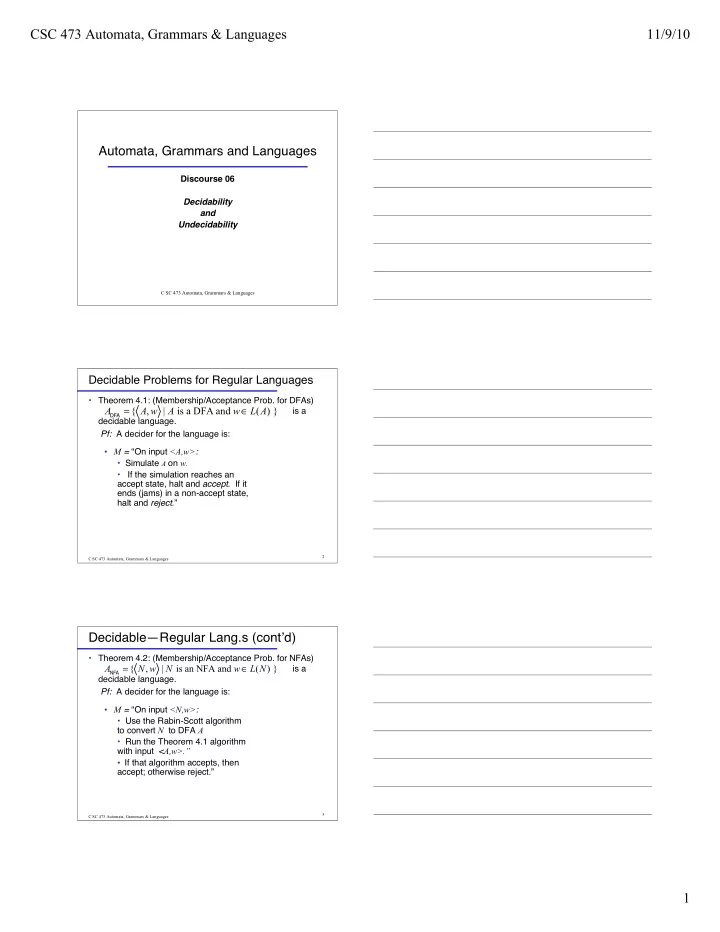
CSC 473 Automata, Grammars & Languages 11/9/10 Automata, Grammars and Languages Discourse 06 Decidability and Undecidability C SC 473 Automata, Grammars & Languages Decidable Problems for Regular Languages Theorem 4.1:


slide-1
SLIDE 1

CSC 473 Automata, Grammars & Languages 11/9/10 1

C SC 473 Automata, Grammars & Languages

Automata, Grammars and Languages

Discourse 06 Decidability and Undecidability

C SC 473 Automata, Grammars & Languages 2

Decidable Problems for Regular Languages

  • Theorem 4.1: (Membership/Acceptance Prob. for DFAs)

is a decidable language. Pf: A decider for the language is:

{ , | is a DFA and ( ) } =

  • A

A w A w L A

DFA

  • M = “On input <A,w>:
  • Simulate A on w.
  • If the simulation reaches an

accept state, halt and accept. If it ends (jams) in a non-accept state, halt and reject.” 

C SC 473 Automata, Grammars & Languages 3

Decidable—Regular Lang.s (contʼd)

  • Theorem 4.2: (Membership/Acceptance Prob. for NFAs)

is a decidable language. Pf: A decider for the language is:

{ , | is an NFA and ( ) } =

  • A

N w N w L N

NFA

  • M = “On input <N,w>:
  • Use the Rabin-Scott algorithm

to convert N to DFA A

  • Run the Theorem 4.1 algorithm

with input <A,w>.”

  • If that algorithm accepts, then

accept; otherwise reject.” 

slide-2
SLIDE 2

CSC 473 Automata, Grammars & Languages 11/9/10 2

C SC 473 Automata, Grammars & Languages 4

Decidable—Regular Lang.s (contʼd)

  • Theorem 4.3: (Membership Prob. for RegExʼs)

is a decidable language. Pf: Use the algorithm to convert R to an equivalent NFA N and use the algorithm of Theorem 4.2 with input <N,w>  { , | is a regular expression and ( ) } =

  • A

R w R w L R

REX

C SC 473 Automata, Grammars & Languages 5

Decidable—Regular Lang.s (contʼd)

  • Theorem 4.4: (Emptiness Problem for DFAs)

is a decidable language. Pf: A decider for the language is:

{ | is a DFA and ( ) = } =

  • E

A A L A

DFA

  • T = “On input <A>:
  • repeat {
  • } until ( )
  • if accept; otherwise reject.”


{ | ( )( ) ( , ) }

  • =

M S S M q a p M p a q = S M { }

  • S

q

  • =

F M

C SC 473 Automata, Grammars & Languages 6

Decidable—Regular Lang.s (contʼd)

  • Theorem 4.5: (Equivalence Problem for DFAs)

is a decidable language. Pf: Observe that Because of closure properties, there is an algorithm to construct a DFA C from A, B that accepts Use Theorem 4.4 with <C> to test whether If that algorithm accepts, then accept; otherwise, reject.  { , | , are DFA and ( ) = ( )} = EQ A B A B L A L B

DFA

( ) ( ) ( ) ( ) where ( ) ( ) ( ( ) ( )) ( ( ) ( )) =

  • =
  • =
  • L A

L B L A L B L A L B L A L B L A L B ( ) ( )

  • L A

L B ( ) . = L C

slide-3
SLIDE 3

CSC 473 Automata, Grammars & Languages 11/9/10 3

C SC 473 Automata, Grammars & Languages 7

  • Theorem 4.7: (Membership/Acceptance Prob. for CFGs)

is a decidable language. Pf: Chomsky Normal Form parse trees look like: { , | is a CFG and ( ) } A G w G w L G =

  • CFG

Decidable Problems for CFLs

A A a a a A A A A A a A A A A A A A A A a a a a a

terminals n 2 1 ' n A s

  • Pure Binary Tree w/ n leaves

has n-1 internal nodes. Add n terminating rules for a parse tree.

C SC 473 Automata, Grammars & Languages 8

  • S = “On input <G,w>:
  • Convert G to CNF
  • If |w|>0 try all derivations with 2|w|-1 steps. If |w|=0 try the 1-

step derivation

  • If any derivation generates w, accept; else reject.” 
  • Corollary (Text Theorem 4.9). Every CFL is a decidable

language. Pf: Let A be a CFL. We want a decider for it. Let G be a CFG generating A. On input w, run the TM S above on <G,w> to accept or reject w. 

Decidable Problems—CFLs (contʼd)

1

.

G

S

  • C SC 473 Automata, Grammars & Languages

9

Decidable—CFLs (contʼd)

  • Theorem 4.8: (Emptiness Problem for CFGs)

is a decidable language. Pf: A variable in a CFG is productive (or co- reachable) iff So iff the start variable is productive. See Homework 4, Problem 2 for an algorithm to decide whether a variable is

  • productive. 
  • All above problems also decidable for PDAs: just convert

to CFGs.

  • What about the Equivalence Problem for CFGs?

We will show (later) that this problem is UNdecidable.

{ | is a CFG and ( ) = } E G G L G =

  • CFG

A ( ) .

G

w A w

  • ( )

L G S

{ , | , are CFGs and ( ) = ( )} EQ G H G H L G L H =

CFG

slide-4
SLIDE 4

CSC 473 Automata, Grammars & Languages 11/9/10 4

C SC 473 Automata, Grammars & Languages 10

The Halting Problem

  • Although the following language is TM-recognizable, we

will show it is not decidable.

  • This is called the Membership Problem for TMs, and by

some authors the Halting Problem for TMs: given a TM M and string w, does M accept w?

  • Why called “Halting Problem”? Given a TM M, can

always alter it to an equivalent TM M′ such that: M′ halts on w iff M′ accepts w (iff M accepts w). Pf: For each undefined transition δ(q,a) in M, M′ will transition to a state and loop forever; also goes to the same loop state 

  • Thus acceptance can be made synonymous with halting

{ , | is a TM and ( )} A M w M w L M =

  • TM

loop

q

reject

q

C SC 473 Automata, Grammars & Languages 11

The Halting Problem (contʼd)

  • Thm: is

Turing-recognizable. Pf: Let U be a UTM. A recognizer for is:

{ , | is a TM and ( )} A M w M w L M =

  • TM

U

yes no

, ( ) , ( ) ( ) , M w L R M w L U w L M M w A

  • TM

yes no

, M w ATM

R

C SC 473 Automata, Grammars & Languages 12

The Halting Problem (contʼd)

  • Thm: is

undecidable. Pf: Proof by contradiction. Assume that is decidable. Then it has a decider; call it H. H behaves as follows: Construct a TM D that calls H as a subroutine. On input 〈 M〉, D runs H on 〈M, 〈M〉〉. That is, D determines if M accepts or rejects its own description as input. If M accepts 〈M〉, then D rejects; If M rejects 〈M〉, then D

  • accepts. Here is the picture of how D behaves:

{ , | is a TM and ( )} A M w M w L M =

  • TM

H

{ if M accepts w } accept reject

, M w ATM

{ if M does not accept w }

slide-5
SLIDE 5

CSC 473 Automata, Grammars & Languages 11/9/10 5

C SC 473 Automata, Grammars & Languages 13

The Halting Problem (contʼd)

  • What happens if we run D on its own description 〈D〉? Set 〈

M〉 = 〈D〉 in the above. Then This contradiction shows that decider H cannot exist. 

H

{ if M accepts 〈M〉 } accept reject

M

{ if M does not accept 〈M〉 }

, M M

D

accept reject { if M does not accept 〈M〉 } { if M accepts 〈M〉 }

( ) ( ) M L D M L M

  • (

) ( ). D L D D L D

  • C SC 473 Automata, Grammars & Languages

14

“Diagonalization”—Why called?

1 2 3 1 1 1 2 1 3 1 2 1 2 2 2 3 2 3 1 3 2 3 3 3

( ) ( ) ( ) ( ) ( ) ( ) ( ) ( ) ( ) M M M M M M M M M M M M M M M M M M M M M M M M … … … …

  • (

) D D D

( ) ? is D D accept or reject =

D

( ) ( )

i i i

D M accept M M reject =

  • =

( ) ( ) D D accept D D reject =

  • =

D computes the opposite of the diagonal entries

TMs → Encodings →

C SC 473 Automata, Grammars & Languages 15

Decidable vs Recognizable Sets: Basics

  • Theorem: decidable decidable

Proof: If L is decidable, it has a decider M. The decider halts for every input in either the accepting halt state

  • r in the rejecting halt state . Construct from

M as follows: make the accepting halt state the rejecting state and the rejecting halt state the accepting state. Then that is,  L

  • accept

q

M ), ( ) ( M L w M L w

  • .

) ( ) ( M L M L = L

reject

q

slide-6
SLIDE 6

CSC 473 Automata, Grammars & Languages 11/9/10 6

C SC 473 Automata, Grammars & Languages 16

Decidable vs Recognizable: Basics (Cont.)

Theorem 4.22: is decidable iff both are Turing- recognizable. Proof: (⇒) Previous theorem. (⇐) Suppose both are recognizable. Let be recognizers for . Construct M* to simulate alternate steps in each recognizer: Given w it is eventually accepted by one or the other, so must halt and either accept or reject; it is a decider.  M M , M

accept

M

w ) ( L w ) ( L w accept reject

* M

* M

& L L L

switch

accept

, L L

C SC 473 Automata, Grammars & Languages 17

A Non-TM-Recognizable Set

  • Corollary 4.23: (the complement of ) is not

Turing-recognizable. Pf: By contradiction. We know that is Turing-

  • recognizable. Suppose is Turing-recognizable.

By Theorem 4.22, it follows that is decidable. Since we know that is not decidable by Theorem 4.11, this contradiction establishes the result.  Note: What does look like? where , which are all the “junk” strings that cannot be of the form 〈 Coded machine, coded input 〉. Note that J is a regular language. { , | is a TM and ( )} A M w M w L M J =

  • TM

ATM

ATM ATM

ATM

ATM ATM

ATM

(0 1) ,(0 1) J

  • =

+ +