CSC 473 Automata, Grammars & Languages 8/15/10 Automata, - - PDF document

csc 473 automata grammars languages 8 15 10
SMART_READER_LITE
LIVE PREVIEW

CSC 473 Automata, Grammars & Languages 8/15/10 Automata, - - PDF document

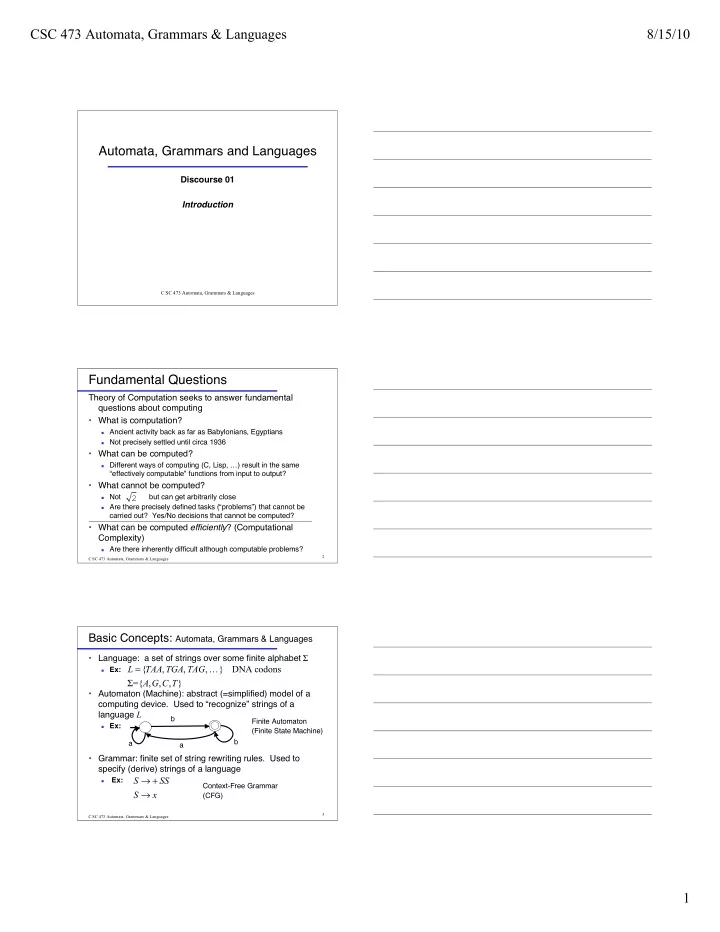
CSC 473 Automata, Grammars & Languages 8/15/10 Automata, Grammars and Languages Discourse 01 Introduction C SC 473 Automata, Grammars & Languages Fundamental Questions Theory of Computation seeks to answer fundamental questions about


slide-1
SLIDE 1

CSC 473 Automata, Grammars & Languages 8/15/10 1

C SC 473 Automata, Grammars & Languages

Automata, Grammars and Languages

Discourse 01 Introduction

C SC 473 Automata, Grammars & Languages 2

Fundamental Questions

Theory of Computation seeks to answer fundamental questions about computing

  • What is computation?

 Ancient activity back as far as Babylonians, Egyptians  Not precisely settled until circa 1936

  • What can be computed?

 Different ways of computing (C, Lisp, …) result in the same

“effectively computable” functions from input to output?

  • What cannot be computed?

 Not but can get arbitrarily close  Are there precisely defined tasks (“problems”) that cannot be

carried out? Yes/No decisions that cannot be computed?

  • What can be computed efficiently? (Computational

Complexity)

 Are there inherently difficult although computable problems?

2

C SC 473 Automata, Grammars & Languages 3

Basic Concepts: Automata, Grammars & Languages

  • Language: a set of strings over some finite alphabet Σ

 Ex:

  • Automaton (Machine): abstract (=simplified) model of a

computing device. Used to “recognize” strings of a language L

 Ex:

  • Grammar: finite set of string rewriting rules. Used to

specify (derive) strings of a language

 Ex:

{ , , , } DNA codons ={ , , , } L TAA TGA TAG A G C T =

a b a b Finite Automaton (Finite State Machine)

S SS S x +

  • Context-Free Grammar

(CFG)

slide-2
SLIDE 2

CSC 473 Automata, Grammars & Languages 8/15/10 2

C SC 473 Automata, Grammars & Languages 4

Languages

1 2 3 4 5

is a well-formed C program is a w.-f.

is a well-formed arithmetic expression in C

{ , , , } { , } { , , , , , } { } { : } ={ , } { : } {ASCII} { : L aa ab ba bb a b L a aa aaa aaaa a L e e L p p L p p

  • =

= = = =

  • =

= = 0-9,a-z,A-Z,+,-, *, /, (, ), ., &, ! …

  • 6

is a decimal integer and is its binary representation

C program that halts for all inputs}

{( , ) : } L x y x y =

C SC 473 Automata, Grammars & Languages 5

Types of Machines

  • Logic circuit

 memoryless; values combined using gates

z x y c s > ⊕ ⊕ < >

Circuit size = 5 Circuit depth = 3

C SC 473 Automata, Grammars & Languages 6

Types of Machines (cont.)

  • Finite-state automaton (FSA)

 bounded number of memory states  step: input, current state determines next state & output

a a a

Mod 3 counter state/ouput (Moore) machine

  • models programs with a finite number of bounded registers
  • reducible to 0 registers

b

0 / 0

q

1 /1

q

2 / 2

q

1 2

( , ) ( ,2) q a q

  • =
slide-3
SLIDE 3

CSC 473 Automata, Grammars & Languages 8/15/10 3

C SC 473 Automata, Grammars & Languages 7

  • Pushdown Automaton (PDA)

finite control and a single unbounded stack

ε, ε → $

} 1 : # {

  • =

n b a L

n n

models finite program + one unbounded stack of bounded registers

$ top

Types of Machines (cont.)

b

#, $ → ε a, ε → A b, A → ε b, A → ε

2 2

( , , ) ( , ) q a q A

  • =

C SC 473 Automata, Grammars & Languages 8

  • Random access machine (RAM)

 finite program and an unbounded, addressable

random access memory of ``registers”

 models general programs ◆ unbounded # of bounded registers ◆ Simple 1-addr instructions

Example:

4 3 2 1

  • 1

1 1 1 1

: : R R R L JMPZ R L INC R DEC R JMP L L CONTINUE

  • +

Types of Machines (cont.)

b

  • C SC 473 Automata, Grammars & Languages

9

  • Turing Machine (TM)

 finite control & tape of bounded cells unbounded in # to R  Input left adjusted on tape at start with blank cell terminating  current state, cell scanned determine next state & overprint symbol  control writes over symbol in cell and moves head 1 cell L or R  models simple ``sequentialʼʼ memory; no addressability  fixed amount of information (b bits) per cell

Types of Machines (cont.)

  • Finite-

state control

b

( , ) ( , , ) q X p Y R

  • =
slide-4
SLIDE 4

CSC 473 Automata, Grammars & Languages 8/15/10 4

C SC 473 Automata, Grammars & Languages 10

Theory of Computation

Study of languages and functions that can be described by computation that is finite in space and time

  • Grammar Theory

 Context-free grammars  Right-linear grammars  Unrestricted grammars  Capabilities and limitations  Application: programming language specification

  • Automata Theory

 FA  PDA  Turing Machines  Capabilities and limitations  Characterizing “what is computable?”  Application: parsing algorithms C SC 473 Automata, Grammars & Languages 11

Theory of Computation (contʼd)

  • Computational Complexity Theory

 Inherent difficulty of “problems”  Time/space resources needed for computation  “Intractable” problems  Ranking of problems by difficulty (hierarchies)  Application: algorithm design, algorithm improvement, analysis C SC 473 Automata, Grammars & Languages 12

FSA Ex: Specifying/Recognizing C Identifiers

  • Deterministic FA Λ={a,…,z,A…,Z, _ } Δ={0,…,9}

 State diagram (labeled digraph)  Regular Expression  Right-Linear Grammar

q

acc

q

Λ Λ Δ

reject

q

Δ (_ ) (_ 9) * a A a A + + + +

  • +

+ + + + + … … … … … a | | z a | | z | A | | Z | A | | Z | _ | 0 | | 9 | _ S T T T T T T T T T T T T T

… … … …

slide-5
SLIDE 5

CSC 473 Automata, Grammars & Languages 8/15/10 5

C SC 473 Automata, Grammars & Languages 13

FSA Ex: C Floating Constants

  • "A floating constant consists of an integer part, a decimal

point, a fraction part, an e or E, an optionally signed integer exponent (and an optional type suffix …). The integer and fraction parts both consist of a sequence of

  • digits. Either the integer part or the fraction part (not both)

may be missing; either the decimal point or the e and the exponent (not both) may be missing. …"

 --B. W. Kernighan and D.M. Ritchie, The C Programming

Language, Prentice-Hall, 1978

 (The type is determined by the suffix; F or f makes it a float, L or l

makes it a long double; otherwise it is double.)

C SC 473 Automata, Grammars & Languages 14

FSA Ex: C Floats (contʼd)

0 | 1 | 9 d = … d d d d d d

, + e, E

  • d

Note: type suffixes f,F,l,L omitted

e, E

“Either the integer part or the fraction part (not both) may be missing; either the decimal point or the e and the exponent (not both) may be missing”

C SC 473 Automata, Grammars & Languages 15

CFG Ex: A Calculator Language

  • Syntactic Classes

 Numerals 3 40  Digits 0 1 9  Expressions 3*9 40-3*3  Commands 3*9= 40-3*3=

  • Context-Free Grammar

20*30-12= 7 8 9 ∗ 4 5 6

  • 1

2 3 + = C →E= E →N →E+N →E-N →E∗N N →ND N →D D →0... →9 rules R terminals Σ = {=,+,−,∗,0,…,9} variables = {N,D,E,C} start variable = C grammar

(V, , ,C) G R

  • =

V

Note: no division & no decimal point

slide-6
SLIDE 6

CSC 473 Automata, Grammars & Languages 8/15/10 6

C SC 473 Automata, Grammars & Languages 16

Calculator Language (contʼd)

  • Syntax Trees—exhibit “phrase structure”
  • Numerals N
  • Expressions E
  • Commands C

N D 3 N D 4 N D N D 3 N D 6 N D 5 E N 3 E N 9 C = ∗ … … E 4 E N 3 C = ∗ … … E N

  • N

… 3 …

3*9= 40-3*3= Is this the parse you expected?

C SC 473 Automata, Grammars & Languages 17

TM Ex: An “Algorithmically Unsolvable” Problem

  • Q: Is there an algorithm for deciding if a given program P

halts on a given input x?

  • A: No. There is no program that works correctly for all

P,x

  • For the proof, we will need a simple programming

language‡: NatC—a simplified C

 One data type: nat = {0,1,2, …}. All variables of type nat  All programs have one nat input and one nat output

‡We will later on use Turing Machines to model a “simple programming language”. NatC is simpler to describe. Halting Decider P x

1 if P(x) 0 if P(x)

  • C SC 473 Automata, Grammars & Languages

18

Unsolvable Problem (contʼd)

  • Observations:

A standard C compiler can be modified to accept only NatC programs as “legal”

Every NatC program P computes a function from natural numbers to natural numbers.

Note: may not be defined for some inputs, i.e., it is a partial function

nat P(nat x) { if (x=3) return(6); else { while(x=x) do x=x+1; return x; } }

:

P

f nat nat

  • P

f

Ex: P does not halt for some inputs

slide-7
SLIDE 7

CSC 473 Automata, Grammars & Languages 8/15/10 7

C SC 473 Automata, Grammars & Languages 19

Unsolvable Problem (contʼd)

  • Enumeration

 A systematic list of all NatC programs  For program i is called the programʼs index  program→index: write out program as bit sequence in ASCII;

interpret the bit sequence as a binary integer—its index

◆ A program is just a string of characters!!!  index→program: given i ≥ 0, convert to binary. Divide into 8-

bit blocks. If such division is impossible (e.g., 3 bits) or if some block is not an ASCII code, or if the string is not a legal program, will be the default “junk” program {nat x; read(x); while(x=x) do x=x+1;write(x)} which is undefined (“diverges” ↑) for every legal input.

 Conclusions about enumeration ◆ Given n can compute with NatC program ◆ Given P can compute index n such that with NatC.

1 2

, , , P P P …

i

P

i

P

1 2

, , , P P P …

n

P

n

P P =

C SC 473 Automata, Grammars & Languages 20

Unsolvable Problem (contʼd)

  • Unsolvability Result: Does halt on input n ?

Question cannot be settled by an algorithm.

  • Theorem: Define the function h: nat → nat by

 h (x) = if Px halts on input x then 1 else 0

Then h is not computable by any NatC program. Proof: Proof by contradiction. Suppose (contrary to what is to be proved) that h is computable by a program called halt. halt has input variable x, and output variable y. By assumption (i.e., that it exists) it has the following behavior: f halt (x) = if Px halts on input x then 1 else 0

n

P

C SC 473 Automata, Grammars & Languages 21

Unsolvable Problem (contʼd)

  • Modify halt to a NatC function nat halt(nat x)
  • Construct the following NatC program:
  • Consequences

If halt is a legal program, so is “diagonal”

Therefore, diagonal has some index e in the enumeration:

◆ Pe = diagonal

nat diagonal(nat n) { nat y; if halt(n)=0 y:=1; else { y:=1; while (y!=0) do y:=y+1;} return y;

}

slide-8
SLIDE 8

CSC 473 Automata, Grammars & Languages 8/15/10 8

C SC 473 Automata, Grammars & Languages 22

Unsolvable Problem (contʼd)

  • How does diagonal behave on its own index e ?
  • fdiagonal(e)=1 ⇔ fhalt (e) = 0 ⇔ Pe does not halt on e ⇔

diagonal does not halt on e

  • fdiagonal(e)=undefined ⇔ fhalt (e) = 1 ⇔ Pe halts on e ⇔

diagonal halts on e

  • ∴ diagonal halts on e ⇔ diagonal does not halt on

e

  • Contradiction!!!
  • ∴ program diagonal cannot exist Q.E.D. 
  • The “Halting Problem” is unsolvable

 Undecidable, recursively undecidable, algorithmically undecidable,

unsolvable—all synonyms