SLIDE 3
Pairwise Independence
Flip two fair coins. Let
◮ A = ‘first coin is H’ = {HT,HH}; ◮ B = ‘second coin is H’ = {TH,HH}; ◮ C = ‘the two coins are different’ = {TH,HT}.
A,C are independent; B,C are independent; A∩B,C are not independent. (Pr[A∩B ∩C] = 0 = Pr[A∩B]Pr[C].) If A did not say anything about C and B did not say anything about C, then A∩B would not say anything about C.
Example 2
Flip a fair coin 5 times. Let An = ‘coin n is H’, for n = 1,...,5. Then, Am,An are independent for all m = n. Also, A1 and A3 ∩A5 are independent. Indeed, Pr[A1 ∩(A3 ∩A5)] = 1 8 = Pr[A1]Pr[A3 ∩A5] . Similarly, A1 ∩A2 and A3 ∩A4 ∩A5 are independent. This leads to a definition ....
Mutual Independence
Definition Mutual Independence (a) The events A1,...,A5 are mutually independent if Pr[∩k∈KAk] = Πk∈KPr[Ak], for all K ⊆ {1,...,5}. (b) More generally, the events {Aj,j ∈ J} are mutually independent if Pr[∩k∈KAk] = Πk∈KPr[Ak], for all finiteK ⊆ J. Thus, Pr[A1 ∩A2] = Pr[A1]Pr[A2], Pr[A1 ∩A3 ∩A4] = Pr[A1]Pr[A3]Pr[A4],.... Example: Flip a fair coin forever. Let An = ‘coin n is H.’ Then the events An are mutually independent.
Mutual Independence
Theorem If the events {Aj,j ∈ J} are mutually independent and if K1 and K2 are disjoint finite subsets of J, then any event V1 defined by {Aj,j ∈ K1} is independent of any event V2 defined by {Aj,j ∈ K2}. (b) More generally, if the Kn are pairwise disjoint finite subsets of J, then events Vn defined by {Aj,j ∈ Kn} are mutually independent. Proof: See Lecture Note 25, Example 2.7. For instance, the fact that there are more heads than tails in the first five flips of a coin is independent of the fact there are fewer heads than tails in flips 6,...,13.
Mutual Independence: Complements
Here is one step in the proof of the previous theorem. Fact Assume A,B,C,...,G,H are mutually independent. Then, A,Bc,C,...,Gc,H are mutually independent. Proof: We show that Pr[A∩Bc ∩C ∩···∩Gc ∩H] = Pr[A]Pr[Bc]···Pr[Gc]Pr[H]. Assume that this is true when there are at most n complements. Base case: n = 0 true by definition of mutual independence. Induction step: Assume true for n. Check for n +1: A∩Bc ∩C ∩···∩Gc ∩H = A∩Bc ∩C ∩···∩F ∩H \A∩Bc ∩C ∩···∩G ∩H. Hence, Pr[A∩Bc ∩C ∩···∩Gc ∩H] = Pr[A∩Bc ∩C ∩···∩F ∩H]−Pr[A∩Bc ∩C ∩···∩G ∩H] = Pr[A]Pr[Bc]···Pr[F]Pr[H]−Pr[A]Pr[Bc]···Pr[F]Pr[G]Pr[H] = Pr[A]Pr[Bc]···Pr[F]Pr[H](1−Pr[G]) = Pr[A]Pr[Bc]···Pr[F]Pr[Gc]Pr[H].
Summary.
Bayes’ Rule, Independence, Mutual Independence Main results:
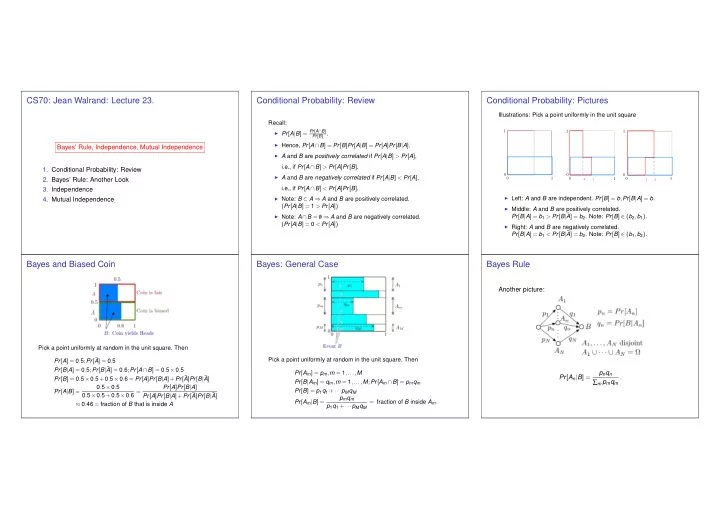
◮ Bayes’ Rule: Pr[Am|B] = pmqm/(p1q1 +···+pMqM). ◮ Mutual Independence: Events defined by disjoint
collections of mutually independent events are mutually independent.