Life in the Fast Lane: the confluence lens George Varghese, - - PowerPoint PPT Presentation

life in the fast lane the confluence lens
SMART_READER_LITE
LIVE PREVIEW

Life in the Fast Lane: the confluence lens George Varghese, - - PowerPoint PPT Presentation

Life in the Fast Lane: the confluence lens George Varghese, Microsoft Research I drive fast only when . . Only drug I use is . . . But I do like to make things run fast Algorithmics to speed abstractions Example 1: Virtual


slide-1
SLIDE 1

Life in the Fast Lane: the confluence lens

George Varghese, Microsoft Research

slide-2
SLIDE 2
  • I drive fast only when . .
  • Only drug I use is . . .
  • But I do like to make things run fast
slide-3
SLIDE 3

Algorithmics to speed abstractions

 Example 1: Virtual Memory:

 Abstraction: Illusion of infinite memory  Algorithmics: Paging Algorithms

 Example 2: Relational Databases

 Abstraction: Operations on Logical tables  Algorithmics: Query Planning

slide-4
SLIDE 4

Networking in 1990s

 Context: Web exploding, traffic doubling,

address doubling.

 Problem: TCP (connected queues) and IP

(datagram) slow, as were routers & servers

 Network Algorithmics: techniques to restore

speed of abstractions to that of fiber.

 This talk: revisionist history of algorithmics and

the confluence lens

slide-5
SLIDE 5

Outline

 What is a confluence?  Network Algorithmics viewed from the

lens of confluence

 Using confluence in Research

slide-6
SLIDE 6

What is a Confluence?

slide-7
SLIDE 7

MISSOURI

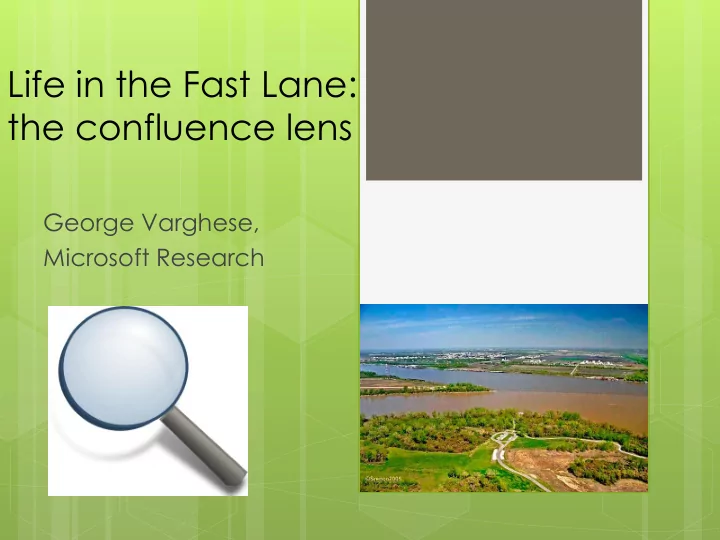
CONFLUENCE: Where Two Rivers meet

slide-8
SLIDE 8

MAIN STREAM IMPACTING STREAM NEW STREAM

Inflection Point Milieu Change Transformed Ideas

Confluence Definition for this talk

slide-9
SLIDE 9

Realistic Painting Psychology Impressionism

Photography Ideas to Canvas Thin to thick strokes

Example 1: Impressionism

slide-10
SLIDE 10

Algorithms Probability

  • R. Algorithms

Crypto Always to sometimes Sieve of Eratosthenes to Miller-Rabin

Algorithm TIme on 𝟐𝟏𝟐𝟏𝟏 + 𝟑𝟕𝟖 Miller-Rabin (100 trials) 0.3 seconds Best Deterministic (AKS) 37 weeks

Example 2: Randomized Algorithms

slide-11
SLIDE 11

More Computer Science examples

 Distributed Algorithms

 Streams: Algorithms, Networks  Inflection Point: Popularity of Internet  Mileu Change: Asynchrony, partial failure

 Computational Economics

 Streams: Economics, Computer Science  Inflection Point: Internet Auctions  Milieu Change: Large scale, small latency

slide-12
SLIDE 12

Why Confluences?

 Separate trends from fads  Provide a research theme  Balance desire for beauty and impact  Suggest a new field in making, especially

when the original field has matured

slide-13
SLIDE 13

Networking Learning Theory Network Learning?

Large network data Distributed data ? What concept has changed?

All Interdisciplinary work ≠ confluence

slide-14
SLIDE 14

Algorithmics via Confluences

slide-15
SLIDE 15

Networking Architecture Algorithmics

Cheap Clusters Machine bus to Network bus

Net Network

DMA RDMA

Example 1: RDMA [KSL 86]

slide-16
SLIDE 16

From RDMA to Fast Servers

Inflection point: Internet heating up (90s)

 Fast Buffers (DP 93): Avoid copies without

changing protocol  0 copy interfaces

 Application Device Channels (DPD 93) 

Avoid interrupts  VIA standard

 Header Prediction (J90)  Fast TCP

slide-17
SLIDE 17

IP Lookups & Path Compression

1 1 1 11 1

Benefit: Worst case storage falls from N W to 2 N. Proof: Adding a new node adds at most 2 trie nodes

slide-18
SLIDE 18

Networking Algorithms Algorithmics

Traffic, IP v6 Msec to usec Binary Search On Lengths

P Prefix 1 Prefix N

O (log N)

Length 0 Length 32

O (log W)

Example 2: IP Lookup [WVTP 97]

slide-19
SLIDE 19

Binary Search vs log W prefix match

1* 101*

Length 1 Length 3 Length 2

Day 1: JST, For binary search start in middle

slide-20
SLIDE 20

Binary Search vs log W prefix match

1* 101*

Length 1 Length 3 Length 2

10

Day 2: JST, Oh, just add markers

slide-21
SLIDE 21

Binary Search vs log W prefix match

1* 101*

Length 1 Length 3 Length 2

10

Day 3, GV, Bug, pre-compute BMP of marker

slide-22
SLIDE 22

Crossbars & HOL BLocking

slide-23
SLIDE 23

Edge coloring versus PIM

Maximal match in log N steps (AOST93) using randomization (PIM) Token ring like approach using O(1) steps (M99)  Cisco GSR

slide-24
SLIDE 24

More Algorithms vs. Algorithmics

 Sorting vs Packet Scheduling (SV 96): DRR

avoids sorting, throughput-fair only

 Geometry vs ACLs (GM01): Real ACLs have

few regions, decision trees

 Bucket Sort vs Timing Wheels (VL97): Empty

bucket overhead OK as OS updates time

slide-25
SLIDE 25

Fast Routers common by 2000s

 Cisco Cat 6K, GSR, Juniper M40  All the problems (switching, lookups, ACLs,

scheduling) had reasonable hardware

 Solutions scaled as link speeds scaled  Would Algorithmics play out by 2000?

slide-26
SLIDE 26

Algorithmics Randomized Algs Security Algorithmics

Attacks, worms Within Across packets Sampling to Sample & Hold

Example 3: Measurement, Security

Randomized algorithms can keep exponentially less space

slide-27
SLIDE 27

Heavy Hitters: Sample & Hold

F1 F1 F1 F1 F2 F1 3 F2 1 F1

Uncertainty only at start leads to O(1/M) error vs O (1 /sqrt(M)) First in Gibbons-Mathias 98, with some added twists in EV 02

F3

slide-28
SLIDE 28

The NetSift Adventure

 Start: Sumeet has idea to automate

signature collection.

 Idea: Why not use heavy-hitters on

content hashes to detect worms

 Prototype: In a week, Sumeet had his

implementation, detected Kibvu

 Realization: NetSift, built a chip -> Cisco.

Transition to Reg Ex obsoleted technology

slide-29
SLIDE 29

More streaming  networks

 Elephant Traps (LWPB07): improves S&H by

evicting low rate flows.

 From heavy hitters to flow distribution

(KXSW 04)

 More complex security predicates like

Super spreaders (VSGB 05)

slide-30
SLIDE 30

Using Confluence in Research

slide-31
SLIDE 31

Paris 1860 Monet Renoir Impressionism Princeton 1973 Confluence: Number Theory with Physics

  • 1. Embrace Collisions

Dyson Montgomery Rabin MIT, 1975 Miller Randomized Algorithms

slide-32
SLIDE 32

Why Collisions help

 Hamming: At first, I ate with the mathematicians

. . . I shifted to eating with the physics table

 Granovetter 83: Power of Weak Ties. More jobs

found from people outside one’s close circle Outsiders bring new ideas into our closed world.

slide-33
SLIDE 33
  • 1. The Procket Collision

NPU pipeline Crossbar Result: 2 Port Memories suffice for perfect memory allocation Source: John Holst of Procket, generalized by Ron & Fan Graham Memory

slide-34
SLIDE 34

Collisions with Events (NPR 14)

Jain-Chiu fairness index

Some preliminary results by Panigrahy et all . . Income Inequality Networking

slide-35
SLIDE 35

Other Networking Confluences

 Queuing & Networking (Kleinrock, Lam, Kurose, Towsley)  Economics & Networking (Shenker, Clark)  Network Security (Paxon, Savage, Voelker)  HPC & Networking (Greenberg, Vahdat)  . . . Any others? I must have missed many. Write to me.

slide-36
SLIDE 36

Genomics Computer Systems ?

Cheap sequencing Fragments mapped to reference LZ, SQL  SlimGene, GQL

  • 2. Discern Confluences: Genomics

With Christos Kozanitis and Vineet Bafna at UCSD. More work in Berkeley with Franklin, Haussler, Patterson, Shenker, Stoica,

slide-37
SLIDE 37

Picking your confluence

 Watch for Trends

 Read Trade Rags  Listen to Grapevine  Talk to others (teenagers, kids)

 Know your Strengths

 Collaborators  Personal skill set  Access to Data (secret weapons)

slide-38
SLIDE 38

Sabbatical Join MSR Peyman Nick James Ratul Nikolaj Ming

Example 4: Network Verification

(Victor)

slide-39
SLIDE 39

Networking

  • Prog. Languages

Cloud services Programs networks 1 Solution to many, SAT to AllSAT

Network Verification as a confluence

Line to rule coverage for testing

slide-40
SLIDE 40

Network Verification

 Opportunities: what are equivalents of static

checks, synthesis, debuggers etc.?

 Many groups: Bjorner, Foster, Rexford, Walker,

Caesar, Godfrey, McKeown, Millstein, Mahajan, Bjorner, Lam, others?

 Confluence: Networks, PL, verification  Data sets: Stanford, Internet 2, Bing, Azure  Invitation: Join the party! Make a difference!

MSR is a pretty magical place to do this . . .

slide-41
SLIDE 41
  • 3. Seek Coherence in Confluence

Identify recurring themes (principles?)

 Move functions in time or space: e.g.,

pre-computation in prefix search

 Relax Specifications: e.g., DRR  Leverage Hardware: e.g., wide words for

compressed trie lookups, logic in iSLIP

 . . .

Balance innovation with scholarship

slide-42
SLIDE 42

Structures to further Coherence

 Gather group of PhD students around theme  Organize a workshop  Teach a tutorial  Write a review.  Teach a course  Write a book

slide-43
SLIDE 43

Coherence via an Idle Loop

Keep thinking of older problems in background as one learns new techniques

 Synchronize LSPs after partition heals (90s)

 Set Difference using IBFs (EGUV 11)

 Bridge Learning via sending SYSIDs (90s)

 Carousel logging (LMV10)

slide-44
SLIDE 44
  • 4. Be contrarian in picking problems

Advice from Towsley, McKeown. My examples:

 Need MPLS, route lookups too slow (’94)

Fast IP Lookups common today

 Earliest deadline scheduling for fairness (‘95)

Cheap modification of RR (DRR) suffices

 Choose security or performance for firewalls (‘96)

Fast packet classification and efficient CAMs

 Humans must produce attack signatures (’03)

Automated signature extraction.

slide-45
SLIDE 45

But balance risk . . .

 Analogy from Football: Don’t just throw long

balls, run the football occasionally.

 Analogy from Finance: Balance your

  • portfolio. Buttress your stocks with bonds.

 Similarly: keep at least one risky bet but add

safer research. Students need papers!

Confluence Safe work

slide-46
SLIDE 46
  • 5. Be congruent -

May the outward man and the inward man be at one.

  • -- Socrates prayer from Plato’s Phaedrus

Some day you will meet a man who cares for none of these things. Then you will know how poor you are.

  • - Rudyard Kipling in address at McGill University
slide-47
SLIDE 47

Ramana Cheenu Cristi Lili Girish Sumeet Florin Frank Adam Shree Marcel

Thanks to my students, my fellow confluencers

Rajib Sandeep Christos Terry Marti Manmohan Mahesh

slide-48
SLIDE 48

More thanks

Many colleagues but most frequent coauthors:

 Subhash Suri: (Algorithmics)  Mike Mitzenmacher (Measurement Algorithmics)  Brad Calder (architecture + networking)  Nick McKeown (network verification)

slide-49
SLIDE 49

Algorithmics Virtualization

Network functions Moved to Vswitch Pipelined HW to Multicore with VMs Greenberg: Scaling SDN in Public Cloud Kompella et al: Improving TCP Throughput

More life in the fast lane?

slide-50
SLIDE 50
  • 6. Avoid extremes

Influenza, commonly known as "the flu", is an infectious disease common among mammals. The most common symptoms are chills and fever. Confluenza, commonly known as "the conflu", is an infectious disease unique to researchers. The most common symptoms is excessive preoccupation with finding confluences in every aspect of life. Get your conflu shot today Thank you!

F1