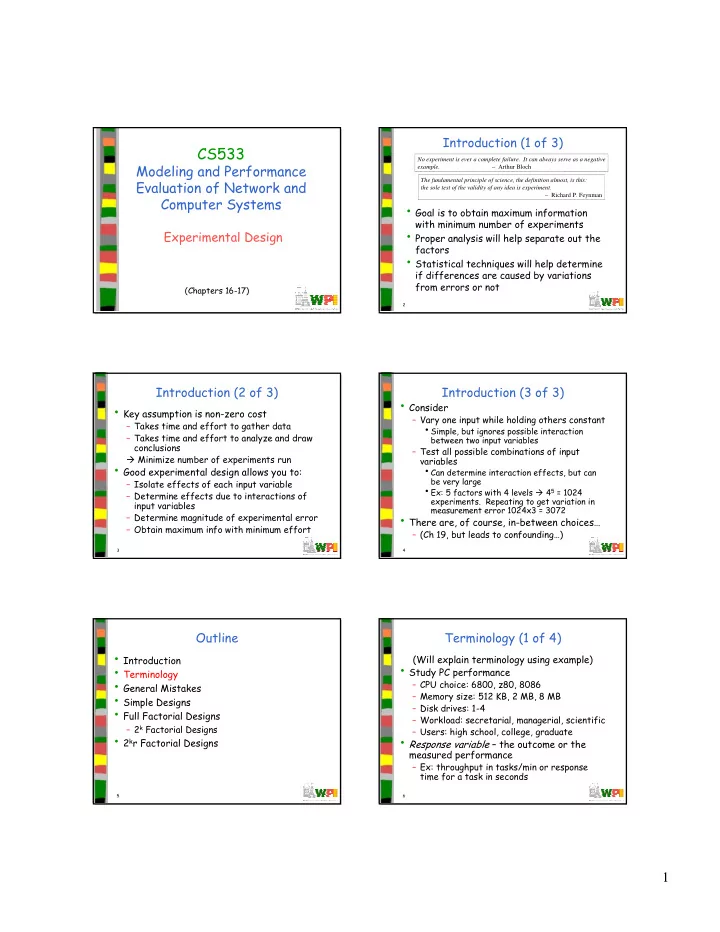
CS533 No experiment is ever a complete failure. It can always serve - - PDF document

cs533
SMART_READER_LITE
LIVE PREVIEW

CS533 No experiment is ever a complete failure. It can always serve - - PDF document

Introduction (1 of 3) CS533 No experiment is ever a complete failure. It can always serve as a negative Modeling and Performance example. Arthur Bloch Evaluation of Network and The fundamental principle of science, the definition almost,


slide-1
SLIDE 1

1

1

CS533

Modeling and Performance Evaluation of Network and Computer Systems

Experimental Design

(Chapters 16-17)

2

Introduction (1 of 3)

  • Goal is to obtain maximum information

with minimum number of experiments

  • Proper analysis will help separate out the

factors

  • Statistical techniques will help determine

if differences are caused by variations from errors or not

No experiment is ever a complete failure. It can always serve as a negative example. – Arthur Bloch The fundamental principle of science, the definition almost, is this: the sole test of the validity of any idea is experiment. – Richard P. Feynman

3

Introduction (2 of 3)

  • Key assumption is non-zero cost

– Takes time and effort to gather data – Takes time and effort to analyze and draw conclusions Minimize number of experiments run

  • Good experimental design allows you to:

– Isolate effects of each input variable – Determine effects due to interactions of input variables – Determine magnitude of experimental error – Obtain maximum info with minimum effort

4

Introduction (3 of 3)

  • Consider

– Vary one input while holding others constant

  • Simple, but ignores possible interaction

between two input variables

– Test all possible combinations of input variables

  • Can determine interaction effects, but can

be very large

  • Ex: 5 factors with 4 levels 45 = 1024
  • experiments. Repeating to get variation in

measurement error 1024x3 = 3072

  • There are, of course, in-between choices…

– (Ch 19, but leads to confounding…)

5

Outline

  • Introduction
  • Terminology
  • General Mistakes
  • Simple Designs
  • Full Factorial Designs

– 2k Factorial Designs

  • 2kr Factorial Designs

6

Terminology (1 of 4)

(Will explain terminology using example)

  • Study PC performance

– CPU choice: 6800, z80, 8086 – Memory size: 512 KB, 2 MB, 8 MB – Disk drives: 1-4 – Workload: secretarial, managerial, scientific – Users: high school, college, graduate

  • Response variable – the outcome or the

measured performance

– Ex: throughput in tasks/min or response time for a task in seconds

slide-2
SLIDE 2

2

7

Terminology (2 of 4)

  • Factors – each variable that affects

response

– Ex: CPU, memory, disks, workload, user – Also called predictor variables or predictors

  • Levels – the different values factors can

take

– EX: CPU 3, memory 3, disks 4, workload 3, users 3 – Also called treatment

  • Primary factors – those of most important

interest

– Ex: maybe CPU and memory the most

8

Terminology (3 of 4)

  • Secondary factors – of less importance

– Ex: maybe user type not as important

  • Replication – repetition of all or some

experiments

– Ex: if run three times, then three replications

  • Design – specification of the replication,

factors, levels

– Ex: Specify all factors, at above levels with 5 replications so 3x3x4x3x3 = 324 time 5 replications yields 1215 total

9

Terminology (4 of 4)

  • Interaction – two factors A and B interact if one

shows dependence upon another

– Ex: non-interacting factor since A always increases by 2 A1 A2 B1 3 5 B2 6 8 – Ex: interacting factors since A change depends upon B A1 A2 B1 3 5 B2 6 9

A1 A2 B1 B2 A1 A2 B1 B2

10

Outline

  • Introduction
  • Terminology
  • General Mistakes
  • Simple Designs
  • Full Factorial Designs

– 2k Factorial Designs

  • 2kr Factorial Designs

11

Common Mistakes in Experiments (1 of 2)

  • Variation due to experimental error is ignored.

– Measured values have randomness due to measurement error. Do not assign (or assume) all variation is due to factors.

  • Important parameters not controlled.

– All parameters (factors) should be listed and accounted for, even if not all are varied.

  • Effects of different factors not isolated.

– May vary several factors simultaneously and then not be able to attribute change to any one. – Use of simple designs (next topic) may help but have their own problems.

12

Common Mistakes in Experiments (2 of 2)

  • Interactions are ignored.

– Often effect of one factor depend upon another. Ex: effects of cache may depend upon size of

  • program. Need to move beyond one-factor-at-a-

time designs

  • Too many experiments are conducted.

– Rather than running all factors, all levels, at all combinations, break into steps – First step, few factors and few levels

  • Determine which factors are significant
  • Two levels per factor (details later)

– More levels added at later design, as appropriate

slide-3
SLIDE 3

3

13

Outline

  • Introduction
  • Terminology
  • General Mistakes
  • Simple Designs
  • Full Factorial Designs

– 2k Factorial Designs

  • 2kr Factorial Designs

14

Simple Designs

  • Start with typical configuration
  • Vary one factor at a time
  • Ex: typical may be PC with z80, 2 MB RAM, 2

disks, managerial workload by college student

– Vary CPU, keeping everything else constant, and compare – Vary disk drives, keeping everything else constant, and compare

  • Given k factors, with ith having ni levels

Total = 1 + Σ(ni-1) for i = 1 to k

  • Example: in workstation study

1 + (3-1) + (3-1) + (4-1) + (3-1) + (3-1) + (3-1) = 14

  • But may ignore interaction

(Example next)

15

Example of Interaction of Factors

  • Consider response time vs. memory size

and degree of multiprogramming Degree 32 MB 64 MB 128MB 1 0.25 0.21 0.15 2 0.52 0.45 0.36 3 0.81 0.66 0.50 4 1.50 1.45 0.70

  • If fixed degree 3, mem 64 and vary one at

a time, may miss interaction

– Example: degree 4, non-linear response time with memory

16

Outline

  • Introduction
  • Terminology
  • General Mistakes
  • Simple Designs
  • Full Factorial Designs

– 2k Factorial Designs

  • 2kr Factorial Designs

17

Full Factorial Designs

  • Every possible combination at all levels of all

factors

  • Given k factors, with ith having ni levels

Total = Π ni for i = 1 to k

  • Example: in CPU design study

(3 CPUs)(3 mem) (4 disks) (3 loads) (3 users) = 324 experiments

  • Advantage is can find every interaction component
  • Disadvantage is costs (time and money), especially

since may need multiple iterations (later)

  • Can reduce costs by: reduce levels, reduce factors,

run fraction of full factorial

(Next, reduce levels)

18

2k Factorial Designs

  • Very often, many levels at each factor

– Ex: effect of network latency on user response time there are lots of latency values to test

  • Often, performance continuously increases or

decreases over levels

– Ex: response time always gets higher – Can determine direction with min and max

  • For each factor, choose 2 alternatives at each

level

– 2k factorial designs

  • Then, can determine which of the factors impacts

performance the most and study those further

Twenty percent of the jobs account for 80% of the resource consumption. – Pareto’s Law

slide-4
SLIDE 4

4

19

22 Factorial Design (1 of 4)

  • Special case with only 2 factors

– Easily analyzed with regression

  • Example: MIPS for Mem (4 or 16 Mbytes) and Cache

(1 or 2 Kbytes)

Mem 4MB Mem 16MB Cache 1 KB 15 45 Cache 2 KB 25 75

  • Define xa = -1 if 4 Mbytes mem, +1 if 16 Mbytes
  • Define xb = -1 if 1 Kbyte cache, +1 if 2 Kbytes
  • Performance:

y = q0 + qaxa + qbxb + qabxaxb

20

22 Factorial Design (2 of 4)

  • Substituting:

15 = q0 - qa - qb + qab 45 = q0 + qa - qb - qab 25 = q0 - qa + qb - qab 75 = q0 + qa + qb + qab

  • Can solve to get:

y = 40 + 20xa + 10xb + 5xaxb

  • Interpret:

– Mean performance is 40 MIPS, memory effect is 20 MIPS, cache effect is 10 MIPS and interaction effect is 5 MIPS (Generalize to easier method next)

(4 equations in 4 unknowns)

21

22 Factorial Design (3 of 4)

Exp a b y 1

  • 1
  • 1

y1 2 1

  • 1

y2 3

  • 1

1 y3 4 1 1 y4

y = q0 + qaxa + qbxb + qabxaxb

  • So:

y1 = q0 - qa - qb + qab y2 = q0 + qa - qb - qab y3 = q0 - qa + qb - qab y4 = q0 + qa + qb + qab

  • Solving, we get:

q0 = ¼( y1 + y2 + y3 + y4) qa = ¼(-y1 + y2 - y3 + y4) qb = ¼(-y1 - y2 + y3 + y4) qab= ¼( y1 - y2 - y3 + y4)

  • Notice for qa can
  • btain by multiplying

“a” column by “y” column and adding

– Same is true for qb and qab

22

22 Factorial Design (4 of 4)

i a b ab y 1

  • 1
  • 1

1 15 1 1

  • 1
  • 1

45 1

  • 1

1

  • 1

25 1 1 1 1 75 160 80 40 20 Total 40 20 10 5 Ttl/4

  • Column “i” has all 1s
  • Columns “a” and “b” have

all combinations of 1, -1

  • Column “ab” is product of

column “a” and “b”

  • Multiply column

entries by yi and sum

  • Dived each by 4 to

give weight in regression model

  • Final:

y = 40 + 20xa + 10xb + 5xaxb

23

Allocation of Variation (1 of 3)

  • Importance of a factor measured by

proportion of total variation in response explained by the factor

– Thus, if two factors explain 90% and 5% of the response, then the second may be ignored

  • Ex: capacity factor (768 Kbps or 10 Mbps)

versus TCP version factor (Reno or Sack)

  • Sample variance of y

sy

2 = Σ(yi – y)2 / (22 – 1)

  • With numerator being total variation, or

Sum of Squares Total (SST)

SST = Σ(yi – y)2

24

Allocation of Variation (2 of 3)

  • For a 22 design, variation is in 3 parts:

– SST = 22q2

a + 22q2 b + 22q2 ab

  • Portion of total variation:

– of a is 22q2

a

– of b is 22q2

b

– of ab is 22q2

ab

  • Thus, SST = SSA + SSB + SSAB
  • And fraction of variation explained by a:

= SSA/SST

– Note, may not explain the same fraction of variance since that depends upon errors+

(Derivation 17.1, p.287)

slide-5
SLIDE 5

5

25

Allocation of Variation (3 of 3)

  • In the memory-cache study

y = ¼ (15 + 55 + 25 + 75) = 40

  • Total variation

= Σ(yi-y)2 = (252 + 152 + 152 + 352) = 2100 = 4x202 + 4x10² + 4x52

  • Thus, total variation is 2100

– 1600 (of 2100, 76%) is attributed to memory – 400 (of 2100, 19%) is attributed to cache – Only 100 (of 2100, 5%) is attributed to interaction

  • This data suggests exploring memory further and

not spending more time on cache (or interaction) (That was for 2 factors. Extend to k next)

26

General 2k Factorial Designs (1 of 4)

  • Can extend same methodology to k factors,

each with 2 levels Need 2k experiments

– k main effects – (k choose 2) two factor effects – (k choose 3) three factor effects…

  • Can use sign table method

(Show with example, next)

27

General 2k Factorial Designs (2 of 4)

  • Example: design LISP machine

– Cache, memory and processors

Factor Level –1 Level 1 Memory (a) 4 Mbytes 16 Mbytes Cache (b) 1 Kbytes 2 Kbytes Processors (c) 1 2

  • The 23 design and MIPS perf results are:

4 Mbytes Mem(a) 16 Mbytes Mem Cache (b) One proc (c) Two procs One proc Two procs 1 KB | 14 46 22 58 2 KB | 10 50 34 86

28

General 2k Factorial Designs (3 of 4)

  • Prepare sign table:

i a b c ab ac bc abc y 1

  • 1
  • 1
  • 1

1 1 1

  • 1

14 1 1

  • 1
  • 1
  • 1
  • 1

1 1 22 1

  • 1

1

  • 1

1

  • 1
  • 1
  • 1

10 1 1 1

  • 1

1

  • 1
  • 1
  • 1

34 1

  • 1

1 1

  • 1
  • 1

1

  • 1

46 1 1

  • 1

1

  • 1

1

  • 1
  • 1

58 1

  • 1

1 1

  • 1
  • 1

1

  • 1

50 1 1 1 1 1 1 1 1 86 320 80 40 160 40 16 24 9 Ttl 40 10 5 20 5 2 3 1 Ttl/8 qa =10, qb=5, qc=20 and qab=5, qac=2, qbc=3 and qabc=1

29

General 2k Factorial Designs (3 of 4)

  • qa=10, qb=5, qc=20 and qab=5, qac=2, qbc=3 and qabc=1
  • SST = 23 (qa

2+qb 2+qc 2+qab 2+qac 2+qbc 2+qabc 2)

= 8 (102+52+202+52+22+32+12) = 800+200+3200+200+32+72+8 = 4512

  • The portion explained by the 7 factors are:

mem = 800/4512 (18%) cache = 200/4512 (4%) proc = 3200/4512 (71%) mem-cache =200/4512 (4%) mem-proc = 32/4512 (1%) cache-proc = 72/4512 (2%) mem-proc-cache = 8/4512 (0%)

30

Outline

  • Introduction
  • Terminology
  • General Mistakes
  • Simple Designs
  • Full Factorial Designs

– 2k Factorial Designs

  • 2kr Factorial Designs
slide-6
SLIDE 6

6

31

2kr Factorial Designs

  • With 2k factorial designs, not possible to estimate

error since only done once

  • So, repeat r times for 2kr observations
  • As before, will start with 22r model and expand
  • Two factors at two levels and want to isolate

experimental errors

– Repeat 4 configurations r times

  • Gives you error term:

– y = q0 + qaxa + qbxb + qabxaxb + e – Want to quantify e (Illustrate by example, next)

No amount of experimentation can ever prove me right; a single experiment can prove me wrong.

  • Albert Einstein

32

22r Factorial Design Errors (1 of 2)

  • Previous cache experiment with r=3

i a b ab y mean y 1

  • 1
  • 1

1 (15, 18, 12) 15 1 1

  • 1
  • 1

(45, 48, 51) 48 1

  • 1

1

  • 1

(25, 28, 19) 24 1 1 1 1 (75, 75, 81) 77 164 86 38 20 Total 41 21.5 9.5 5 Ttl/4

  • Have estimate for each y

– yi = q0 + qaxai + qbxbi + qabxaixbi + ei

  • Have difference (error) for each repetition

– eij = yij – yi = yij - q0 - qaxai - qbxbi - qabxaixbi

33

22r Factorial Design Errors (2 of 2)

  • Use sum of squared errors (SSE) to compute variance

and confidence intervals

SSE = ΣΣe2

ij for i = 1 to 4 and j = 1 to r

  • Example

i a b ab yi yi1 yi2 yi3 ei1 ei2 ei3 1

  • 1
  • 1

1 15 15 18 12 0 3 -3 1 1

  • 1
  • 1

48 45 48 51

  • 3 0 3

1

  • 1

1

  • 1

24 25 28 19 1 4 -5 1 1 1 1 77 75 75 81

  • 2 -2 4
  • Ex: y1 = q0-qa-qb+qab = 41-21.5-9.5+5 = 15
  • Ex: e11 = y11 – y1 = 15 – 15 = 0
  • SSE = 02+32+(-3)2+(-3)2+02+32+12+42+(-5)2

+(-2)2+(-2)2+42 = 102

34

22r Factorial Allocation of Variation

  • Total variation (SST)

SST = Σ(yij – y..)2

  • Can be divided into 4 parts:

Σ(yij – y..)2 = 22rq2

a + 22rq2 b + 22rq2 ab + Σe2 ij

SST = SSA + SSB + SSAB + SSE

  • Thus

– SSA, SSB, SSAB are variations explained by factors a, b and ab – SSE is unexplained variation due to experimental errors

  • Can also write SST = SSY-SS0 where SS0 is sum

squares of mean

(Derivation 18.1, p.296)

35

22r Factorial Allocation of Variation Example

  • For memory cache study:

– SSY = 152+182+122+ … +752 + 812 = 27,204 – SS0 = 22rq2

0 = 12x412 = 20,172

– SSA = 22rq2

a = 12x(21.5)2 = 5547

– SSB = 22rq2

b = 12x(9.5)2 = 1083

– SSAB = 22rq2

ab = 12x52 = 300

– SSE = 27,204-22x3(412+21.52+9.52+52)=102 – SST = 5547 + 1083 + 300 + 102 = 7032

  • Thus, total variation of 7032 divided into 4 parts:

– Factor a explains 5547/7032 (78.88%), b explains 15.40%, ab explains 4.27% – Remaining 1.45% unexplained and attributed to error

36

Confidence Intervals for Effects

  • Assuming errors are normally distributed,

then yijs are normally distributed with same variance

  • Since qo, qa, qb, qab are all linear

combinations of yij’s (divided by 22r), then they have same variance (divided by 22r)

  • Variance s2 = SSE /(22(r-1))
  • Confidence intervals for effects then:

– qi±t[1-α/2; 2

2 (r-1)]sqi

  • If confidence interval does not include

zero, then effect is significant

slide-7
SLIDE 7

7

37

Confidence Intervals for Effects (Example)

  • Memory-cache study, std dev of errors:

se = sqrt[SSE / (22(r-1)] = sqrt(102/8) = 3.57

  • And std dev of effects:

sqi = se / sqrt(22r) = 3.57/3.47 = 1.03

  • The t-value at 8 degrees of freedom and

95% confidence is 1.86

  • Confidence intervals for parameters:

qi ±(1.86)(1.03) = qi ±1.92 – q0 (39.08,42.91), qa(19.58,23,41), qb(7.58,11.41), qab(3.08,6.91) – Since none include zero, all are statistically significant

38

Confidence Intervals for Predicted Responses (1 of 2)

  • Mean response predicted

– y = q0 + qaxa + qbxb + qabxaxb

  • If predict mean from m more experiments,

will have same mean but confidence interval

  • n predicted response decreases
  • Can show that std dev of predicted y with

me more experiments

– sym = sesqrt(1/neff + 1/m) – Where neff = runs/(1+df)

  • In 2 level case, each parameter has 1 df, so

neff = 22r/5

39

Confidence Intervals for Predicted Responses (2 of 2)

  • A 100(1-α)% confidence interval of

response:

– yp±t[1-α/2; 2

2 (r-1)]sym

  • Two cases are of interest.

– Std dev of one run (m=1)

  • sy1 = sesqrt(5/22r + 1)

– Std dev for many runs (m=∞)

  • sy1 = sesqrt(5/22r)

40

Confidence Intervals for Predicted Responses Example (1 of 2)

  • Mem-cache study, for xa=-1, xb=-1
  • Predicted mean response for future

experiment

– y1 = q0-qa-qb+qab = 41-21.5+1=15 – Std dev = 3.57 x sqrt(5/12 + 1) = 4.25

  • Using t[0.95;8] = 1.86, 90% conf interval

15±1.86x4.25 = (8.09,22.91)

  • Predicted mean response for 5 future

experiments

– Std dev = 3.57(sqrt 5/12 + 1/5) = 2.80 15±1.86x2.80 = (9.79,20.29)

41

Confidence Intervals for Predicted Responses Example (2 of 2)

  • Predicted Mean Response for Large

Number of Experiments

– Std dev = 3.57xsqrt(5/12) = 2.30 – The confidence interval: 15±1.86x2.30=(10.72,19.28)