CS525u Perceptual Quality Multimedia Computing Network Issues - - PDF document

cs525u
SMART_READER_LITE
LIVE PREVIEW

CS525u Perceptual Quality Multimedia Computing Network Issues - - PDF document

Introduction Purpose Brief introduction to: Digital Audio Digital Video CS525u Perceptual Quality Multimedia Computing Network Issues The Science (or lack of) in Computer Science Get you ready for


slide-1
SLIDE 1

1

CS525u Multimedia Computing

Introduction

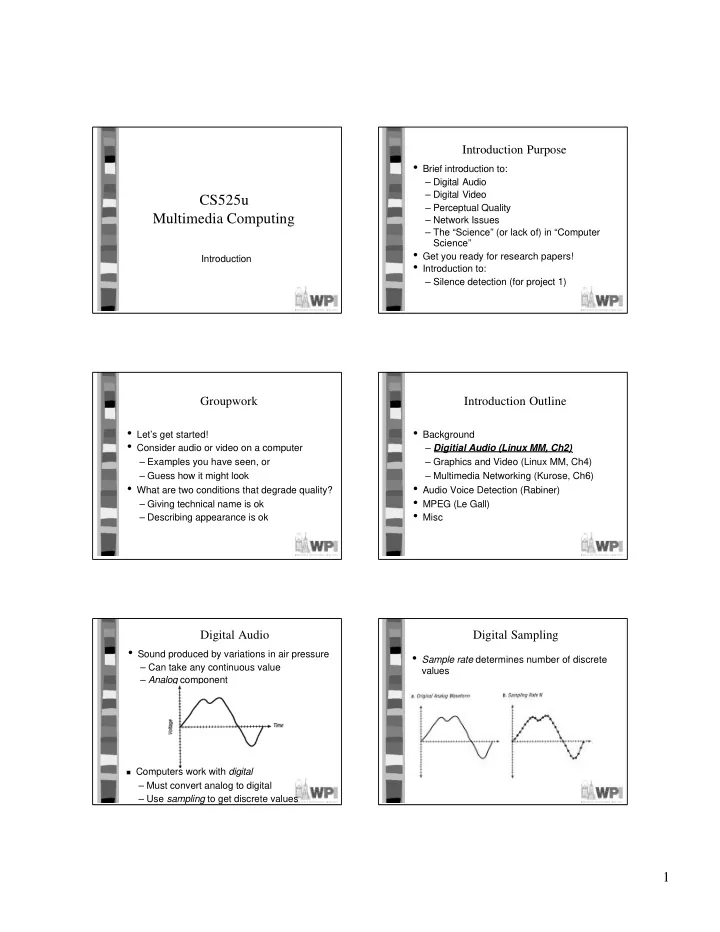
Introduction Purpose

  • Brief introduction to:

– Digital Audio – Digital Video – Perceptual Quality – Network Issues – The “Science” (or lack of) in “Computer Science”

  • Get you ready for research papers!
  • Introduction to:

– Silence detection (for project 1)

Groupwork

  • Let’s get started!
  • Consider audio or video on a computer

– Examples you have seen, or – Guess how it might look

  • What are two conditions that degrade quality?

– Giving technical name is ok – Describing appearance is ok

Introduction Outline

  • Background

– Digitial Audio (Linux MM, Ch2) – Graphics and Video (Linux MM, Ch4) – Multimedia Networking (Kurose, Ch6)

  • Audio Voice Detection (Rabiner)
  • MPEG (Le Gall)
  • Misc

Digital Audio

  • Sound produced by variations in air pressure

– Can take any continuous value – Analog component

Computers work with digital

– Must convert analog to digital – Use sampling to get discrete values

Digital Sampling

  • Sample rate determines number of discrete

values

slide-2
SLIDE 2

2

Digital Sampling

  • Half the sample rate

Digital Sampling

  • Quarter the sample rate

Sample Rate

  • Nyquist’s Theorem: to accurately reproduce

signal, must sample at twice the highest frequency

  • Why not always use high sampling rate?

– Requires more storage – Complexity and cost of analog to digital hardware – Typically want an adequate sampling rate

Sample Size

  • Samples have discrete values

How many possible values? Sample Size Common is 256 values from 8 bits

Sample Size

  • Quantization error from rounding

– Ex: 28.3 rounded to 28

  • Why not always have large sample size?

– Storage increases per sample – Analog to digital hardware becomes more expensive

Introduction Outline

  • Background

– Digitial Audio (Linux MM, Ch2) – Graphics and Video (Linux MM, Ch4) – Multimedia Networking (Kurose, Ch6)

  • Audio Voice Detection (Rabiner)
  • MPEG (Le Gall)
  • Misc
slide-3
SLIDE 3

3

Review

  • What is the relationship between samples

and fidelity? – Why not always have a high sample frequency? – Why not always have a large sample size?

Groupwork

  • Think of as many uses of computer audio as

you can

  • Which require a high sample rate and large

sample size? Which do not? Why?

Back of the Envelope Calculations

  • Telephones typically carry digitized voice
  • 8 KHz (8000 samples per second)
  • 8-bit sample size
  • For 10 seconds of speech:

– 10 sec x 8000 samp/sec x 8 bits/samp = 640,000 bits or 80 Kbytes – Fit 3 minutes on floppy

  • Fine for voice, but what about music?

More Back of the Envelope Calculations

  • Can only represent 4 KHz frequencies (why?)
  • Human ear can perceive 10-20 KHz

– Used in music

  • CD quality audio:

– sample rate of 44,100 samples/sec – sample size of 16-bits – 60 min x 60 secs/min x 44,100 samp/sec x 2 bytes/samples x 2 channels = 635,040,000 or about 600 Mbytes

  • Can use compression to reduce

Audio Compression

  • Above sampling assumed linear scale with

respect to intensity

  • Human ear not keen at very loud or very quiet
  • Companding uses modified logarithmic scale

to greater range of values with smaller sample size – µ-law effectively stores 12 bits of data in 8- bit sample – Used in U.S. telephones – Used in Sun computer audio – MP3 for music

MIDI

  • Musical Instrument Digital Interface

– Protocol for controlling electronic musical instruments

  • MIDI message

– Which device – Key press or key release – Which key – How hard (controls volume)

  • MIDI file can play ‘song’ to MIDI device
slide-4
SLIDE 4

4

Sound File Formats

  • Raw data has samples (interleaved w/stereo)
  • Need way to ‘parse’ raw audio file
  • Typically a header

– Sample rate – Sample size – Number of channels – Coding format – …

  • Examples:

– .au for Sun µ-law, .wav for IBM/Microsoft

Example Sound Files Outline

  • Introduction

– Digital Audio (Linux MM, Ch2) – Graphics and Video (Linux MM, Ch4) – Multimedia Networking (Kurose, Ch6)

  • Audio Voice Detection (Rabiner)
  • MPEG (Le Gall)
  • Misc

Graphics and Video “A Picture is Worth a Thousand Words”

  • People are visual by nature
  • Many concepts hard to explain or draw
  • Pictures to the rescue!
  • Sequences of pictures can depict motion

– Video!

Graphics Basics

  • Computer graphics (pictures) made up of

pixels – Each pixel corresponds to region of memory – Called video memory or frame buffer

  • Write to video memory

– monitor displays with raster cannon

Monochrome Display

  • Pixels are on (black) or off (white)

– Dithering can appear gray

slide-5
SLIDE 5

5

Grayscale Display

  • Bit-planes

– 4 bits per pixel, 24 = 16 gray levels

Color Displays

  • Combine red, green and blue
  • 24 bits/pixel, 224 = 16 million colors
  • But now requires 3 bytes required per pixel

Video Palettes

  • Still have 16 million colors, only 256 at a time
  • Complexity to lookup, color flashing
  • Can dither for more colors, too

Video Wrapup

  • xdpyinfo

Introduction Outline

  • Background

– Digitial Audio (Linux MM, Ch2) – Graphics and Video (Linux MM, Ch4) – Multimedia Networking (Kurose, Ch6)

  • (6.1 to 6.3)
  • Audio Voice Detection (Rabiner)
  • MPEG (Le Gall)
  • Misc
slide-6
SLIDE 6

6

Internet Traffic Today

  • Internet dominated by text-based applications

– Email, FTP, Web Browsing

  • Very sensitive to loss

– Example: lose a byte in your blah.exe program and it crashes!

  • Not very sensitive to delay

– 10’s of seconds ok for web page download – Minutes for file transfer – Hours for email to delivery

Multimedia on the Internet

  • Multimedia not as sensitive to loss

– Words from sentence lost still ok – Frames in video missing still ok

  • Multimedia can be very sensitive to delay

– Interactive session needs one-way delays less than 1 second!

  • New phenomenon is jitter!

Jitter Jitter-Free Classes of Internet Multimedia Apps

  • Streaming stored media
  • Streaming live media
  • Real-time interactive media

Streaming Stored Media

  • Stored on server
  • Examples: pre-recorded songs, famous

lectures, video-on-demand

  • RealPlayer and Netshow
  • Interactivity, includes pause, ff, rewind…
  • Delays of 1 to 10 seconds or so
  • Not so sensitive to jitter

Streaming Live Media

  • “Captured” from live camera, radio, T.V.
  • 1-way communication, maybe multicast
  • Examples: concerts, radio broadcasts,

lectures

  • RealPlayer and Netshow
  • Limited interactivity…
  • Delays of 1 to 10 seconds or so
  • Not so sensitive to jitter
slide-7
SLIDE 7

7

Real-Time Interactive Media

  • 2-way communication
  • Examples: Internet phone, video conference
  • Very sensitive to delay

< 150ms very good < 400ms ok > 400ms lousy

Hurdles for Multimedia on the Internet

  • IP is best-effort

– No delivery guarantees – No bandwidth guarantees – No timing guarantees

  • So … how do we do it?

– Not too well for now – This class is largely about techniques to make it better!

Multimedia on the Internet

  • The Media Player
  • Streaming through the Web
  • The Internet Phone Example

The Media Player

  • End-host application

– Real Player, Windows Media Player

  • Needs to be pretty smart
  • Decompression (MPEG)
  • Jitter-removal (Buffering)
  • Error correction (Repair, as a topic)
  • GUI with controls (HCI issues)

– Volume, pause/play, sliders for jumps

Streaming through a Web Browser

Must download whole file first!

Streaming through a Plug-In

Must still use TCP!

slide-8
SLIDE 8

8

Streaming through the Media Player An Example: Internet Phone

  • Specification
  • Removing Jitter
  • Recovering from Loss

Internet Phone: Specification

  • 8 Kbytes per second, send every 20 ms

– 20 ms * 8 kbytes/sec = 160 bytes per packet

  • Header per packet

– Sequence number, time-stamp, playout delay

  • End-to-End delay of 150 – 400 ms
  • UDP

– Can be lost – Can be delayed different amounts

Internet Phone: Removing Jitter

  • Use header information to reduce jitter

– Sequence number and Timestamp

  • Two strategies:

–Fixed playout delay –Adaptive playout delay

Fixed Playout Delay Adaptive Playout Delay

slide-9
SLIDE 9

9

Internet Phone: Recovering from Loss