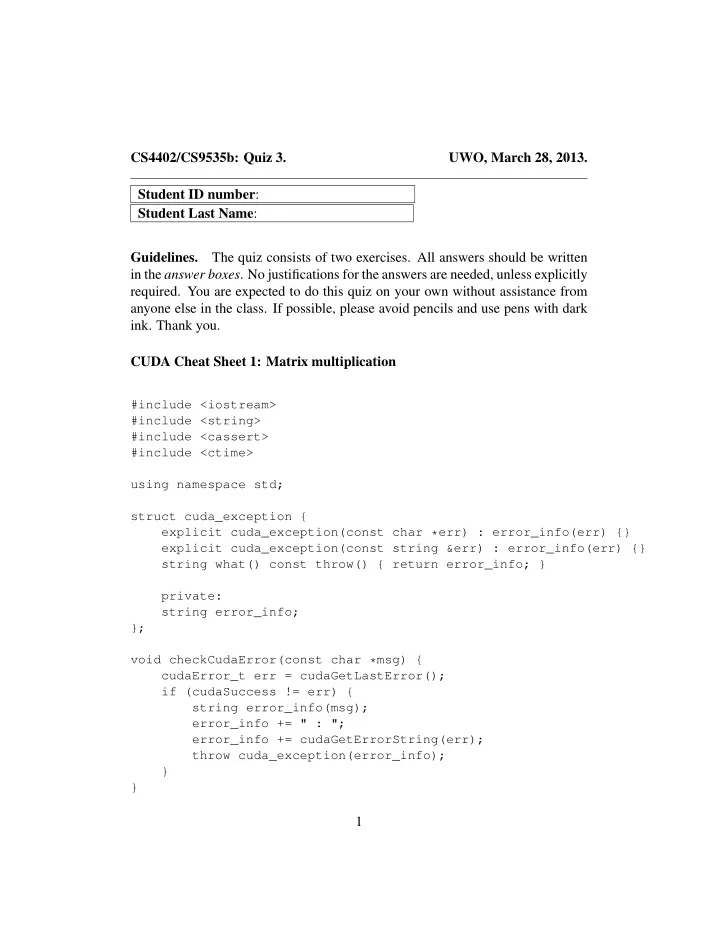
SLIDE 1 CS4402/CS9535b: Quiz 3. UWO, March 28, 2013. Student ID number: Student Last Name: Guidelines. The quiz consists of two exercises. All answers should be written in the answer boxes. No justifications for the answers are needed, unless explicitly
- required. You are expected to do this quiz on your own without assistance from
anyone else in the class. If possible, please avoid pencils and use pens with dark
CUDA Cheat Sheet 1: Matrix multiplication
#include <iostream> #include <string> #include <cassert> #include <ctime> using namespace std; struct cuda_exception { explicit cuda_exception(const char *err) : error_info(err) {} explicit cuda_exception(const string &err) : error_info(err) {} string what() const throw() { return error_info; } private: string error_info; }; void checkCudaError(const char *msg) { cudaError_t err = cudaGetLastError(); if (cudaSuccess != err) { string error_info(msg); error_info += " : "; error_info += cudaGetErrorString(err); throw cuda_exception(error_info); } }
1
SLIDE 2
template<typename T> void random_matrix(T *M, size_t height, size_t width, int p = 2) { for(size_t i = 0; i < height; ++i) { for (size_t j = 0; j < width; ++j) { M[i * width + j] = rand() % p; } } } template<typename T> void print_matrix(const T *M, size_t height, size_t width) { if (height >= 32 || width >= 32) { cout << "a matrix of height " << height << ", of width " << width << return; } for(size_t i = 0; i < height; ++i) { for (size_t j = 0; j < width; ++j) { cout << M[i * width + j] << " "; } cout << endl; } cout << endl; } #define BLOCK_SIZE 16 /** * CUDA kernel for matrix multiplication, blockwise multiplcation * * @C, the output matrix C = A * B * @A, the first input matrix * @B, the second input matrix * @wa, is the width of A * @wb, is the width of B * * returns void. * */
2
SLIDE 3
template <typename T> __global__ void matrix_mul_ker(T* C, const T *A, const T *B, size_t wa, size_t wb) { // Block index; WARNING: should be at most 2ˆ16 - 1 int bx = blockIdx.x; int by = blockIdx.y; // Thread index int tx = threadIdx.x; int ty = threadIdx.y; // Index of the first submatrix of A processed by the block // This is the y-coordinate of the NW corner of the working tile int aBegin = wa * BLOCK_SIZE * by; // Index of the last submatrix of A processed by the block // This is the y-coordinate of the SE corner of the working tile int aEnd = aBegin + wa - 1; // Step size used to iterate through the submatrices of A // int aStep = BLOCK_SIZE; // Index of the first submatrix of B processed by the block // This is the x-coordinate of the NW corner of the working tile int bBegin = BLOCK_SIZE * bx; // Step size used to iterate through the submatrices of B int bStep = BLOCK_SIZE * wb; // The element of the block submatrix that is computed by the thread // WARNING: This is a local variable for the working thread int Csub = 0; // Loop over all the submatrices of A and B required to // compute the block submatrix // This loop iterates through the tiles in A ndn B that // contribute to the working tile of C for(int a = aBegin, b = bBegin; a <= aEnd; a += aStep, b += bStep) {
3
SLIDE 4
// shared memory for the submatrix of A __shared__ int As[BLOCK_SIZE][BLOCK_SIZE]; // shared memory for the submatrix of B __shared__ int Bs[BLOCK_SIZE][BLOCK_SIZE]; // Load the matrices from global memory to shared memory // each thread loads one element of each matrix As[ty][tx] = A[a + wa * ty + tx]; Bs[ty][tx] = B[b + wb * ty + tx]; // synchronize to make sure the matrices are loaded __syncthreads(); // Multiply the two matrices together // each thread computes one element of the block submatrix for(int k = 0; k < BLOCK_SIZE; ++k) { Csub += As[ty][k] * Bs[k][tx]; } // synchronize to make sure that the preceding computation is // done before loading two new submatrices of A dnd B in the next iteration __syncthreads(); } // Write the block submatrix to global memory; // each thread writes one element int c = wb * BLOCK_SIZE * by + BLOCK_SIZE * bx; C[c + wb * ty + tx] = Csub; } template <typename T> void matrix_mul_dev(T* C, const T* A, const T* B, int ha, int wa, int wb) { assert(wa % BLOCK_SIZE == 0); assert(wb % BLOCK_SIZE == 0); // load A and B to the device size_t mem_size = ha * wa * sizeof(T); T* Ad; cudaMalloc((void **)&Ad, mem_size);
4
SLIDE 5
checkCudaError("allocate GPU memory for the first matrix"); cudaMemcpy(Ad, A, mem_size, cudaMemcpyHostToDevice); T* Bd; mem_size = wa * wb * sizeof(T); cudaMalloc((void **)&Bd, mem_size); checkCudaError("allocate GPU memory for the second matrix"); cudaMemcpy(Bd, B, mem_size, cudaMemcpyHostToDevice); // allocate C on the device T* Cd; mem_size = ha * wb * sizeof(int); cudaMalloc((void**)&Cd, mem_size); checkCudaError("allocate GPU memory for the output matrix"); // compute the execution configure // assume that the matrix dimensions are multiples of BLOCK_SIZE dim3 dimBlock(BLOCK_SIZE, BLOCK_SIZE); size_t dgx = wb / dimBlock.x; size_t dgy = ha / dimBlock.y; dim3 dimGrid(dgx, dgy); // launch the device computation matrix_mul_ker<<<dimGrid, dimBlock>>>(Cd, Ad, Bd, wa, wb); cudaThreadSynchronize(); checkCudaError("call the matrix multiplication kernel"); // read C from the device cudaMemcpy(C, Cd, mem_size, cudaMemcpyDeviceToHost); // Free device memory cudaFree(Ad); cudaFree(Bd); cudaFree(Cd); } /** * Returns the time spent in seconds */ template <typename T>
5
SLIDE 6
double matrix_mul_gpu(T* C, const T* A, const T* B, int ha, int wa, int wb) { clock_t t1 = clock(); // do the multiplication matrix_mul_dev(C, A, B, ha, wa, wb); clock_t t2 = clock(); return (t2 - t1) / double(CLOCKS_PER_SEC); } /** * ha = 2ˆeha, * wa = 2ˆewa, * wb = 2ˆewb; * * If no parameter entered, then default values are used. * If one parameter rentered, it is eha = ewa = ewb = argv[1]. * If three parameters rentered, there are eha, ewa, and ewb, respectively. * */ int matrix_mul_test(int argc, char **argv) { int *A, *B, *C; size_t eha = 4; size_t ewa = 4; size_t ewb = 4; if (argc == 2) { eha = ewa = ewb = atoi(argv[1]); } else if (argc >= 3) { eha = atoi(argv[1]); ewa = atoi(argv[2]); ewb = atoi(argv[3]); } size_t ha = (1L << eha); size_t wa = (1L << ewa); size_t wb = (1L << ewb); try { A = new int[ha * wa];
6
SLIDE 7
B = new int[wa * wb]; C = new int[ha * wb]; random_matrix(A, ha, wa); random_matrix(B, wa, wb); // timing gpu based method cout << matrix_mul_gpu(C, A, B, ha, wa, wb) << "(seconds)" << endl; } catch (cuda_exception& err) { cout << err.what() << endl; delete [] A; delete [] B; delete [] C; return EXIT_FAILURE; } catch (...) { delete [] A; delete [] B; delete [] C; cout << "unknown exeception" << endl; return EXIT_FAILURE; } print_matrix(A, ha, wa); print_matrix(B, wa, wb); print_matrix(C, ha, wb); delete [] A; delete [] B; delete [] C; return 0; } int main(int argc, char** argv) { matrix_mul_test(argc, argv); return 0; }
7
SLIDE 8 Exercise 1. The following C function adds two float vectors iA and iB into
void vector_add (float *iA, float *iB, float* oC, int width) { int i; for (i=0; i<width ; i++) {
} Write a CUDA kernel with the same specification, for a 1-D grid, with 1-D thread blocks, assuming that each thread is in charge of computing one element in
8
SLIDE 9
9
SLIDE 10 Exercise 2. Write a CUDA kernel (and the launching code) implementing the reversal of an input integer array A od size n. This reversing process will be
- ut-of-place. You are asked to proceed in two steps.
(1) First write a “naive” kernel which does not use shared memory. (2) Then, write a kernel using shared memory. 10
SLIDE 11
11
SLIDE 12
12