
SLIDE 1
CS440 - Introduction to Artificial Intelligence
What is AI?
1
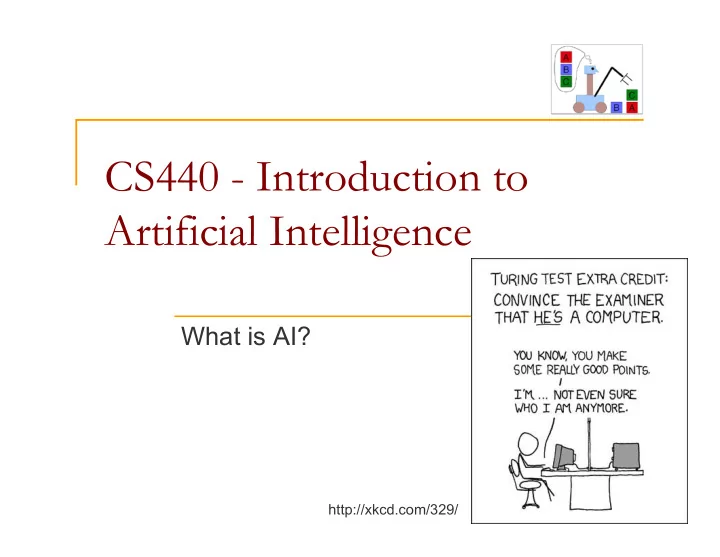
http://xkcd.com/329/
CS440 - Introduction to Artificial Intelligence What is AI? 1 - - PowerPoint PPT Presentation
CS440 - Introduction to Artificial Intelligence What is AI? 1 http://xkcd.com/329/ COMPUTER SCIENCE DEPARTMENT PICNIC Welcome to the 2019-2020 Academic year ! Meet your faculty, department staff, and fellow students in a social setting.
1
http://xkcd.com/329/
When: Saturday, August 31st Time: 1pm-4pm Where: City Park Shelter #7 Welcome to the 2019-2020 Academic year ! Meet your faculty, department staff, and fellow students in a social setting. Food and drink will be provided.
q Instructor: Asa Ben-Hur
n Office: 448 n Office Hours: TBD n Email: asa at cs dot colostate dot edu
q Teaching Assistants:
n Sadaf Ghaffari n Ameni Trabelsi
3
n Web Site: www.cs.colostate.edu/~cs440 n What you can find there:
q All slides (hopefully before class so you can print and take notes
q All homework assignments
n Canvas: only grades n Piazza: discussion board and announcements
4
n Textbook: S. Russell and
5
n Programming/written assignments (~6)
n Project n Midterm exam n Canvas quizzes
6
n Assignments:
n Project:
n Midterm:
n Canvas quizzes: 10%
7
All im All images a are m movie vie p posters t taken f from im imdb db.com. .
Within thirty years, we will have the technological means to create superhuman intelligence. Shortly after, the human era will be ended. —"The Coming Technological Singularity" by Vernor Vinge, 1993
n Is the system safe? n Can we hold the system accountable? (The
n Is the system fair?
10
11
n “The exciting new effort to
12
n How do humans think?
q Requires understanding of brain activity (cognitive
model).
n The available theories do not explain anything
13
n “The art of creating machines that perform
14
n When does a system behave intelligently?
q Turing (1950) Computing Machinery and Intelligence q Operational test of intelligence. q Requires the successful application of major fields of AI:
knowledge representation, reasoning, natural language processing, machine learning
15
n To avoid defining intelligence. n How significant is the Turing test?
q How would you administer it? q What would you ask? q Would we all agree on the outcome?
n How close are we?
16
17
http://xkcd.com/632/
CAPTCHA: Acronym for: "Completely Automated Public Turing test to tell Computers and Humans Apart"
18
n “The study of the computations that make it
19
n Rationality as captured by logic. n Problems:
q Not all intelligent behavior is mediated by logical
q What is the purpose of thinking? What thoughts
20
n “A field of study that seeks to explain and emulate
intelligent behavior in terms of computation processes” Schalkoff, 1990
n “The branch of computer science that is concerned with
the automation of intelligent behavior” Luger and Stubblefield
n Rational behavior: doing the right thing
q The “right thing” is that which is expected to maximize
goal given the available information.
n Our focus: rational agents, and how to construct them.
21
n The definitions vary by:
q Thought processes vs. action q Judged according to human standards vs. success according to an
ideal concept of intelligence.
22
Systems that think like humans Systems that think rationally Systems that act like humans Systems that act rationally
1.
2.
3.
4.
5.
6.
7.
8.
9.
n Deep Space 1: AI planner
controls space probe - NASA 1999.
n Deep Blue: Defeats
Kasparov, Chess Grand Master - IBM 1997
n DARPA grand challenge
2005: 130 mile race of driverless cars in the desert.
n Curiosity Mars rover 2012
24
http://www.grandchallenge.org/
The Curiosity rover
25
Image from http://en.wikipedia.org/wiki/Google_driverless_car
n Disease diagnosis n Patient monitoring n Detection of disease using imaging
n Analysis of electronic health records
n Mundane
q Identifying objects in an image q Answering a question q Picking up an arbitrary object
n Expert
q Chess q Medical diagnosis q Configuring computer hardware (circuit layout) q Special purpose robots
29
n Philosophy: Logic, reasoning, rationality. n Mathematics: Logic, computability, tractability n Psychology: understanding how humans think and act. n Neuroscience: how do brains process information? n Economics: theory of rational decisions, game theory. n Computer Engineering: building the hardware and software
that make AI
n Linguistics: how to deal with language n …
30
n “Solvable in principle”: little help in practice n Beware of intractability…
q Considering all possibilities often leads to correct,
q Intractable means exponential time to solution.
n NP-Complete Problems
q Class of intractable problems
31
32
Artist’s depiction of a neural network
http://www.bitspin.net/images/neuron.jpg
Abstraction as an artificial neural network
http://en.wikipedia.org/wiki/Neural_network
33
n Search: Find a solution. n Planning: What to do when. n Computer vision: Seeing is knowing. n Speech recognition: What words are spoken. n Natural language processing (NLP): What do the words
mean.
n Machine learning n Game playing n Robotics
34
n Darrell Whitley
n Ross Beveridge
Computer vision
n Bruce Draper
Computer vision
n Nathaniel Blanchard
Computer vision
n Charles Anderson
Machine learning /
computational neuroscience
n Asa Ben-Hur
Machine learning in bioinformatics
n Hamid Chitsaz
Machine learning in bioinformatics
35
36
n Lisp
q The traditional AI language
n Python
q More common in AI research these days
n Prolog
q Logic programming: fundamentally different!
37