CS 640: Introduction to Computer Networks Aditya Akella Lecture 12 - - PDF document

cs 640 introduction to computer networks
SMART_READER_LITE
LIVE PREVIEW

CS 640: Introduction to Computer Networks Aditya Akella Lecture 12 - - PDF document

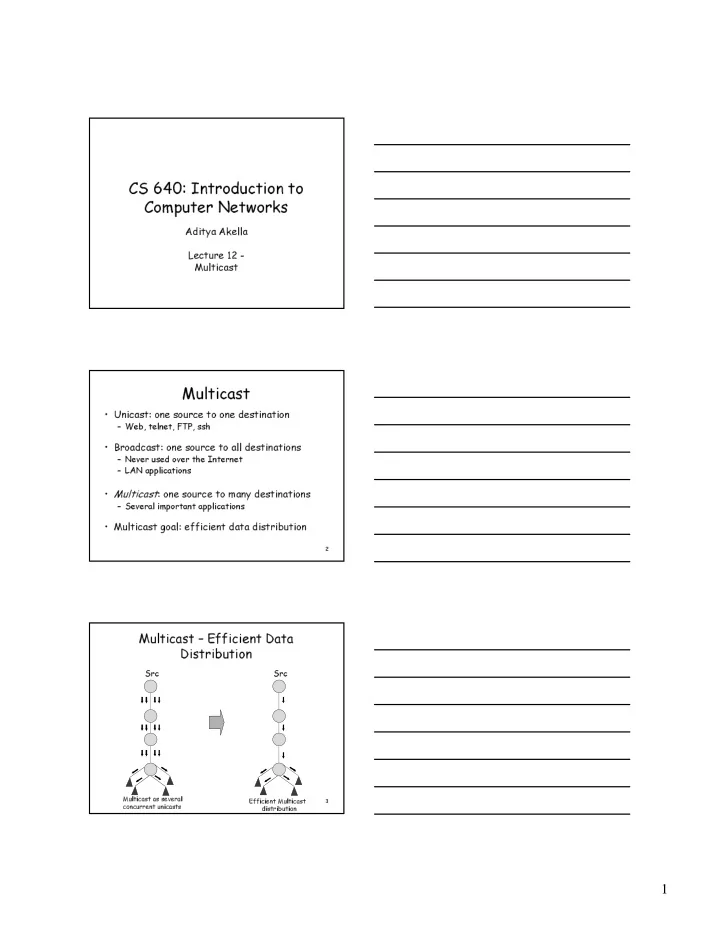
CS 640: Introduction to Computer Networks Aditya Akella Lecture 12 - Multicast Multicast Unicast: one source to one destination Web, telnet, FTP, ssh Broadcast: one source to all destinations Never used over the Internet


slide-1
SLIDE 1

1

CS 640: Introduction to Computer Networks

Aditya Akella Lecture 12 - Multicast

2

Multicast

  • Unicast: one source to one destination

– Web, telnet, FTP, ssh

  • Broadcast: one source to all destinations

– Never used over the Internet – LAN applications

  • Multicast: one source to many destinations

– Several important applications

  • Multicast goal: efficient data distribution

3

Multicast – Efficient Data Distribution

Src Src

Multicast as several concurrent unicasts Efficient Multicast distribution

slide-2
SLIDE 2

2

4

Multicast Example Applications

  • Broadcast audio/video
  • Push-based systems
  • Software distribution
  • Web-cache updates
  • Teleconferencing (audio, video, shared

whiteboard, text editor)

  • Multi-player games
  • Server/service location
  • Other distributed applications

5

The Road Ahead

  • IP Multicast Service Basics (host API)
  • Host/Router Interaction
  • Multicast Routing Basics
  • MOSPF/DVMRP

6

IP Multicast Architecture

Hosts Routers

Service model/API Host-to-router protocol (IGMP) Multicast routing protocols (various)

slide-3
SLIDE 3

3

7

Logical Addressing/Naming

  • Single name/address maps to logically

related set of destinations

– Destination set == multicast group

  • Key challenges: dynamics & scalability

– Single name/address independent of group growth or changes

8

Multicast Router Responsibilities

  • Learn of the existence of multicast groups

(through peer advertisements)

  • Identify incident links with group members
  • Establish state to route packets

– Replicate packets on appropriate interfaces – Routing entry:

Grp, incoming interface List of outgoing interfaces 9

IP Multicast Service Model (rfc1112)

  • Each group identified by a single IP address
  • Groups may be of any size
  • Members of groups may be located anywhere

in the Internet

  • Members of groups can join and leave at will
  • Senders need not be members
  • Group membership not known explicitly
slide-4
SLIDE 4

4

10

IP Multicast Addresses

  • Class D IP addresses

– 224.0.0.0 – 239.255.255.255

  • How to allocate these addresses?

– Well-known multicast addresses, assigned by IANA – Transient multicast addresses, assigned and reclaimed dynamically

  • e.g., by “sdr” program

1 1 1 0 Group ID

11

IP Multicast API

  • Sending – same as before

– Use sockets as usual, send to multicast IP

  • Receiving – two new operations

– Join-IP-Multicast-Group(group-address, interface) – Leave-IP-Multicast-Group(group-address, interface) – Receive multicast packets for joined groups via normal IP-Receive operation – Implemented using socket options

12

TTL-based Multicast Scope Control

  • TTL expanding-ring search to reach or find a

nearby subset of a group

s 1 2 3

slide-5
SLIDE 5

5

13

Administrative Scope Control

  • Administrative TTL Boundaries to keep

multicast traffic within an administrative domain, e.g., for privacy or resource reasons

An administrative domain TTL threshold set on interfaces to these links, greater than the diameter

  • f the admin. domain

The rest of the Internet

14

IP Multicast Architecture

Hosts Routers

Service model Host-to-router protocol (IGMP) Multicast routing protocols (various)

15

Internet Group Management Protocol

  • End system to router protocol is IGMP
  • Each host keeps track of which mcast groups

it has subscribed to

– Socket API informs IGMP process of all joins

  • Objective is to keep router up-to-date with

group membership of entire LAN

– Routers need not know who all the members are,

  • nly that members exist
slide-6
SLIDE 6

6

16

How IGMP Works

  • On each link, one router is elected the “querier”
  • Querier periodically sends a Membership Query message to

the all-systems group (224.0.0.1), with TTL = 1

  • On receipt, hosts start random timers (between 0 and 10

seconds) for each multicast group to which they belong Q Routers: Hosts:

17

How IGMP Works (cont.)

  • When a host’s timer for group G expires, it sends a Membership

Report to group G, with TTL = 1

  • Other members of G hear the report and stop their timers
  • Routers hear all reports, and time out non-responding groups

– “Soft state” again

Q G G G G Routers: Hosts:

18

How IGMP Works (cont.)

  • Note that, in normal case, only one

report message per group present is sent in response to a query

  • Query interval is typically 60-90

seconds

  • When a host first joins a group, it

sends one or two immediate reports, instead of waiting for a query

slide-7
SLIDE 7

7

19

IP Multicast Architecture

Hosts Routers

Service model Host-to-router protocol (IGMP) Multicast routing protocols (various)

20

Routing Techniques

  • Basic objective – routers must collectively build

distribution tree for multicast packets

  • Flood and prune

– Begin by flooding traffic to entire network – Prune branches with no receivers – Examples: DVMRP, PIM-DM – Unwanted state where there are no receivers

  • Link-state multicast protocols

– Routers advertise groups for which they have receivers to entire network – Compute trees on demand – Example: MOSPF – Unwanted state where there are no senders

21

Routing Techniques (Contd.)

  • Core based protocols

– Specify “meeting place” aka core – Sources send initial packets to core – Receivers join group at core – Requires mapping between multicast group address and “meeting place” – Examples: CBT, PIM-SM

slide-8
SLIDE 8

8

22

Shared vs. Source-Based Trees

  • Source-based trees

– Separate shortest path tree for each sender – DVMRP, MOSPF, PIM-DM, PIM-SM

  • Shared trees

– Single tree shared by all members – Data flows on same tree regardless of sender – CBT, PIM-SM

23

Source-based Trees

Router Source Receiver S R R R R R S S

24

Shared Tree

RP

Router Source Receiver S S S R R R R R

slide-9
SLIDE 9

9

25

Shared vs. Source-Based Trees

  • Source-based trees

– Shortest path trees – low delay, better load distribution – More state at routers (per-source state) – Efficient for dense-area multicast

  • Shared trees

– Higher delay (bounded by factor of 2), traffic concentration – Choice of core affects efficiency – Per-group state at routers – Efficient for sparse-area multicast

26

Multicast OSPF (MOSPF)

  • Add-on to OSPF (Open Shortest-Path First,

popular link-state, intra-domain routing protocol)

  • Multicast-capable routers flag link state routing

advertisements

  • Link-state packets include multicast group addresses

to which local members have joined

  • Routing algorithm augmented to compute shortest-

path distribution tree from a source to any set of destinations

27

Example

Source 1 Receiver 1 Receiver 2 Z W Q T

slide-10
SLIDE 10

10

28

Link Failure/Topology Change

Source 1 Receiver 1 Receiver 2 Z W Q T

29

Impact on Route Computation

  • Can’t pre-compute multicast trees for all

possible sources

  • Compute on demand when first packet from a

source S to a group G arrives

  • New link-state advertisement

– May lead to addition or deletion of outgoing interfaces if it contains different group addresses – May lead to re-computation of entire tree if links are changed

30

Distance-Vector Multicast Routing

  • DVMRP consists of two major components:

– A conventional distance-vector routing protocol (like RIP) – A protocol for determining how to forward multicast packets, based on the routing table

  • DVMRP router forwards a packet if

– The packet arrived from the link used to reach the source of the packet (reverse path forwarding check – RPF) – If downstream links have not pruned the tree

slide-11
SLIDE 11

11

31

Example Topology

G G S G

32

Broadcast with Truncation

G G S G

33

Prune

G G S

Prune (s,g) Prune (s,g)

G

slide-12
SLIDE 12

12

34

Graft (s,g) Graft (s,g)

Graft

G G S G G

Report (g)

35

Failure of IP Multicast

  • Not widely deployed even after 15 years!

– Use carefully – e.g., on LAN or campus, rarely over WAN

  • Various failings

– Scalability of routing protocols – Hard to implement TCP equivalent – Hard to get applications to use IP Multicast without existing wide deployment – Hard to get router vendors to support functionality and hard to get ISPs to configure routers to enable multicast

  • Economic incentives?

36

Next Lecture

  • IP-Foo

– NAT – IPv6 – Tunneling – Management

  • 10/19

– Mid-term – In-class – Closed-book