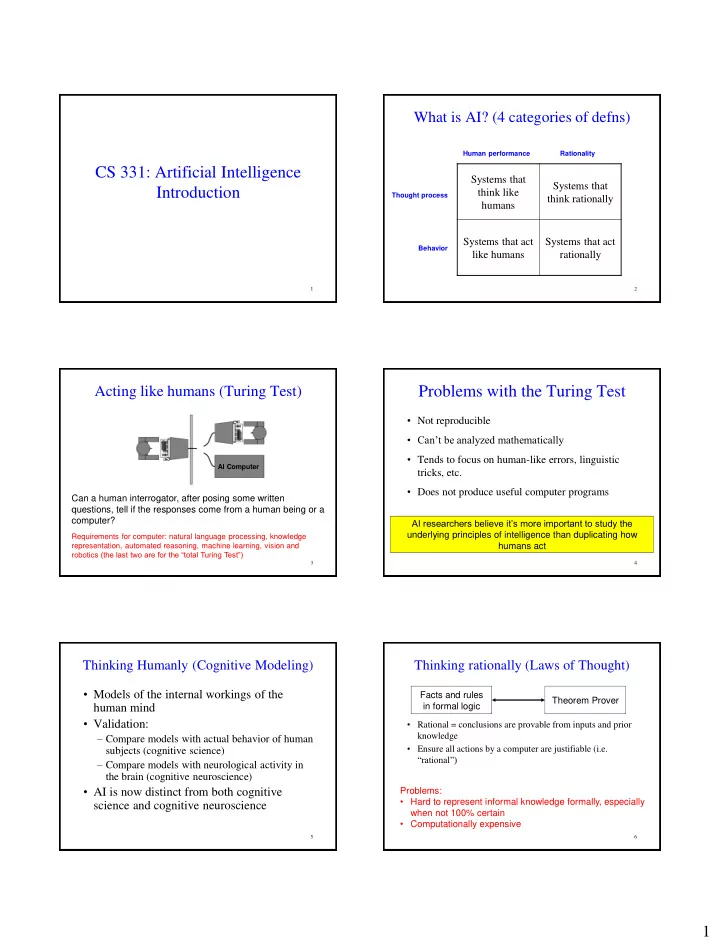

SLIDE 1
1
1
CS 331: Artificial Intelligence Introduction
2
What is AI? (4 categories of defns)
Systems that think like humans Systems that think rationally Systems that act like humans Systems that act rationally
Thought process Behavior Human performance Rationality
3
Acting like humans (Turing Test)
Can a human interrogator, after posing some written questions, tell if the responses come from a human being or a computer?
AI Computer
Requirements for computer: natural language processing, knowledge representation, automated reasoning, machine learning, vision and robotics (the last two are for the “total Turing Test”)
4
Problems with the Turing Test
- Not reproducible
- Can’t be analyzed mathematically
- Tends to focus on human-like errors, linguistic
tricks, etc.
- Does not produce useful computer programs
AI researchers believe it’s more important to study the underlying principles of intelligence than duplicating how humans act
5
Thinking Humanly (Cognitive Modeling)
- Models of the internal workings of the
human mind
- Validation:
– Compare models with actual behavior of human subjects (cognitive science) – Compare models with neurological activity in the brain (cognitive neuroscience)
- AI is now distinct from both cognitive
science and cognitive neuroscience
6
Thinking rationally (Laws of Thought)
- Rational = conclusions are provable from inputs and prior
knowledge
- Ensure all actions by a computer are justifiable (i.e.
“rational”) Facts and rules in formal logic Problems:
- Hard to represent informal knowledge formally, especially
when not 100% certain
- Computationally expensive