CS 188: Artificial Intelligence Perceptual and Sensory Augmented - - PDF document

cs 188 artificial intelligence
SMART_READER_LITE
LIVE PREVIEW

CS 188: Artificial Intelligence Perceptual and Sensory Augmented - - PDF document

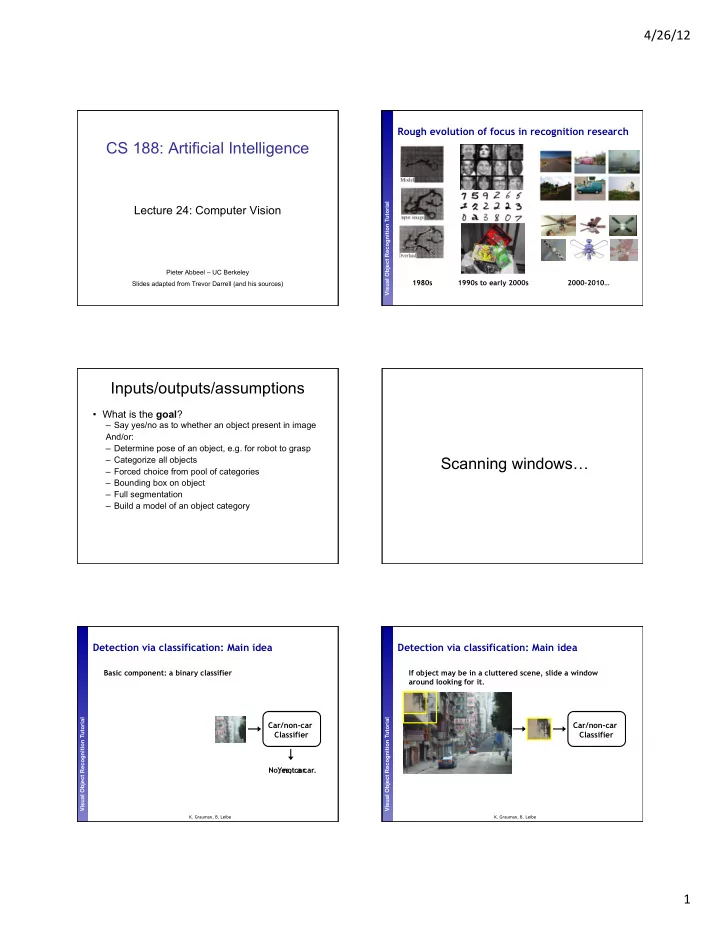
4/26/12 Rough evolution of focus in recognition research CS 188: Artificial Intelligence Perceptual and Sensory Augmented Computing Visual Object Recognition Tutorial Lecture 24: Computer Vision Pieter Abbeel UC Berkeley 1980s 1990s


slide-1
SLIDE 1

4/26/12 ¡ 1 ¡

CS 188: Artificial Intelligence

Lecture 24: Computer Vision

Pieter Abbeel – UC Berkeley Slides adapted from Trevor Darrell (and his sources)

Perceptual and Sensory Augmented Computing Visual Object Recognition Tutorial

Rough evolution of focus in recognition research

1980s 2000-2010… 1990s to early 2000s

Inputs/outputs/assumptions

  • What is the goal?

– Say yes/no as to whether an object present in image And/or: – Determine pose of an object, e.g. for robot to grasp – Categorize all objects – Forced choice from pool of categories – Bounding box on object – Full segmentation – Build a model of an object category

Scanning windows…

Perceptual and Sensory Augmented Computing Visual Object Recognition Tutorial Visual Object Recognition Tutorial

Detection via classification: Main idea

Car/non-car Classifier Yes, car. No, not a car.

  • K. Grauman, B. Leibe

Basic component: a binary classifier

Perceptual and Sensory Augmented Computing Visual Object Recognition Tutorial Visual Object Recognition Tutorial

Detection via classification: Main idea

Car/non-car Classifier

  • K. Grauman, B. Leibe

If object may be in a cluttered scene, slide a window around looking for it.

slide-2
SLIDE 2

4/26/12 ¡ 2 ¡

Perceptual and Sensory Augmented Computing Visual Object Recognition Tutorial Visual Object Recognition Tutorial

Detection via classification: Main idea

Car/non-car Classifier Feature extraction

Training examples

  • K. Grauman, B. Leibe
  • 1. Obtain training data
  • 2. Define features
  • 3. Define classifier

Fleshing out this pipeline a bit more, we need to:

Perceptual and Sensory Augmented Computing Visual Object Recognition Tutorial Visual Object Recognition Tutorial

8

  • K. Grauman, B. Leibe

Detection via classification: Main idea

  • Consider all subwindows in an image

Ø Sample at multiple scales and positions (and orientations)

  • Make a decision per window:

Ø “Does this contain object category X or not?”

Perceptual and Sensory Augmented Computing Visual Object Recognition Tutorial Visual Object Recognition Tutorial

Feature extraction: global appearance

Feature extraction

Simple holistic descriptions of image content

Ø grayscale / color histogram Ø vector of pixel intensities

  • K. Grauman, B. Leibe

Perceptual and Sensory Augmented Computing Visual Object Recognition Tutorial Visual Object Recognition Tutorial

Eigenfaces: global appearance description

  • K. Grauman, B. Leibe

Turk & Pentland, 1991

Training images Mean Eigenvectors computed from covariance matrix

Project new images to “face space”. Recognition via nearest neighbors in face space Generate low- dimensional representation

  • f appearance

with a linear subspace.

+ +

Mean

+ +

... An early appearance-based approach to face recognition

Perceptual and Sensory Augmented Computing Visual Object Recognition Tutorial Visual Object Recognition Tutorial

Feature extraction: global appearance

  • Pixel-based representations sensitive to small shifts
  • Color or grayscale-based appearance description can be

sensitive to illumination and intra-class appearance variation

  • K. Grauman, B. Leibe

Cartoon example: an albino koala Perceptual and Sensory Augmented Computing Visual Object Recognition Tutorial Visual Object Recognition Tutorial

Gradient-based representations

  • Consider edges, contours, and (oriented) intensity

gradients

  • K. Grauman, B. Leibe
slide-3
SLIDE 3

4/26/12 ¡ 3 ¡

HOG (one of the most widely used features)

Perceptual and Sensory Augmented Computing Visual Object Recognition Tutorial Visual Object Recognition Tutorial

Gradient-based representations: Histograms of oriented gradients (HoG)

Dalal & Triggs, CVPR 2005

Map each grid cell in the input window to a histogram counting the gradients per orientation.

Code available: http://pascal.inrialpes.fr/ soft/olt/

  • K. Grauman, B. Leibe

Slide credit: Dalal, Triggs, P . Barnum Slide credit: Dalal, Triggs, P . Barnum

uncentered centered cubic- corrected diagonal Sobel

Slide credit: Dalal, Triggs, P . Barnum

  • Histogram of gradient
  • rientations
  • Orientation -Position

– Weighted by magnitude

Slide credit: Dalal, Triggs, P . Barnum

slide-4
SLIDE 4

4/26/12 ¡ 4 ¡

Slide credit: Dalal, Triggs, P . Barnum Slide credit: Dalal, Triggs, P . Barnum Slide credit: Dalal, Triggs, P . Barnum Slide credit: Dalal, Triggs, P . Barnum