
SLIDE 1
1
CS 188: Artificial Intelligence
Advanced Applications: Robotics
Pieter Abbeel – UC Berkeley A few slides from Sebastian Thrun, Dan Klein
2
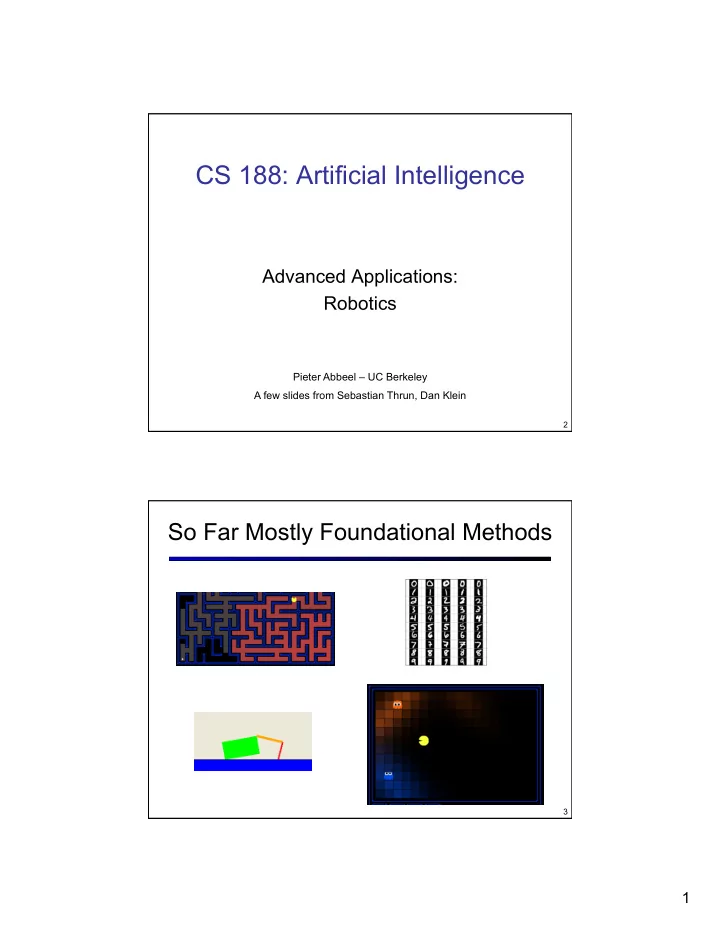
So Far Mostly Foundational Methods
3
CS 188: Artificial Intelligence Advanced Applications: Robotics - - PDF document
CS 188: Artificial Intelligence Advanced Applications: Robotics Pieter Abbeel UC Berkeley A few slides from Sebastian Thrun, Dan Klein 2 So Far Mostly Foundational Methods 3 1 Advanced Applications 4 [DEMO: Race, Short] Autonomous
Pieter Abbeel – UC Berkeley A few slides from Sebastian Thrun, Dan Klein
2
3
4
Autonomous vehicle slides adapted from Sebastian Thrun
[DEMO: Race, Short]
§
150 mile off-road robot race across the Mojave desert
§
Natural and manmade hazards
§
No driver, no remote control
§
No dynamic passing
[DEMO: GC Bad, Good]
5 Lasers Camera Radar E-stop GPS GPS compass 6 Computers IMU Steering motor Control Screen
Reference Trajectory Error Velocity Steering Angle (with respect to trajectory)
[DEMO: LIDAR]
1 2 3
ΔZ
GPS IMU GPS IMU GPS IMU
HMM Inference: 0.02% false positives Raw Measurements: 12.6% false positives
n How do we execute a task like this?
[demo: autorotate / tictoc]
§ Track helicopter position and orientation during flight § Decide on control inputs to send to helicopter
On-board inertial measurement unit (IMU) Send out controls to helicopter Position
27
§ 3-D coordinates from vision, 3-axis magnetometer, 3-axis gyro, 3-axis accelerometer
§ st+1 = f (st, at) + wt
[f encodes helicopter dynamics] [w is a probabilistic noise model]
§ alon : Main rotor longitudinal cyclic pitch control (affects pitch rate) § alat : Main rotor latitudinal cyclic pitch control (affects roll rate) § acoll : Main rotor collective pitch (affects main rotor thrust) § arud : Tail rotor collective pitch (affects tail rotor thrust)
§ st+1 = f (st, at) + wt
[f encodes helicopter dynamics] [w is a probabilistic noise model]
29
[demo: hover] [demo: bad]
30
[demo: unaligned]
§ But we don’t know exactly which one.
[Coates, Abbeel & Ng, 2008]
32
[demo: alignment]
33
[demo: airshow]
§ Low-level control problem: moving a foot into a new location à search with successor function ~ moving the motors § High-level control problem: where should we place the feet?
§ Reward function R(x) = w . f(s) [25 features]
[Kolter, Abbeel & Ng, 2008]
35