SLIDE 1 CS 188: Artificial Intelligence
Markov Decision Processes II
Instructors: Dan Klein and Pieter Abbeel --- University of California, Berkeley
[These slides were created by Dan Klein and Pieter Abbeel for CS188 Intro to AI at UC Berkeley. All CS188 materials are available at http://ai.berkeley.edu.]
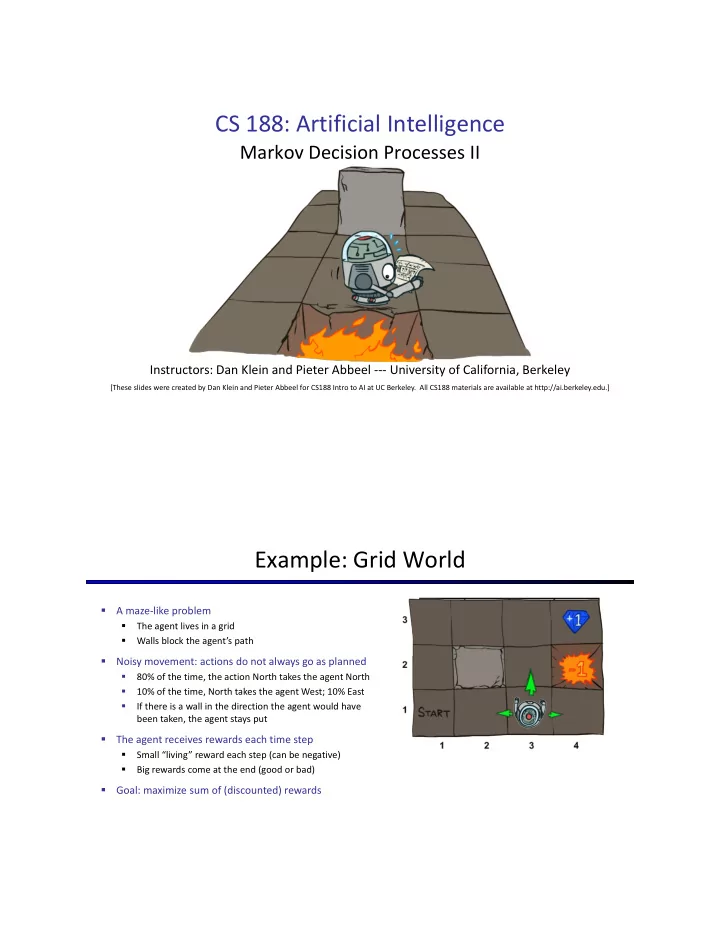
Example: Grid World
- A maze-like problem
- The agent lives in a grid
- Walls block the agent’s path
- Noisy movement: actions do not always go as planned
- 80% of the time, the action North takes the agent North
- 10% of the time, North takes the agent West; 10% East
- If there is a wall in the direction the agent would have
been taken, the agent stays put
- The agent receives rewards each time step
- Small “living” reward each step (can be negative)
- Big rewards come at the end (good or bad)
- Goal: maximize sum of (discounted) rewards
SLIDE 2 Recap: MDPs
Markov decision processes:
States S Actions A Transitions P(s’|s,a) (or T(s,a,s’)) Rewards R(s,a,s’) (and discount γ) Start state s0
Quantities:
Policy = map of states to actions Utility = sum of discounted rewards Values = expected future utility from a state (max node) Q-Values = expected future utility from a q-state (chance node) a s s, a s,a,s’ s’
Optimal Quantities
The value (utility) of a state s: V*(s) = expected utility starting in s and acting optimally The value (utility) of a q-state (s,a): Q*(s,a) = expected utility starting out having taken action a from state s and (thereafter) acting optimally The optimal policy: π*(s) = optimal action from state s
a s s’ s, a
(s,a,s’) is a transition
s,a,s’
s is a state (s, a) is a q-state
[Demo: gridworld values (L9D1)]
SLIDE 3
Gridworld Values V* Gridworld: Q*
SLIDE 4 The Bellman Equations
How to be optimal: Step 1: Take correct first action Step 2: Keep being optimal
The Bellman Equations
Definition of “optimal utility” via expectimax recurrence gives a simple one-step lookahead relationship amongst optimal utility values These are the Bellman equations, and they characterize
- ptimal values in a way we’ll use over and over
a s s, a s,a,s’ s’
SLIDE 5 Value Iteration
Bellman equations characterize the optimal values: Value iteration computes them: Value iteration is just a fixed point solution method
… though the Vk vectors are also interpretable as time-limited values
a V(s) s, a s,a,s’ V(s’)
Convergence*
- How do we know the Vk vectors are going to converge?
- Case 1: If the tree has maximum depth M, then VM holds
the actual untruncated values
- Case 2: If the discount is less than 1
Sketch: For any state Vk and Vk+1 can be viewed as depth k+1 expectimax results in nearly identical search trees The difference is that on the bottom layer, Vk+1 has actual rewards while Vk has zeros That last layer is at best all RMAX It is at worst RMIN But everything is discounted by γk that far out So Vk and Vk+1 are at most γk max|R| different So as k increases, the values converge
SLIDE 6
Policy Methods Policy Evaluation
SLIDE 7 Fixed Policies
Expectimax trees max over all actions to compute the optimal values If we fixed some policy π(s), then the tree would be simpler – only one action per state
… though the tree’s value would depend on which policy we fixed
a s s, a s,a,s’ s’ π(s) s s, π(s) s, π(s),s’ s’ Do the optimal action Do what π says to do
Utilities for a Fixed Policy
Another basic operation: compute the utility of a state s under a fixed (generally non-optimal) policy Define the utility of a state s, under a fixed policy π:
Vπ(s) = expected total discounted rewards starting in s and following π
Recursive relation (one-step look-ahead / Bellman equation): π(s) s s, π(s) s, π(s),s’ s’
SLIDE 8
Example: Policy Evaluation
Always Go Right Always Go Forward
Example: Policy Evaluation
Always Go Right Always Go Forward
SLIDE 9 Policy Evaluation
How do we calculate the V’s for a fixed policy π? Idea 1: Turn recursive Bellman equations into updates (like value iteration) Efficiency: O(S2) per iteration Idea 2: Without the maxes, the Bellman equations are just a linear system
Solve with Matlab (or your favorite linear system solver)
π(s) s s, π(s) s, π(s),s’ s’
Policy Extraction
SLIDE 10
Computing Actions from Values
Let’s imagine we have the optimal values V*(s) How should we act?
It’s not obvious!
We need to do a mini-expectimax (one step) This is called policy extraction, since it gets the policy implied by the values
Computing Actions from Q-Values
Let’s imagine we have the optimal q-values: How should we act?
Completely trivial to decide!
Important lesson: actions are easier to select from q-values than values!
SLIDE 11 Policy Iteration Problems with Value Iteration
Value iteration repeats the Bellman updates: Problem 1: It’s slow – O(S2A) per iteration Problem 2: The “max” at each state rarely changes Problem 3: The policy often converges long before the values
a s s, a s,a,s’ s’
[Demo: value iteration (L9D2)]
SLIDE 12 k=0
Noise = 0.2 Discount = 0.9 Living reward = 0
k=1
Noise = 0.2 Discount = 0.9 Living reward = 0
SLIDE 13 k=2
Noise = 0.2 Discount = 0.9 Living reward = 0
k=3
Noise = 0.2 Discount = 0.9 Living reward = 0
SLIDE 14 k=4
Noise = 0.2 Discount = 0.9 Living reward = 0
k=5
Noise = 0.2 Discount = 0.9 Living reward = 0
SLIDE 15 k=6
Noise = 0.2 Discount = 0.9 Living reward = 0
k=7
Noise = 0.2 Discount = 0.9 Living reward = 0
SLIDE 16 k=8
Noise = 0.2 Discount = 0.9 Living reward = 0
k=9
Noise = 0.2 Discount = 0.9 Living reward = 0
SLIDE 17 k=10
Noise = 0.2 Discount = 0.9 Living reward = 0
k=11
Noise = 0.2 Discount = 0.9 Living reward = 0
SLIDE 18 k=12
Noise = 0.2 Discount = 0.9 Living reward = 0
k=100
Noise = 0.2 Discount = 0.9 Living reward = 0
SLIDE 19 Policy Iteration
Alternative approach for optimal values:
Step 1: Policy evaluation: calculate utilities for some fixed policy (not optimal utilities!) until convergence Step 2: Policy improvement: update policy using one-step look-ahead with resulting converged (but not optimal!) utilities as future values Repeat steps until policy converges
This is policy iteration
It’s still optimal! Can converge (much) faster under some conditions
Policy Iteration
Evaluation: For fixed current policy π, find values with policy evaluation:
Iterate until values converge:
Improvement: For fixed values, get a better policy using policy extraction
One-step look-ahead:
SLIDE 20 Comparison
Both value iteration and policy iteration compute the same thing (all optimal values) In value iteration:
Every iteration updates both the values and (implicitly) the policy We don’t track the policy, but taking the max over actions implicitly recomputes it
In policy iteration:
We do several passes that update utilities with fixed policy (each pass is fast because we consider only one action, not all of them) After the policy is evaluated, a new policy is chosen (slow like a value iteration pass) The new policy will be better (or we’re done)
Both are dynamic programs for solving MDPs
Summary: MDP Algorithms
So you want to….
Compute optimal values: use value iteration or policy iteration Compute values for a particular policy: use policy evaluation Turn your values into a policy: use policy extraction (one-step lookahead)
These all look the same!
They basically are – they are all variations of Bellman updates They all use one-step lookahead expectimax fragments They differ only in whether we plug in a fixed policy or max over actions
SLIDE 21 Double Bandits Double-Bandit MDP
Actions: Blue, Red States: Win, Lose
W L
$1 1.0 $1 1.0 0.25 $0 0.75 $2 0.75 $2 0.25 $0
No discount 100 time steps Both states have the same value
SLIDE 22 Offline Planning
Solving MDPs is offline planning
You determine all quantities through computation You need to know the details of the MDP You do not actually play the game!
Play Red Play Blue Value
No discount 100 time steps Both states have the same value
150 100 W L
$1 1.0 $1 1.0 0.25 $0 0.75 $2 0.75 $2 0.25 $0
Let’s Play!
$2 $2 $0 $2 $2 $2 $2 $0 $0 $0
SLIDE 23
Online Planning
Rules changed! Red’s win chance is different. W L
$1 1.0 $1 1.0 ?? $0 ?? $2 ?? $2 ?? $0
Let’s Play!
$0 $0 $0 $2 $0 $2 $0 $0 $0 $0
SLIDE 24
What Just Happened?
That wasn’t planning, it was learning!
Specifically, reinforcement learning There was an MDP, but you couldn’t solve it with just computation You needed to actually act to figure it out
Important ideas in reinforcement learning that came up
Exploration: you have to try unknown actions to get information Exploitation: eventually, you have to use what you know Regret: even if you learn intelligently, you make mistakes Sampling: because of chance, you have to try things repeatedly Difficulty: learning can be much harder than solving a known MDP
Next Time: Reinforcement Learning!