CS 170 ARTIFICIAL INTELLIGENCE Monday, Wednesday, Friday 09/26/2019 - - PowerPoint PPT Presentation

cs 170 artificial intelligence
SMART_READER_LITE
LIVE PREVIEW

CS 170 ARTIFICIAL INTELLIGENCE Monday, Wednesday, Friday 09/26/2019 - - PowerPoint PPT Presentation

CS 170 ARTIFICIAL INTELLIGENCE Monday, Wednesday, Friday 09/26/2019 - 12/06/2019 9:00 am to 9:50am Winston Chung Hall | Room 138 Dr Eamonn Keogh eamonn@cs.ucr.edu www.cs.ucr.edu/~eamonn/ MRB: 4120 Today (and today only) we will start 5


slide-1
SLIDE 1

CS 170 ARTIFICIAL INTELLIGENCE

Monday, Wednesday, Friday 09/26/2019 - 12/06/2019 9:00 am to 9:50am Winston Chung Hall | Room 138

Dr Eamonn Keogh

eamonn@cs.ucr.edu www.cs.ucr.edu/~eamonn/ MRB: 4120

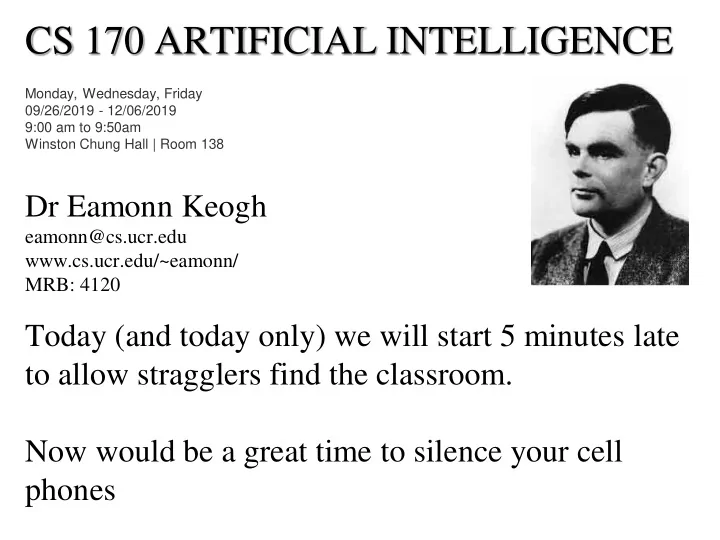
Today (and today only) we will start 5 minutes late to allow stragglers find the classroom. Now would be a great time to silence your cell phones

slide-2
SLIDE 2

Before we begin to learn, the usual administration trivia…

  • There is a class webpage! All the

notes/overheads/homeworks will be put online about a week in advance of when we use them.

www.cs.ucr.edu/~eamonn/cs170/

Note that there is a small chance that I might change/add to the material, so you should always make sure that you have the latest version.

  • I recommend that you print out the slides (six to a page) before attending lecture.
slide-3
SLIDE 3

Email

If you are not getting emails about this class, then you need to do whatever it takes to fix this (talk to the registrar, I assume). You are responsible for any emails I broadcast.

slide-4
SLIDE 4

Grading

Midterm Exam: ~ 25% Final Exam (cumulative) ~ 25% Homework Assignments: ~ 10% Programming Assignments: ~ 30% Participation / pop quizzes: ~ 10%

Programming assignments can be in any language Pop quizzes are given in the first five min of class, no make ups

slide-5
SLIDE 5

I may give pop quizzes at the beginning of class. If you are more than

  • ne second late, you will not be allowed to take the quiz. You cannot

“make up” missed quizzes. To get participation credit you can… ask meaningful questions in class, point out errors in my slides and handouts, email me with pointers to interesting websites (that refer to topics discussed in class)… Homework is due on my desk in the first 5 seconds of the class on the date in question. After 5 seconds the homework is considered late. You will be penalized 5% for each day you are late. For all homework and programming projects you are obliged to keep an electronic copy until at least one week after the final. If requested, you must email me a copy of the file(s) within 48 hours. Failure to produce the electronic copy will result (at least) in a grade of zero for the assignment in question.

slide-6
SLIDE 6

Homework and projects must be carefully stapled and contain a coversheet exactly in the format shown below. Any text, URL or person consulted must be referenced. I will not accept a HW that is not in this format.

slide-7
SLIDE 7

TextBook

Optional

Artificial Intelligence: A Modern Approach

Stuart Russell and Peter Norvig

University of California, Berkeley Director of Research at Google Inc.

slide-8
SLIDE 8

Slides

I make very nice slides, I suggest you print them out 6 per page, before coming to class. I deliberately put only about 90% of the material I want to communicate on the slides. The remaining 10% I explain at lecture, and I expect you to annotate your slides to reflect this.

slide-9
SLIDE 9

Cheating Policy

Students must read and understand UCR policy on academic

  • honesty. http://www.cs.ucr.edu/curriculum/acad_honest.html

Note, I am very good at detecting cheating (I have taught classes

  • n the subject). Anyone caught cheating will given a final grade of

F and will have a letter placed in his or her permanent record. Students are expected to take care that others cannot “cheat off them”. For example, if leave your homework on a shared hard drive or an abandoned USB and someone else hands it in, you are liable and will have your grade adjusted downward.

slide-10
SLIDE 10

Classroom Behavior

I do not want to hear your cell phones during class. First offence will result in the lowering of your final grade by one letter. Second

  • ffence will result in a failing grade and removal from class.

You can use a laptop/tablet to take notes if you want, but sending or receiving text messages/email, or using the web while in class, will result a failing grade. Chronic lateness (or leaving class early) is unacceptable (it is disrespectful and disruptive to the instructor and other students). If you are late once, forget about it. The second time you are late you should approach me after class to explain why (failing to do so may result in a 1-percentage point reduction in your grade).

slide-11
SLIDE 11

Classroom Attendance

Attendance is compulsory. If you miss one class, do nothing. If you miss two classes, you need to come to me in person, to explain why (no emails about this). I may make announcements and or changes in class, you are responsible for knowing what you missed.

slide-12
SLIDE 12

Office Hours

Open door Policy MRB 4120

I am in my office 40 to 50 hours each week. Just stop by. If you need to come a long way to campus, you can make an appointment.

slide-13
SLIDE 13

Email Policy

Please put cs170 in the subject line of every email you send me. Please avoid cryptic emails. Please avoid: WDYMBT Am I 2L8 4 UR exam?

slide-14
SLIDE 14

TA

Ryan Mercer If you need TA help, visit Ryan during any of the sessions below. Important Rule: I told Ryan to be available in the first 10 minutes of the times below, after that, if no one shows up, he can go home. So, either 1) Show up in the first 10 min 2) Email Ryan and tell him what time you will show up at.

Discussion Sessions

Thursday: 11:00 AM - 11:50 AM Materials Sciences and Eng: Room 003 Tuesday: 06:30 PM - 07:20 PM Gordan Watkins Hall 1111 Monday: 06:00 PM - 06:50 PM Winston Chung Hall 143

Office Hours

Room: Chung 110 Times: Thursday 4-5, Friday 10-11

<rmerc002@ucr.edu>

slide-15
SLIDE 15

Questions?

Review:

Cheating, that’s a paddlin’ Tardiness, that’s a paddlin’ Surfing the web in class, that’s a paddlin’ Cell phone goes off, Oh, you better believe that's a paddlin'

slide-16
SLIDE 16

Feel free to give me a five minute warning before the end of class

slide-17
SLIDE 17

What is AI?

“A Steven Spielberg movie that really sucked”

Eamonn Keogh

“The capacity of a digital computer to perform tasks commonly associated with the higher intellectual processes characteristic of humans, such as the ability to reason, discover meaning, generalize,

  • r learn from past experience.”

Encyclopaedia Britannica. AI is trying to solve by computer any problem that a human can solve faster/better. “FOLDOC”

slide-18
SLIDE 18

Why Study AI? Part 0

  • Consider the following 3 classes you could take

– Spn 201: Medieval Spanish Poetry – CS 152: Compiler Design – CS 170: Artificial Intelligence

slide-19
SLIDE 19

Why Study AI? Part 0

  • Consider the following 3 classes you could take

– Spn 201: Medieval Spanish Poetry

  • Two jobs per year, chance of impacting humanity, zero.

– CS 152: Compiler Design

  • Hundreds of jobs a year, chance of impacting humanity, low.

– CS 170: Artificial Intelligence

  • Tens of thousand of jobs each year, thousands of startup

possibilities, chance of impacting humanity, high.

slide-20
SLIDE 20

Why Study AI? Part I

  • Computers with intelligence would have (are

having) a huge impact on civilization.

  • Unlike faster-than-light-travel or anti-gravity

devices, there is strong evidence that AI is actually possible (hint, it is between your ears).

  • AI (along with genetics) is most often cited as

“the field I would most like to be in” by researchers in other fields.

  • Personal motivation. The last big mystery?
slide-21
SLIDE 21

Why Study AI? Part II

Some people who study AI are only interested in solving problems. Others reason like this… “I want to study humans, since the most interesting feature of humans is their intelligence, I will study artificial intelligence to understand true intelligence”. This has always struck me as a weak argument. The very earliest attempts at flight tried to emulate birds by building flying machines that flapped their wings (ornithopters). Although manned aircraft can hover/carry enormous loads/fly faster than sound, no manned ornithopter has ever flown.

slide-22
SLIDE 22

(Reuters) -- Apple has ramped up its hiring of artificial intelligence experts, recruiting from PhD programs, posting dozens of job listings and greatly increasing the size of its AI staff, a review of hiring sites suggests and numerous sources confirm….

Why Study AI? Part III

slide-23
SLIDE 23

The most Intelligent Object in the Universe

  • The human brain is currently the most

intelligent device in the known universe.

  • It has held that record for perhaps a million

years (before that, whales, elephants, other primates were about as smart).

  • Examples:

– In 1665/66 a single human mind invented/discovered most of classic physics and calculus. – In the 1850’s a single human mind discovered the explanation for the diversity of life on earth. – In 1904/5 a single human mind wrote four papers, Photoelectric effect, Brownian motion, Special relativity, Matter–energy equivalence, any one of these ideas was worth a Nobel prize.

human brain

slide-24
SLIDE 24

The most Intelligent Object in the Universe

  • The human brain weights about 3lbs. Not as large as an

elephant or a whale etc.

  • We can normalize for size in a few ways: The

encephalization (EQ) level is a measure of relative brain size defined as the ratio between actual brain mass and predicted brain mass for an animal of a given size.

  • Mean EQ for mammals is around 1. Animals tend to

have higher EQ if: They are social, they need to catch prey/have complex diets, they live in a 3D world (trees,

  • cean, the air).
  • Even given that humans are social, omnivorous and

evolved from tree dwellers, we are unexpectedly large brained.

  • Why do human’s have big brains? (why are we so

smart).

Species EQ Human 7.8 Bottlenose dolphin 4.1 Chimpanzee 2.2 Rhesus monkey 2.1 Elephant 1.1 Dog 1.2 Squirrel 1.1 Sheep 0.8 Mouse 0.5 Rabbit 0.4

slide-25
SLIDE 25

Where are we in AI?

  • AI is trying to solve by computer any problem that

a human can solve faster/better.

  • So we can see the performance of AI on a given

problem as:

– optimal: it is not possible to perform better – strong super-human: performs better than all humans – super-human: performs better than most humans – par-human: performs similarly to most humans – sub-human: performs worse than most humans

slide-26
SLIDE 26

– optimal: it is not possible to perform better

  • Arithmetic (not normally considered an AI problem)
  • Checkers (draughts)
  • Rubik's Cube (as we will see, AI takes 20 moves or fewer)
  • 15-Puzzle (But not optimal for larger versions)
  • Playing Poker (most variations)
  • Shortest Route Finding (i.e. directions on Google maps)
slide-27
SLIDE 27

– super-human: performs better than most humans

  • Backgammon: super-human
  • Bridge: nearing strong super-human
  • Chess: strong super-human
  • Crosswords: super-human
  • Jigsaw puzzles: strong super-human
  • Scrabble: strong super-human
  • Quiz show question answering: strong super-human
  • Driving a car: super-human.

(Google driverless cars are safer and smoother when steering themselves than when a human takes the wheel. However, most tests have been in good weather, good traffic. Perhaps humans have the edge for now in driving in snow storms, or driving in India https://www.youtube.com/watch?v=RjrEQaG5jPM#t=43)

slide-28
SLIDE 28

– par-human: performs similarly to most humans

  • Optical character recognition for certain fonts (ISO 1073-1, MICR)
  • Go (game) However this is changing quickly (a year out of date)
  • Classification of images (general, or specialized: sex/age/ID)

Trained human

Progress on Imagenet large scale visual recognition challenge. arxiv.org/pdf/1502.01852v1.pdf

slide-29
SLIDE 29

– sub-human: performs worse than most humans

  • Handwriting recognition (but closing fast)
  • Language Translation (i.e. English to Chinese)
  • Speech recognition (but closing very fast)
  • Word-sense disambiguation
  • Natural language processing
  • Captcha (by definition!)

AI had sub-human ability on this kind of Captcha just a few years ago, now AI is par-human

  • The boy leapt from the bank into the

water.

  • The bank was closed.

Susan saw a diamond ring in the window of a department store in New York, and she press her nose against it. Does the ‘it’ refer to the ring, the window, the department store, or New York?

slide-30
SLIDE 30

– sub-human: performs worse than most humans

  • Common Sense Reasoning

Suppose I point to this photo and ask “can you tell me which person in this photo was not a millionaire yesterday?”

slide-31
SLIDE 31

– sub-human: performs worse than most humans

  • Common Sense Reasoning

Suppose I point to this photo and say “can you tell me which person in this photo was not a millionaire yesterday?” An AI would have to:

  • Transcribe my spoken words into ASCII

Pretty Easy

  • Understand what is been asked. Difficult
  • Find the “persons” in the photo. Pretty Easy
  • The AI could extract some more information from the image. It could get both sex

and age. Pretty Easy It could get emotion/attractiveness (not shown) Pretty Easy

  • The AI might get the concept “wedding”. Difficult

However, much of the task requires information is not explicit in the image.

  • The average marriage age difference is just 3 or 4 years (in most of the western world).
  • Most people tend to marry someone with about the same “attractiveness” level.
  • In the western world, most married couples share financial resources (and alimony would

ensure this in the case of divorce).

  • Of a couple, the man is much more likely to be a millionaire (sad, but true).
  • Some people may be willing to trade attractiveness of partner for financial security.
slide-32
SLIDE 32

Common Sense Reasoning: Examples

Suppose I point to this photo and ask: “what is happening here?”

Current algorithms could count the number of people, guess their age and sex. They could detect there is an ATM, that one person is smoking. They might be able to guess the location by noting some Thai text, they would spot the 7-11 logo…

slide-33
SLIDE 33
  • Common Sense Reasoning: Examples

Suppose I point to this photo and ask: “what is happening here?”

Current algorithms could perhaps recognize the location, and probably recognize the adult (even tough the head orientation is unusual), and give a good estimate of the child's age etc. But why is this image poignant?

slide-34
SLIDE 34

The Ultimate Goal of AI

  • We don’t want to have lots of different programs to

solve lots of different problems.

(Imagine if we different sorting algorithms for sorting names, sorting ages, sorting heights, sorting GPAs, sorting dollars, sorting Euros etc.)

  • We would like a single program that can do everything,

Artificial General Intelligence (AGI)

  • AGI is sometimes called Strong AI or Full AI or High-

level machine intelligence (HLMI)

  • How would we know if we ever achieve AGI? That is a

surprisingly deep question…

  • The answer, like many answers in CS, comes from…
slide-35
SLIDE 35

The Imitation Game (2014)

slide-36
SLIDE 36

How do we know if we have succeeded?

The Turing Test

Alan Turing 1912-54

  • The human must try to determine if he is

talking to a human or a machine.

  • The computer can lie!
  • The test does not check the ability to

give correct answers to questions, only how closely answers resemble those a human would give.

  • The conversation would be limited to a

text-only channel such as a computer keyboard and screens so that the result would not be dependent on the machine's ability to render words as speech.

human evaluator A machine OR a human

slide-37
SLIDE 37

What questions would you ask in a Turing Test?

  • What is the cube root of 13? (computer is allowed to pause, and give an approximate answer)
  • My King is on the K1 square, and I have no other pieces. You have only your King on the

K6 square and a Rook on the R1 square. Your move. (This is in Turing’s paper. In 1950 he realized that chess-playing computers would be inevitable, Rook to R8, checkmate)

  • For which country is the flag a red circle on a white background?
  • John is fat and tall and in a very bad mood, his dad David, is illiterate, loves Chinese food

and wears ugly clothes, who is older, John or David? (I added red herrings)

  • What would an “M” look like if you were standing on your head?
  • What do you think of Roald Dahl? (and probe with follow up questions)
  • Bob weighs 12 pounds, Bob likes to chase mice, Bob is afraid of dogs, What is Bob?
  • Please explain these jokes:
  • I went to the bank the other day and asked the banker to check my balance, so she pushed me!
  • The early bird might get the worm, but the second mouse gets the cheese.
  • Politicians and diapers have one thing in common. They should both be changed regularly, and

for the same reason.

slide-38
SLIDE 38

A Stunning Idea

If one day we have Artificial General Intelligence, then the next day we will have Superintelligence! This is sometimes called “the singularity” See recent works by

  • Ray Kurzweil
  • Nick Bostrom
slide-39
SLIDE 39

Irving John (I. J.) Good (1916 –2009)

slide-40
SLIDE 40

Let us imagine for a moment that you could measure intelligence on a linear scale, something like: ...< bacteria < mouse < monkey < chimp < average human < stephen hawking < … And let us imagine that we are building smarter and smarter AIs, constantly moving up this hierarchy over time…

human chimp monkey mouse

intelligence

Today

slide-41
SLIDE 41

Let an ultraintelligent machine be defined as a machine that can far surpass all the intellectual activities of any man however clever. Since the design of machines is one of these intellectual activities, an ultraintelligent machine could design even better machines; there would then unquestionably be an 'intelligence explosion,' and the intelligence of man would be left far behind. Thus the first ultraintelligent machine is the last invention that man need ever make.

human chimp monkey mouse

…the last invention that man need ever make.

intelligence

slide-42
SLIDE 42

The Library of Congress is the worlds largest library, with 40 million books. However, the ASCII text of all those books can fit into main memory. If the AI can read at CPU throughput speeds, it could read the Library of Congress in the first few minutes of its “life”. We can only understand video/audio at normal speed, but the AI could watch videos at 1,000X

  • r 10,000X. So, ask it a question about the Simpsons…

In the Simpsons TV show, how many siblings does Homer have? ..and it can watch every show before you finish your question.

human

What will it be like to be a human in the presence of an intelligence so much greater than our own?

intelligence

slide-43
SLIDE 43

When, if ever, will we have AGI?

Katja Grace asked all researchers who published at the 2015 NIPS and ICML conferences (top AI venues). There was huge variation in the responses, including some folk who claim never However, the aggregate forecast gave:

  • a 50% chance of HLMI occurring within 45 years
  • a 10% chance of it occurring within 9 years

https://arxiv.org/pdf/1705.08807.pdf

slide-44
SLIDE 44

The Best Case

  • We obtain strong AI…
  • .. now 99.9% of all humans are now unemployed,

that is OK.

  • We can control the AI, and we use it to cure

cancer, create renewable energy, to explore the universe…

slide-45
SLIDE 45

Physicist Stephen Hawking, Microsoft founder Bill Gates and SpaceX founder Elon Musk have expressed concerns about the possibility that AI could evolve to the point that humans could not control it.

The Worst Case

Success in creating AI would be the biggest event in human

  • history. Unfortunately, it might

also be the last, unless we learn how to avoid the risks

  • We obtain strong AI.
  • The AI kills us all

Or

  • Humans weaponize the AI
slide-46
SLIDE 46

Checkpoint

  • This is not a class on the philosophy of AI
  • The is a pragmatic class on doing AI
  • If you are interested, I recommend the following books
slide-47
SLIDE 47

The plan for the quarter (subject to change)

  • Three weeks studying search (exhaustive search,

uninformed search, informed search, adversarial search).

  • Three weeks studying machine learning (nearest

neighbor and decision trees classification, neural networks and clustering).

  • Two weeks studying logic systems (propositional logic,

first order logic, resolution).

  • A week of advanced topics (possible topics: genetic

algorithms, bayesian networks, similarity, biometrics...).

slide-48
SLIDE 48

Farmer, Wolf, Goat, Cabbage Farmer, Fox, Chicken, Corn Farmer Dog, Rabbit, Lettuce Homer, Maggie, poison, Santa’s Little Helper

The Farmer, Wolf, Duck, Corn Problem

A farmer with his wolf, duck and bag of corn come to the east side of a river they wish to cross. There is a boat at the rivers edge, but of course only the farmer can row. The boat can only hold two things (including the rower) at any one time. If the wolf is ever left alone with the duck, the wolf will eat it. Similarly if the duck is ever left alone with the corn, the duck will eat it. How can the farmer get across the river so that all four arrive safely on the other side?

The Farmer, Wolf, Duck, Corm problem dates back to the eighth century and the writings of Alcuin, a poet, educator, cleric, and friend of Charlemagne.
slide-49
SLIDE 49

F W D C F D C W

This means that everybody/everything is

  • n the same side of the

river. This means that we somehow got the Wolf to the other side.

slide-50
SLIDE 50

F W D C W D C F D C F W W C F D W D F C

Illegal State

Search Tree for “Farmer, Wolf, Duck, Corn”

slide-51
SLIDE 51

F W D C W D C F D C F W W C F D W D F C F W C D F W D C

Repeated State Illegal State

Search Tree for “Farmer, Wolf, Duck, Corn”

slide-52
SLIDE 52

F W D C W D C F D C F W W C F D W D F C F W C D F W D C W F D C F W C D W C F D C F W D F C W D F D C W D F W C F W D C F W D C F W C D W D F C W F D C C F W D D C F W D F W C F D C W F W D C F D W C F W D C D F W C

Goal State Repeated State Illegal State

Search Tree for “Farmer, Wolf, Duck, Corn”

slide-53
SLIDE 53

F W D C W C F D F W C D C F W D F D C W D F W C F D W C F W D C F W D C W C F D F W C D C F W D F D C W D F W C F D W C F W D C

Farmer returns alone Farmer takes duck to left bank Farmer takes wolf to left bank Farmer returns with duck Farmer takes corn to left bank Farmer returns alone Farmer takes duck to left bank Success! Initial State

slide-54
SLIDE 54
  • Missionaries and Cannibals: (three of each, boat holds 2, if cannibals
  • utnumber the missionaries they'll eat them).
  • Jealous Husbands: three couples, boat holds 2 people at most, no wife

can be left with any man unless her husband is also present.

  • U2 has a concert that starts in 17 minutes and they must all cross a bridge to get
  • there. All four men begin on the same side of the bridge. You must help them across to the
  • ther side. It is night. There is one flashlight. A maximum of two people can cross at one time.

Any party who crosses, either 1 or 2 people, must have the flashlight with them. The flashlight must be

walked back and forth, it cannot be thrown, etc. Each band member walks at a different speed. A pair must walk together

at the rate of the slower man's pace. Bono takes 1 minute to cross, the Edge takes 2 minutes to cross, Adam takes 5 minutes to cross, and Larry takes 10 minutes to cross. How can they accomplish the crossing in the allotted time?

It is no surprise to learn that the technique used to solve Farmer, Wolf, Duck, Corn can be used to solve other similar problems... What is surprising, is that search can be used to solve an amazing number of important problems that don’t appear (at first glance) to be amiable to search...

slide-55
SLIDE 55

A farm hand was sent to a nearby pond to fetch 8 gallons of water. He was given two pails - one 11, the other 6 gallons. How can he measure the requested amount of water?

Rubiks Cube Can you place 8 queens

  • n a chessboard such

that no piece is attacking another? Find a route from LAX to UCR that minimizes the mileage

Which tree shows the correct relationship between gorilla, chimp and man? When you have just 3 animals, there are

  • nly three possible trees...

Species Number of trees 3 3 10 34,459,425

slide-56
SLIDE 56

We have seen that the Farmer, Wolf, Duck, Corn can be easily solved using search. So why spend so much time on a trivial technique for solving problems? Farmer, Wolf, Duck, Corn has a small search space! However, many real world problems have very large (possibly infinite) search spaces. How do we search a space that has more states than there are electrons in the universe? Also Farmer, Wolf, Duck, Corn assumes we have perfect knowledge (we always know where everything is) and a static world (the river is not changing, the boat is always the same etc). However, in many real world problems we do not have perfect knowledge of the current state of the world, furthermore the world is changing in ways we cannot predict or control.

slide-57
SLIDE 57

That was search… Now lets preview Machine Learning….

slide-58
SLIDE 58

Examples of class A

3 4 1.5 5 6 8 2.5 5

Examples of class B

5 2.5 5 2 8 3 4.5 3

Pigeon Problem 1

slide-59
SLIDE 59

Examples of class A

3 4 1.5 5 6 8 2.5 5

Examples of class B

5 2.5 5 2 8 3 4.5 3 8 1.5 4.5 7

What class is this object? What about this

  • ne, A or B?

Pigeon Problem 1

slide-60
SLIDE 60

Examples of class A

3 4 1.5 5 6 8 2.5 5

Examples of class B

5 2.5 5 2 8 3 4.5 3 8 1.5

This is a B!

Pigeon Problem 1

Here is the rule. If the left bar is smaller than the right bar, it is an A,

  • therwise it is a B.
slide-61
SLIDE 61

Examples of class A

4 4 5 5 6 6 3 3

Examples of class B

5 2.5 2 5 5 3 2.5 3 8 1.5 7 7

Even I know this

  • ne

Pigeon Problem 2

Oh! This ones hard!

slide-62
SLIDE 62

Examples of class A

4 4 5 5 6 6 3 3

Examples of class B

5 2.5 2 5 5 3 2.5 3 7 7

Pigeon Problem 2

So this one is an A. The rule is as follows, if the two bars are equal sizes, it is an A. Otherwise it is a B.

slide-63
SLIDE 63

Examples of class A

4 4 1 5 6 3 3 7

Examples of class B

5 6 7 5 4 8 7 7 6 6

Pigeon Problem 3

This one is really hard! What is this, A or B?

slide-64
SLIDE 64

Examples of class A

4 4 1 5 6 3 3 7

Examples of class B

5 6 7 5 4 8 7 7 6 6

Pigeon Problem 3

It is a B!

The rule is as follows, if the square of the sum of the two bars is less than or equal to 100, it is an A. Otherwise it is a B.

slide-65
SLIDE 65

The “game” we have just been playing is Supervised Classification, a sub-field of Machine Learning, which is itself a sub-field of artificial intelligence. Why is it useful?

slide-66
SLIDE 66

Examples of class A

People who contracted disease X.

Examples of class B

People who are disease free.

1) What class is this person?

Is this person at risk

  • f getting the

disease?

2) What class is this person?

Is this person at risk

  • f getting the

disease?

1 2 3 4 1 2 3 4

Patient temperature 99 Blood count 4214 Weight 167 Patient temperature 98 Blood count 3214 Weight 179 Patient temperature 97 Blood count 2763 Weight 121 Patient temperature 99 Blood count 3234 Weight 117 Patient temperature 97 Blood count 0012 Weight 190 Patient temperature 99 Blood count 0114 Weight 202 Patient temperature 98 Blood count 1014 Weight 345 Patient temperature 99 Blood count 1214 Weight 190 Patient temperature 97 Blood count 0118 Weight 280 Patient temperature 99 Blood count 3452 Weight 99

slide-67
SLIDE 67

Grasshoppers Katydids Given a collection of annotated data. In this case 5 instances Katydids of and five of Grasshoppers, decide what type of insect the unlabeled example is.

Katydid or Grasshopper?

slide-68
SLIDE 68

Machine Learning can be used to learn…

  • Who might die of a certain disease.
  • Which people are likely to default of their credit card loan.
  • Which new movies you might enjoy.
  • Whether or not this X-ray of a suitcase shows a bomb.
  • Which webpages contain pornography.
  • What are the likely side effects of this new drug.
  • The best way to route an email.
  • The most efficient settings for your car’s fuel injector.
  • Should the autonomous car hit the gas or the brake
  • Etc etc
slide-69
SLIDE 69

Why is Machine Learning a hard problem?

  • There might be missing/noisy features.
  • There might be irrelevant features.
  • The features may be related.
  • It might be hard to create a good

representation of the data

  • We might “overfit” when learning.
  • We might have problems with time/space

complexity. Examples of class A

People who contracted disease X.

Patients name: Dave Ho Patient temperature 103 Blood count: unknown Weight 407 Patients name: Dave Smith Patient temperature 102 Blood count: 3214 Weight 445

slide-70
SLIDE 70

That was Machine Learning … Now lets preview Knowledge Representation (reasoning)

slide-71
SLIDE 71

Knowledge Representation I

Suppose I tell you that…

  • Bob weighs 12 pounds
  • Bob likes to chase mice
  • Bob is afraid of dogs

…if someone asked you “What is Bob?”, what would you say?

slide-72
SLIDE 72

Knowledge Representation II

This ability of humans (and to a lesser extent other animals) to be able to take a set of facts and a set of rules for manipulating facts, then to come up with new facts is at the heart of intelligence. This is true at a high level…

  • Given a set of facts about physics and math, Einstein was able to come up with a

new fact, E = MC2 …and a low level

  • Given a set of facts* about the Accounting Assistant in the CS department, I was

able to come up with the fact that she is married.

* She wears a ring on her left “ring” finger. Her business card has a last name scratched out and a new name penciled in.

slide-73
SLIDE 73

For next time

Bring slides on Blind Search Spend 10 minutes playing Frogs and Toads http://img.izismile.com/img/img2/20090601//frog.swf