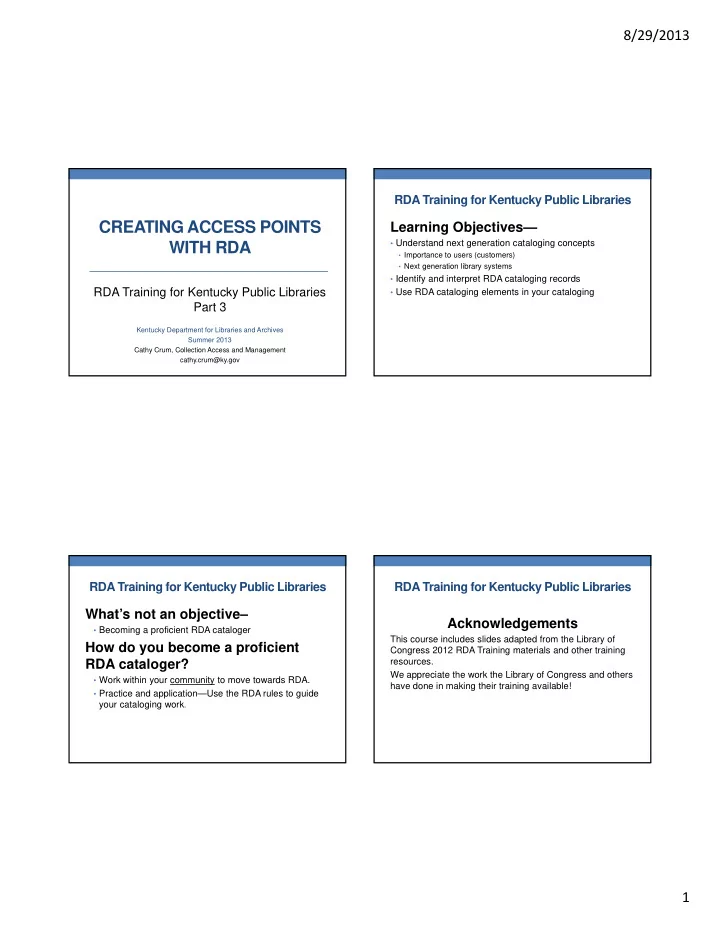
CREATING ACCESS POINTS Learning Objectives Understand next - - PDF document

creating access points
SMART_READER_LITE
LIVE PREVIEW

CREATING ACCESS POINTS Learning Objectives Understand next - - PDF document

8/29/2013 RDA Training for Kentucky Public Libraries CREATING ACCESS POINTS Learning Objectives Understand next generation cataloging concepts WITH RDA Importance to users (customers) Next generation library systems Identify


slide-1
SLIDE 1

8/29/2013 1

CREATING ACCESS POINTS WITH RDA

Kentucky Department for Libraries and Archives Summer 2013 Cathy Crum, Collection Access and Management cathy.crum@ky.gov

RDA Training for Kentucky Public Libraries Part 3 RDA Training for Kentucky Public Libraries

Learning Objectives—

  • Understand next generation cataloging concepts
  • Importance to users (customers)
  • Next generation library systems
  • Identify and interpret RDA cataloging records
  • Use RDA cataloging elements in your cataloging

RDA Training for Kentucky Public Libraries

What’s not an objective–

  • Becoming a proficient RDA cataloger

How do you become a proficient RDA cataloger?

  • Work within your community to move towards RDA.
  • Practice and application—Use the RDA rules to guide

your cataloging work.

RDA Training for Kentucky Public Libraries

Acknowledgements

This course includes slides adapted from the Library of Congress 2012 RDA Training materials and other training resources. We appreciate the work the Library of Congress and others have done in making their training available!

slide-2
SLIDE 2

8/29/2013 2 On the Agenda

  • Identifying RDA Vocabulary
  • Constructing RDA Access Points for:
  • Persons
  • Families
  • Corporate Bodies
  • Places
  • Works
  • Expressions

What’s Not On the Agenda

  • Creating Authority Records

Vocabulary

 Preferred Name: Form to be used when constructing

the authorized access point

 Variant Name: Form used in variant access points  Authorized Access Point: Standardized access point

representing an entity ; uses the preferred name for an entity

 Variant Access Point: Alternative to the authorized

access point representing an entity ; constructed using a variant name for an entity ; 4XX fields in name authority records

RDA Authorities Overview

  • General Guidelines: RDA Chapter 8
  • Personal Names:

RDA Chapter 9

  • Family Names:

RDA Chapter 10

  • Corporate Bodies:

RDA Chapter 11

  • Geographic Names:

RDA Chapter 16

Creating Access Points

  • Access points should be unique
  • Is there a conflict with another name?
  • Additions added to resolve conflicts with authority file
  • Which authority file to use?
  • Does it really matter?
slide-3
SLIDE 3

8/29/2013 3

“What’s in a Name?”

Identifying Persons RDA Chapter 9

Scope of “Person”

 “An individual or an identity established by an

individual (either alone or in collaboration with one or more other individuals)”– RDA 8.1.2

 An individual does not have to be a real

person!

Changes from AACR2 to RDA : a comparison of examples by Adam Schiff

Constructing the Authorized Access Points for Persons (RDA 9.19)

  • Preferred name is the basis
  • Additions to the name as instructed under

9.19.1.2–9.19.1.7

Preferred Name (RDA 9.2.2)

  • Choose the form most commonly known
  • Surnames: words indicating relationships (e.g.,

Jr., IV) part of the preferred name -- not just to differentiate

  • Example:

Hank Williams, Jr.

slide-4
SLIDE 4

8/29/2013 4

Preferred Name (RDA 9.2.2)

  • Different names for the same person (RDA 9.2.2.6)

a)

Name that appears most frequently in resources

b)

Name that appears most frequently in reference sources

c)

Use the latest name.

  • Change of name (RDA 9.2.2.7)
  • Latest name or form of name
  • If individual has more than one identity, choose a

preferred name for each identity (RDA 9.2.2.8)

  • Different categories of names: RDA 9.2.2.9-RDA

9.2.2.26

Additions to the Preferred Name

  • Title or other designation associated with person
  • Date of birth and/or death
  • Fuller form of name Period of activity of person and/or

Profession or Occupation

  • Other Terms of Rank, Honour, or Office
  • Other Designation

Title of Person and Other Designations (RDA 9.19.1.2)

* Title of the person (RDA 9.4):

  • Royalty, nobility, or ecclesiastical rank or office
  • Person of religious vocation
  • Other designation associated with the person (RDA 9.6):
  • Saints *
  • Spirits *
  • Persons Named in Sacred Scriptures or Apocryphal Books
  • Fictitious and Legendary Persons
  • Real Non-Human Entities (ex. Animals)

* Required for certain names, not just to break a conflict 100 0 _ $a Luke, $c Saint.

Date Associated with the Person (RDA 9.3, RDA 9.19.1.3)

  • An addition to the preferred name
  • Date of birth (RDA 9.3.2) -- if available
  • Date of death (RDA 9.3.3) -- if available
  • Guidelines for probable dates (RDA 9.3.1)
  • LC policy: add date(s) of birth and/or death if

available

100 1 _ $a Copland, Aaron, $d 1900-1990.

slide-5
SLIDE 5

8/29/2013 5

Dates: What’s New and Different?

  • Abbreviations “cent.,” “ca.,” “b.,” “d.,” and “fl.” not

in RDA Appendix B

  • “cent.” becomes “century”
  • “approximately” replaces “ca.”
  • “b.” and “d.” dates: LC is using hyphens instead of

spelling out the abbreviations

  • “fl.”: LC is using “active”

Fuller Form of Name (RDA 9.5, RDA 9.19.1.4)

  • Scope:
  • Full form of a part of a name represented only by an

initial or abbreviation in the form chosen as the preferred name, or

  • A part of the name not included in the form chosen as

the preferred name (change from AACR2)

  • Add to differentiate

100 1 _ $a Carmichael, Emmett B. $q (Emmett Bryan)

Period of Activity of a Person Profession or Occupation (RDA 9.19.1.5)

  • Period of Activity of a Person (RDA 9.3.4)
  • Add if needed to differentiate and birth and/or death dates are not

available.

  • Profession or Occupation (RDA 9.16)
  • Add:
  • If name does not convey the idea of a person
  • If needed to distinguish one person from another with the

same name (cataloger’s judgment)

100 1 $a Cavaliere, Alfonso $c (Physicist) 100 1 $a Smith, John, $d active 1719-1758

Other Terms of Rank, Honour or Office (RDA 9.4.1.9, RDA 9.19.1.6)

  • Add a term that indicates rank, honour, or office if the term

appears with the preferred name.

  • Only add if needed to resolve conflict

100 1 _ $a Wood, John, $c Captain.

slide-6
SLIDE 6

8/29/2013 6

Other Designation (RDA 9.6.1.9, RDA 9.19.1.7)

  • Add If none of the additions at 9.19.1.3–9.19.1.6

is sufficient or appropriate for distinguishing between the access points for two or more persons

  • Only add if needed to resolve a conflict

100 1 _ $a Budd, Henry, $c Cree Indian.

Identifying Persons Which of these elements CANNOT be used in an authorized access point for a person?

  • A. Title of Person
  • B. Gender
  • C. Fuller Form of Name
  • D. Date of Birth

“We Are Family…”

Identifying Families RDA Chapter 10

slide-7
SLIDE 7

8/29/2013 7

Creating the authorized access point

  • Always start with the name (RDA 10.2)

100 3 _ Carleton

  • Followed by these qualifiers in this order:
  • Required
  • Type of Family (RDA 10.3)
  • If needed
  • Dates Associated with Family (RDA 10.4)
  • Place Associated with Family (RDA 10.5)
  • Prominent Member of Family (RDA 10.6)
  • If needed = to break conflict OR if it assists in the

identification of the name (cataloger’s judgment)

Creating the authorized access point

100 3 _ Carleton (Family) 100 3 _ Carleton (Family : $d 1757-1865) 100 3 _ Carleton (Family : $c Alexandria, Va.)

  • Don’t forget to use the authorized form of name of place

100 3 _ Carleton (Family : $d 1757-1865 : $c Alexandria, Va.) 100 3 _ Carleton (Family : $g Carleton, James, 1757-1827)

  • Don’t forget to use the authorized form of the personal name

I’ve got this state pub from the Division of Pest and Noxious Weed Control…

Identifying Corporate Bodies RDA Chapter 11

Scope of “Corporate Body”

  • Typical examples of corporate bodies are

associations, institutions, business firms, nonprofit enterprises, governments, government agencies, projects and programs, religious bodies, local church groups identified by the name of the church, and conferences. (RDA 11.0)

  • Ad hoc events (such as athletic contests,

exhibitions, expeditions, fairs, and festivals) and vessels (e.g., ships and spacecraft) are considered to be corporate bodies. (RDA 11.0)

slide-8
SLIDE 8

8/29/2013 8

Constructing Authorized Access Points for Corporate Bodies (RDA 11.13)

  • Preferred name is the basis
  • Additions to the name as instructed under

11.13.1.2–11.13.1.8, in that order, as applicable

Preferred Name (RDA 11.2.2)

  • Choose the form most commonly known
  • Variant spellings: choose the form found in the

first resource received (RDA 11.2.2.5.1)

  • Not abbreviating “Department”

Preferred Name (RDA 11.2.2)

  • Names containing initials, terms of honor, terms
  • f incorporation, etc. (RDA 11.2.2.7-RDA

11.2.2.10)

  • Various categories of corporate bodies (e.g.,

subordinate bodies both government and non- government, courts, religious officials, etc.) (RDA 11.2.2.13-RDA 11.2.2.29)

Subordinate Bodies

  • Body whose name that implies it is part of another
  • (Department, Division, Section, Branch)
  • Name on Resource: Department of Biology
  • 110 2 _ $a Western Kentucky University. $b Department of

Biology

  • Body Whose Name Implies Administrative Subordination
  • (Committees, Commissions, etc.)
  • Name on Resource: Royal Commission on Banking and Finance
  • 110 1 _ $a Canada. $b Royal Commission on Banking and

Finance

  • Body Whose Name Is General in Nature…
  • Name on Resource: Research Institute
  • 110 2 _ $a American Dental Association. $b Research Institute
slide-9
SLIDE 9

8/29/2013 9

Additions to the Preferred Name

  • Addition if name not “corporate” enough
  • Place associated with the body
  • Associated institution
  • Date associated with the body
  • Type of jurisdiction
  • Other designation
  • Number, date, & location of a conference

Addition if not “Corporate” Enough (RDA 11.7, 11.13.1.2)

  • Added if a name does not convey that it is a

corporate body

  • Remember: if subordinate body, establish

subordinately to higher body

110 2 _ $a Levantine Entertainment (Firm) 110 2 _ $a Health of the Public (Program)

Associated Place (RDA 11.3, 11.13.1.3)

  • Two categories:
  • Location of conference, etc. (RDA 11.3.2)
  • Location of headquarters (RDA 11.3.3)
  • Form of place:
  • Form prescribed in Chapter 16
  • Abbreviate name of countries, states, etc., as instructed

in Appendix B 110 2 _ $a Republican Party (Mont.)

Associated Institution (RDA 11.5, 11.13.1.4)

  • Use the preferred name for the institution

(not the authorized access point for the institution)

110 2 _ $a Annual Computer Law Institute (Practising Law Institute)

slide-10
SLIDE 10

8/29/2013 10

Date of Establishment or Termination (RDA 11.4.3-11.4.4, 11.13.1.5)

  • Year in which a corporate body was established
  • r terminated
  • Give if needed to differentiate the name of one

corporate body from another

  • Add to preferred name in parentheses; use

hyphen between dates

110 1 _ $a South Dakota. $b Department of Public Safety (2003– )

Type of Jurisdiction (RDA 11.7.1.5, 11.13.1.6)

  • Term designating the type of jurisdiction added if

necessary, to distinguish between access points for two or more governments that have the same

  • r a similar name

New York (N.Y.) New York (State)

“Other Designation ... ” (RDA 11.7.1.6, 11.13.1.7)

  • If other elements in list of additions not appropriate
  • r not sufficient to differentiate between two different

non-conference bodies, add:

  • A word, phrase, or abbreviation indicating incorporation or

legal status

  • Any term serving to differentiate the body from other

corporate bodies, persons, etc. 111 2 _ World Cup (Cricket) 111 2 _ World Cup (Soccer)

Additions to Preferred Name for Conferences

  • Number of a Conference (RDA 11.6, 11.13.1.8)
  • Date of Conference, etc. (RDA 11.4.2, 11.13.1.8)
  • Location of Conference (RDA 11.3.2, 11.13.1.8)
  • Institution as “Place” for Conference (RDA 11.3.2,

11.13.1.8)

111 2 _ Governor’s Conference on Aging (Fla.) (3rd : 1992 : Tallahassee, Fla.) 111 2 _ Australian Bioethics Association. National Conference (6th : 1998 : Hobart, Tas.)

slide-11
SLIDE 11

8/29/2013 11

Identifying Corporate Bodies Which of these elements CANNOT be used in an authorized access point for a corporate body?

  • A. Place associated with the body
  • B. Type of Jurisdiction
  • C. Date associated with the body
  • D. Address of the body

Identifying Places

RDA Chapter 16

Where is the information found?

  • Chapter 16
  • Chapter 11 (Corporate Bodies)
  • 16.4 points to 11.13.1.1 – adding qualifiers
  • 16.2.2.8.2 points to 11.13.1.6 – add type of

jurisdiction as qualifier

  • 16.2.2.4 points to 11.2.2.5.4 – conventional name of

a government

  • 16.2.2.7 points to –
  • 11.2.2.5.4 for change of name rules
  • 11.13.1.3; 11.13.1.8 for use as qualifiers
  • Chapter 11 in general
slide-12
SLIDE 12

8/29/2013 12

Creating the authorized access point

  • Choosing the preferred name
  • Sources of information:
  • Gazetteers or ref sources in cat agency language (English)
  • Gazetteers or ref sources in official language of jurisdiction
  • Still in use:
  • Spell out abbreviations
  • Anticipate conflict
  • Give next larger jurisdiction to break conflict
  • 651 _ 0 Cork (Ireland)
  • Give jurisdiction type to break conflict
  • 651 _ 0 Cork (Ireland : County)

Creating the authorized access point

  • Special treatment for certain countries and cities:
  • In RDA: Australia, US, Canada, USSR, Yugoslavia;

Britain: RDA 16.2.2.9

  • In LCPS: Berlin, London, Taiwan (China), Wash, DC;

Israel, Jordan, Syria; South Africa: LCPS 16.4

Identifying Works

RDA Chapter 6

Where are the Instructions?

  • Generally, the instructions for identifying

works and expressions are in chapter 6.

  • You will also need to consult the related

instructions in:

  • Chapter 19, “Persons, Families, and Corporate

Bodies Associated with a Work”

  • Chapter 20, “Persons, Families, and Corporate

Bodies Associated with an Expression”

slide-13
SLIDE 13

8/29/2013 13

“Naming the Work”

  • Just like ‘naming’ persons and corporate bodies

(and now, families)

  • Similar to AACR2 concept of “main entry”

Why Name the Work? (RDA 6.0)

  • a) Bringing together all descriptions of resources

embodying a work when various manifestations have appeared under various titles

  • b) Identifying a work when the title by which it is known

differs from the title proper of the resource being described

  • c) Differentiating between two or more works with the

same title

  • d) Organizing hierarchical displays of descriptions for

resources embodying different expressions of a work

  • e) Referencing a related work (see chapter 25) or a

related expression (see chapter 26).

Terminology Related to “Works”

  • Title of the work (RDA 6.2.1.1)
  • “word, character, or group of words and/or characters by

which a work is known”

  • Preferred title for the work (RDA 6.2.2.1)
  • the form of title used when constructing the authorized

access point

  • Variant title for the work (RDA 6.2.3.1)
  • the form of title used when constructing a variant access

point

  • aka “see references”

Authorized Access Points for Works (6.27.1.1 - 6.27.1.8)

  • How to put together the elements to construct an

authorized access point:

  • Preferred title is the basis
  • Authorized access point for the creator precedes the

preferred title, as applicable

  • Additions to the preferred title as instructed under

6.27.1.9

slide-14
SLIDE 14

8/29/2013 14

“Naming the Work” One More Time….

  • 1XX + 240 = Creator + Preferred Title for Work
  • 1XX + 245 = Creator + Manifestation Title
  • 130 = Preferred Title for Work with no Creator
  • 245 = Manifestation Title with no Creator

Preferred Title for the Work

  • CORE ELEMENT
  • General instructions (RDA 6.2.1 and 6.2.2.)
  • Specific instructions (RDA 6.2.2.9, 6.2.2.10 and others)
  • some musical works (6.14.2)
  • some legal works (6.19.2)
  • some religious works (6.23.2)
  • some official communications (6.26.2)

Sources for Preferred Titles (6.2.2.2)

  • Commonly-known title
  • For a work created after 1500
  • From resources embodying the work or from reference

sources

  • Sometimes: title proper of the first manifestation received
  • For a work created before 1501
  • From modern reference sources
  • If this evidence is inconclusive, use (in this order):
  • a) modern editions
  • b) early editions
  • c) manuscript copies

Creator (19.2)

  • CORE ELEMENT
  • “person, family, or corporate body responsible for the

creation of a work”

  • If there is a creator of a work, record the authorized access

point for the creator along with the preferred title of the

  • work. (RDA 0.6.3)
  • Creator + Preferred title

100 1_ $a Mozart, Wolfgang Amadeus, $d 1756-1791. 240 10 $a Nozze di Figaro 245 14 $a The marriage of Figaro

slide-15
SLIDE 15

8/29/2013 15

Corporate Bodies as Creators

  • Categories of works (RDA 19.2.1.1.1)
  • Administrative works of body itself
  • Works that record collective thought of body
  • Conference proceedings
  • Several others…
  • Corporate body takes precedence over a first-named

person or family as creator

  • RDA 19.2.1.1.2 on government and religious officials

as creators

Additions to Access Points Representing Works (RDA 6.27.1.9)

  • Formulating the Authorized Access Point
  • Start with preferred title
  • Preceded by creator, if appropriate
  • Addition(s) to make it distinct
  • Form of work (6.3)
  • Date of the work (6.4)
  • Place of origin of the work (6.5)
  • Another distinguishing characteristic of the work (6.6)
  • no priority order
  • can give more than one if needed

Additions to Access Points -- Form of Work (6.3)

  • CORE ELEMENT when needed to differentiate
  • “class or genre to which a work belongs”
  • Take from any source
  • No controlled vocabulary
  • Added after preferred title in parentheses

130 0 _ $a Harry Potter and the goblet of fire (Motion Picture)

Additions to Access Points -- Date of Work (6.4)

  • CORE ELEMENT when needed to differentiate
  • “earliest date associated with a work”
  • created, first published, or released
  • Year(s) alone
  • Added after preferred title in parentheses

110 2_ $a Connecticut Commission on Children. 240 10 $a Annual report (2005)

slide-16
SLIDE 16

8/29/2013 16

Additions to Access Points -- Place of Origin of Work (6.5)

  • CORE ELEMENT when needed to differentiate
  • “the country or other territorial jurisdiction from which a

work originated”

  • In form prescribed in Chapter 16
  • Added after preferred title in parentheses

130 0_ $a Renaissance history (Boston, Mass.) 245 10 $a Renaissance history : $b a re- examination.

Additions to Access Points -- Other Distinguishing Characteristic (6.6)

  • CORE ELEMENT when needed to differentiate
  • “a characteristic other than form of work, date of work,
  • r place of origin of the work that serves to

differentiate a work from another work or from the name of a person, family, or corporate body”

  • In established form
  • Added after preferred title in parentheses

Additions to Access Points -- Examples

Advocate (Boise, Idaho) Advocate (Nairobi, Kenya) Fulton leader (Fulton, Ky. : 1898) Fulton leader (Fulton, Ky. : 1989) Dublin magazine (1762) Dublin magazine (1965) distinguish with place distinguish with date Distinguish with place and date Ocean’s eleven (Motion picture : 1960) Ocean’s eleven (Motion picture : 2001) Distinguish with form

  • f work and date

Compilations and Collaborations

  • Important distinction
  • Determines how each is ‘identified’
  • Compilations (RDA 6.27.1.4)
  • Collaborations (RDA 6.27.1.3)
slide-17
SLIDE 17

8/29/2013 17

How to Decide?

  • Clues that you have a compilation:
  • Indication of who created what
  • From the preferred source, table of contents, preface,

program notes, home page, other components in the resource

  • Assume it is a collaboration if:
  • you have no indication who created what
  • you are in doubt

Compilations: Multiple Works by One Creator

  • Must be treated as a compilation
  • i.e., there are no collaborators
  • Identified by
  • Creator + Preferred title
  • Constructing a preferred title (RDA 6.2.2.10)
  • Constructing the access point (RDA 6.27.1.2)

Compilation by One Creator (6.2.2.10)

  • Has compilation become known by a title?
  • Not usually
  • However, Leaves of grass is an example of a compilation

known by a title

  • If not, may use a conventional collective title:
  • Complete works = use “Works”
  • Complete works in a single form = use term chosen by

cataloger

  • Essays, Novels, Plays, Poems, etc.

Compilation of 2 Works by the Same Creator

RDA: Record preferred titles of each work in a compilation

100 1_ $a Miller, Arthur, $d 1915-2005 245 10 $a Two plays / $c Arthur Miller. 505 0_ $a The Archbishop’s ceiling – The American clock. 700 12 $a Miller, Arthur, $d 1915-2005. $t Archbishop’s ceiling. *700 12 $a Miller, Arthur, $d 1915-2005. $t American clock.

* 2nd 700 not a core requirement but helpful to the user

slide-18
SLIDE 18

8/29/2013 18

Compilations of Works by Multiple Creators

  • Compilation of separate works by different creators
  • Identify the compilation by its preferred title (6.27.1.4)
  • Either …
  • Title by which the compilation has become known

(uncommon), or

  • The title proper of the manifestation
  • 245 00 $a Best of Broadway.

What if Such a Compilation Lacks a Collective Title?

RDA and LCPS 25.1

  • How to treat:
  • 1. For the preferred title, use the title proper of the first

work in the compilation, and

  • 2. Create an authorized access point for the

predominant or first work in the compilation.

Compilation of Works by Different Creators (No Collective Title)

RDA: use the title proper of the first work as the preferred title (do not devise a title)

245 00 $a Community band concerts / $c Sharon Polk. Fall harvest festivals / Terri Swanson. 700 12 $a Polk, Sharon. $t Community band concerts. *700 12 $a Swanson, Terri. $t Fall harvest festivals.

* 2nd 700 not a core requirement but helpful to the user

Collaborative Works – Single Work, Multiple Creators

  • Principally-responsible, or first-named creator
  • Construction of name of work
  • Creator (principal or first-named) + Preferred title
  • Exceptions listed in 6.27.1.3
  • moving image resources
  • some resources involving both corporate bodies and persons
  • some musical collaborations
  • treaties
  • most serials
slide-19
SLIDE 19

8/29/2013 19

Multiple Creators – Principal Responsibility

100 $a Sweet, Martha. 245 $a Georgia history / $c by Martha Sweet and Linda Bruce with contributions by Gus Peterson and Marilee James. *700 $a Bruce, Linda. *700 $a Peterson, Gus. *700 $a James, Marilee. * Can make access points for all creators named in 245 statement of responsibility but not required.

No change from AACR2, except for ‘added entries’

Multiple Creators -- No Principal Responsibility

245 00 $a Architecture / $c by Susan Brown … [et al.]. *700 1 $a Susan Brown.

AACR2 : “Rule of 3 ” - ‘enter’ under title, w ith no 1 XX field Other authors (Melanie Carlson, Stephen Lindell, Kevin Ott, and Janet Wilson) listed on source, but not recorded in 245.

Example: Multiple Creators -- No Principal Responsibility

100 $a Brown, Susan. 245 $a Architecture / $c by Susan Brown, Melanie Carlson, Stephen Lindell, Kevin Ott, and Janet Wilson. *700 $a Carlson, Melanie. *700 $a Lindell, Stephen. *700 $a Ott, Kevin. *700 $a Wilson, Janet. *You can make access points for all creators named in 245 statement of responsibility, but not required.

RDA: precede preferred title by first-nam ed creator

Example: Multiple Creators -- No Principal Responsibility

100 $a Brown, Susan. 245 $a Architecture / $c by Susan Brown [and four

  • thers]

RDA option: “Option of 3 ” Other authors (Melanie Carlson, Stephen Lindell, Kevin Ott, and Janet Wilson) listed on source, but not recorded in 245.

slide-20
SLIDE 20

8/29/2013 20

Works Reissued Under a New Name

  • New title in 245, but content not revised –

New Manifestation, not a New Work

Original: 100 $a Macomber, Debbie. 245 $a When Christmas comes / $c Debbie Macomber. 260 $a Don Mills, Ont. : $b MIRA, $c c2004. Later title: 100 $a Macomber, Debbie. 240 $a When Christmas comes 245 $a Trading Christmas / $c Debbie Macomber. 264 $a Don Mills, Ont. : $b Mira Books $c 2011. 500 $a "First published in 2004 by MIRA Books under the title When Christmas comes" -- T.p. verso.

Identifying Works Which of these elements CANNOT be used in an authorized access point for a work?

  • A. Form of work
  • B. History of work
  • C. Date of work
  • D. Place of origin of the work

Identifying Expressions

RDA Chapter 6

slide-21
SLIDE 21

8/29/2013 21

Elements for Expressions

  • “Expression” – the FRBR Entity
  • Identifying the Expression
  • Contributors
  • Constructing the Authorized Access Point Representing

an Expression

  • Additions to Authorized Access Points for Expressions

Expression – the FRBR Entity

  • ‘the way in which a work (the idea in the creator’s

mind) is expressed’

  • through …
  • Language (i.e., alpha-numeric)
  • Sound
  • Movement
  • Performance
  • etc.

Identifying the Expression

  • Authorized access points are used in bibliographic records

to identify the expression being cataloged;

  • Also used in 6XX and 7XX to represent relationships to
  • ther expressions
  • Forms according to RDA chapter 6
  • Two steps (similar to identifying the Work)
  • Name the work
  • Add expression-level identifying information

LC Decisions on … How to Identify Expressions

  • LCPS 0.6.3
  • Identify these expressions by adding an attribute to the

authorized access point

  • Music resources (6.28.3)
  • Sacred scriptures (6.30.3)
  • Translations and language editions (6.27.3)
  • For other categories, LC will include the expression

attributes in other fields in the bibliographic record

  • 336 field (Content type)
  • 264 field (Date of expression)
  • Often, the date of manifestation is used
slide-22
SLIDE 22

8/29/2013 22

Contributors RDA Chapter 20

  • “ … contributing to the realization of a work through an

expression”

  • Editors, translators, illustrators, arrangers of music,

performers, narrators, writers of commentary, and others

  • MARC 7XX fields
  • Not a core element in RDA.

Constructing the Authorized Access Point Representing an Expression (RDA 6.27)

  • The basis is the authorized access point for the work
  • Additions as outlined in 6.27.3
  • content type * (RDA 6.9)
  • date of the expression * (RDA 6.10)
  • language of the expression * (RDA 6.11)
  • another distinguishing characteristic of the expression * (RDA

6.12)

* if needed to differentiate

Additions to Access Points for Expressions -- Content Type

  • RDA 6.9
  • CORE ELEMENT when needed to differentiate
  • Take from any source
  • Controlled vocabulary in RDA 6.9.1.3
  • Not a CORE ELEMENT for LC

130 $a ____________ $h Spoken word [For the audiobook of a printed text]

Additions to Access Points for Expressions - Date of Expression (RDA 6.10)

  • Not a CORE ELEMENT for LC
  • Only for music, sacred scripture, translations
  • “earliest date associated with an expression”
  • May use date of manifestation in 264 field
slide-23
SLIDE 23

8/29/2013 23

Additions to Access Points for Expressions -- Language of Expression (RDA 6.11)

  • CORE ELEMENT when needed to differentiate
  • “language in which a work is expressed”
  • Use term(s) from the MARC 21 list of languages
  • Access point: in subfield $l (not repeatable)

If One Expression …

  • One language
  • give $l only if a translation

100 1_ $a Brunhoff, Jean de, $d 1899-1937. 240 10 $a Babar en famille. $l English 245 10 $a Babar and his children.

If Two or More Expressions … Original and One Translation

  • If the manifestation is a compilation of the original and
  • ne translation of the same work:
  • record an authorized access point for the original expression

(without $l for the language)

  • record a separate authorized access point for the translation (with

$l for the language)

  • Changes for Multiple Languages
  • No longer use…
  • “Polyglot”
  • Single subfield with multiple languages
  • e.g., “French & English”

Examples: Two Expressions -- Original and One Translation

Original + Spanish translation in the same resource

100 1# $a Macken, JoAnn Early, $d 1953- 245 10 $a Mail carrier = $b El cartero / $c JoAnn Early Macken. 700 12 $a Macken, JoAnn Early, $d 1953- $t Mail carrier. 700 12 $a Macken, JoAnn Early, $d 1953- $t Mail carrier. $l Spanish 100 1# $a Macken, JoAnn Early, $d 1953- 240 10 $a Mail carrier. $l Spanish & English 245 10 $a Mail carrier = $b El cartero / $c JoAnn Early Macken.

AACR2 RDA * Can add 700 fields for any additional translations in resource *don’t give $l for original – LCPS 6.27.3

slide-24
SLIDE 24

8/29/2013 24

Additions to Access Points for Expressions -- Other Distinguishing Characteristic (RDA 6.12)

  • CORE ELEMENT when needed to differentiate
  • “a characteristic other than content type, language of

expression, or date of expression that serves to differentiate an expression”

  • Specific instructions for musical works (6.18), legal works (6.21)

and religious works (6.25)

  • Access point: at end of last subfield unless a separate subfield

is available

  • subfield $o for musical expressions (e.g., “arranged”)
  • subfield $s for versions of the Bible, etc.

Examples – Other Distinguishing Characteristic

130 #0 $a Nutcracker (Choreographic work : Baryshnikov) 130 #0 $a Bible. $l English. $s Authorized. $f 2004

Match these RDA terms on the left with the corresponding definitions on the right. PREFERRED TITLE AUTHORIZED ACCESS POINT CREATOR VARIANT ACCESS POINT CONTRIBUTOR

  • Person, family, or corporate body

contributing to the realization of a work through an expression

  • Alternative to the authorized access

point representing an entity

  • Person, family, or corporate body

responsible for the creation of a work

  • Standardized access point

representing an entity

  • Form of title used to construct

authorized access point for work

slide-25
SLIDE 25

8/29/2013 25

The _____________ _______ is the basis for the authorized access point for a person. preferred name

True or False…

A fictional person can be considered a creator.

TRUE—According to RDA, a fictional person can be a creator.

The 4 additions that can be added to the name of a family include:

  • Type of Family
  • Dates associated with Family
  • Place associated with Family
  • _____________ ____________ of Family

Prominent Member True or False…

A contributor is a core element and must always be included in a bibliographic record.

False—a contributor is not a core element, and you are not required to trace them in a bibliographic record. Use cataloger’s judgment when deciding whether or not to include authorized access points for contributors.

slide-26
SLIDE 26

8/29/2013 26

Creating an authorized access point for a work is also called “ _____________ the work.” naming

True or False…

A corporate body cannot be a creator.

False—A corporate body can be a creator as long as the work falls into one of the categories listed at RDA 19.2.1.1.1.

Which of these is NOT a reason for naming a work?

  • A. Differentiating between two or more works with the

same title.

  • B. Identifying a work when the title by which it is known

differs from the title of the resource being described.

  • C. Bringing together all resources in the same language.
  • D. Referencing a related work or a related expression.

True or False…

The authorized access point for a creator can be part of the authorized access point of a work.

True—After determining the preferred title, the next step is to decide whether a work has a creator. If so, the access point for the creator then becomes part of the name of the work.

slide-27
SLIDE 27

8/29/2013 27

A __________ is a collection of individual works by the same or different creators. A __________ is a work for which two or more creators are responsible. compilation

collaboration

True or False…

You create the access point for a work by naming the expression and adding RDA elements for works.

False—You create the access point for an expression by naming the work and adding RDA elements for expression.

Authorized access point for the _____ + Any _______________ (if needed) = Authorized access point for the expression work

additions or elements

A translation is an example of a:

  • A. Work
  • B. Expression
  • C. Manifestation
  • D. Item
slide-28
SLIDE 28

8/29/2013 28