
SLIDE 1
bluegreencities.ac.uk
EPSRC Grant EP/K013661/1
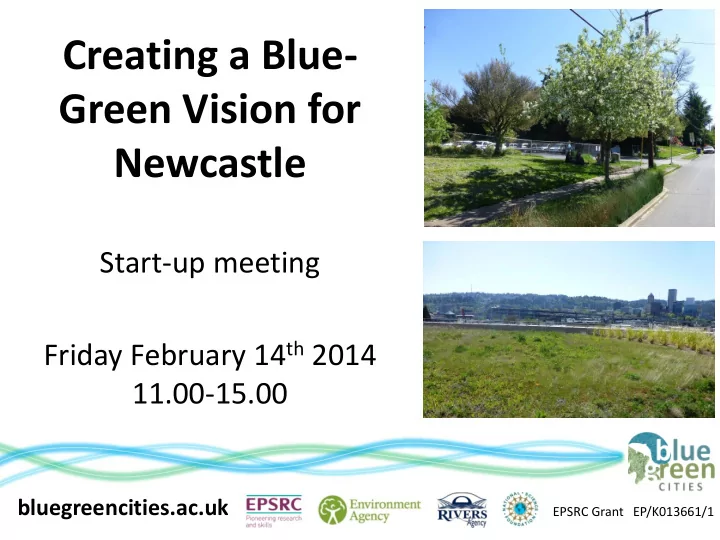
Creating a Blue- Green Vision for Newcastle Start-up meeting Friday - - PowerPoint PPT Presentation
Creating a Blue- Green Vision for Newcastle Start-up meeting Friday February 14 th 2014 11.00-15.00 bluegreencities.ac.uk EPSRC Grant EP/K013661/1 Workshop agenda 11.00 Introduction to the Blue-Green Cities Research Project, Emily Lawson
bluegreencities.ac.uk
EPSRC Grant EP/K013661/1
11.00 Introduction to the Blue-Green Cities Research Project, Emily Lawson 11.15 Mapping and managing flood risk in Newcastle with CityCAT, Chris Kilsby, Vassilis Glenis, Vedrana Kutija 11.30 Comparative UK/Australia study of retrofit SuDS in the CBD for improved flood mitigation, Jessica Lamond 11.45 Q&A session 1 12.00 Local perspectives on Blue-Green Cities, Kit England (Newcastle City Council) 12.15 Partnership approach to sustainable drainage area planning, Martin Kennedy (NWL) 12.30 Q&A session 2 12.45 Lunch and networking
13.30 Briefing on the Learning and Action Alliance (LAA) and discussion of membership options, Jessica Lamond 13.50 Presentation on a stakeholder map for Newcastle, Glyn Everett (UWE) 14.00 Workshop exercise; validating the stakeholder map and discussing how different stakeholder groups perceive, utilise and value Blue-Green infrastructure 15.00 Closing remarks and end of meeting
Newcastle) with BGC team and US collaborators
J4M8, Edinburgh Hebden Bridge Wortley Beck, Leeds The Dings, Bristol Case Study City: Newcastle
Blue-Green Cities are working with Ningbo academics
James Griffiths, David Higgitt, Faith Chan and Odette Paramor
Portland, Oregon Ningbo, China
Blue-Green Cities are working with:
Uncertainty
Fidelity Sensitivity
Quantification
Relevance Validity Verification
Water depth map of Ouseburn catchment (area = 120km2 , cell size = 2m, cells = 30million). Storm event = 60 minutes, 100-year return period
PIT technology
methodologies to represent urban FRM and Blue-Green networks within a single urban environment
interdependencies with wider urban infrastructure
footprint” accounting tool
Source Adelard Document 2009.
Fratini et al.,(2012) Three Points Approach (3PA) for urban flood risk management.
Blue Condition Green Condition
1. Design standards apply. Levels of service are met 2. Adaptation in the wider urban area. New spaces for water conveyance and urban storage
used on a day to day basis by community
benefits in context specific locations
and make recommendations to the design guidance to enhance the most significant non-flood benefits
Identified flood risk (pluvial/ fluvial)? Change flood risk management strategies? Is Blue-Green infrastructure viable? Buy-in from all local stakeholders Data availability
Demo Case Study City?
The research reported in this presentation is being conducted as part of the Blue-Green Cities Research Consortium with support from the:
bluegreencities.ac.uk
EPSRC Grant EP/K013661/1
Delivering and Evaluating Multiple Flood Risk Benefits in Blue-Green Cities