Crafting the Introduction to a Scientific Presentation: Create a - - PowerPoint PPT Presentation

crafting the introduction to a scientific presentation
SMART_READER_LITE
LIVE PREVIEW

Crafting the Introduction to a Scientific Presentation: Create a - - PowerPoint PPT Presentation

Crafting the Introduction to a Scientific Presentation: Create a mystery box Steve Lee, PhD CLIMB Program Assistant Director Winter 2013 Our CLIMB curriculum of workshops on communication in scientific research: 1) Delivering scientific


slide-1
SLIDE 1

Steve Lee, PhD

CLIMB Program Assistant Director Winter 2013
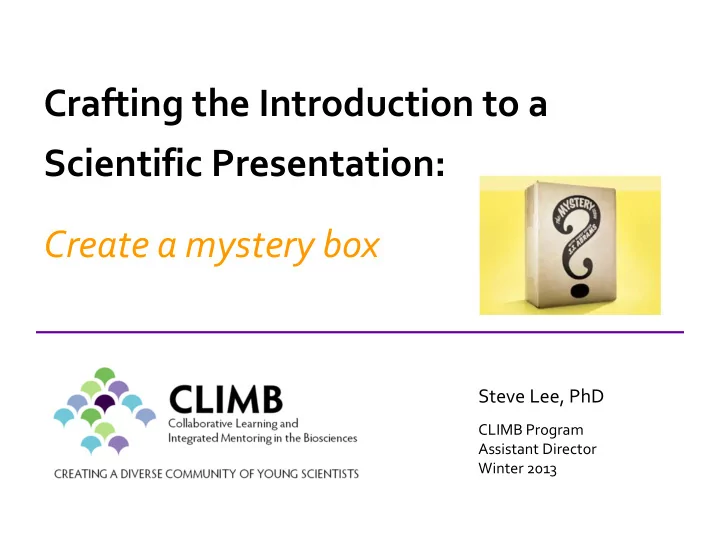
Crafting the Introduction to a Scientific Presentation: Create a mystery box

slide-2
SLIDE 2

Our CLIMB curriculum of workshops

  • n communication in scientific research:

2

1) Delivering scientific presentations and posters for impact: Make it stick with SUCCESs 2) Crafting the introduction to a scientific presentation: Create a mystery box 3) Communicating and collaborating across disciplines: Use simple words 4) Displaying visual evidence in scientific presentations: Help viewers make valid scientific decisions

slide-3
SLIDE 3

3

Why are we focusing on a 10-minute presentation to a broad audience?

  • to stretch your communication skills with a

tough challenge: ○ to explain your research concisely and ○ to engage a broad audience

  • to help you collaborate across your fields
  • to provide a brief presentation for all to

practice

slide-4
SLIDE 4

4

How do you set up your intro? The traditional introduction is boring

  • background

○ full of acronyms and jargon ○ definitions (maybe)

  • question
  • hypothesis

This is dry and does not engage the audience.

slide-5
SLIDE 5

5

Instead, set up a scientific story for your introduction

  • A story helps to connect with a broad audience

○ they won’t be familiar with the context and jargon

  • Set up a scientific story by creating a mystery

box ○ Let’s view JJ Abram’s TED talk

slide-6
SLIDE 6

6

How do you create a mystery box?

  • help your audience to imagine

○ ex: a major problem will be solved with this new instrument

  • explain why your research is significant

○ ex: the disease affects millions of people

  • describe why your research is so fascinating

○ a unique or counter-intuitive research puzzle

slide-7
SLIDE 7

Remember to address the Curse of Knowledge: make your ideas stick with SUCCESs

7

Simple: find and share the core message

Unexpected: get their attention – surprise or twist Concrete: help people understand – be specific Credible: help people believe – give evidence Emotional: help people to care – inspire Stories: share ideas to simulate and inspire

slide-8
SLIDE 8

8

Inform

○ concrete information ○ visual and audio info ○ details; raw data ○ credible evidence But, if you only inform, your talk may be: ○ dry or flat ○ random details ○ lack meaning

Inspire

○ significance ○ stories & analogies ○ cast a vision for future ○ big picture But, if you only inspire, your talk may be: ○ vague ○ ambiguous ○ not concrete

Communicate to inform and inspire

slide-9
SLIDE 9

The challenge is to go broad and deep

speak to broad audiences: use analogies and illustrations

9

speak deeply: use 1 or 2 examples for the experts

slide-10
SLIDE 10

For slides: pay attention to these details

  • plan for 1-2 min/slide

○ for 10-min talk: 5-8 slides

  • maximize the “info to ink” ratio
  • don’t use serif fonts (e.g. )
  • convert bullet lists into word tables (if possible)
  • use message or question titles

10

slide-11
SLIDE 11

Practice and get feedback

  • pay attention to your physical stance

○ your posture affects your audience’s perception

  • f you

○ and your performance as well

  • View Amy Cuddy’s Poptech talk
  • connect your spoken words with slides
  • get feedback early and often

11

slide-12
SLIDE 12

Your first practice: set up your intro

  • select a research project with some results
  • present your intro (few slides)
  • explain up to your question and hypothesis

12

Scheduling

  • Winter

Quarter

  • Spring

Quarter ○ Part 1: intro ○ Part 2: intro + design and methods ○ Part 3: full presentations (videotaped) ○ individual mtgs for feedback