SLIDE 1 Title goes here
sept 11
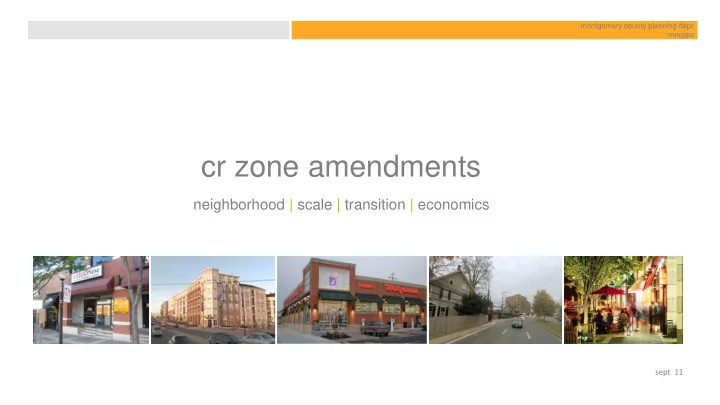
neighborhood | scale | transition | economics
cr zone amendments
montgomery county planning dept mncppc
SLIDE 2 better way to achieve smart, efficient development sets the mix of uses - predictability jobs | housing ratio lower vmt’s greener building better use of shrinking land resources meet the current & future building trends
- vercome the barriers of our current myriad of zones
more public process | transparency in development review what are the CR zoning goals ?
SLIDE 3
commercial | residential mixed use zoning it combines permitted uses total building size the mix of uses - limits on floor area height of buildings limitless combinations tailor the zone to any neighborhood defined public amenities what is CR zoning ?
SLIDE 4
future development will be infill zoning must focus on neighborhood transition | scale | public role CR zoning reflects the scale | intensity of different neighborhoods provides for the public & their role in future site plans greater certainty for public & property owners there is no bonusing - height and density are absolute takes the negotiations over public benefits out of the backroom why propose CR zones ?
SLIDE 5
pending master plans use the CR subgroups wheaton | takoma - langley | kensington exploring CR in ongoing master plans long branch | ecsc | chevy chase lake | burtonsville to be studied in upcoming master plans white flint II | glenmont | montgomery village where are we using the CR zones ?
SLIDE 6 CR has been well vetted in all the pending master plan areas CR is being well received in the upcoming master areas CR is requested in both the future master plan areas & in infill locations
City of Rockville White Flint Phase I Phase II Phase II 3
5 5
SLIDE 7
CR regulates use | maximum density | maximum height CR 1.0 C 0.5 R 1.0 H 40 cr sets the use cr 1.0 = total building floor area < 1 x the size of the lot C 0.5 = total commercial floor area allowed R 1.0 = total residential floor area allowed any mix of commercial & residential uses must be less than 1 x lot area building height < 40 feet how does CR work ?
SLIDE 8
CR sets a total size with no increases no bonus density no increases in height must provide amenities in order to build to the allowed density and height
SLIDE 9 standard & optional methods for floor area std method reduces the permitted floor area significantly to build higher than the std method amenities area required
amenities list major public facilities small business opportunities more mpdu’s adult & child day care enhanced access for disabled persons live | work units tree canopy public open space mix of unit sizes blt’s advance right of way dedication neighborhood services transit proximity better transit access historic resource protection neighborhood services adaptive buildings energy conservation | generation reduced parking structured parking public parking
public art through block connections green walls | roofs upper building level setbacks energy conservation | generation vegetated areas cool roof trip mitigation agreements better design way finding building elevations recycling facility plan habitat preservation | restoration
SLIDE 10 council request to engage the public on refining the cr zone
- ver a year on wheaton | takoma | kensington master plans
lead to discussions on fine graining the uses better reflect neighborhood character & scale proposed zta reflects extensive community engagement focus on revising the use list & the amenities required why propose changes to the CR zone Council approved a year ago ?
SLIDE 11
CRN neighborhood new CRT town new CR general minor amendments new use list for CRN and CRT to reduce the intensity of uses what are the new cr zone subgroups
SLIDE 12
CRT - town center mixed-use town centers | edges housing | commercial diversity to achieve CR objectives design and review oversight to ensure public review limited uses | medium parking requirements | no blt requirement moderate density & height range
SLIDE 13
CRN - neighborhood transition between residential areas & commercial centres more restrictive uses focus on neighborhood services site plan review now required at low thresholds limited uses | higher parking | no blt required restricted density | height range amenities not required in exchange for density
SLIDE 14
current CR zone white flint | great seneca changes to the current zone points system to determine amenity contribution payment into the amenity fund for public facilities & open space parking refinements
SLIDE 15
the fact we have 30+ zones should tell us the existing zones are ineffective transparency public process more will go through site plan sketch plan “master plans” larger sites securing public benefits current zones do not allow for fine graining of uses | density | height floating zones are not “predictable” build certainty into our zoning let people in neighborhoods know what to expect let property owners know what they can do provide a vision for the future why are the CR zones an improvement over any of the 30 + commercial | mixed use zones we already have ?
SLIDE 16 C1 & C2 - no site plan or density limitation | no predictability TOMX - nobody is using it - owners are using previous approvals CBD - only 3 varieties & this is where infill will be most active h m - one use zone
- m - antique stores & florists but no deli or retail
cbd - height is not the max - it can be exceeded ? why are CR zones an improvement ?
SLIDE 17
example - kensington c2 zone crn zone
SLIDE 18
kensington c2 zone crn zone
SLIDE 19 kensington - results
less surface parking lower height incentives for green building, etc. more public review - site plan requirement pedestrian-friendly streets
- pen space or other amenities
SLIDE 20
many deletions from the amenities list impacts smaller properties the pb list reflects neighborhood input as requested by council different application to white flint & gssc - not necessary no need to have separate list for CR pre phed & post phed pb draft keeps one amenities list this list was discussed over the past year acceptance for wf | gssc | current master plans changes to the mpdu incentive makes it better - generally well received how do the phed recommendations impact the planning bd. version of the zta ?
SLIDE 21
zoning rewrite issue - one zoning code or two planning staff have reviewed every current master plan statements re commercial areas any height and density recommendations not an upzoning not residential areas considering uniform conversion C1 becomes a standard CR zone any application of CR zone would involve a master plan decision
SLIDE 22
why not use overlay zones ? no need - CR provides flexibility certainty for the community for property owners allows for incremental development through sketch plans think out the site now develop incrementally
SLIDE 23
conclusion planning bd. draft accomplishes many things increased public participation neighborhood compatibility certainty in outcomes public benefits