COVID-19 pandemic: health promotion responses INTERACTIVE WEBINAR - - PowerPoint PPT Presentation

covid 19 pandemic health promotion responses
SMART_READER_LITE
LIVE PREVIEW

COVID-19 pandemic: health promotion responses INTERACTIVE WEBINAR - - PowerPoint PPT Presentation

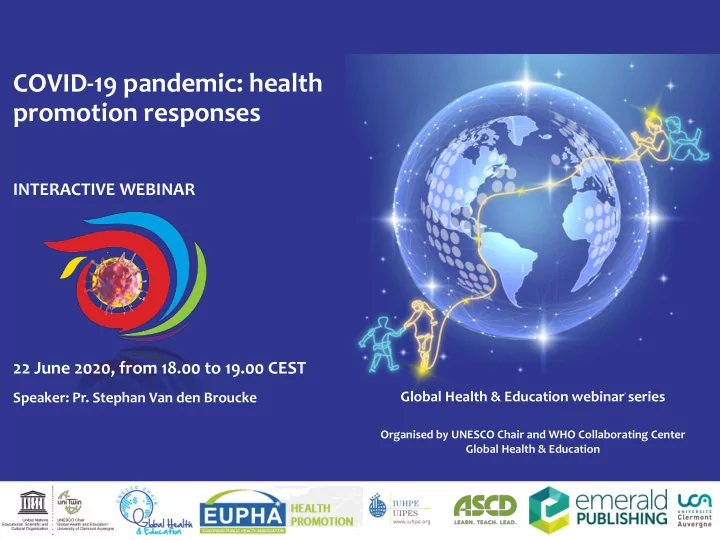
COVID-19 pandemic: health promotion responses INTERACTIVE WEBINAR 22 June 2020, from 18.00 to 19.00 CEST Global Health & Education webinar series Speaker: Pr. Stephan Van den Broucke Organised by UNESCO Chair and WHO Collaborating Center


slide-1
SLIDE 1

Global Health & Education webinar series

Organised by UNESCO Chair and WHO Collaborating Center Global Health & Education

COVID-19 pandemic: health promotion responses

INTERACTIVE WEBINAR 22 June 2020, from 18.00 to 19.00 CEST

Speaker: Pr. Stephan Van den Broucke

slide-2
SLIDE 2

Global Health & Education webinar series 2020

Send your questions using the Q&A at the bottom of your window.

COVID-19 pandemic: health promotion responses

slide-3
SLIDE 3

Health Promotion Responses to the COVID-19 Pandemic

Stephan Van den Broucke UC Louvain

Global Health & Education webinar series UNESCO Chair and WHO Collaborating Centre Global Health & Education 22 June 2020

slide-4
SLIDE 4

Global Health & Education webinar series 2020

What can health promotion contribute in terms of management

  • f the pandemic?

COVID-19 pandemic: health promotion responses

slide-5
SLIDE 5

Global Health & Education webinar series 2020

QUESTION

COVID-19 pandemic: health promotion responses

What are your key words to describe the contribution of health promotion in managing the pandemic?

slide-6
SLIDE 6

Why health promotion matters to address the COVID-19 challenge

  • COVID-19 has a huge health and societal

impact

  • Measures to prevent the virus from spreading and to

reinforce treatment capacities are unprecedented

  • Lockdown has disruptive societal consequences
  • Health promotion is more important than ever
  • Many protective measures involve behaviour change by

citizens & health workers

  • Perception that the existing health system is failing to

protect citizens against the spread of the virus creates a need for people to regain control of their health

  • to protect oneself against the disease
  • to deal with its disruptive consequences
  • Health promotion’s contribution to tackle the pandemic

can focus at the downstream, midstream and upstream level

slide-7
SLIDE 7

Improving Preventive Behaviour Change Measures

  • Health authorities have tried to enhance protective behaviour

– through providing information, issuing health warnings, and imposing legal restrictions – low adherence is condemned as “irresponsible” and “selfish”

  • Health behaviour models show that people will only act on

health warnings if they

– believe that they are personally susceptible – perceive the consequences as severe; – perceive the preventive action as effective to reduce the threat – believe they are capable to perform the preventive action

  • Wide coverage of the pandemic by the media creates anxiety

– too much anxiety can elicit cognitive avoidance strategies that minimize the perceived threat – social identity needs in interaction with contextual factors can increase and mitigate the actual rejection of evidence (knowledge resistance)

slide-8
SLIDE 8

Maintaining preventive behaviour

  • Behaviour change ≠ behaviour maintenance

– Protective behaviour will have to be maintainend as there is chance of infection – Relying on health warnings, fear appeals and legal restrictions will become increasingly ineffective to maintain preventive behaviour

  • Encouraging sustainable behaviour change requires

– the establishing of social norms – modification of the context to facilitate and encourage (« nudge ») protective behaviour – envouraging habit formation

  • takes shape when the newly learnt behaviour persists
  • takes place automatically, without the need for conscious reflection
  • robust against change
slide-9
SLIDE 9

Empowering Organizations and Communities

  • Efforts to implement protective measures will be more successful if the

advice from experts is combined with local community knowledge

– community partners can help to improve the understanding of disease control protocols – moderate changes can be made that better reflect the community’s sensitivities

  • Community engagement can strengthen the capacity to deal with the

disruptive effects of the pandemic

– despite the insecurity and stress due to the switch to different modes of operating, many communities show high levels of solidarity and mutual support – community resilience and trust provide a strong basis to help organizations and communities cope with the unfamiliar situation, re-organize and regain control

  • Strengthening community action is a key competence of health

promotion

– builds on the existing strengths and capacities within a community – expertise creating healthy settings can be a source of inspiration and support to help schools, universities and workplaces deal with the longer-term disruptive effects

slide-10
SLIDE 10

Global Health & Education webinar series 2020

Fake news, understanding complex issues, health knowledge: how to develop the capacity of each individual to take charge of their

  • wn health?

COVID-19 pandemic: health promotion responses

slide-11
SLIDE 11

Global Health & Education webinar series 2020

QUESTION

COVID-19 pandemic: health promotion responses

Do you think the people have the necessary skills to deal with the COVID-19 pandemic?

slide-12
SLIDE 12

The importance of health literacy

  • To (re)gain control of their lives in the pandemic, people must

– know what individual preventive measures to take – know how to deal with the consequences

  • With respect to COVID-19, there is (too) much information

– not all information is useful, some information is biased or wrong – too much information can create confusion

  • The challenge is not to provide more information, but to help people

find the way to accurate and reliable health information

– provide information in an understandable, transparent and consistent way recognizing that people with low health literacy may need more explanation and different communication formats – explain the situation transparently and clarify the objectives repeatedly – communicate new evidence and information without being afraid to correct earlier messages and statements if necessary; and – avoid blaming, but instead strengthen the well-informed responsibility of the individual while showing solidarity with vulnerable groups

slide-13
SLIDE 13

Taking up information is an active cognitive process

  • People actively select information sources and information from within

these sources

– selection is influenced by context, emotions and selective attention – subject to selection and confirmation bias

  • Cognitive schemes are activated to understand and appraise

information about the virus and to judge the importance of preventive measures

This can also cause bias

– negative information bias

(i.e. the tendency to attach more importance to negative than to positive information, resulting in « catastrophic thinking »)

– positive information bias

(i.e. the tendency to consider oneself as less at risk for negative consequence, causing « unrealistic optimism »)

– familiarity or recency bias
slide-14
SLIDE 14

Countering fake news

  • Persistent ‘myths’ about COVID-19

– belief that the virus was made in a laboratory or otherwise engineered – belief that cold weather or hand dryers kill the virus – belief that young people cannot get infected – belief that antibiotics or vaccines against pneumonia protect against the infection

  • False beliefs are reinforced by the false consensus that is created

when information is shared on social media leading to the ‘echo chamber’ or ‘illusion of truth’ effect

  • Can be countered by encouraging people to

– cross check the accuracy and credibility of information – check the source of the information

where does it come from, who is behind the information, what is the intention, why was it shared, when was it published …

– verify the information by consulting a second source – think twice before sharing information that has not been fact-checked

slide-15
SLIDE 15

Global Health & Education webinar series 2020

There will probably be several waves of COVID-19 outbreaks or other pandemics. What are the health promotion recommendations for a sustainable response to the pandemic and for the future?

COVID-19 pandemic: health promotion responses

slide-16
SLIDE 16

Global Health & Education webinar series 2020

QUESTION

COVID-19 pandemic: health promotion responses

Will health promotion be widely implemented in managing future pandemics?

slide-17
SLIDE 17

A sustainable reply to the COVID-19 pandemic

  • Health promotion can contribute to containing COVID-19 and help

people and communities to regain control

– encourage and facilitate people to adopt and maintain protective behavior – strengthen people’s competences to find the way to accurate and reliable health information – strengthen communities to take action, building on the existing strengths and capacities within the community – draw on the expertise with the settings approach to help schools, universities and workplaces deal with the longer-term disruptive effects of COVID-19

slide-18
SLIDE 18

Learning from the crisis

  • Recognize the importance of infectious diseases

– Health promotion has traditionally focused on non-communicable diseases and promoting positive health, but neglected to apply health promotion principles and methods to address infectious diseases – Requires a stronger focus on intervention research and a better understanding in the processes involved in implementation, rather than on outcomes and causality

  • Recognize that human health is not an isolated issue

– Embrace the concept of “One Health”, which recognizes the interconnection between people, animals, plants and their shared environment

  • Prepare to respond swiftly and effectively to epidemics

– Learn about the ways in which people make decisions, organizations operate and communities relate in reaction to epidemics and other crises – Seek out how social cohesion and trust in public institutions can be strengthened and mobilized to make communities and populations more resilient against crisis

  • Accept that not all events can be predicted and controlled, and that

uncertainty is part of life

slide-19
SLIDE 19
slide-20
SLIDE 20

Global Health & Education webinar series

Organised by UNESCO Chair and WHO Collaborating Center Global Health & Education

COVID-19 pandemic: health promotion responses

INTERACTIVE WEBINAR 22 June 2020, from 18.00 to 19.00 CEST

Speaker: Pr. Stephan Van den Broucke