Coupling: co-adapted vs. maximal (joint work with W.S. Kendall and - - PowerPoint PPT Presentation

coupling co adapted vs maximal
SMART_READER_LITE
LIVE PREVIEW

Coupling: co-adapted vs. maximal (joint work with W.S. Kendall and - - PowerPoint PPT Presentation

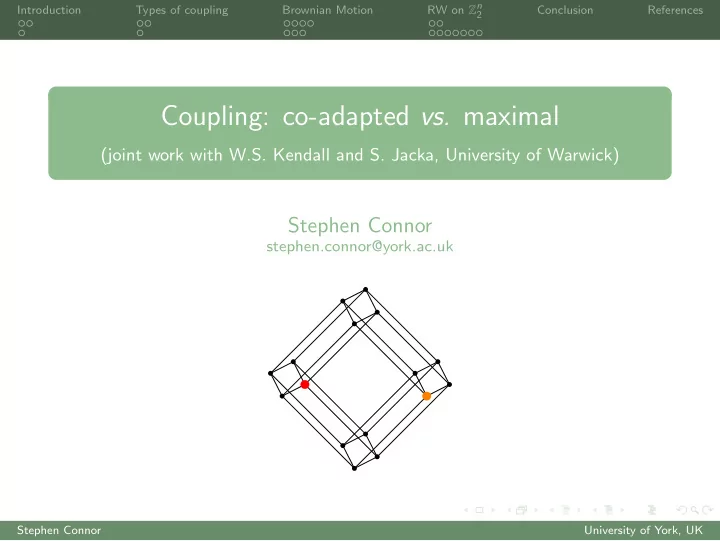
RW on Z n Introduction Types of coupling Brownian Motion Conclusion References 2 Coupling: co-adapted vs. maximal (joint work with W.S. Kendall and S. Jacka, University of Warwick) Stephen Connor stephen.connor@york.ac.uk Stephen Connor


slide-1
SLIDE 1

Introduction Types of coupling Brownian Motion RW on Zn

2

Conclusion References

Coupling: co-adapted vs. maximal

(joint work with W.S. Kendall and S. Jacka, University of Warwick)

Stephen Connor

stephen.connor@york.ac.uk

Stephen Connor University of York, UK

slide-2
SLIDE 2

Introduction Types of coupling Brownian Motion RW on Zn

2

Conclusion References

Outline

1

Introduction Coupling The coupling inequality

2

Types of coupling Maximal coupling Co-adapted coupling

3

Brownian Motion

4

Random walk on the hypercube, Zn

2 5

Concluding remarks

Stephen Connor University of York, UK

slide-3
SLIDE 3

Introduction Types of coupling Brownian Motion RW on Zn

2

Conclusion References

Coupling

Let X be a Markov process with state space S. We are interested in the situation where we have two copies of this process, X and Y , started from different states.

Definition

A coupling of X and Y is a process (X ′, Y ′) on S × S, such that X ′ D = X and Y ′ D = Y . That is, viewed marginally, X ′ behaves as a version of X and Y ′ as a version of Y .

Stephen Connor University of York, UK

slide-4
SLIDE 4

Introduction Types of coupling Brownian Motion RW on Zn

2

Conclusion References

The coupling time is defined by τ = inf

  • t : X ′

s = Y ′ s

for all s ≥ t

  • The coupling is successful if P (τ < ∞) = 1

τ is not, in general, a stopping time (for the marginal processes nor the joint process) A ‘good’ coupling is usually one with a ‘small’ coupling time τ

existence of a coupling is trivial: let X ′ and Y ′ be independent until they first meet, then stay together

this idea goes back to Doeblin (1938)

a major use of coupling is to provide information about the convergence of X...

Stephen Connor University of York, UK

slide-5
SLIDE 5

Introduction Types of coupling Brownian Motion RW on Zn

2

Conclusion References

The coupling inequality

Definition

Let µ and ν be probability measures defined on S. The total variation distance between µ and ν is given by µ − νTV = sup

A⊂S

(µ(A) − ν(A))

Stephen Connor University of York, UK

slide-6
SLIDE 6

Introduction Types of coupling Brownian Motion RW on Zn

2

Conclusion References

The coupling inequality

Definition

Let µ and ν be probability measures defined on S. The total variation distance between µ and ν is given by µ − νTV = sup

A⊂S

(µ(A) − ν(A))

Lemma (The coupling inequality)

Let (X, Y ) be a coupling as above. Then P (Xt ∈ ·) − P (Yt ∈ ·)TV ≤ P (τ > t) .

Stephen Connor University of York, UK

slide-7
SLIDE 7

Introduction Types of coupling Brownian Motion RW on Zn

2

Conclusion References

Maximal coupling

It is well known that there exists a maximal coupling of X and Y (Griffeath, 1975); that is, a joint process (X ∗, Y ∗) with coupling time τ ∗ satisfying P (X ∗

t ∈ ·) − P (Y ∗ t ∈ ·)TV = P (τ ∗ > t) .

Thus there exists a successful coupling for X if and only if X is weakly ergodic

Stephen Connor University of York, UK

slide-8
SLIDE 8

Introduction Types of coupling Brownian Motion RW on Zn

2

Conclusion References

Although a maximal coupling is known to exist, such a coupling is typically (at best) non-Markovian, unintuitive, and very difficult to compute explicitly – they are rarely used in practical applications

Stephen Connor University of York, UK

slide-9
SLIDE 9

Introduction Types of coupling Brownian Motion RW on Zn

2

Conclusion References

Although a maximal coupling is known to exist, such a coupling is typically (at best) non-Markovian, unintuitive, and very difficult to compute explicitly – they are rarely used in practical applications

Stephen Connor University of York, UK

slide-10
SLIDE 10

Introduction Types of coupling Brownian Motion RW on Zn

2

Conclusion References

Although a maximal coupling is known to exist, such a coupling is typically (at best) non-Markovian, unintuitive, and very difficult to compute explicitly – they are rarely used in practical applications

Stephen Connor University of York, UK

slide-11
SLIDE 11

Introduction Types of coupling Brownian Motion RW on Zn

2

Conclusion References

Co-adapted coupling

Definition

(X, Y ) is called co-adapted if X and Y are both Markov with respect to a common filtration (Ft). (We don’t require that (X, Y ) is Markov w.r.t. (Ft).)

Stephen Connor University of York, UK

slide-12
SLIDE 12

Introduction Types of coupling Brownian Motion RW on Zn

2

Conclusion References

Co-adapted coupling

Definition

(X, Y ) is called co-adapted if X and Y are both Markov with respect to a common filtration (Ft). (We don’t require that (X, Y ) is Markov w.r.t. (Ft).) It now suffices to study the first collision time of X and Y → X and Y can be made to agree from this time onwards co-adapted couplings are much more intuitive (neither process is allowed to ‘cheat’ by looking into the future) maximal couplings are in general not co-adapted

Stephen Connor University of York, UK

slide-13
SLIDE 13

Introduction Types of coupling Brownian Motion RW on Zn

2

Conclusion References

Co-adapted coupling

Definition

(X, Y ) is called co-adapted if X and Y are both Markov with respect to a common filtration (Ft). (We don’t require that (X, Y ) is Markov w.r.t. (Ft).) It now suffices to study the first collision time of X and Y → X and Y can be made to agree from this time onwards co-adapted couplings are much more intuitive (neither process is allowed to ‘cheat’ by looking into the future) maximal couplings are in general not co-adapted But how good can a co-adapted coupling be?

Stephen Connor University of York, UK

slide-14
SLIDE 14

Introduction Types of coupling Brownian Motion RW on Zn

2

Conclusion References

Brownian motion: a maximal coupling

Consider two Brownian motions, X and Y , on R, with X0 = x and Y0 = y (and x ≥ y). Write pt(x, u) = e−(u−x)2/2t √ 2πt . It is simple to calculate the total variation distance between these two processes at any time t using the following result...

Stephen Connor University of York, UK

slide-15
SLIDE 15

Introduction Types of coupling Brownian Motion RW on Zn

2

Conclusion References

Lemma

For probability measures µ and ν, let µ ∧ ν be their greatest common component, and let λ be a measure that dominates µ and ν. Write f = dµ dλ , f ′ = dν dλ . Then µ − νTV = 1 −

  • (f ∧ f ′) dλ .

Stephen Connor University of York, UK

slide-16
SLIDE 16

Introduction Types of coupling Brownian Motion RW on Zn

2

Conclusion References

y x

So... L (Xt) − L (Yt) = 1 − 2 (x+y)/2

−∞

pt(x, z)dz = Erf (x − y)/2 √ 2t

  • = Px
  • τ(x+y)/2 > t
  • .

where τ(x+y)/2 = inf {t ≥ 0 | Xt = (x + y)/2} .

Stephen Connor University of York, UK

slide-17
SLIDE 17

Introduction Types of coupling Brownian Motion RW on Zn

2

Conclusion References

y x

So... L (Xt) − L (Yt) = 1 − 2 (x+y)/2

−∞

pt(x, z)dz = Erf (x − y)/2 √ 2t

  • = Px
  • τ(x+y)/2 > t
  • .

where τ(x+y)/2 = inf {t ≥ 0 | Xt = (x + y)/2} .

Stephen Connor University of York, UK

slide-18
SLIDE 18

Introduction Types of coupling Brownian Motion RW on Zn

2

Conclusion References

y x

So... L (Xt) − L (Yt) = 1 − 2 (x+y)/2

−∞

pt(x, z)dz = Erf (x − y)/2 √ 2t

  • = Px
  • τ(x+y)/2 > t
  • .

where τ(x+y)/2 = inf {t ≥ 0 | Xt = (x + y)/2} .

Stephen Connor University of York, UK

slide-19
SLIDE 19

Introduction Types of coupling Brownian Motion RW on Zn

2

Conclusion References

Thanks to the symmetry of BM, this shows that reflection coupling is maximal for X and Y . In other words, if we define Y by Yt =

  • y − (Xt − x)

for t ≤ τ(x+y)/2 Xt for t > τ(x+y)/2 , then L (Xt) − L (Yt) = Px

  • τ(x+y)/2 > t
  • = P (Xt = Yt) .

y x

xy 2

Stephen Connor University of York, UK

slide-20
SLIDE 20

Introduction Types of coupling Brownian Motion RW on Zn

2

Conclusion References

Altering the initial conditions

Note that this reflection coupling is co-adapted

Stephen Connor University of York, UK

slide-21
SLIDE 21

Introduction Types of coupling Brownian Motion RW on Zn

2

Conclusion References

Altering the initial conditions

Note that this reflection coupling is co-adapted But what if we now alter the starting conditions, so that X0 = x is fixed, but Y0 ∼ N(0, σ2)?

Stephen Connor University of York, UK

slide-22
SLIDE 22

Introduction Types of coupling Brownian Motion RW on Zn

2

Conclusion References

Altering the initial conditions

Note that this reflection coupling is co-adapted But what if we now alter the starting conditions, so that X0 = x is fixed, but Y0 ∼ N(0, σ2)? Perhaps surprisingly...

Lemma

Under these initial conditions, reflection coupling for the pair of Brownian motions (X, Y ) is not maximal

Stephen Connor University of York, UK

slide-23
SLIDE 23

Introduction Types of coupling Brownian Motion RW on Zn

2

Conclusion References

However, reflection is an optimal co-adapted coupling for X and Y when Y0 is randomised using any distribution: any co-adapted coupling must be conditioned at time zero upon the σ-algebra F0 = σ {Xs, Ys : s ≤ 0}; in particular, the coupling scheme at time zero is conditioned

  • n the event {Y0 = y};

so the best that any co-adapted coupling can do is to match the coupling time of a maximal coupling between X and Y when (X0, Y0) = (x, y), averaged over the distribution of Y0; this bound is achieved uniquely by reflection coupling.

Stephen Connor University of York, UK

slide-24
SLIDE 24

Introduction Types of coupling Brownian Motion RW on Zn

2

Conclusion References

However, reflection is an optimal co-adapted coupling for X and Y when Y0 is randomised using any distribution: any co-adapted coupling must be conditioned at time zero upon the σ-algebra F0 = σ {Xs, Ys : s ≤ 0}; in particular, the coupling scheme at time zero is conditioned

  • n the event {Y0 = y};

so the best that any co-adapted coupling can do is to match the coupling time of a maximal coupling between X and Y when (X0, Y0) = (x, y), averaged over the distribution of Y0; this bound is achieved uniquely by reflection coupling.

Stephen Connor University of York, UK

slide-25
SLIDE 25

Introduction Types of coupling Brownian Motion RW on Zn

2

Conclusion References

However, reflection is an optimal co-adapted coupling for X and Y when Y0 is randomised using any distribution: any co-adapted coupling must be conditioned at time zero upon the σ-algebra F0 = σ {Xs, Ys : s ≤ 0}; in particular, the coupling scheme at time zero is conditioned

  • n the event {Y0 = y};

so the best that any co-adapted coupling can do is to match the coupling time of a maximal coupling between X and Y when (X0, Y0) = (x, y), averaged over the distribution of Y0; this bound is achieved uniquely by reflection coupling.

Stephen Connor University of York, UK

slide-26
SLIDE 26

Introduction Types of coupling Brownian Motion RW on Zn

2

Conclusion References

However, reflection is an optimal co-adapted coupling for X and Y when Y0 is randomised using any distribution: any co-adapted coupling must be conditioned at time zero upon the σ-algebra F0 = σ {Xs, Ys : s ≤ 0}; in particular, the coupling scheme at time zero is conditioned

  • n the event {Y0 = y};

so the best that any co-adapted coupling can do is to match the coupling time of a maximal coupling between X and Y when (X0, Y0) = (x, y), averaged over the distribution of Y0; this bound is achieved uniquely by reflection coupling.

Stephen Connor University of York, UK

slide-27
SLIDE 27

Introduction Types of coupling Brownian Motion RW on Zn

2

Conclusion References

However, reflection is an optimal co-adapted coupling for X and Y when Y0 is randomised using any distribution: any co-adapted coupling must be conditioned at time zero upon the σ-algebra F0 = σ {Xs, Ys : s ≤ 0}; in particular, the coupling scheme at time zero is conditioned

  • n the event {Y0 = y};

so the best that any co-adapted coupling can do is to match the coupling time of a maximal coupling between X and Y when (X0, Y0) = (x, y), averaged over the distribution of Y0; this bound is achieved uniquely by reflection coupling. Question Is there an intuitive description of a maximal coupling under these initial conditions?

Stephen Connor University of York, UK

slide-28
SLIDE 28

Introduction Types of coupling Brownian Motion RW on Zn

2

Conclusion References

Some extensions

A similar set of results holds for couplings of two Ornstein-Uhlenbeck processes. What about couplings for more general diffusions? dXt = b(Xt) dt + σ(Xt) dBt Question Is reflection (reflecting Bt) maximal when X0 and Y0 are deterministic? it seems natural to conjecture that reflection is not maximal when X0 = x and Y0 is randomised but is reflection still a (unique) optimal co-adapted coupling?

Stephen Connor University of York, UK

slide-29
SLIDE 29

Introduction Types of coupling Brownian Motion RW on Zn

2

Conclusion References

Random walk on the hypercube, Zn

2

Let Zn

2 be the group of binary n-tuples, under coordinate-wise

addition modulo 2: this is the set of vertices of an n-dimensional cube we write x ∈ Zn

2 as x = (x(1), . . . , x(n)) ∈ {0, 1}n

This is one of the simplest groups on which to study random walks, due to its high level of symmetry.

Stephen Connor University of York, UK

slide-30
SLIDE 30

Introduction Types of coupling Brownian Motion RW on Zn

2

Conclusion References

We define a simple, symmetric, continuous-time random walk X

  • n Zn

2 as follows:

let Λi, 1 ≤ i ≤ n, be independent unit-rate Poisson processes at incident times of Λi, the ith coordinate of X flips to its

  • pposite value (0 or 1)

unique equilibrium distribution is Uniform(Zn

2)

e.g., with n = 6:

Stephen Connor University of York, UK

slide-31
SLIDE 31

Introduction Types of coupling Brownian Motion RW on Zn

2

Conclusion References

We define a simple, symmetric, continuous-time random walk X

  • n Zn

2 as follows:

let Λi, 1 ≤ i ≤ n, be independent unit-rate Poisson processes at incident times of Λi, the ith coordinate of X flips to its

  • pposite value (0 or 1)

unique equilibrium distribution is Uniform(Zn

2)

e.g., with n = 6:

Stephen Connor University of York, UK

slide-32
SLIDE 32

Introduction Types of coupling Brownian Motion RW on Zn

2

Conclusion References

We define a simple, symmetric, continuous-time random walk X

  • n Zn

2 as follows:

let Λi, 1 ≤ i ≤ n, be independent unit-rate Poisson processes at incident times of Λi, the ith coordinate of X flips to its

  • pposite value (0 or 1)

unique equilibrium distribution is Uniform(Zn

2)

e.g., with n = 6:

Stephen Connor University of York, UK

slide-33
SLIDE 33

Introduction Types of coupling Brownian Motion RW on Zn

2

Conclusion References

Now suppose that we wish to couple two such random walks, X and Y , with X0 = (0, 0, . . . , 0) and Y0 ∼ Uniform(Zn

2)

Maximal coupling An almost-maximal coupling was described by Matthews (1987): not co-adapted, but still intuitive! expected coupling time ∼ (log n)/4

Stephen Connor University of York, UK

slide-34
SLIDE 34

Introduction Types of coupling Brownian Motion RW on Zn

2

Conclusion References

Now suppose that we wish to couple two such random walks, X and Y , with X0 = (0, 0, . . . , 0) and Y0 ∼ Uniform(Zn

2)

Maximal coupling An almost-maximal coupling was described by Matthews (1987): not co-adapted, but still intuitive! expected coupling time ∼ (log n)/4 But how good can a co-adapted coupling be for this process?

Stephen Connor University of York, UK

slide-35
SLIDE 35

Introduction Types of coupling Brownian Motion RW on Zn

2

Conclusion References

Optimal co-adapted coupling

Any co-adapted coupling must satisfy three constraints (all imposed by the marginal processes X(i) being unit-rate Poisson processes): in any instant, no. of jumps of (X, Y ) cannot exceed two all ‘single’ and ‘double’ jumps have rates bounded above by 1 the total rate at which X(i) jumps must equal 1

Stephen Connor University of York, UK

slide-36
SLIDE 36

Introduction Types of coupling Brownian Motion RW on Zn

2

Conclusion References

Optimal co-adapted coupling

Any co-adapted coupling must satisfy three constraints (all imposed by the marginal processes X(i) being unit-rate Poisson processes): in any instant, no. of jumps of (X, Y ) cannot exceed two all ‘single’ and ‘double’ jumps have rates bounded above by 1 the total rate at which X(i) jumps must equal 1 This allows us to describe any co-adapted coupling (X, Y ) using marked Poisson processes Λij (0 ≤ i, j ≤ n) a (n + 1) × (n + 1) matrix-valued control process, Q Let C be the class of all co-adapted couplings.

Stephen Connor University of York, UK

slide-37
SLIDE 37

Introduction Types of coupling Brownian Motion RW on Zn

2

Conclusion References

Stochastic control problem

We now just need to find the best control process Q:

Method

1 Make a guess at a good process: call it ˆ

Q;

2 Choose a cost function v, that measures how good any

control process Q is e.g. v(Q) = E [τQ], or v(Q, t) = P (τQ > t);

3 Use Bellman’s principle to show that v is minimized by ˆ

Q.

Stephen Connor University of York, UK

slide-38
SLIDE 38

Introduction Types of coupling Brownian Motion RW on Zn

2

Conclusion References

Making a good guess: intuition

Matching coordinates should be made to move synchronously:

Stephen Connor University of York, UK

slide-39
SLIDE 39

Introduction Types of coupling Brownian Motion RW on Zn

2

Conclusion References

Making a good guess: intuition

Matching coordinates should be made to move synchronously:

Stephen Connor University of York, UK

slide-40
SLIDE 40

Introduction Types of coupling Brownian Motion RW on Zn

2

Conclusion References

Making a good guess: intuition

Matching coordinates should be made to move synchronously:

Stephen Connor University of York, UK

slide-41
SLIDE 41

Introduction Types of coupling Brownian Motion RW on Zn

2

Conclusion References

Making a good guess: intuition

Matching coordinates should be made to move synchronously: Coupling strategy should depend only on Nt = no. of unmatched bits at time t

Stephen Connor University of York, UK

slide-42
SLIDE 42

Introduction Types of coupling Brownian Motion RW on Zn

2

Conclusion References

Two possible strategies (I)

Allow unmatched bits to evolve independently:

Stephen Connor University of York, UK

slide-43
SLIDE 43

Introduction Types of coupling Brownian Motion RW on Zn

2

Conclusion References

Two possible strategies (I)

Allow unmatched bits to evolve independently: → single new matches are made at rate 2Nt

Stephen Connor University of York, UK

slide-44
SLIDE 44

Introduction Types of coupling Brownian Motion RW on Zn

2

Conclusion References

Two possible strategies (I)

Allow unmatched bits to evolve independently: → single new matches are made at rate 2Nt

Stephen Connor University of York, UK

slide-45
SLIDE 45

Introduction Types of coupling Brownian Motion RW on Zn

2

Conclusion References

Two possible strategies (II)

Pair unmatched bits:

Stephen Connor University of York, UK

slide-46
SLIDE 46

Introduction Types of coupling Brownian Motion RW on Zn

2

Conclusion References

Two possible strategies (II)

Pair unmatched bits: → two new matches are made at rate Nt

Stephen Connor University of York, UK

slide-47
SLIDE 47

Introduction Types of coupling Brownian Motion RW on Zn

2

Conclusion References

Two possible strategies (II)

Pair unmatched bits: → two new matches are made at rate Nt

Stephen Connor University of York, UK

slide-48
SLIDE 48

Introduction Types of coupling Brownian Motion RW on Zn

2

Conclusion References

Main result: the optimal co-adapted coupling

Let ˆ Q control (X, Y ) as follows:

1 matched bits move synchronously; Stephen Connor University of York, UK

slide-49
SLIDE 49

Introduction Types of coupling Brownian Motion RW on Zn

2

Conclusion References

Main result: the optimal co-adapted coupling

Let ˆ Q control (X, Y ) as follows:

1 matched bits move synchronously; 2 if Nt is even then coupled unmatched bits in pairs; Stephen Connor University of York, UK

slide-50
SLIDE 50

Introduction Types of coupling Brownian Motion RW on Zn

2

Conclusion References

Main result: the optimal co-adapted coupling

Let ˆ Q control (X, Y ) as follows:

1 matched bits move synchronously; 2 if Nt is even then coupled unmatched bits in pairs; 3 if Nt is odd then let unmatched bits move independently. Stephen Connor University of York, UK

slide-51
SLIDE 51

Introduction Types of coupling Brownian Motion RW on Zn

2

Conclusion References

Main result: the optimal co-adapted coupling

Let ˆ Q control (X, Y ) as follows:

1 matched bits move synchronously; 2 if Nt is even then coupled unmatched bits in pairs; 3 if Nt is odd then let unmatched bits move independently.

Let ˆ τ be the associated coupling time. What cost function should we use?

Stephen Connor University of York, UK

slide-52
SLIDE 52

Introduction Types of coupling Brownian Motion RW on Zn

2

Conclusion References

Main result: the optimal co-adapted coupling

Let ˆ Q control (X, Y ) as follows:

1 matched bits move synchronously; 2 if Nt is even then coupled unmatched bits in pairs; 3 if Nt is odd then let unmatched bits move independently.

Let ˆ τ be the associated coupling time. What cost function should we use? Define ˆ v(x, y, t) = P (ˆ τ > t | X0 = x, Y0 = y) .

Stephen Connor University of York, UK

slide-53
SLIDE 53

Introduction Types of coupling Brownian Motion RW on Zn

2

Conclusion References

Main result: the stochastically optimal co-adapted coupling

Let ˆ Q control (X, Y ) as follows:

1 matched bits move synchronously; 2 if Nt is even then coupled unmatched bits in pairs; 3 if Nt is odd then let unmatched bits move independently.

Let ˆ τ be the associated coupling time. What cost function should we use? Define ˆ v(x, y, t) = P (ˆ τ > t | X0 = x, Y0 = y) .

Theorem (Connor & Jacka, 2008)

For any states x, y ∈ Zn

2 and time t ≥ 0,

ˆ v(x, y, t) = inf

c∈C P (τ c > t | X0 = x, Y0 = y) .

Stephen Connor University of York, UK

slide-54
SLIDE 54

Introduction Types of coupling Brownian Motion RW on Zn

2

Conclusion References

Remarks

Proof uses notion of totally monotone functions; The optimal co-adapted coupling is not a maximal coupling: E [ˆ τ] ∼ 1 2 log n but E [τ ∗] ∼ 1 4 log n ; If the rate at which X(i) flips is allowed to vary with i then there is, in general, no stochastically optimal coupling.

Stephen Connor University of York, UK

slide-55
SLIDE 55

Introduction Types of coupling Brownian Motion RW on Zn

2

Conclusion References

Analysis can be extended to simple symmetric random walk on G n

d , where Gd

is the complete graph on d vertices.

Theorem (Connor, 2009)

There exists a stochastically minimal co-adapted coupling for this random walk: the coupling is not maximal for any fixed d; but as d → ∞, the coupling tends to a maximal coupling.

Stephen Connor University of York, UK

slide-56
SLIDE 56

Introduction Types of coupling Brownian Motion RW on Zn

2

Conclusion References

Concluding remarks

For some processes (such as the transposition shuffle on Sn) co-adapted couplings perform much worse than maximal couplings, while for others (such as the examples above) there is not a big difference Not obvious a priori when a co-adapted maximal coupling will exist for a given process, nor how big the ‘gap’ between maximal and optimal co-adapted couplings will be Might lead to an interesting classification system for e.g. random walks on groups Possibly interesting consequences for perfect simulation algorithms?

Stephen Connor University of York, UK

slide-57
SLIDE 57

Introduction Types of coupling Brownian Motion RW on Zn

2

Conclusion References

References

Connor, S. B. (2009). Optimal co-adapted coupling for a random walk on the hyper-complete-graph. Connor, S. B. and S. Jacka (2008). Optimal co-adapted coupling for the symmetric random walk on the hypercube. Journal of Applied Probability 45, 703–713. Griffeath, D. (1975). A maximal coupling for Markov chains.

  • Z. Wahrscheinlichkeitstheorie und Verw. Gebiete 31, 95–106.

Matthews, P. (1987). Mixing rates for a random walk on the cube. SIAM J. Algebraic Discrete Methods 8(4), 746–752.

Stephen Connor University of York, UK