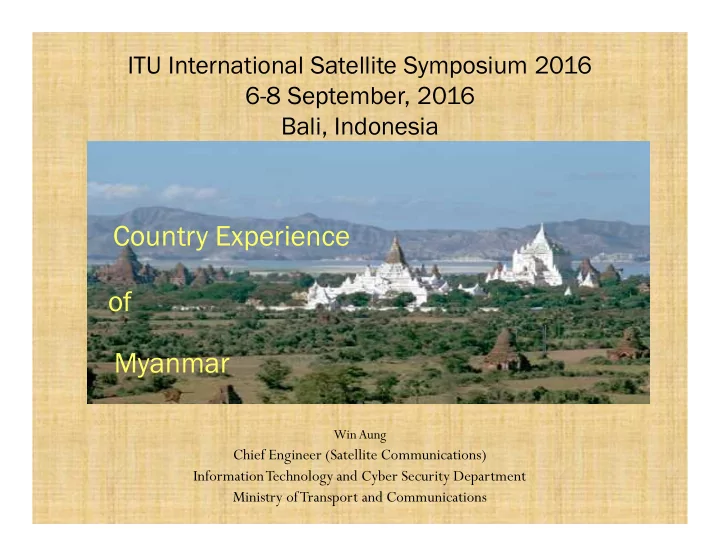
SLIDE 1 Win Aung
Chief Engineer (Satellite Communications) Information Technology and Cyber Security Department Ministry of Transport and Communications
ITU International Satellite Symposium 2016 6-8 September, 2016 Bali, Indonesia
Myanmar Country Experience
SLIDE 2
Agenda
Brief about Myanmar Organization Structure National Slots Regulatory Framework Market Opportunity Status of Myanmar Satellite Project Future Plan Challenges
Agenda Agenda
SLIDE 3 Brief about Myanmar
largest on the mainland in south-east Asia total land area of 676,577 square kilometer International borders of 5858 Kilometer with-
Bangladesh ,India ,China, Thailand and Laos
total coastal line length 2832kilometer. 2090 kilometer (north to south )and 925 kilometer
(east to west ). 50% of mountains and forests (northern and eastern)
Geography Geography Topography Topography
11.10%
Brief about Myanmar Brief about Myanmar
SLIDE 4
Organization Structure
Post and Telecommunication Department (PTD) Myanma Telecommunication (MPT) Myanmar Post (MP) Information Technology and Cyber Security Department
(ITCSD)
Ministry Office for Communications Ministry Office for Communications
Ministry of Transport and Communications
SLIDE 5
Orbital Resources
Fixed Satellite Service
FSS Orbital Position = 111.5 E Notice BRM00000 ( Notice ID. 90558038)
Broadcasting Satellite Service
BSS Orbital Position = 104 E Notices BRM29800 (IDs 100550035 and 100550680)
Orbital Resources Orbital Resources
SLIDE 6
Frequency Assignment
FSS
4.4 - 4.8 GHz, 6.725 – 7.025 GHz 10.7 – 10.95 GHz, 11.2 – 11.45 and
12.75 – 13.25 (downlink)
14.5 – 14.8 GHz and 17.3 – 18.1 GHz (uplink)
BSS
11.7 – 12.2 GHz, 6.725 – 7.025 GHz 10.7 – 10.95 GHz, 11.2 – 11.45 and
12.75 – 13.25 (downlink)
17.3- 17.8 GHz and 17.3 – 18.1 GHz (uplink)
Frequency Assignment Frequency Assignment
SLIDE 7
Regulatory Framework Regulatory Framework Regulatory Framework
Regulatory Framework in Telecommunication
Spectrum & Indicator Management Competitive Markets Infrastructure Sharing and Interconnection Licensing Voice over Internet Protocol Universal Access and Service
SLIDE 8
Licenses Licenses Licenses
Licenses are regulated by PTD and there are
(i) wide area network license (establishment and service), (ii) service license, (iii) station license, (iv) satellite phone and very small aperture terminal license, (v) mobile license, (vi) microwave license, (vii) wireless local loop license, (viii) long-range and short-range cordless phone license, (ix) point-to-point license,(x) telecom equipment repair license, (xi)
telecom equipment dealer license,
(xii) certificating authority license, and (xiii) public access center license.
SLIDE 9
Telecom Policy in Myanmar Telecom Policy in Myanmar Telecom Policy in Myanmar
To increase deployment of national telecommunications
infrastructure.
To provide a financially viable telecommunications sector
conductive to sustainable investment in telecommunications infrastructure.
To improve the efficiency and effectiveness of telecommunications
service delivery to end users.
To provide telecommunication services at the affordable price. To fulfill universal services obligation to the people of Myanmar.
SLIDE 10 ICT Policy ICT Policy ICT Policy
Promote cooperation for ICT development Enhance competitiveness of the ICT sectors Promote cooperation to reduce digital divide Promote cooperation between State and private sectors Increase the availability of information technologies to all the citizens
SLIDE 11
Market Opportunity Market Opportunity Market Opportunity
Opportunities and Developments in Myanmar’s ICT and Broadcasting Markets
The new broadcasting law was promulgated. This will facilitate the launch of new media channels Satellite Internet Broadband Satellite DTH There will be strong demand for Satellite Capacity.
SLIDE 12
Status of Myanmar Satellite Project Status of Myanmar Satellite Project Status of Myanmar Satellite Project
First step of Myanmar Satellite System Project was started as CondoSat Scheme
Naming MyanmarSat 1 a for C band service was launched in
1st May, 2016. Initial Capacity = 7 x (36 MHz Transponder) CondoSat Scheme on IS 902, 62°E Satellite
Naming MyanmarSat 1 b for Ku band service will be
launched on 1st Oct 2016 Initial Capacity = 3 x (36 MHz Transponder) CondoSat Scheme on IS 906, 64.15° E Satellite
SLIDE 13
Future Plan Future Plan Future Plan
Second Step
J V or Co-ownership Scheme Availability to use national allotment resources Naming MyanmarSat 2 will be launched in future More C band and Ku band Services in same Satellite
Third Step
National Satellite 5
Years Plan
SLIDE 14
challenges Challenges Challenges
CondoSat System faced with Following Challenges
Lack of Human Resources Technical Issue for Migrating of existing Networks to combine with the
new system
To least the Capacity in time Delaying to build the Tower cause of national disaster
( flooding & earth quake)
Taxes
Stamp Tax = 3 % of contract amount Commercial Tax = 5 % on payment Withholding Tax = 2 % or 3.5 % on payment
SLIDE 15
Challenges 2 Challenges 2 Challenges 2
Challenges to Launch National Satellite System
Lack of Human Resources Lack of Financial Resources Delayed Demand Need to do long term plan Need Consultancy Not a Viable Business for now Difficulties to do Sale and Marketing in neighboring Countries.
SLIDE 16
Thank you