COUGAR DOWNSTREAM PASSAGE Upper Baker Swift 237 217 200 80 252 - - PowerPoint PPT Presentation

cougar downstream passage
SMART_READER_LITE
LIVE PREVIEW

COUGAR DOWNSTREAM PASSAGE Upper Baker Swift 237 217 200 80 252 - - PowerPoint PPT Presentation

COUGAR DOWNSTREAM PASSAGE Upper Baker Swift 237 217 200 80 252 83 237 217 200 119 174 36 237 217 200 27 .59 118 255 0 163 131 239 110 112 62 102 130 255 0 163 132 65 135 92 102 56 120 255 0 163 122 53


slide-1
SLIDE 1

217 217 217 200 200 200 255 255 255 163 163 163 131 132 122 239 65 53 110 135 120 112 92 56 62 102 130 102 56 48 130 120 111 237 237 237 80 119 27 252 174 .59 83 36 118

1

Jeremy Britton, Technical Lead Kelly Janes, Environmental Resource Specialist 8 February 2018

COUGAR DOWNSTREAM PASSAGE

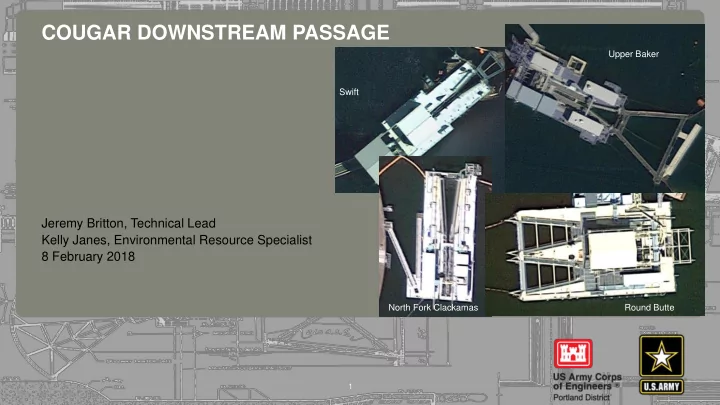
Swift Upper Baker Round Butte North Fork Clackamas Round Butte

slide-2
SLIDE 2

PURPOSE

Purpose and Need Biological Opinion Overview Project History Alternatives Analysis Preferred Alternative Project Schedule Affected Resources NEPA Process

2

To brief McKenzie River watershed stakeholders on the status of the U.S. Army Corps of Engineers (Corps) Cougar Downstream Passage Project.

AGENDA

slide-3
SLIDE 3

3

PURPOSE AND NEED PURPOSE: To enhance downstream passage for populations of Upper Willamette River spring Chinook salmon listed as threatened under the Endangered Species Act. To comply with the Reasonably Prudent Alternatives measure 4.12 of the National Marine Fisheries Service 2008 Biological Opinion NEED:

  • Lack of passage - the most significant limiting factor to the viability of the

affected populations of Upper Willamette River spring Chinook salmon (2008 Biological Opinion).

slide-4
SLIDE 4

WILLAMETTE JEOPARDY BIOLOGICAL OPINION (BIOP)

4

  • Issued in 2008 by National Marine Fisheries Service (NMFS) and US Fish and Wildlife Service

(USFWS) – Willamette Valley Project Operations jeopardizes the Endangered Species Act listed Species

  • Upper Willamette River spring Chinook
  • BiOp Reasonable and Prudent Action measure 4.12.1, Cougar Dam Downstream Passage –

requires:

  • investigation into feasibility of improving downstream fish passage at Cougar Dam through

structural modifications and operational changes, and

  • if found feasible to construct and operate the downstream fish passage facility.
  • Action agencies (USACE and BPA) determined that fish passage at Cougar Dam was feasible
slide-5
SLIDE 5

BACKGROUND: TIMELINE

5

‘18 ‘19 ‘20 ‘21

Cougar Downstream Passage Detailed Design Report NEPA Analysis

WE ARE HERE

‘17 ‘22 ‘23

Plans & Specification Cougar Downstream Passage Construction EA released for Public Review UWR salmonids ESA listing Willamette Valley Project (WVP) BA NMFS WVP BiOp

Drawdown to 1450’ (avoids sediment transport impacts) Cougar Tower EA Amendment2 Drawdown to 1375’ Storms raise elevation to 14131 (high turbidity event) Cougar Adult Fish Facility EA

‘99 ‘08 ‘00 ‘01 ‘02 ‘07 ‘03 ‘04 ‘06 ‘05

Temperature Control Tower Construction WVP ESA Section 7 Consultation

‘09 ‘10 ‘11 ‘12 ‘17 ‘13 ‘14 ‘16 ‘15

WVP COP Phase I analysis2 WVP COP Phase II analysis3 Cougar Downstream Passage Engineering Design Report

Drawdown to 1450’ for emergency trash rack repairs

Cougar Adult Fish Facility Construction

Cougar Dam Completed

‘63

Cougar Temperature Control Tower EIS

‘95
slide-6
SLIDE 6

GENERAL DOWNSTREAM PASSAGE PROJECT GOALS (COP PHASE II REPORT)

6

Chinook goals

  • Establish a self-sustaining population upstream of Cougar Dam.
  • Retain diverse life history pattern characteristics of the local

stock. Bull trout goals

  • Increase genetic exchanges between populations above and

below Cougar Dam.

  • Avoid interrupting natural movement patterns between the

tributaries and the reservoir.

slide-7
SLIDE 7

ALTERNATIVES ANALYSIS HISTORY

7

Prioritization and Screening EDR preliminary design & screening An Initial Array of 30 alternatives developed Top 11 alternatives: 6 Structural, 5 Operational further developed Initial screening based on a qualitative evaluation of each alternative using criteria (from 2008 BiOp) to determine whether or not the alternative was:

  • (1) biologically feasible (5 criteria),
  • (2) technically feasible (3 criteria), and
  • (3) cost effective (5 criteria).
  • A numerical rating was developed based on

PDT consensus (1- very bad/severe impact to 5 – very good/large benefit) .

  • The ratings were summed across all

categories to provide an overall rating and the alternatives were sorted for prioritization.

slide-8
SLIDE 8

ALTERNATIVES ANALYSIS HISTORY

8

Engineering Design Report – Alternatives Analysis (will be described in Environmental Assessment) Six structural alternatives for downstream passage at Cougar Dam were prioritized:

  • Alternative No. 24: Weir Box/Collection Channel

with holding barge and truck transport

  • Alternative No. 25: Weir Box/Collection Channel

with tower bypass

  • Alternative No. 28: Floating Screen Structure with

holding barge and truck transport

  • Alternative No. 29: Floating Screen Structure with

tower bypass

  • Alternative No. 5: Floating Surface Collector with

tower bypass

  • Alternative No. 20: Floating Surface with holding

barge and truck transport Five operational alternatives for downstream passage at Cougar Dam were prioritized. These include:

  • DP01c(RO) - Use Preferential Outlets (RO) within

TDG Cap

  • DP01c(RO) – Use Preferential Outlets (RO)
  • DP01d – Pulsing Flow Releases
  • DP01f – Below Minimum Conservation Pool
  • DP01h – Delay Refill

Were deprioritized based on Research, Monitoring & Evaluation results from special operations tests and Fish Benefits Workbook scores.

slide-9
SLIDE 9

ALTERNATIVES ANALYSIS HISTORY

9

Prioritization and Screening EDR preliminary design & screening Initial Array of 30 alternatives developed Top 11 Alternatives: 6 Structural, 5 Operational further developed

Quantitative Analysis based on COP Phase II Screening Criteria:

  • Meet dam safety requirements
  • Maintain flood risk management
  • Above-dam fish reintroduction efforts must reach

“replacement”

  • Cost-effective, including consideration of

hydropower impacts – considered but not a deciding factor.

Non-monetized impacts were also Scored (high negative impact (1) up to a high benefit (5)):

  • Flood risk management
  • Meeting Downstream Tributary Flows
  • Meeting Mainstem Flows
  • Reservoir Recreation
  • River Recreation

Preliminary Preferred Alternative: Floating Screen Structure w/ Truck and Haul

  • Water Supply- M&I and Irrigation (Future and Current)
  • Constructability
  • Implementation Timing
  • Clean Water Act (TDG)
  • Temperature
slide-10
SLIDE 10

LOCATION WITHIN RESERVOIR

10

slide-11
SLIDE 11

LOCATION IN THE CUL-DE-SAC

11

CRANE PAD PARKING LOT PARKING LOT COUGAR RESERVOIR RUSH CREEK EL.1699 EL.1541

  • EL. 1470
slide-12
SLIDE 12

LOCATION – NEAR WATER TEMPERATURE CONTROL TOWER

12

WTCT MOORING TOWER FSS AMPHIBIOUS VEHICLE MOORING TOWER FSS WTCT AMPHIBIOUS VEHICLE

400 cfs 600 cfs

slide-13
SLIDE 13

POOL FLUCTUATIONS

13

Elevation ~1,690 Elevation ~1,532 158 Ft.

slide-14
SLIDE 14

CONSTRUCTION

14

  • Reservoir

Drawdown to 1450 feet required to dewater construction area

  • Similar to

previous drawdowns

slide-15
SLIDE 15

15

slide-16
SLIDE 16

CONSTRUCTION FEATURES DURING DRAWDOWN

16

  • Retaining wall
  • Rock excavation
  • Mooring structures
  • Tower modifications
slide-17
SLIDE 17

17

CONSTRUCTION WORK AREA

  • Staging at Slide Creek
  • Construction &

assembly of FSS

slide-18
SLIDE 18

SCHEDULE

18 18

‘18 ‘19 ‘20 ‘21

NEPA Analysis

WE ARE HERE

‘17 ‘22 ‘23

Plans & Specification Cougar Downstream Passage Construction

‘16 ‘15

Cougar Downstream Passage Engineering Design Report

  • Determine problem
  • Determine solutions

that would solve the problem

  • Initial Alternatives

Analysis and Screening

  • Construction Alternatives

Analysis Develop design, confirm constructability

  • Environmental Impacts

Assessment – NEPA public review and comment – Fall/Winter 2018

  • Refine/optimize the

recommended solution

  • Detailed Cost Estimate
  • Initial Drawdown of Reservoir to 1450’– 1 month
  • Drawdown maintained at 1450’ - 1 Year (~2021)
  • Temperature Control Tower Modifications for

connecting Floating Screen Structure

  • Mooring construction
  • Rock removal for Floating Screen Structure (FSS)
  • Retention wall construction
  • Flow likely below minimum flow requirements

(coordinating with NMFS)

  • Staging/Construction at Slide Creek Campground - 2 years

(~2021-2022)

  • Coffer dam off portion of near shore to construct FSS.

Once complete, FSS will be floated downstream to Temperature Control Tower.

  • Will require large areas for large machinery and

stockpiles

Cougar Downstream Passage Detailed Design Report

Complete

slide-19
SLIDE 19

NEPA: ENVIRONMENTAL ASSESSMENT

19

The following will be evaluated in the EA:

  • Aesthetics
  • Air Quality
  • Biological Environment (terrestrial and

aquatic species)

  • Historic and Cultural Resources
  • Hydro Power
  • Recreation
  • Socioeconomics
  • Transportation
  • Water Quality
  • Water Supply

This list does not reflect priority/importance of these potential impacts being evaluated. The topics and subject matter that are evaluated may be further refined as work on the EA proceeds.

slide-20
SLIDE 20

HOW TO PROVIDE INPUT

20

Draft EA is planned to be available for public review in Fall, 2018.

Notice of availability will be provided via our stakeholder distribution list, facebook, and local news sources. A public meeting will be held during review period. Input can be submitted by email: cougar.fish.passage@usace.army.mil Input can be submitted by mail: Kelly Janes, U.S. Army Corps of Engineers Attn: PM-E, PO Box 2946 Portland, OR 97208-2946 Input can be submitted in person: Written input can be given to any project staff at public meetings

slide-21
SLIDE 21

IF YOU WOULD LIKE TO GET UPDATES ON THIS PROJECT

21

Send an email with the subject line: “COUGAR DOWNSTREAM PASSAGE DISTRIBUTION LIST” to cougar.fish.passage@usace.army.mil

slide-22
SLIDE 22

FSS TECHNICAL SLIDES

22

slide-23
SLIDE 23

DESIGN CRITERIA BASED ON LIFE HISTORY TACTICS: SALMON ARE SURFACE ORIENTED AND ATTRACTED TO FLOW

23

slide-24
SLIDE 24

QUANTITATIVE ANALYSIS TOOLS

24

Computational Fluid Dynamics to model surface flow velocity Biological monitoring to determine fish congregation and reservoir depth Biological monitoring to migration timing and the probabilities of fish movements through the reservoir

slide-25
SLIDE 25

ENTRANCE SHAPE & CONFIGURATION

25

16 FT 25 FT PRIMARY SCREENS 350-400CFS SECONDARY SCREENS 50-75 CFS ENTRANCE RAMP

slide-26
SLIDE 26

WATER MOVEMENT THROUGH SYSTEM

26

PRIMARY DEWATERING SECONDARY DEWATERING PRIMARY DEWATERING SECONDARY DEWATERING

slide-27
SLIDE 27

FISH MOVEMENT THROUGH SYSTEM

27

AV W/ TRANSPORT TANK

CAPTURE VELOCITY ~8 FT/S TAKES PLACE AT THE SECONDARY SCREENS.