Putting fish back in the rivers and so much more F Lorraine Bodi, - - PowerPoint PPT Presentation

putting fish back in the rivers and so much more
SMART_READER_LITE
LIVE PREVIEW

Putting fish back in the rivers and so much more F Lorraine Bodi, - - PowerPoint PPT Presentation

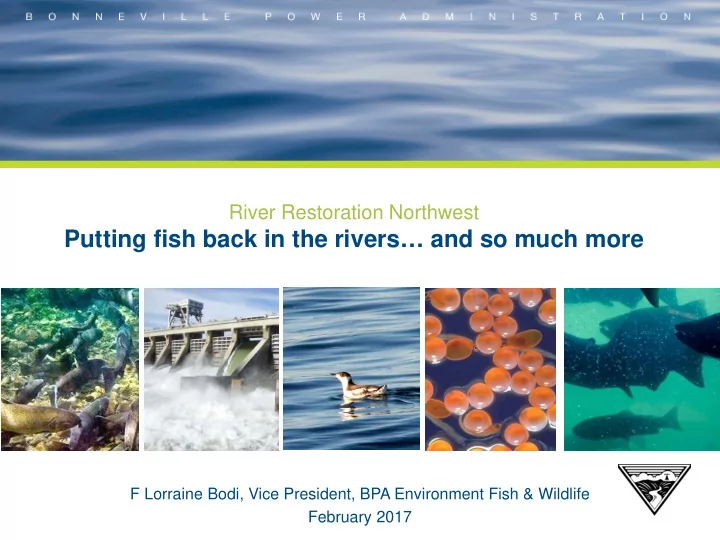
River Restoration Northwest Putting fish back in the rivers and so much more F Lorraine Bodi, Vice President, BPA Environment Fish & Wildlife February 2017 B O N N E V I L L E P O W E R A D M I N I S T R A T I O


slide-1
SLIDE 1

River Restoration Northwest

Putting fish back in the rivers… and so much more

F Lorraine Bodi, Vice President, BPA Environment Fish & Wildlife February 2017
slide-2
SLIDE 2

B O N N E V I L L E P O W E R A D M I N I S T R A T I O N

Footprint of BPA Fish and Wildlife Program

Oregon Idaho Washington

John Day The Dalles

McNary

Chief Joseph Hungry Horse Ice Harbor Lower Monumental Little Goose Lower Granite Dworshak

Montana

Libby Albeni Falls Grand Coulee Bonneville

Hells Canyon Oxbow Brownlee

Chum Salmon Chinook Salmon Steelhead Sockeye Salmon White Sturgeon Bull Trout Priest Rapids Wanapum Rock Island Rocky Reach Wells 2

slide-3
SLIDE 3

B O N N E V I L L E P O W E R A D M I N I S T R A T I O N

Legal overview of BPA’s F&W mitigation program

Pacific Northwest Electric Power Planning and Conservation Act

  • Protect, mitigate, and enhance fish and wildlife,

including related spawning grounds and habitat,

  • n the Columbia River and its tributaries.
  • Equitable treatment of F&W with other purposes.
  • Consistency with the Columbia Basin F&W

program.

Endangered Species Act

  • Avoiding jeopardy to listed fish and wildlife.
  • Avoiding adverse modification of critical habitat.
  • Biological Opinions.

Tribal treaty and trust responsibilities

  • The right to take fish at usual and accustomed

places.

  • Government to government consultations.

Clean Water Act

  • Address water quality standards adopted by

states & tribes.

National Environmental Policy Act

  • Assess major federal actions that may

significantly affect the environment.

National Historic Preservation Act

  • Assess federal undertakings that may adversely

affect historic and cultural resources.

3

slide-4
SLIDE 4

B O N N E V I L L E P O W E R A D M I N I S T R A T I O N

  • Approximately $500

million per year in direct expenditures.

  • Includes debt service,
  • perations and

maintenance for fish ladders, hatcheries, etc.

  • All paid for by the region’s

electric ratepayers, comprising more than 20 percent of BPA’s power revenues, and roughly 30 percent of total costs.

BPA annual funding for fish and wildlife mitigation

slide-5
SLIDE 5

B O N N E V I L L E P O W E R A D M I N I S T R A T I O N

  • Hydro: Achieve 96% dam survival for migrating spring fish and 93% for summer fish.
  • Habitat: Restore high priority habitat in tributaries and the estuary

(more than $50 m per year).

  • Hatcheries: Manage hatcheries to support and not impede recovery of listed fish.
  • Harvest: “Companion” BiOps with abundance-based sliding-scale harvest numbers.
  • Predator management: Managing predation from non-native fish, birds, and marine

mammals.

Implementing the 2008 NOAA Fisheries BiOp

slide-6
SLIDE 6

B O N N E V I L L E P O W E R A D M I N I S T R A T I O N

Results for fish – optimizing fish passage through dams

Bonneville

CORNER COLLECTOR INSTALLED 2004

95.7%

John Day

SURFACE PASSAGE INSTALLED 2008

96.7%

McNary

SURFACE PASSAGE INSTALLED 2007

96.1%

Little Goose

SURFACE PASSAGE INSTALLED 2009

98.2%

The Dalles

SPILL WALL INSTALLED 2008

96%

Ice Harbor

SURFACE PASSAGE INSTALLED 2005

Lower Monumental

SURFACE PASSAGE INST. 2008

98.7%

Lower Granite

SURFACE PASSAGE INSTALLED 2001 SURVIVAL DATA FOR YEARLING SPRING CHINOOK,

  • NOV. 2012

W A S H I N G T O N O R E G O N I D A H O

  • Dams are on track to meet performance standards of 96% average survival for spring

and 93% for summer migrating fish.

  • Fish travel times and survivals per kilometer are approaching those for an undammed river. 6
slide-7
SLIDE 7

B O N N E V I L L E P O W E R A D M I N I S T R A T I O N

Little Goose Dam passage and survival Chinook Salmon (2012)

Spillway survival 95% Turbine survival 87% Spillway passage 21% Turbine passage 4% Bypass passage 31% Surface weir passage 44% Surface weir survival 100% Bypass survival 99% 98%

OVERALL SURVIVAL

slide-8
SLIDE 8

B O N N E V I L L E P O W E R A D M I N I S T R A T I O N

Results for fish – Habitat restoration

Tributary habitat (2007 to 2015)

  • Protected more than 373,000

acre feet of water.

  • Opened access to more than

3,304 miles of fish habitat.

  • Restored 400 miles of stream

habitat complexity. Estuary habitat (2007 to 2015)

  • Protected or restored more than

7,760 acres of estuary floodplain by purchase or lease, including 1,321 acres in 2015.

  • Restored or enhanced more

than 42 miles of estuarine tidal channels.

slide-9
SLIDE 9

B O N N E V I L L E P O W E R A D M I N I S T R A T I O N

Here’s one example in Washington

  • Removed eight miles of asphalt road next to the mainstem Klickitat River.
  • Reconnected 31 acres of floodplain and off-channel habitat.
  • Built 1/2 mile of secondary channel.
  • Removed railroad bridge.
  • Removed 34 culverts.
  • Installed tens of thousands of native plants on 60 acres of floodplain riparian habitat.
  • Cost share averaged $5.50 for every BPA dollar expended.

Klickitat Watershed Enhancement Project – Yakama Nation

slide-10
SLIDE 10

B O N N E V I L L E P O W E R A D M I N I S T R A T I O N

How are the fish doing? Abundance of salmon and steelhead

Of the 49 Columbia Basin wild fish populations where data are available, 48 have increased in abundance since ESA listings. On average, abundance levels of wild Chinook salmon and steelhead have more than doubled. NOAA has concluded that combined hatchery and wild fish numbers indicate that operation of the system is “not likely to affect” Southern resident orcas.

Adult and Jack Salmon/Steelhead Returns (in millions) at Bonneville Dam

slide-11
SLIDE 11

B O N N E V I L L E P O W E R A D M I N I S T R A T I O N

Summary of court ruling and next steps

  • On May 4, 2016, the U.S. District Court for

the District of Oregon issued a decision invalidating NOAA Fisheries’ latest FCRPS Biological Opinion.

  • The Court also ruled that the Corps and

Reclamation failed to comply with the National Environmental Policy Act (NEPA) when they issued decision documents to adopt and implement the BiOp.

  • NOAA will issue a new BiOp by December

31, 2018, and the Action Agencies will continue to implement the current BiOp until then.

  • BPA and its partnering federal agencies

will issue a Columbia River System Operations (CRSO) EIS by March 2021.

slide-12
SLIDE 12

B O N N E V I L L E P O W E R A D M I N I S T R A T I O N

CRSO EIS next steps

  • Scoping and comment period on the multi-

faceted operation of federal dams ended February 7.

  • Issues included flood risk management,

irrigation, power generation, fish and wildlife, navigation and recreation.

  • 16 public meetings and two webinars held
  • Held in four states, in major cities and areas affected
  • More than 2,300 people attended, 81,000 comments

received

  • Attendees included the general public,

environmental groups, elected officials, river users, tribes and others

  • Status report to the court, and hearing,

in Fall 2017.

  • Draft EIS in Spring 2020, and final EIS/BiOp

in Spring 2021.

slide-13
SLIDE 13

B O N N E V I L L E P O W E R A D M I N I S T R A T I O N

Questions?

Resources: http://www.crso.info/ https://www.salmonrecovery.gov/