
SLIDE 1
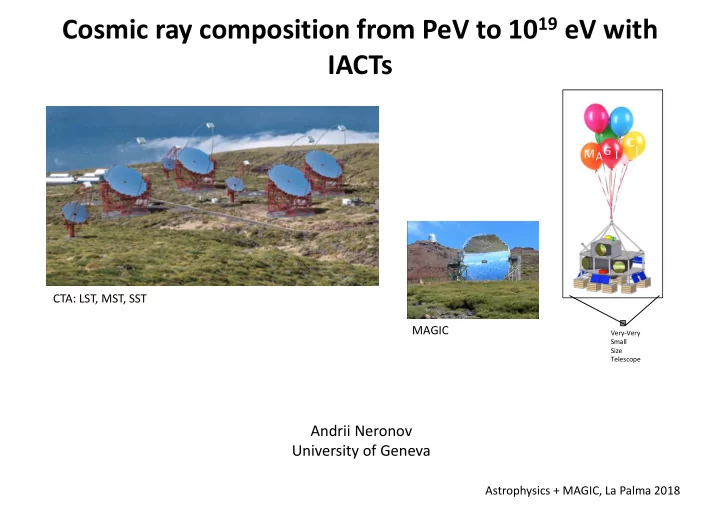
Cosmic ¡ray ¡composition ¡from ¡PeV to ¡1019 eV ¡with ¡ IACTs
Andrii ¡Neronov University ¡of ¡Geneva
MAGIC CTA: ¡LST, ¡MST, ¡SST
Very-‑Very Small Size Telescope
Astrophysics ¡+ ¡MAGIC, ¡La ¡Palma ¡2018 MAG I C!
Cosmic ray composition from PeV to 10 19 eV with IACTs C! - - PowerPoint PPT Presentation
Cosmic ray composition from PeV to 10 19 eV with IACTs C! MAG I CTA: LST, MST, SST MAGIC Very-Very Small Size Telescope Andrii Neronov University of Geneva Astrophysics +
MAGIC CTA: ¡LST, ¡MST, ¡SST
Very-‑Very Small Size Telescope
Astrophysics ¡+ ¡MAGIC, ¡La ¡Palma ¡2018 MAG I C!
Introduction: ¡Cosmic ¡ray ¡composition ¡data: ¡TeV, ¡PeV, ¡EeV to ¡UHECR Muon component ¡of ¡strongly ¡inclined ¡air ¡showers MAGIC ¡/ ¡CTA ¡vs. ¡dedicated ¡small ¡IACT Imaging ¡of ¡muon ¡and ¡electromagnetic ¡component ¡in ¡high ¡zenith ¡angle ¡showers
Quality ¡of ¡identification ¡of ¡primary ¡cosmic ¡ray ¡particles ¡ degrades ¡with ¡the ¡increase ¡of ¡energy ¡because ¡of ¡the ¡ decreasing ¡number ¡of ¡measurable ¡characteristics ¡of ¡the ¡CR ¡ events.
KASCADE Pierre ¡Auger ¡Observatory KASCADE-‑Grande
Carbon ¡ target NUCLEON ¡detector ¡at ¡Resurs P-‑2 ¡sattelite
Γ ≃ 2.5 Γ ≃ 2.6
Direct ¡measurement ¡of ¡CR ¡primary ¡particle ¡ID ¡are ¡done ¡with ¡balloon-‑ or ¡space–based ¡detectors ¡ (PAMELA, ¡AMS-‑02, ¡NUCLEON, ¡CREAM,….. ¡ Hardening ¡of ¡the ¡CR ¡spectrum ¡is ¡observed ¡above ¡several ¡hundred ¡GeV, ¡and ¡the ¡spectra ¡of ¡different ¡ elements ¡seem ¡to have ¡different ¡slopes ¡…..
ISS-‑CREAM AMS-‑02
Γ ≥ 2.7
Atkin ¡et ¡al. ¡‘17
KASCADE
Above ¡100 ¡TeV CR ¡particle ¡ID ¡is ¡measured ¡only ¡indirectly, ¡via ¡its ¡imprint ¡on ¡development ¡of ¡Extensive ¡ air ¡showers ¡(EAS): – heavier ¡nuclei ¡primary ¡CR ¡particles ¡produce ¡more ¡muon-‑rich ¡EAS – heavier ¡nuclei ¡primary ¡CR ¡particles ¡induce ¡EAS ¡developing ¡at ¡shallower ¡atmospheric ¡depths
Composition ¡of ¡the ¡CR ¡flux ¡rapidly ¡changes ¡above ¡1015 eV ¡(the ¡“knee”). ¡Heavier ¡particles ¡up ¡to ¡iron ¡ starts ¡to ¡dominate* the ¡flux ¡at ¡in ¡1016-‑1017eV ¡range. ¡
Apel et ¡al. ¡‘09 * ¡Details ¡depend ¡on ¡hadronic ¡interaction ¡models ¡used
KASCADE-‑Grande
Above ¡100 ¡TeV CR ¡particle ¡ID ¡is ¡measured ¡only ¡indirectly, ¡via ¡its ¡imprint ¡on ¡development ¡of ¡Extensive ¡ air ¡showers ¡(EAS): – heavier ¡nuclei ¡primary ¡CR ¡particles ¡produce ¡more ¡muon-‑rich ¡EAS – heavier ¡nuclei ¡primary ¡CR ¡particles ¡induce ¡EAS ¡developing ¡at ¡shallower ¡atmospheric ¡depths Above ¡3x10¹⁷ eV ¡the ¡composition changes ¡back *. ¡The ¡flux ¡is ¡again ¡dominated ¡by ¡lighter ¡nuclei.
Apel et ¡al. ¡‘14
Composition ¡of ¡the ¡CR ¡flux ¡rapidly ¡changes ¡above ¡1015 eV ¡(the ¡“knee”). ¡Heavier ¡particles ¡up ¡to ¡iron ¡ starts ¡to ¡dominate* the ¡flux ¡at ¡in ¡1016-‑1017eV ¡range. ¡
* ¡Details ¡depend ¡on ¡hadronic ¡interaction ¡models ¡used
Pierre ¡Auger ¡Observatory
Above ¡100 ¡TeV CR ¡particle ¡ID ¡is ¡measured ¡only ¡indirectly, ¡via ¡its ¡imprint ¡on ¡development ¡of ¡Extensive ¡ air ¡showers ¡(EAS): – heavier ¡nuclei ¡primary ¡CR ¡particles ¡produce ¡more ¡muon-‑rich ¡EAS – heavier ¡nuclei ¡primary ¡CR ¡particles ¡induce ¡EAS ¡developing ¡at ¡shallower ¡atmospheric ¡depths … ¡and ¡ ¡above ¡1019 eV ¡the ¡composition ¡seems ¡to ¡change ¡back Composition ¡of ¡the ¡CR ¡flux ¡rapidly ¡changes ¡above ¡1015 eV ¡(the ¡“knee”). ¡Heavier ¡particles ¡up ¡to ¡iron ¡ starts ¡to ¡dominate* the ¡flux ¡at ¡in ¡1016-‑1017eV ¡range. ¡ Above ¡3x10¹⁷ eV ¡the ¡composition changes ¡back *. ¡The ¡flux ¡is ¡again ¡dominated ¡by ¡lighter ¡nuclei.
* ¡Details ¡depend ¡on ¡hadronic ¡interaction ¡models ¡used Pierre ¡Auger ¡Collab. ¡ ¡‘16
Pierre ¡Auger ¡Observatory
* ¡ ¡Hadronic ¡interaction ¡model ¡uncertainties Pierre ¡Auger ¡Collab. ¡ ¡‘16
Different ¡nuclei ¡have ¡ different ¡spectral ¡slopes? Z-‑dependent ¡cut-‑offs ¡of ¡ Galactic ¡cosmic ¡ray ¡ spectral ¡components? Appearance ¡of extracalactic component? Photo-‑disintegration ¡cut-‑
spectral ¡components
Differences ¡in ¡slopes ¡of ¡spectra ¡of ¡different ¡nuclei ¡could ¡be ¡explained ¡e.g. ¡by ¡the ¡presence ¡of ¡“local” ¡ recent ¡cosmic ¡ray ¡injection ¡event ¡(2-‑3 ¡Myr ago, ¡within ¡100 ¡pc ¡distance). ¡Lower ¡and ¡lower ¡energy ¡ cosmic ¡rays ¡gradually ¡reach ¡the ¡Solar ¡system ¡boundary ¡in ¡rigidity-‑dependent ¡manner ¡and ¡provide ¡flux ¡ components ¡in ¡excess ¡of ¡the ¡average ¡Galactic ¡cosmic ¡ray ¡“sea”.
Kacherliess et ¡al. ¡‘17
The ¡“knee” ¡feature ¡could ¡be ¡either ¡due ¡to ¡ – high-‑energy ¡cut-‑off ¡in ¡the ¡spectrum ¡of ¡single ¡recent ¡nearby ¡dominant ¡CR ¡source – high-‑energy ¡cut-‑off ¡of ¡the ¡average ¡Galactic ¡CR ¡source ¡population – Change ¡of ¡regime ¡of ¡diffusion ¡of ¡CRs ¡at ¡the ¡energy ¡where ¡CR ¡scattering ¡length ¡becomes ¡ longer ¡than ¡the ¡coherence ¡length ¡scale ¡of ¡Galactic ¡magnetic ¡field ¡
Giacinti et ¡al. ¡‘14
Lightening ¡of ¡the ¡composition ¡above ¡3x10¹⁷ eV ¡could ¡be ¡due ¡to ¡presence ¡of ¡extragalactic ¡flux ¡ component ¡with ¡nearly ¡E-‑2 type ¡spectrum ¡(generically ¡expected) ¡with ¡high-‑energy ¡cut-‑off ¡above ¡∼ 3×10./ eV ¡energy.
Giacinti et ¡al. ¡‘15
Heavier ¡composition ¡above ¡1019 eV ¡is ¡then ¡due ¡to ¡the ¡Z-‑dependent ¡high-‑energy ¡cut-‑off ¡of ¡ extragalactic ¡CR ¡spectrum.
Above ¡100 ¡TeV CR ¡particle ¡ID ¡is ¡measured ¡only ¡indirectly, ¡via ¡its ¡imprint ¡on ¡development ¡of ¡Extensive ¡ air ¡showers ¡(EAS): – heavier ¡nuclei ¡primary ¡CR ¡particles ¡produce ¡more ¡muon-‑rich ¡EAS – heavier ¡nuclei ¡primary ¡CR ¡particles ¡induce ¡EAS ¡developing ¡at ¡shallower ¡atmospheric ¡depths
Apel et ¡al. ¡‘09
PeV proton-‑induced ¡shower ¡incident ¡at ¡87o zenith ¡angle
Muon component ¡is ¡largely ¡sub-‑dominant ¡in ¡ the ¡shower ¡maximum ¡region. It ¡starts ¡to ¡dominate ¡at ¡large ¡depth ¡in ¡the ¡ atmosphere.
e μ
Neronov et ¡al. ¡‘16
gamma iron proton 3 ¡km ¡ ¡ ¡ ¡ ¡ ¡ ¡ ¡ ¡ ¡ ¡impact ¡ ¡ ¡ ¡ ¡ ¡ ¡ ¡ ¡ ¡ ¡ ¡ ¡6 ¡km
Muon ¡“tail” ¡or ¡“halo” ¡has ¡different ¡ appearance ¡in ¡strongly ¡inclined ¡EAS ¡initiated ¡ by ¡different ¡particles ¡ Muon component ¡is ¡largely ¡sub-‑dominant ¡in ¡ the ¡shower ¡maximum ¡region. It ¡starts ¡to ¡dominate ¡at ¡large ¡depth ¡in ¡the ¡ atmosphere.
Neronov et ¡al. ¡‘16
IACT ¡imaging ¡of ¡strongly ¡inclined ¡showers ¡provides ¡data ¡needed ¡for ¡measurement ¡of ¡primary ¡particle ¡ID ¡ via ¡muon ¡content ¡measurements.
KASCADE IACT 𝐵1234 ∼ 4×10⁶m2 Ω ∼ 𝜌 𝐵1234×Ω ∼ 0.1 ¡km<sr 𝐵2?? ∼ Ω@3A𝐸< ∼ 300
C DEF ¡G4 < HIJK <×.FLM ¡km2
Ω ∼ 𝜌 1.4𝜌 180
<
≃ 2×10OD 𝐵2??×Ω ∼ 0.5 ¡km<sr ¡
Distance ¡to ¡top-‑of-‑Troposphere: ¡ 2𝑆Q𝐼
T .F ¡G4 ./<
¡km
Neronov et ¡al. ¡‘16
MAGIC
High-‑zenith ¡angle ¡observations ¡with ¡MAGIC ¡could ¡provide ¡composition ¡data ¡across ¡the ¡knee ¡energy ¡ range. IACT ¡imaging ¡of ¡strongly ¡inclined ¡showers ¡provides ¡data ¡needed ¡for ¡measurement ¡of ¡primary ¡particle ¡ID ¡ via ¡muon ¡content ¡measurements. – with ¡larger ¡“Grasp” ¡(𝐵×Ω), ¡even ¡for ¡IACT ¡not ¡optimized ¡for ¡composition ¡studies
MAGIC, ¡100 ¡hr exposure
3 6 9 𝜄, ¡deg /102 – Electromagnetic ¡core ¡+muon ¡halo ¡/ ¡tail ¡seems ¡to ¡ be ¡ ¡present ¡in ¡∼ 𝑄𝑓𝑊 energy ¡scale ¡shower ¡images. – Next ¡step: ¡Monte-‑Carlo ¡convolving ¡CORSIKA ¡ simulations ¡with ¡camera ¡response ¡are ¡needed. – MAGIC ¡FoV is ¡somewhat ¡too ¡narrow ¡for ¡ detection ¡of ¡muon ¡halo ¡/ ¡tail ¡at ¡80o zenith.
Neronov et ¡al. ¡‘16
/102 – Electromagnetic ¡core ¡+uon halo ¡/ ¡tail ¡seems ¡to ¡ be ¡ ¡present ¡in ¡∼ 𝑄𝑓𝑊 energy ¡scale ¡shower ¡images. – Next ¡step: ¡Monte-‑Carlo ¡convolving ¡CORSIKA ¡ simulations ¡with ¡camera ¡response ¡are ¡needed. – MAGIC ¡FoV is ¡somewhat ¡too ¡narrow ¡for ¡ detection ¡of ¡muon ¡halo ¡/ ¡tail ¡at ¡80o zenith.
Neronov et ¡al. ¡‘16
– Observing ¡at ¡still ¡larger ¡zenith ¡angles ¡ ¡would ¡ make ¡electromagnetic ¡/ ¡muon ¡component ¡ separation ¡more ¡clear.
𝐵2?? ∼ Ω@3A𝐸< ∼ 300
C DEF ¡G4 < HIJK <×.FLM ¡km2
Ω ∼ 𝜌 1.4𝜌 180
<
≃ 2×10OD 𝐵2??×Ω ∼ 0.5 ¡km<sr ¡
IACT ¡system ¡ ¡with ¡very ¡wide ¡FoV, ¡e.g. ¡monitoring ¡a ¡10o x ¡360o strip ¡at ¡large ¡zenith ¡angle, ¡could ¡provide ¡ large ¡statistics ¡of ¡measurement ¡of ¡muon ¡content ¡of ¡EAS. ¡
KASCADE IACT 𝐵1234 ∼ 106m2 Ω ∼ 𝜌 𝐵1234×Ω ∼ 0.03 ¡km<sr
𝐵2?? ∼ Ω@3A𝐸< ∼ 10E
C DEF ¡G4 < HIJK .
¡km2 Ω ∼ 𝜌 1.4𝜌 180
<
≃ 2×10OD 𝐵2??×Ω ∼ 200 ¡km<sr ¡ Distance ¡to ¡top-‑of-‑Troposphere: ¡ 2𝑆Q𝐼
T .F ¡G4 ./<
¡km
IACT ¡system ¡ ¡with ¡very ¡wide ¡FoV, ¡e.g. ¡monitoring ¡a ¡10o x ¡360o strip ¡at ¡large ¡zenith ¡angle, ¡could ¡provide ¡ large ¡statistics ¡of ¡measurement ¡of ¡muon ¡content ¡of ¡EAS. ¡ Example: ¡EUSO-‑SPB2: ¡Small ¡(1 ¡m ¡aperture) ¡wide ¡FoV (40o) ¡Cherenkov ¡telescope ¡system ¡for ¡deployment ¡
arXiv:1703.04513
Very-‑Very ¡Small ¡Size ¡Telescopes ¡for ¡EUSO-‑SPB2
1 ¡m ¡aperture ¡telescope ¡system, ¡ 1000 ¡hr
IACT ¡system ¡ ¡with ¡very ¡wide ¡FoV, ¡e.g. ¡monitoring ¡a ¡10o x ¡360o strip ¡at ¡large ¡zenith ¡angle, ¡could ¡provide ¡ large ¡statistics ¡of ¡measurement ¡of ¡muon ¡content ¡of ¡EAS. ¡ Example: ¡EUSO-‑SPB2: ¡Small ¡(1 ¡m ¡aperture) ¡wide ¡FoV (40o) ¡Cherenkov ¡telescope ¡system ¡for ¡deployment ¡
arXiv:1703.04513
* ¡ ¡Hadronic ¡interaction ¡model ¡uncertainties
EUSO-‑SPB2 1 ¡m ¡aperture ¡telescope ¡system, ¡ 1000 ¡hr Lifting ¡telescopes ¡on ¡a ¡balloon ¡would ¡allow ¡to ¡see ¡shower ¡ development ¡in ¡shallow ¡atmosphere, ¡to ¡test ¡hadronic ¡ interaction ¡models MAG I C!
Measurement ¡of ¡muon ¡content ¡of ¡EAS ¡is ¡ possible ¡with ¡IACT ¡systems Different ¡telescope ¡configuration ¡optimisations ¡could ¡ be ¡found ¡for ¡the ¡measurements ¡in ¡different ¡energy ¡ ranges: ¡knee, ¡ankle, ¡Galactic-‑to-‑extragalactic ¡transition. ¡ Very ¡small ¡size ¡IACTs ¡with ¡very ¡wide ¡FoV are ¡needed ¡for ¡ measurement ¡of ¡composition ¡in ¡the ¡energy ¡range ¡≥EeV