
SLIDE 1
Corringham Primary School Middle Street Corringham DN21 5QS Head - - PowerPoint PPT Presentation
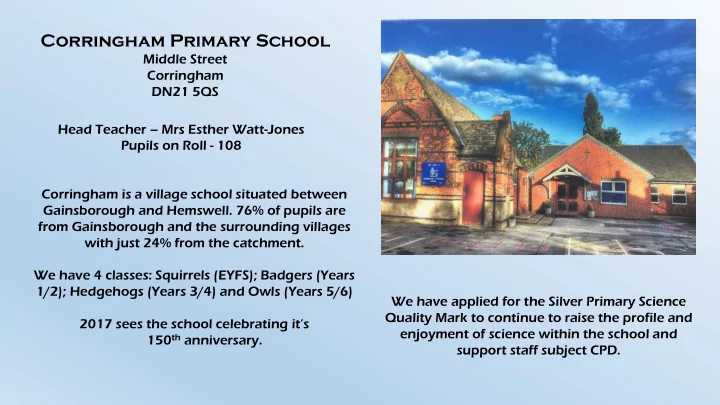
Corringham Primary School Middle Street Corringham DN21 5QS Head Teacher Mrs Esther Watt-Jones Pupils on Roll - 108 Corringham is a village school situated between Gainsborough and Hemswell. 76% of pupils are from Gainsborough and the
Impact of Science Leader There has been a very positive impact in Science this year because of the efforts of Lesley Burnett, the subject leader. The profile of science in our school has been significantly raised. Pupil interviews show that this is a popular subject that many children of different ages enjoy taking part in. The Impact: This year we have had a whole school science day (activities planned by Lesley that enabled the elder pupils to lead and teach) The after school Science club (Mad Science) that 20% pupils from different classes attended 5-minute science activities/investigations planned each half term done by each class and displayed prominently on a display board Lesley and myself (the Y5/6) teacher both went on the Thinking Doing Talking Science course and this has enabled staff to increase knowledge and receive new equipment New storage space has been found so that all equipment is easily found and not hidden in various cupboards! Science plans for each year group have been adapted where
leader. Increase in the amount of practical science going on in each class, including children sharing their own science homework experiments with others Science display boards in each classroom, with the “Principles of Science” prominently displayed. Patrick Reeve Staff Meeting 15/3/17- Agenda Action Plan Share updated action plan and areas still to be addressed Time Scale Criteria Reflections to be written within next 3 weeks. PSQM to be completed by end of May ready for pre assessment PSQM to be submitted in June Principles of Science Posters to be displayed in classrooms. Principles to be added to Medium Term Planning Principles to be displayed in corridor Staff & Children’s comments to be added using Post- its / speech bubbles Pupil Voice Update Share results from pupil voice questionnaire
Updated Events Log - arranged for planning & book scrutiny 19/4/17 Remind staff to upload all evidence to their folders on G drive
I enjoyed cooking as part
made ratatouille and used lots of vegetables. C.S. Year 3
Spring The beautiful leaves grow
buds. In Autumn, the brown crunchy leaves fall off the brown trees.
Predictions I think it’s going to erupt because the bicarbonate of soda will react with the vinegar. Asking questions Why are we using vinegar? Could we use a different liquid? Scientific Vocabulary It’s called photosynthesis
EYFS & KS1 sometimes use floor books to record evidence. I like using ICT to record my scientific data. TBR Year 5
I made notes about my 5 minute science experiment then used ICT to present my work. MS Year 6 In Badger class, children wrote their predictions on Post-its and an adult scribed their questions.
Subject Leader Development Science subject leader – develop subject knowledge. Attend: Thinking, Doing, Talking Science training and work with collaboration schools to apply for science quality mark. To undertake PSQM. SL and Y5 teacher to feed back to staff. SL to re-introduce ‘5 minute science’ across the school to raise profile.
Objective Action Time scale Success Criteria People involved Monitoring and evaluation To continue to develop the role
leader Attend science subject leaders meeting To attend PSQM training days Thinking, Doing, talking Science 4 day training (Year 5 focus) Mar 2017 Feb/May 2017 School continues to work towards achieving PSQM. Training is used within classroom. LB LB /EWJ LB / PR Staff meeting to update staff on requirements and way forward Staff meeting Impact of pupil progress – June 2017 (Y5 assessments) To continue to raise the profile
the school Chn to complete questionnaire regarding attitude to Science in the school. Science Club available for Y1-6 Science Week Whole school cross curricular theme Jan 2017 Every Tues after sch 13-17 March Awareness of how children view Science. Chn enjoy science and have
science club. Whole school take part in Science week. Chn are excited about Science and are talking about in school and at home. LB LB/AJ All staff Feedback to staff Get chn to write an evaluation of what they like about science club and how it could be improved. Ask chn; what do you think about Science? Do you enjoy Science? To continue to support staff in the new curriculum Science teaching cycles and NC progression amalgamated to ensure coverage at correct point within school year. Feb 2017 Staff are aware of what they are expected to teach and to what level. LB/AJ All staff Staff meeting Lesson drop ins/study To monitor progression in Science across the school. To ensure assessment is accurate. Staff to use Eazmag to complete formative and summative assessment of children. Working scientifically to be updated half termly. Ongoing April 2017 Eazmag reports show that sufficient progress has been made. CT LB/AJ to complete data analysis.
Excerpt of the School Development Plan
We are also looking for ‘green fingered’ volunteers. Our school garden is looking tired and we could really do with some help. Do you have any spare time to help us, either during the day or after school? Please get in touch if you can spare some time. We are also looking for donations of top soil ;-)
As part of our science topic, we are looking at different ways to record the weather. Please make a rain gauge or weather vane.
I am really interested in science and technology so I wanted to see if I could create an electrical circuit using fruit to power my
JE Year 5
I like doing this kind of
helps me find things out and we enjoy making things together. RR Year 3
We are aiming to raise the profile of science within our school and require your help. Are you an engineer, pharmacist, food technician, farmer (arable or livestock), veterinary nurse, doctor, hospital worker, dentist, animal worker, gardener or have any job linked to science? Would you be interested in coming in to school to share your expertise with our amazing children through a Q&A session about how your job is linked to science? Would you be available any time during the week’s 30th January - 3rd February 13th – 17th March – Science Week We would be happy to accommodate your time table. Please contact Mrs Burnett (Badgers) or Mrs Jones (Squirrels) for further information.
I enjoyed having the defibrillator on. I want to be a paramedic when I grow up! Charlie I enjoy growing plants and it is lovely to watch the children engaging with nature and asking questions. Mrs R S (Parent helper)
I enjoyed showing
helping them make predictions and just the WOW factor! KS Year 6 I loved teaching everyone how to do the activity and using scientific
reactions of everyone. LG Year 5 I liked having the responsibility and trust TR Year 6 I liked doing all the different activities IM Year 2
As part of our work towards the PSQM, the Science leader asked me to attend the Symbiotic Science training day. In EYFS, science is covered through ‘understanding the world’ and so it can sometimes be tricky to ensure children are being introduced to simple scientific concepts without losing the basis of play and exploration. The Symbiotic Science course gave me so many ideas which were adaptable to EYFS, showing how science can be done in a simple, practical, fun way. I really liked the floor books as a way of recording a scientific investigation and so I used this tool in my following science topic, materials. The floor book allowed me to record everything from the investigation in one place and showed a build up of work and evidence over
The children were really excited to be making their own book. This training also developed my confidence in exploring scientific ideas with children and developing their vocabulary. By pairing practical, fun activities with scientific vocabulary the children have a key learning memory which helps them to recall the vocabulary at a later date. Even after the materials topic, children are still talking about different materials and their properties! Overall, this CPD has increased my confidence to explore scientific ideas and vocabulary with my class which I previously thought may have been to high level for
developing scientific vocabulary and a thirst to find out more on their own. Anja Jones
The children shared their knowledge about materials. A ruler can be made
P.E. (EYFS) Paper didn’t work ‘cos it let water through. A.R. (EYFS)
The topic was linked to EYFS literacy topic about The Three Little Pigs story. The children wanted to find out which material was waterproof and would make a good roof for the pigs houses.
Overview 5 Minute Science Experiments / Investigations To take place ½ termly Photos / predictions / observations / conclusions / further investigative questions etc to be added to whole school display asap Term 3 – Chromatography Term 4 – Dissolving gases Term 5 – Air pressure – magic jumping coin Term 6 –Float or Sink experiment – Salt Water Egg Children relate previous knowledge showing greater depth and making links in their learning Small groups enable TA to scribe observations to evidence children’s understanding and use
Children not working with an adult are able to explore scientific equipment independently and create their own investigations Planned questioning The bubbles are carbon dioxide, CO2, Sonny told us about them on science day. IM Year 2
Forces Force meters/ Newton meters * Pushmeters * Ramps and stands * toy cars * K'Nex / Lego / Duplo wheels and wheel bases * Rubber bands / Forces bands * Springs * Toys * Wooden blocks / friction blocks * Different types
*
May 2016 2 children from each year group were given a questionnaire to complete in order to assess their perception of science throughout the school. It is proposed that the findings will contribute in constructively supporting to raise the profile of science throughout the school. Conclusion 75% of the children taking part in the questionnaire like science with 67% understanding their learning. 75% indicated studying science is really useful with 67% expressing that asking scientific questions promotes further questioning. 67% expressed a preference for group work. 58% preferred to draw pictures related to their science with the same % enjoying writing about the experiments. Next Steps Ensure that science planning includes group and individual activities to support all learning styles. Evidence science in a variety of ways to support all learning styles. Photos, pictures, writing, videos, TA observations etc. March 2017 Pupil Voice Results All children from Year 1 to Year 6 completed the PSQM pupil voice questionnaires and the results were collated. Conclusion Science is being taught on a regular basis throughout the school. Most pupils enjoy science and taking part in experiments / investigations. School trips and visitors into school support pupils learning and help to develop a good attitude to this subject. Most pupils prefer ‘hands on experience’ such as experiments and investigations. Pupils work in groups, with partners or independently dependent on the activity. Some pupils do not like working in teams as it can lead to arguing. A number of pupils commented that scientific language / vocabulary was an area of science they found difficult. Writing up investigations / experiments was also referred to as a difficulty in science. Co-operating / working as part of a team was a frequent comment by KS2 pupils. Next steps
photos floor books annotated pictures / annotated diagrams focusing on a specific aspect i.e just the method; fair test; hypothese; questions; conclusion videos
We did lots of different activities and it made science real. EB (Year 3)
When we’d finished building the dens, we poured water on them to see which was waterproof. Our den was the most waterproof because we used shiny leaves to make a roof. CE (Year 2)
We did a range of activities and filmed them with a special slow motion
improve our throwing
because using the playback, we could discuss the pro’s and con’s clearly. JB (Year 6) I enjoyed the day because I had the opportunity that not many people would have. KS (Year 6)